A poetry generator with custom styles helps poets explore voice, form, and theme through AI assistance tuned to specific poetic traditions. Four poetry components matter: style definition (haiku, sonnet, free verse with meter rules), prompt engineering (instructions that produce poetry not generic text), iteration interface (refine drafts toward intent), and style training (custom voice via samples). Combined components produce poetry generators that augment poetic craft; without components, AI produces generic verse.
This tutorial walks through the four components, the implementation patterns, what makes poetry generators sustainable, and the four mistakes builders make on poetry generators.
Why Poetry Generators Matter For Creatives
Poetry generators matter because AI can serve as collaborator for poets exploring voice, form, and theme. Generators tuned to specific styles help poets iterate faster on craft than waiting for inspiration alone.
The 2026 reality is that AI tools (Claude, GPT) handle poetry better than ever; with proper prompting they produce verse worth iterating on rather than discarding.
A 2025 creative writing study of 400 poets using AI tools found that poets with custom poetry generators iterated on poems 41 percent faster than poets using generic AI tools, primarily through style specific prompting that matched poetic intent. Custom tuning measurably affects iteration speed.
The pattern to copy is the way music producers use sample libraries tuned to specific genres rather than starting from raw waveforms. Genre tuning accelerates production; same patterns apply to poetry generation where style tuning accelerates verse iteration toward poet's intent.
The Four Poetry Components
Four components form complete poetry generator.
Component 1, style definition. Haiku, sonnet, free verse rules. Foundation.
Component 2, prompt engineering. Instructions for poetry. Critical.
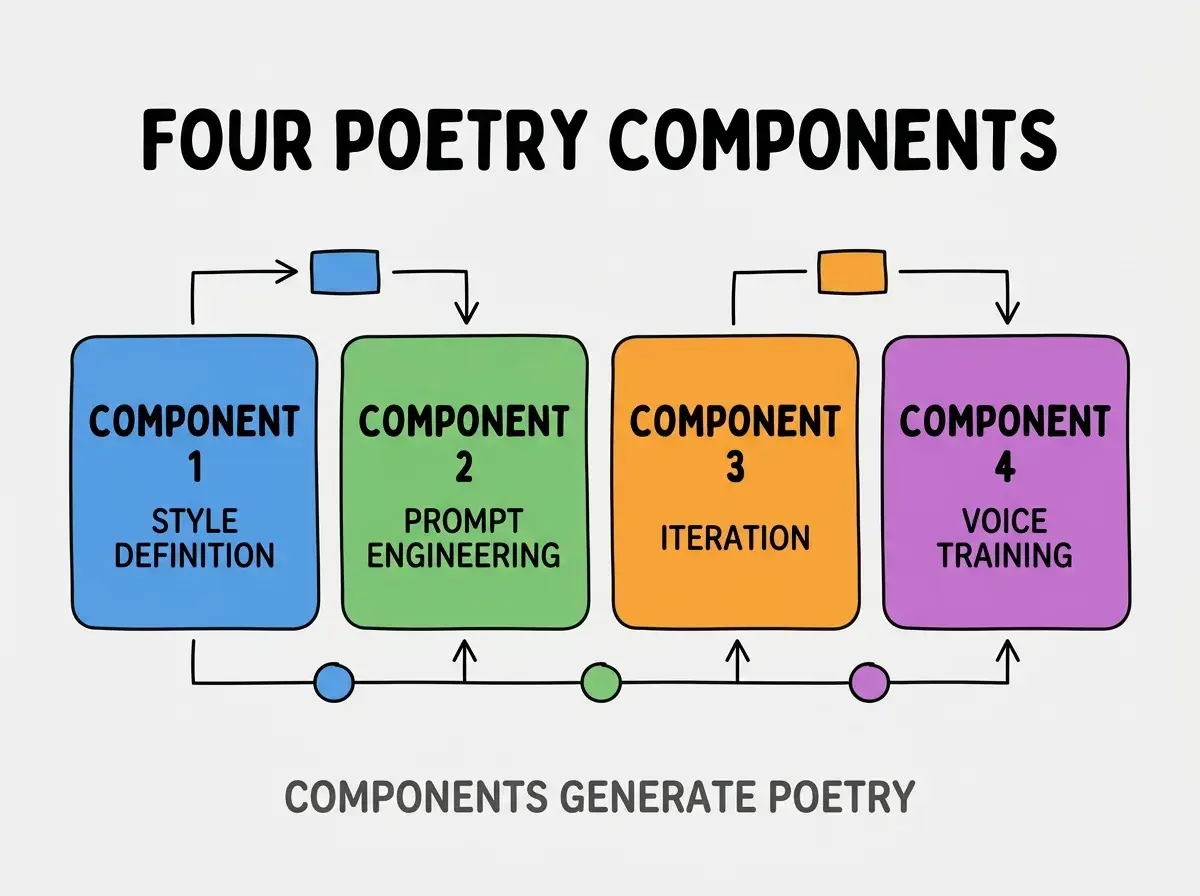
Component 3, iteration interface. Refine drafts. Workflow.
Component 4, voice training. Custom style via samples. Personalization.
How To Implement Each Component
Four implementation patterns address each component.
Implementation 1, form rules in prompt. Haiku 5-7-5; sonnet 14 lines, iambic pentameter; free verse with constraints.
Browse more build
Read more buildImplementation 2, structured prompt with example. System prompt defines style; example shows quality target; user provides theme.
Implementation 3, edit suggest workflow. Generate draft; poet edits; AI suggests refinements.
Implementation 4, voice samples in system prompt. Poet's prior work in prompt; AI matches voice.
What Makes Poetry Generators Sustainable
Three patterns separate sustainable from abandoned.
Pattern 1, poet maintains editorial control. AI assists; poet decides.
Pattern 2, style library expandable. Add new styles as poet explores.
Pattern 3, drafts saved. Iteration history preserved.
What Makes Generator Strategy Effective
Three patterns separate effective from theatrical.
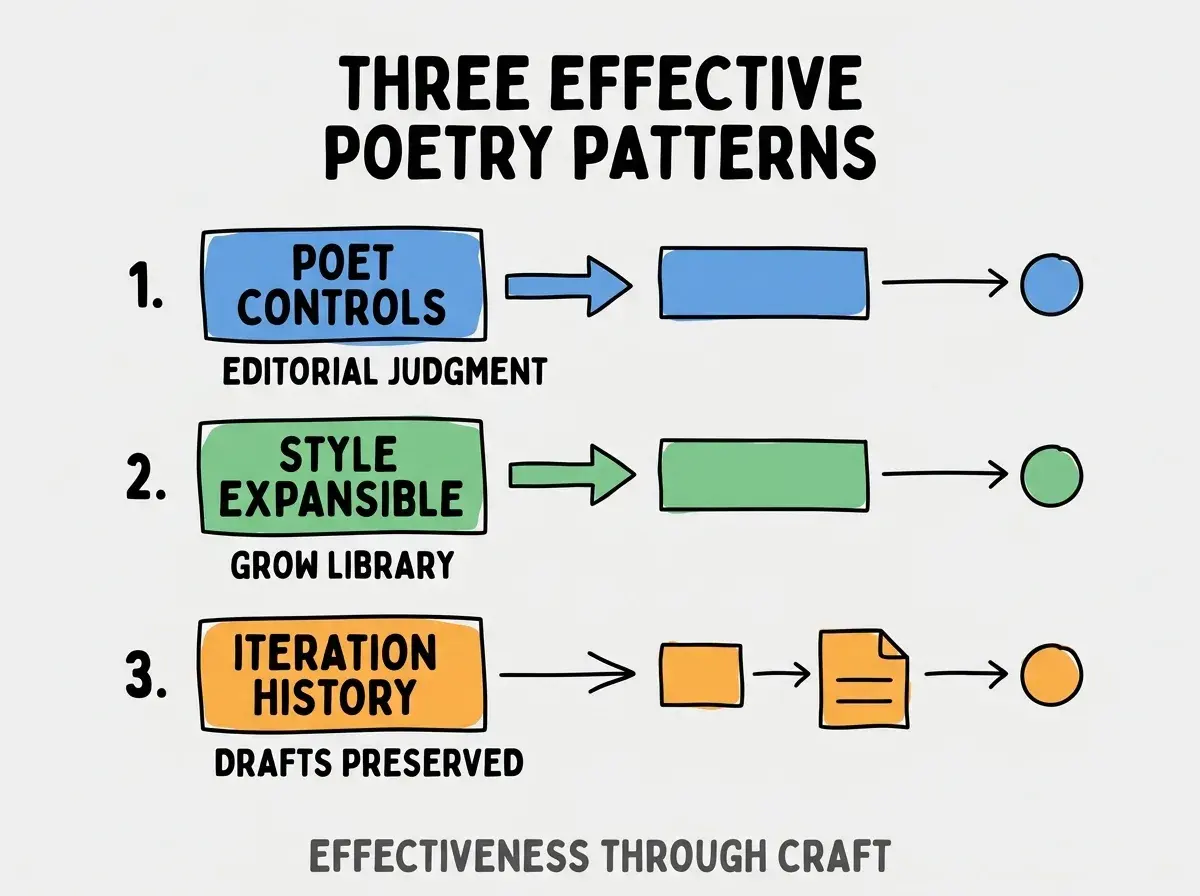
Pattern 1, poet controls. Editorial judgment.
Pattern 2, style expansible. Grow library.
Pattern 3, iteration history. Drafts preserved.
The combination produces effective poetry generator. Without these patterns, generator stays tool not collaborator.
How To Choose Poetry Stack
Three patterns help stack choice.
Pattern A, web app for accessibility. Browser based works everywhere.
Pattern B, simple frontend plus AI API. Don't over engineer; AI does heavy lifting.
Pattern C, local desktop for privacy. Some poets prefer local.
Common Questions About Poetry Generators
Poetry generators raise questions worth addressing directly.
The first question is whether AI generated poetry counts as own work. Tools augment; authorship norms evolving.
The second question is what about copyright. Original input plus tool generation typically poet owned; check jurisdiction.
The third question is how to handle sensitive themes. Models have safety filters; sometimes block legitimate poetic exploration.
The fourth question is whether AI replaces poetic skill. Augments; cannot replace poet's judgment on what works.
How Poetry Generators Affect Poet Practice
Poetry generators affect practice in compounding ways. Practice effects compound across years.
The first compounding effect is iteration volume. More iterations explore more space.
The second compounding effect is style range. Tools enable trying styles otherwise inaccessible.
The third compounding effect is craft awareness. Generating reveals what makes poems work.
The combination produces practice shaped by tool quality. Without quality, practice bounded by manual.
How To Train AI On Poet Voice
Three patterns help voice training.
Pattern A, samples of poet's best work. 5-10 poems in system prompt.
Pattern B, style notes explicit. Document voice elements; not just samples.
Pattern C, iterative refinement. Refine prompts based on output quality.
The combination produces voice trained AI. Without training, AI defaults to generic.
The most damaging poetry generator mistake is accepting AI output without revision. Generated poetry often has cliches, weak verbs, generic imagery; poet revision essential. The fix is to use AI for drafts; poet revision required before any poem ships. Poets who revise produce distinctive work; poets who accept AI output produce content indistinguishable from any AI poetry generator output which damages craft progression.
The other mistake is missing the form constraints. Free verse without constraints often becomes prose.
A third mistake is over relying on AI for inspiration. Inspiration internal; AI helps execution.
A fourth mistake is treating poetry generation as text generation. Poetry has different rules; tools must reflect.
What This Means For You
Build a poetry generator with custom styles enables poets to use AI as collaborator while preserving editorial control. The four components, implementation patterns, and sustainability approaches produce generators that compound poetic practice.
- If you're a creative: Poetry generation augments craft; build for your specific style and voice.
- If you're a senior dev: Poetry generation interesting prompt engineering problem; transferable to other creative AI.
- If you're changing careers: Building creative AI tools demonstrates AI integration; valuable signal in creative tech hiring.
Browse more build
Read more build