A product recommendation engine with AI helps ecommerce stores increase average order value through relevant suggestions tailored to each shopper. Four recommendation approaches matter: collaborative filtering (users who bought X also bought Y), content based (similar attributes to viewed items), hybrid recommendations (combine collaborative and content), and AI semantic recommendations (LLM understands product context for nuanced suggestions). Combined approaches produce recommendations that lift conversion; without recommendation engines, stores leave revenue on the table.
This tutorial walks through the four approaches, the implementation patterns, what makes recommendations sustainable, and the four mistakes builders make on recommendation engines.
Why Product Recommendations Matter For Stores
Product recommendations matter because basket size and conversion both lift with relevant suggestions. Generic store layouts capture intent purchases; recommendations capture exploration and adjacent needs.
The 2026 reality is that AI tools (Claude, GPT, embedding models) make sophisticated recommendation engines buildable in weeks; previously required dedicated machine learning teams.
A 2025 ecommerce recommendation study of 400 stores found that stores with hybrid AI recommendation engines lifted average order value 23 percent compared to stores without recommendations, primarily through related product surfaces during checkout flow. Recommendations measurably affect AOV.
The pattern to copy is the way bookstores historically placed related books on shelf endcaps to increase basket size. Physical placement guided exploration; recommendation engines do the same digitally with personalization at scale impossible in physical stores.
The Four Recommendation Approaches
Four approaches form complete recommendation system.
Approach 1, collaborative filtering. Users who bought X also bought Y. Foundation.
Approach 2, content based. Similar attributes. Item focused.
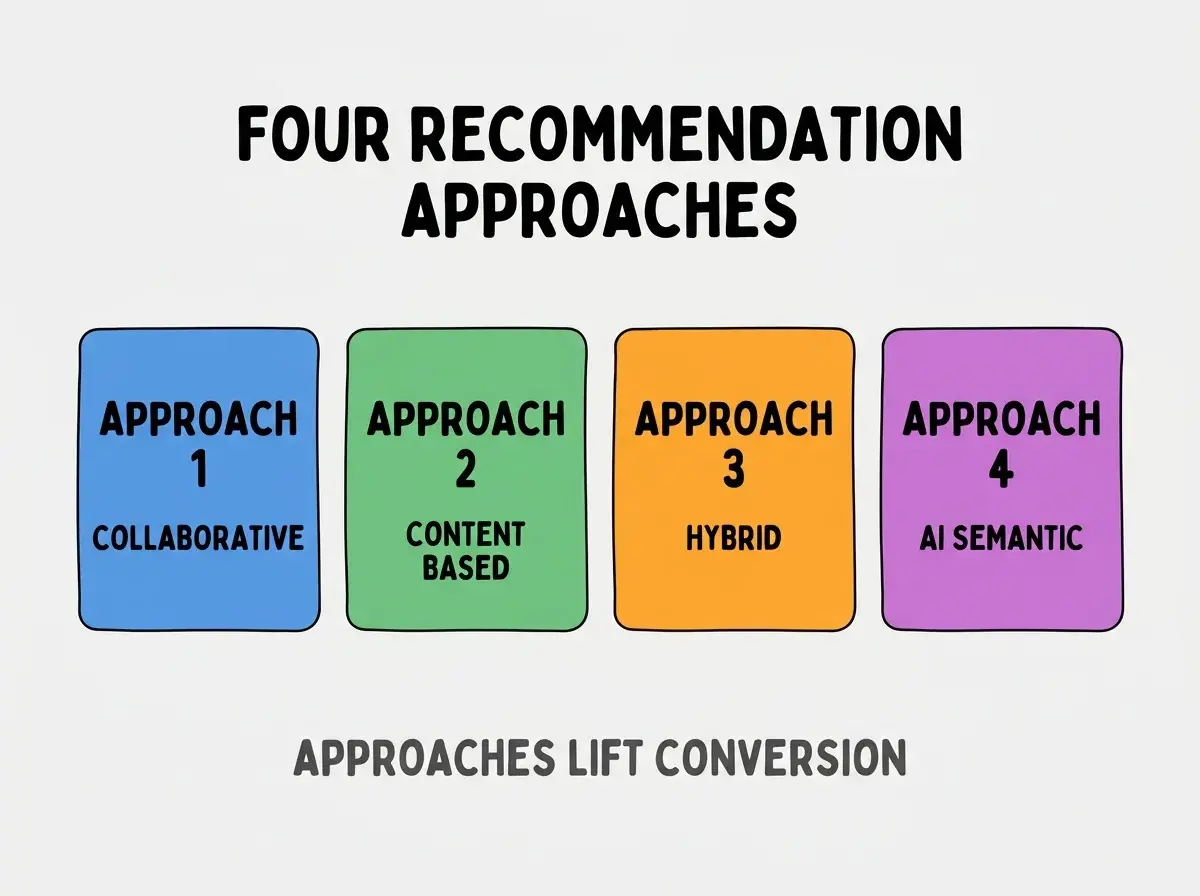
Approach 3, hybrid. Combine collaborative and content. Effective.
Approach 4, AI semantic. LLM understands context. Modern.
How To Implement Each Approach
Four implementation patterns address each approach.
Implementation 1, matrix factorization for collaborative. Standard library implementations; Surprise, implicit.
Browse more build
Read more buildImplementation 2, similarity by attribute embeddings. Product embeddings; cosine similarity for matches.
Implementation 3, weighted hybrid with tuning. Combine scores; tune weights via A B test.
Implementation 4, semantic search with LLM. Product descriptions to embeddings; LLM ranks.
What Makes Recommendations Sustainable
Three patterns separate sustainable from theatrical.
Pattern 1, cold start handled. New users, products work without history.
Pattern 2, real time and batch hybrid. Real time for hot, batch for cold.
Pattern 3, A B testing built in. Recommendations tested continuously.
What Makes Recommendation Strategy Effective
Three patterns separate effective from theatrical.
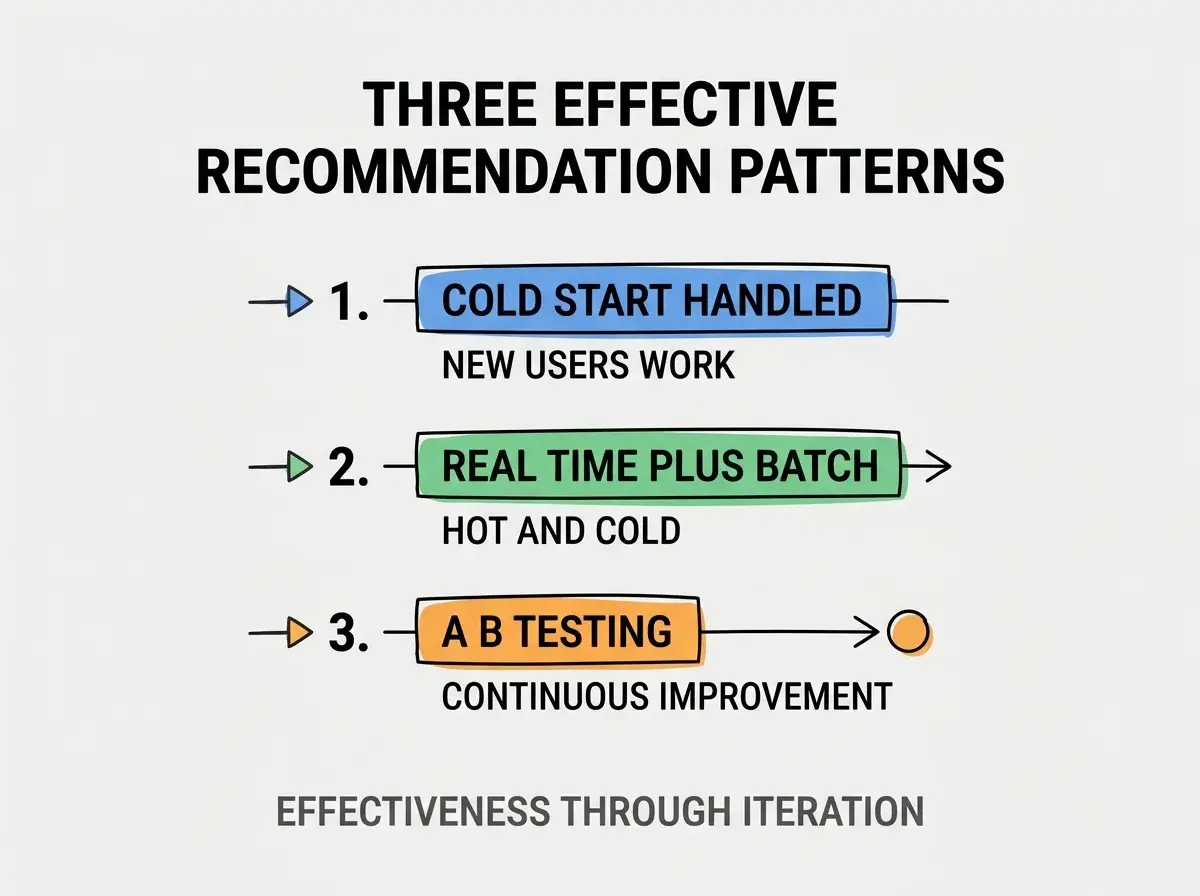
Pattern 1, cold start handled. New users work.
Pattern 2, real time plus batch. Hot and cold.
Pattern 3, A B testing. Continuous improvement.
The combination produces effective recommendations. Without these patterns, recommendations decay.
How To Choose Recommendation Stack
Three patterns help stack choice.
Pattern A, Algolia or Typesense for managed. Search plus recommendations integrated.
Pattern B, custom with embeddings for control. OpenAI embeddings, Pinecone for vector search.
Pattern C, platform native first. Shopify recommendations adequate to start.
Common Questions About Recommendations
Recommendations raise questions worth addressing directly.
The first question is whether to need huge data for AI. No; embeddings work on small catalogs.
The second question is what about privacy. Personalization vs privacy tradeoff; respect opt outs.
The third question is how to handle seasonality. Time decay weights; recent matters more.
The fourth question is whether to recommend out of stock. Don't; recommend in stock alternatives.
How Recommendations Affect Store Economics
Recommendations affect economics in compounding ways. Economics effects compound across orders.
The first compounding effect is AOV lift. Higher basket size per order.
The second compounding effect is conversion. Relevant suggestions convert better.
The third compounding effect is repeat purchase. Discovery drives return visits.
The combination produces economics shaped by recommendation quality. Without quality, economics constrained.
How To Measure Recommendation Effectiveness
Three patterns help measurement.
Pattern A, click through rate on recommendations. Direct relevance signal.
Pattern B, attributed revenue. Revenue from recommended products.
Pattern C, A B against control. No recommendations baseline; lift measured.
The combination produces measured recommendations. Without measurement, optimization blind.
The most damaging recommendation engine mistake is recommending what's already in cart. Recommending added items annoys shoppers; trust erodes. The fix is to filter recommendations against cart contents; recommend complements not duplicates. Stores that filter maintain shopper trust; stores that don't lose conversion when shoppers feel system doesn't understand them which damages return purchase rates.
The other mistake is missing the cold start handling. New shoppers need recommendations too.
A third mistake is over indexing on collaborative filtering. New stores lack data; content based works without history.
A fourth mistake is treating recommendations as set and forget. Recommendations need continuous tuning.
Dig deeper
A few hand-picked sources if you want to go further.
What This Means For You
Build a product recommendation engine with AI lifts ecommerce store AOV through relevant personalization. The four approaches, implementation patterns, and sustainability practices produce recommendations that compound store revenue.
- If you're an ecommerce operator: Recommendations central to growth; investment justified by AOV lift.
- If you're a senior dev: Recommendation systems interesting ML problem; transferable beyond ecommerce.
- If you're changing careers: Recommendation engineering valuable specialty; demonstrates ML applied skill.
Browse more build
Read more build