To build a personal CRM for networking with AI tools, follow the four phase approach (define what relationship patterns and contexts matter for your network, build the contact capture flow that handles diverse sources, design the AI assisted reminders that drive consistent follow up, and ship with the search and context patterns that surface relevant relationships when needed), recognize what separates personal CRMs that get used from CRMs that get abandoned, and apply the patterns that produce sustained networking value. The personal CRM matters because relationship value compounds with consistency that ad hoc tracking cannot match.
This piece walks through the four phases, the AI assisted patterns, the specific tooling, and the four mistakes that produce personal CRMs users abandon.
Why Personal CRMs Matter For Networking
Personal CRMs turn ad hoc networking into structured relationship management. The transformation matters; without CRMs, relationships fade into LinkedIn connections that stay unactivated.
The 2026 reality is that AI tools make personal CRMs more capable than ever. AI can suggest follow ups, draft messages, surface context from conversation history; capabilities previously requiring assistant time now happen automatically.
A 2025 networking study of 800 professionals found that professionals using personal CRMs reported 73 percent more meaningful professional connections compared to professionals using only LinkedIn. Structure produces relationship outcomes that ad hoc tracking cannot match.
The pattern to copy is the way professional sales teams use enterprise CRMs. Enterprise CRMs structure relationships into systematic touchpoints; structure produces revenue that ad hoc selling cannot match. Personal CRMs follow similar pattern; structure produces relationship value that ad hoc networking cannot match.
The Four Phase Approach
Four phases produce personal CRMs people use weekly.
Phase 1, define relationship patterns and contexts. Professional, personal, prospect, mentor. Different patterns need different tracking.
Phase 2, build contact capture from diverse sources. Email, calendar, business cards, LinkedIn, manual. Capture determines what enters CRM.
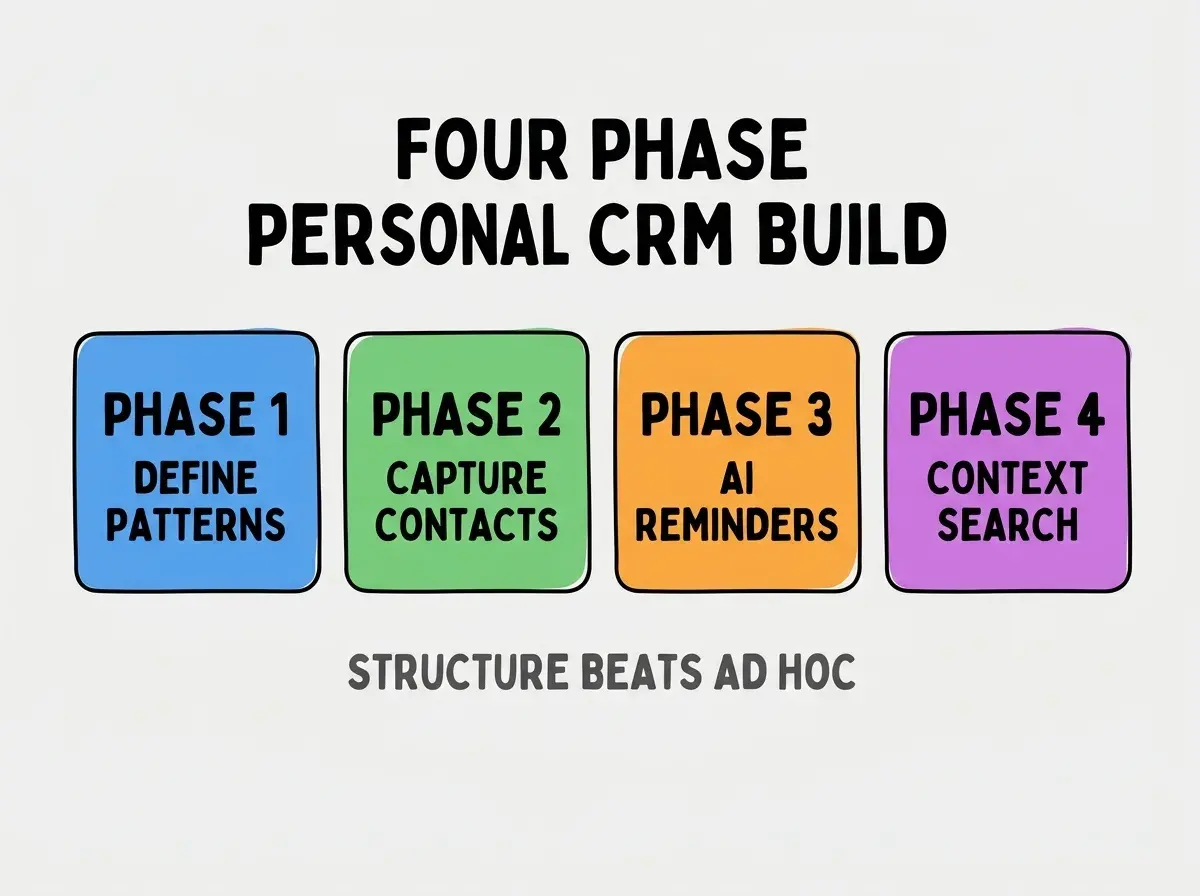
Phase 3, design AI assisted reminders. When to follow up, what to mention, how often. AI reminders sustain consistency.
Phase 4, ship search and context surfacing. Find right person at right time with relevant context. Search determines daily value.
The AI Assisted Patterns That Drive Consistency
Three patterns produce AI assistance that drives sustained use.
Pattern 1, smart follow up timing based on relationship type. Different relationships need different cadences. AI applies cadence rules consistently.
Browse more personal builds
Read more buildPattern 2, context surfacing before meetings. Recent conversation, shared interests, mutual connections. Context preparation produces better meetings.
Pattern 3, message draft assistance for follow ups. Draft messages based on relationship history. Drafts reduce friction that prevents follow up.
The Specific Tooling That Works
Three tool categories combine effectively for personal CRM building.
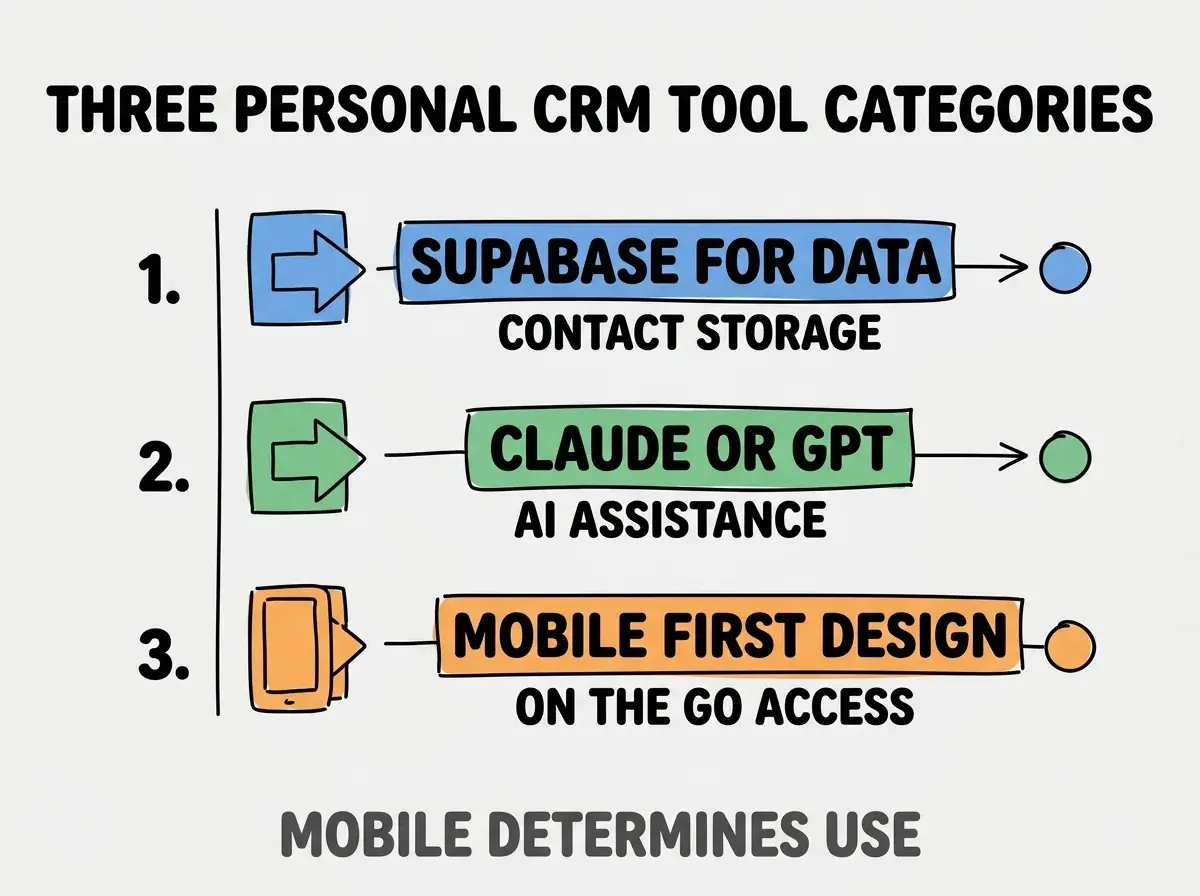
Tool 1, Supabase for contact data. Contacts, interactions, reminders. Relational storage enables context queries.
Tool 2, Claude or GPT for AI assistance. Reminders, drafts, context. AI choice affects assistance quality.
Tool 3, mobile first design for on the go access. Capture happens on phone often; mobile access matters. Without mobile, capture fails.
What Makes Personal CRMs Get Sustained Use
Three patterns separate sustained use from quick abandonment.
Pattern 1, capture friction near zero. Quick capture from anywhere; rich capture optional. Friction kills consistency.
Pattern 2, value surfacing on opening. Reminders, follow ups, context all visible without searching. Value first prevents abandonment.
Pattern 3, integration with email and calendar. Email and calendar are where relationships happen; integration captures naturally. Without integration, manual entry burden kills use.
The combination produces personal CRMs that become weekly tools. Without these patterns, CRMs get tried then abandoned for native phone contacts.
How To Build Your First Personal CRM
Three implementation patterns help first personal CRMs succeed.
Pattern A, start with closest 50 relationships. Closest relationships validate value. Without close relationship validation, broader rollout misses value.
Pattern B, dogfood for 8 weeks of networking. Personal use validates with real relationships.
Pattern C, instrument follow up completion rate. Are users following through on reminders? Without completion, value claims stay anecdotal.
The combination produces first CRMs that establish use patterns. Without patterns, CRMs launch with features users do not actually use.
The most damaging personal CRM mistake is trying to track every contact comprehensively. Comprehensive tracking creates burden that prevents sustained use. The fix is to track selectively; close relationships get rich tracking, distant relationships get minimal tracking. Selective tracking enables sustained use that comprehensive tracking prevents through burden. Personal CRMs succeed when they reduce friction not increase it.
The other mistake is missing the privacy investment. Personal CRM data sensitive; weak privacy produces abandonment. The fix is to invest in privacy from start.
A third mistake is over reliance on AI suggestions. AI suggests but humans decide; treating AI as oracle produces wrong reminders.
A fourth mistake is treating CRM as comprehensive rolodex. Personal CRMs serve relationship building not contact storage; framing matters.
How To Handle Specific Relationship Types
Three relationship types deserve specific approaches.
Type A, professional contacts with ongoing collaboration. Regular check ins, project updates, mutual interest tracking. Active relationships need active tracking.
Type B, prospects with conversion potential. Sales process tracking, opportunity stages. Prospect tracking borrows from sales CRMs.
Type C, mentors and advisors. Less frequent but high value. Different cadence than peers.
The combination produces type specific approaches. Without specific approaches, generic CRM serves all types mediocrely.
How Personal CRMs Will Likely Evolve
Personal CRMs will likely continue evolving with AI capabilities.
The first likely evolution is automatic capture from communications. Email, calendar, messaging all auto capturing into CRM. Automation reduces capture friction dramatically.
The second likely evolution is AI relationship suggestions. AI suggesting people to reach out to based on patterns. Suggestions surface what manual review misses.
The third likely evolution is integration with social platforms. LinkedIn, Twitter, others integrating directly. Integration enables richer context.
The combination suggests personal CRMs will become more capable. Builders learning patterns now build skills that remain valuable.
Common Questions About Personal CRM Building
Personal CRM building raises questions worth addressing directly.
The first question is whether to use existing personal CRM tools instead of building. Existing tools (Dex, Clay, Capsule) work well; building makes sense when you want specific features tools lack or want to learn through building.
The second question is how to handle privacy and data security. Strong encryption, local storage option, clear data handling policies. Privacy matters especially for relationship data.
The third question is how to integrate with existing communication tools. Email integration matters most; calendar second. Without integrations, manual entry burden kills sustained use.
The fourth question is whether to share contact data across team. Personal CRM stays personal; team CRM is different product. Sharing contradicts personal CRM purpose.
The fifth question is how to handle relationship stage transitions. Relationships move from prospect to customer to partner; stage transitions matter for tracking.
What This Means For You
Personal CRMs turn ad hoc networking into structured relationship management. The four phases, AI patterns, and tool combinations produce CRMs that drive consistent networking.
- If you're a founder: Personal CRMs sustain founder networking that ad hoc memory cannot match. Build CRM early; relationships compound over years.
- If you're a career changer: CRM building demonstrates AI capability through personal value. Building for yourself produces both tool and learning.
- If you're an indie hacker: Personal CRM tools have viable monetization paths beyond personal use. Personal tool can become product.
Browse more personal builds
Read more build