To build an OKR tracking tool with vibe coding, follow the four phase approach (define your team's specific OKR cadence and measurement patterns, build the data model that supports the cadence, design the entry interface that produces honest progress reporting, and ship with the review patterns that make OKRs drive decisions), recognize what separates OKR tools that drive accountability from tools teams treat as bureaucratic theater, and apply the patterns that produce OKR tracking teams genuinely engage with. The OKR tracking tool becomes valuable when honest reporting connects to real decisions; without that bar, the tool becomes ritual rather than instrument.
This piece walks through the four phases, the entry patterns that produce honest reporting, the specific tooling, and the four mistakes that produce OKR tools teams game rather than use.
Why OKR Tracking Tools Matter
OKR tracking tools turn quarterly objectives into weekly accountability. The transformation matters; OKRs without tracking become forgotten plans, while tracked OKRs become organizational direction. Good tracking produces sustained focus on what matters.
The 2026 reality is that AI tools dramatically accelerate OKR tool building while AI integration during progress reporting can summarize updates, surface risks, and suggest interventions faster than manual review. The combination means even small teams can have OKR tooling matching what enterprises previously paid for as separate platforms.
A 2025 organizational effectiveness survey of 600 mid sized companies found that companies using actively tracked OKRs achieved 32 percent higher goal completion rates than companies using untracked OKRs. The tracking discipline produces the focus that completion requires; untracked OKRs often drift into forgotten quarterly artifacts.
The pattern to copy is the way personal trainers track client workouts. The trainers track every session because the data informs program decisions; without tracking, programs drift from goals. OKR tracking plays similar role for organizations; the tracking enables the course corrections that move teams toward stated goals.
The Four Phase Approach
Four phases produce OKR tracking tools that drive team accountability.
Phase 1, define your team's specific OKR cadence and measurement patterns. Quarterly objectives, weekly check ins, monthly reviews. Every team has slightly different patterns; clarity here determines downstream tool design.
Phase 2, build the data model that supports the cadence. Objectives, key results, owners, progress entries. AI tools generate the schema effectively given clear specifications.
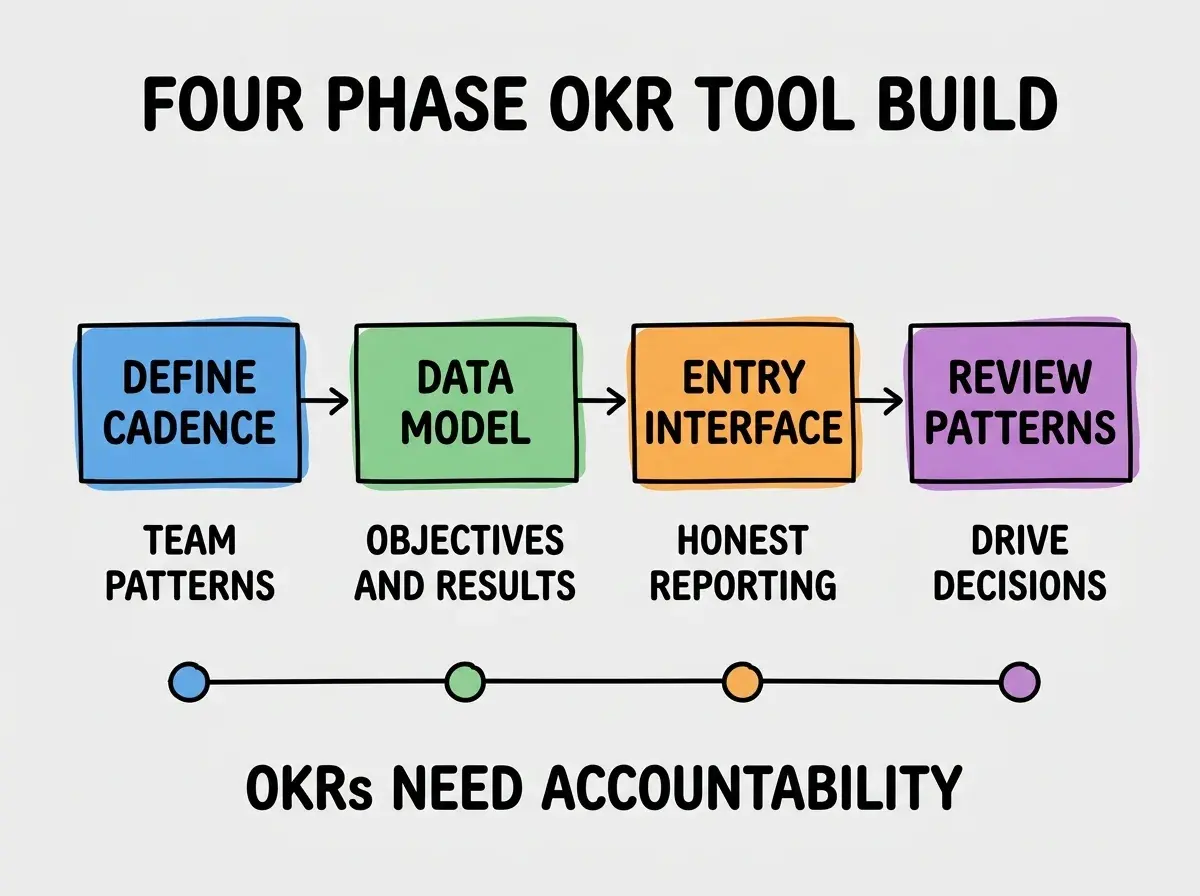
Phase 3, design the entry interface that produces honest progress reporting. Quick weekly updates, confidence ratings, blocker identification. Entry friction determines reporting quality; high friction produces missed updates or padded reports.
Phase 4, ship with review patterns that make OKRs drive decisions. Weekly check ins, monthly leadership reviews, quarterly recalibration. Review patterns turn data into action; tools without reviews become dashboards no one acts on.
The Entry Patterns That Produce Honest Reporting
Three patterns produce entry interfaces that produce honest reporting.
Pattern 1, confidence ratings rather than just percentages. "I am 60 percent confident we hit this" beats "we are 75 percent done". Confidence captures uncertainty; pure percentage hides it.
Browse more internal tool tutorials
Read more build tutorialsPattern 2, explicit blocker fields encourage problem surfacing. Spaces for "what is blocking" produce blocker conversations; without the field, blockers stay hidden until quarter end.
Pattern 3, change history visible to all participants. Past entries visible alongside current. Visibility produces accountability; hidden history allows revision without notice.
The Specific Tooling That Worked
Three tool categories combine effectively for OKR tool building.
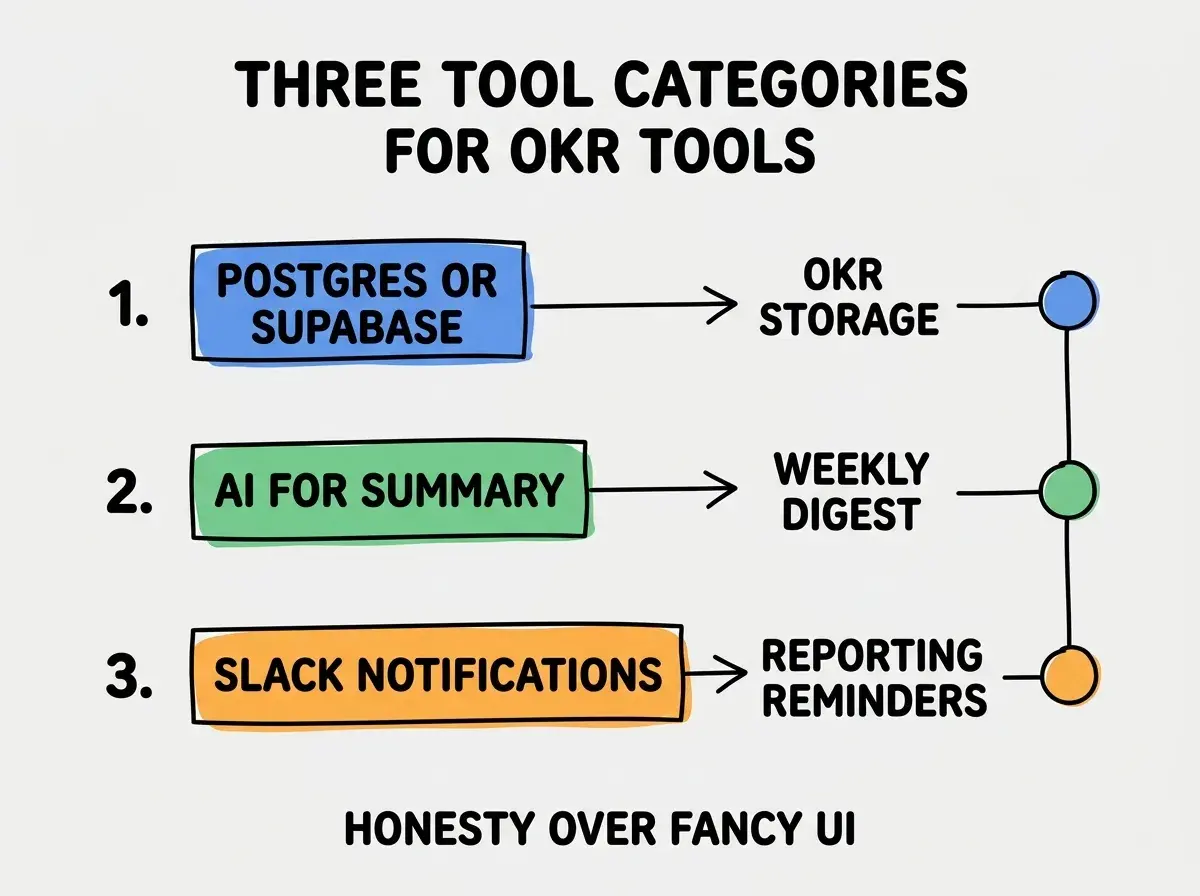
Tool 1, Postgres or Supabase for OKR storage. Objectives, key results, progress entries, change history. Relational data fits naturally.
Tool 2, AI for weekly summary digest. Claude or GPT summarizes status changes across all OKRs into single weekly digest. Reduces manual review work; surfaces patterns humans might miss.
Tool 3, Slack notifications for reporting reminders. Friday afternoon reminders for weekly updates. Without reminders, reports lag; with reminders, reporting becomes habit.
What Makes OKR Tools Drive Real Accountability
Three patterns separate accountability driving tools from theater tools.
Pattern 1, leadership references the tool in real conversations. When leaders reference OKR data in actual decisions, teams report honestly because the data matters. When leaders ignore the data, teams report aspirationally because reporting becomes performance.
Pattern 2, missed targets get analyzed rather than punished. Punishment for missed targets produces sandbagged targets; analysis produces stretch targets honestly pursued. Culture matters more than tool features.
Pattern 3, OKR adjustments happen quarterly, not annually. Quarterly recalibration based on actual progress produces realistic OKRs; annual recalibration produces increasingly disconnected aspiration.
The combination produces OKR tools that drive real organizational direction. Without these patterns, tools become quarterly compliance theater that consumes time without producing focus.
How to Build Your First OKR Tool
Three implementation patterns help first OKR tools succeed.
Pattern A, start with one team, not company wide. Single team OKRs validate the tool and patterns. Company wide rollout from day one often produces incomplete coverage and inconsistent practices.
Pattern B, integrate with where teams already work. Slack reminders, browser based UI, email digests. Standalone tools see less use than integrated ones.
Pattern C, instrument adoption metrics from day one. Reporting compliance rate, update frequency, comment activity. Without instrumentation, adoption problems stay hidden until they become culture problems.
The combination produces first OKR tools that establish the pattern for sustained organizational accountability. Without these patterns, first tools often launch then fade as the rhythm fails to take hold.
The most damaging OKR tool mistake is launching without leadership commitment to actually use the data. Tools without leadership use produce theater; teams report what looks good rather than what is true. The fix is to require leadership commitment before launching; leadership reference of the data in real decisions produces honest reporting, while leadership ignoring the data produces aspirational reporting that wastes everyone's time. Without leadership commitment, do not build the tool.
The other mistake is overengineering the tool with features no team needs. Comprehensive OKR platforms produce friction without value for most teams. The fix is to build for your team specifically; generic OKR tools rarely match team specific patterns.
A third mistake is treating OKRs as performance reviews. OKR tracking measures direction not performance; conflating them produces gamed reporting. The fix is to keep performance reviews separate from OKR tracking; the separation preserves OKR honesty.
A fourth mistake is failing to celebrate completed OKRs publicly. Achievement without recognition demoralizes; recognition produces motivation for next quarter. The fix is to build celebration into the review cadence; completion deserves visibility.
What This Means For You
The OKR tracking tool built with vibe coding becomes valuable through honest reporting, leadership engagement, and quarterly recalibration. The four phases, entry patterns, and tool combinations produce OKR tracking that drives real accountability.
- If you're a product manager: OKR tools clarify team direction. Build them when team scale makes ad hoc direction setting unclear; below that scale, clear conversations may suffice.
- If you're a founder: OKR tools become valuable as team grows beyond direct conversation reach. Build them when team size makes ad hoc alignment difficult; before that, ad hoc beats premature OKR formality.
- If you're a senior dev: AI tools handle OKR tool implementation effectively. The bottleneck is leadership commitment and review discipline, not implementation; invest in those areas more than tool features.
Browse more internal tool tutorials
Read more build tutorials