To build a knowledge base wiki for your team with AI tools, follow the four phase approach (define what knowledge needs to live in the wiki, build the search and structure that makes it findable, integrate AI for question answering and summarization, and ship with the maintenance patterns that prevent decay), recognize what separates living wikis from dead documentation graveyards, and apply the patterns that produce wikis teams actually consult. The team knowledge base becomes valuable only when the team consults it; the consultation depends on findability, freshness, and usefulness.
This piece walks through the four phases, the AI integration patterns that work, the specific tooling, and the four mistakes that produce wikis that decay into uselessness.
Why Team Knowledge Bases Matter
Team knowledge bases exist to reduce the same questions getting asked repeatedly. The reduction matters; senior team members spend significant time answering questions whose answers should live in shared documentation. Good wikis transfer that knowledge to anyone who needs it.
The 2026 reality is that AI tools transform knowledge bases from static documentation to queryable knowledge. Stakeholders ask questions in natural language; AI surfaces relevant content. The combination produces wikis that get used through familiar conversational patterns rather than navigation.
A 2025 internal documentation survey of 1,200 companies found that 71 percent of corporate wikis were last updated more than 6 months prior. The build cost is rarely the constraint; the maintenance discipline is. AI integration helps with creation and search; only sustained team commitment keeps wikis alive.
The pattern to copy is the way libraries maintain currency. Librarians actively curate collections, removing outdated material and adding new acquisitions. Team wikis without active curation become like libraries that only added books for decades; useful for history but not for current work. AI tools help with curation tasks but cannot replace human judgment about what matters.
The Four Phase Approach
Four phases produce team knowledge bases that get sustained use.
Phase 1, define what knowledge needs to live in the wiki. Onboarding info, repeated processes, technical decisions. Categorize before building; clear categories produce findable wikis.
Phase 2, build the search and structure that makes it findable. Strong search with semantic capability. Hierarchical structure with clear navigation. Findability matters more than completeness for actual use.
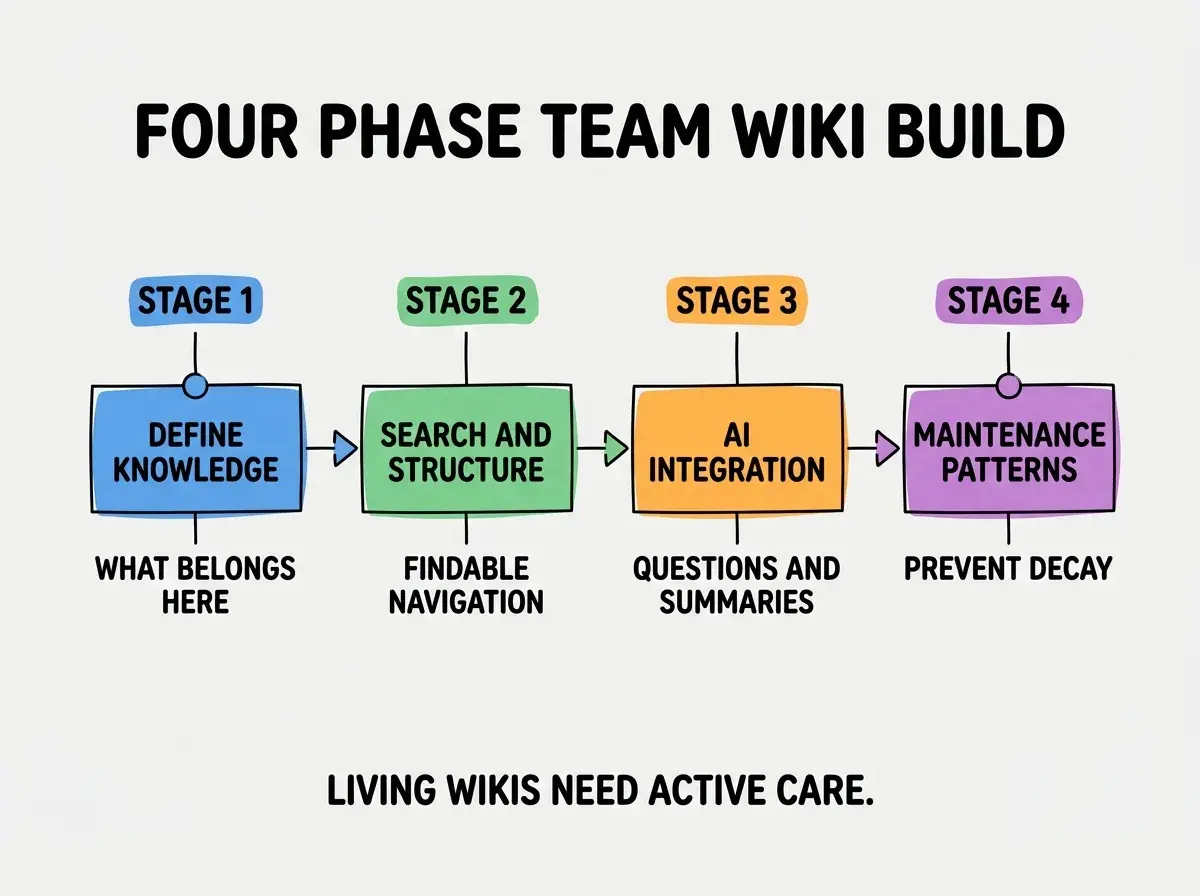
Phase 3, integrate AI for question answering and summarization. Natural language queries against the wiki content. Auto generated summaries of long documents. AI integration changes the use pattern from navigation to conversation.
Phase 4, ship with maintenance patterns that prevent decay. Ownership assignments, update reminders, deprecation workflows. The maintenance work prevents the slow death that wikis without curation experience.
The AI Integration Patterns That Work
Three patterns produce useful AI integration in team wikis.
Pattern 1, semantic search across all content. Stakeholders ask questions in natural language; AI surfaces relevant pages. Beats keyword search dramatically for actual use.
Browse more internal tool tutorials
Read more build tutorialsPattern 2, AI summarization for long documents. Multi page processes get auto generated summaries. Stakeholders read summaries first, drill into details only when needed.
Pattern 3, AI question answering with citations. Stakeholders ask questions; AI answers with links to source pages. The citations preserve trust; uncited AI answers in wikis erode trust over time.
The Specific Tooling That Worked
Three tool categories combine effectively for team wiki building.
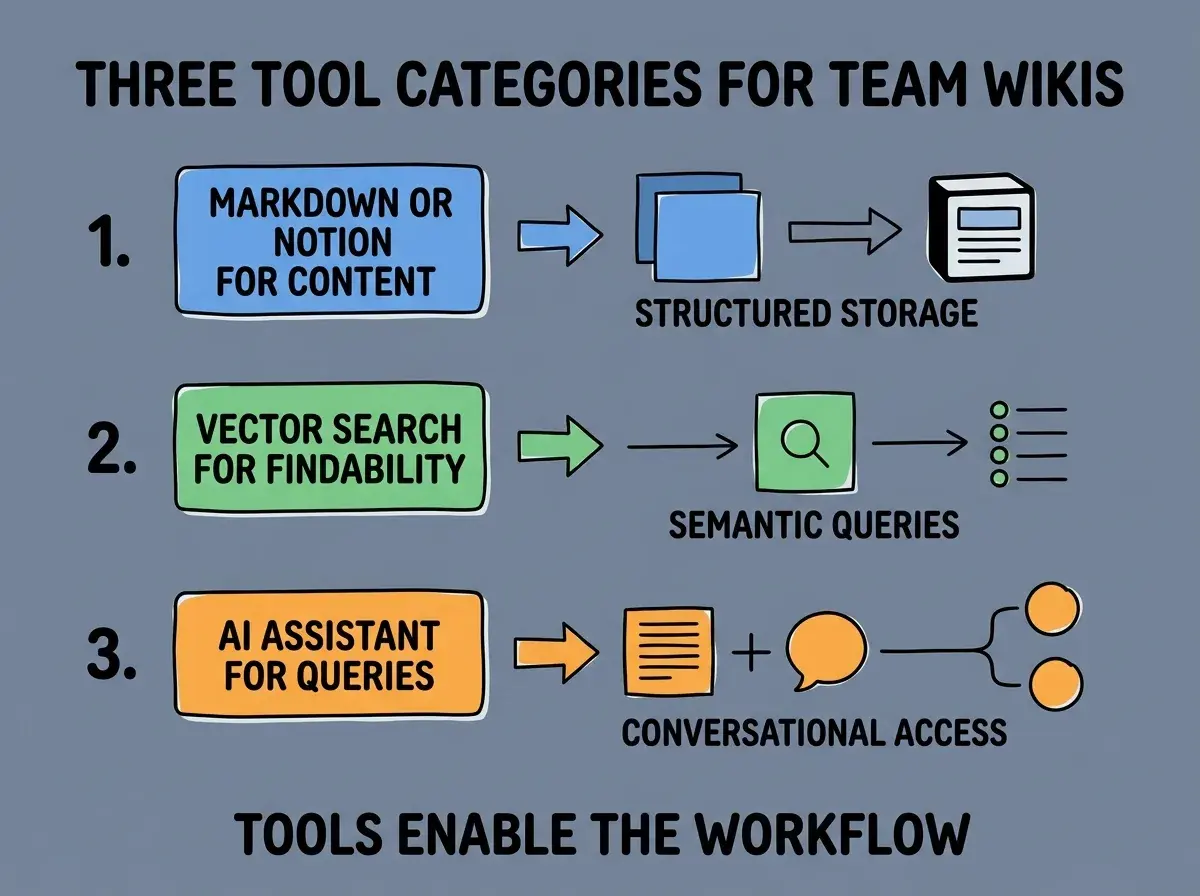
Tool 1, Markdown or Notion for content storage. Structured storage that supports search. Markdown if you want git versioning; Notion if you want WYSIWYG editing.
Tool 2, vector search for semantic findability. Pinecone, Weaviate, or pgvector embeddings. Semantic queries find relevant content even when wording differs from the original.
Tool 3, AI assistant for conversational access. Claude or GPT-4 wrapped with retrieval. Stakeholders ask questions; assistant answers with citations from the wiki.
What Makes Team Wikis Stay Alive
Three patterns separate living wikis from documentation graveyards.
Pattern 1, named ownership for every section. Each section has an owner responsible for currency. Without ownership, sections decay; with ownership, decay is rare.
Pattern 2, update prompts integrated into normal workflow. When code changes, related docs get update flags. When processes change, related wiki pages get review prompts. Workflow integration produces updates; manual review schedules rarely produce sustained updates.
Pattern 3, dead content gets archived, not preserved. Outdated pages get marked archived rather than left in active navigation. Archive workflow keeps the active wiki current; preservation pollutes searches with stale content.
The combination produces wikis that stay valuable for years. Without these patterns, wikis decay within months and become liabilities rather than assets.
How to Build Your First Team Wiki
Three implementation patterns help first wikis succeed.
Pattern A, start with onboarding documentation, not everything. New hire onboarding produces immediate value and clear ownership. Comprehensive wikis often produce nothing complete enough to use.
Pattern B, recruit maintainers before adding pages. Each section needs an owner before it gets created. No owner means certain decay; finding owners after creation rarely works.
Pattern C, track usage and remove unused content. Pages that get less than monthly visits should be reviewed for deletion. Wiki simplicity correlates with sustained use; sprawling wikis confuse users.
The combination produces first wikis that establish maintenance discipline. Without these patterns, first wikis often grow into unused archives within a year.
The most damaging wiki mistake is treating wiki creation as a one time project rather than ongoing work. The fix is to budget for maintenance from the start; without ongoing time investment, wikis decay regardless of initial quality. Sustained wikis require named owners, update workflows, and archive disciplines; one time builds without these patterns become problems rather than assets within 12 months.
The other mistake is requiring perfect content before publishing pages. Imperfect published pages get improved through use; perfect unpublished pages add nothing. The fix is to publish drafts and iterate; iteration produces better content than waiting for perfection before publishing.
A third mistake is using AI to generate wiki content without human review. AI generated content has errors; uncritical publication erodes wiki trust. The fix is to use AI as drafter with mandatory human review; the combination produces faster authoring while preserving accuracy.
A fourth mistake is failing to integrate the wiki with daily team tools. Wikis that require leaving Slack to consult get consulted less than wikis surfaced inside Slack. The fix is to integrate search and AI question answering into the tools the team already uses; integration produces use that standalone wikis rarely achieve.
What This Means For You
The team knowledge base wiki built with AI tools becomes valuable through findability, AI integration, and maintenance discipline. The four phases, AI patterns, and tool combinations produce wikis teams consult for years.
- If you're a product manager: Wikis reduce repeated questions about product context. Build them when team size makes ad hoc answering inefficient; budget for ongoing maintenance from day one.
- If you're a founder: Team knowledge bases become valuable as team grows beyond 5-10 people. Below that, ad hoc beats premature wiki investment; above that, wikis pay back rapidly.
- If you're a senior dev: AI tools handle wiki building effectively. The bottleneck is content authorship and maintenance, not implementation; invest time in maintenance patterns more than tooling.
Browse more internal tool tutorials
Read more build tutorials