To build an inventory management system with AI tools, follow the four phase approach (define what items, locations, and movements your inventory needs to track, build the data model that supports those tracking patterns, design the entry interface that makes movements easy to record, and ship with the alert patterns that prevent stockouts and overstocks), recognize what separates inventory systems that drive operations from systems that get bypassed, and apply the patterns that produce sustained tracking accuracy. The inventory management system becomes valuable when stock levels match reality; without that bar, the system produces phantom inventory that frustrates everyone.
This piece walks through the four phases, the alert patterns, the specific tooling, and the four mistakes that produce inventory systems with inaccurate data.
Why Inventory Management Systems Matter
Inventory management systems turn stock data into operational decisions. The transformation matters; without systems, stock levels become guesses, while systems produce the accuracy that enables purchasing decisions, fulfillment promises, and financial reporting.
The 2026 reality is that AI tools dramatically accelerate inventory system building while AI integration during inventory management can predict demand, surface unusual patterns, and recommend reorder timing faster than manual analysis. The combination means small operations can have inventory accuracy matching what enterprise operations previously required as separate ERP investments.
A 2025 small business operations survey of 800 product companies found that companies with accurate inventory tracking had 41 percent fewer stockouts and 23 percent lower carrying costs than companies with poor tracking. The accuracy enables both better fulfillment and better cash management; poor accuracy hurts both.
The pattern to copy is the way pharmacies maintain controlled substance inventory. Strict tracking with multiple verification points produces accuracy required by regulation; the discipline matters because errors have serious consequences. Inventory systems for general products benefit from similar discipline; without it, inventory drifts to inaccurate states that hurt operations.
The Four Phase Approach
Four phases produce inventory management systems that drive operations.
Phase 1, define what items, locations, and movements your inventory needs to track. SKU structure, location hierarchy, movement types. Defined scope determines data model; unclear scope produces inflexible models.
Phase 2, build the data model that supports those tracking patterns. Items, locations, movements, audit trail. AI tools generate the schema effectively given clear specifications.
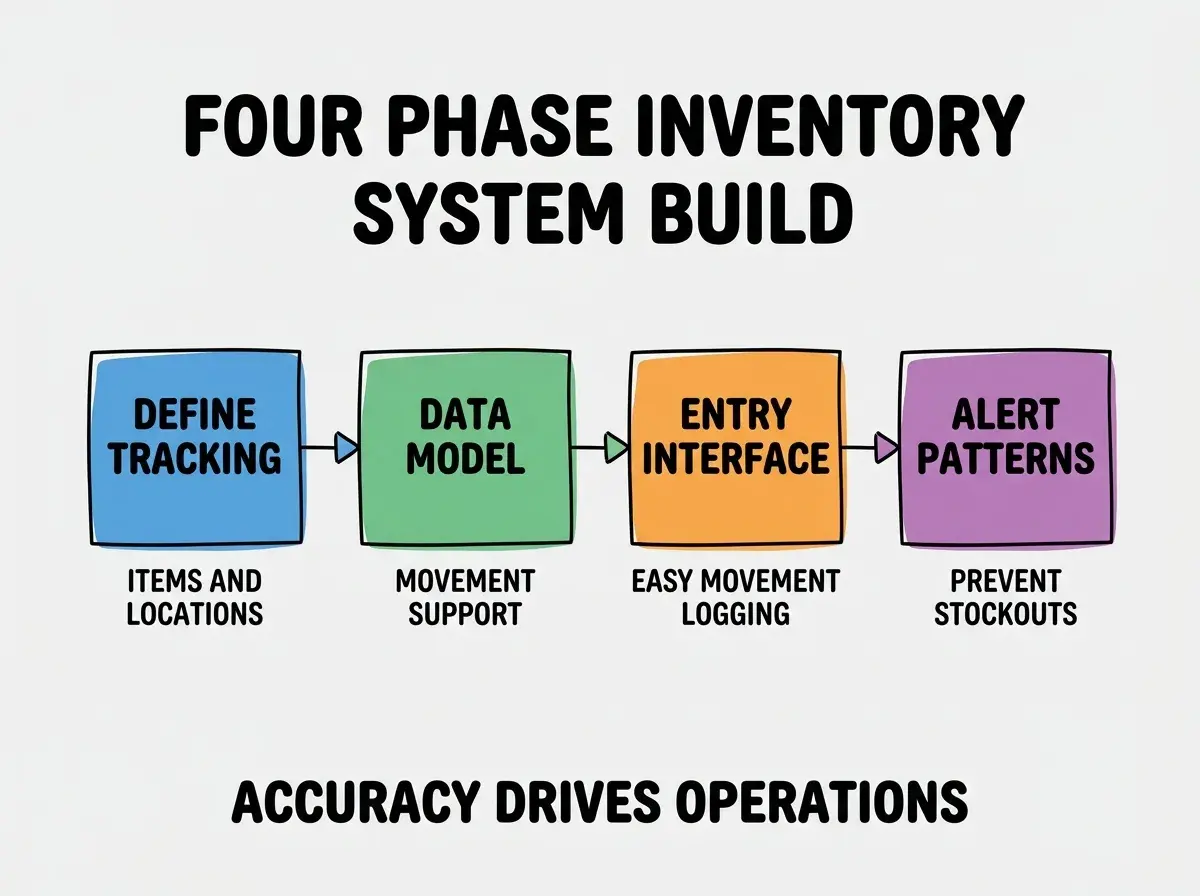
Phase 3, design the entry interface that makes movements easy to record. Barcode scanning, mobile entry, batch operations. Entry friction determines logging compliance; high friction produces missed movements that erode accuracy.
Phase 4, ship with alert patterns that prevent stockouts and overstocks. Reorder thresholds, demand forecasting, slow moving alerts. Alerts surface problems before they become operational issues; without alerts, problems compound undetected.
The Alert Patterns That Drive Action
Three patterns produce alerts operations teams act on.
Pattern 1, reorder thresholds based on demand patterns. Static thresholds produce stockouts during demand spikes; dynamic thresholds adjust to recent patterns. Pattern based thresholds prevent more stockouts.
Browse more operations tutorials
Read more build tutorialsPattern 2, slow moving inventory alerts surface tied up cash. Items not moving for 90+ days indicate cash trapped in stock. Surfacing these enables clearance decisions that free cash.
Pattern 3, AI demand forecasting for seasonal patterns. AI pattern detection across years of history produces better forecasts than manual seasonal awareness. Forecast accuracy improves purchasing decisions.
The Specific Tooling That Worked
Three tool categories combine effectively for inventory system building.
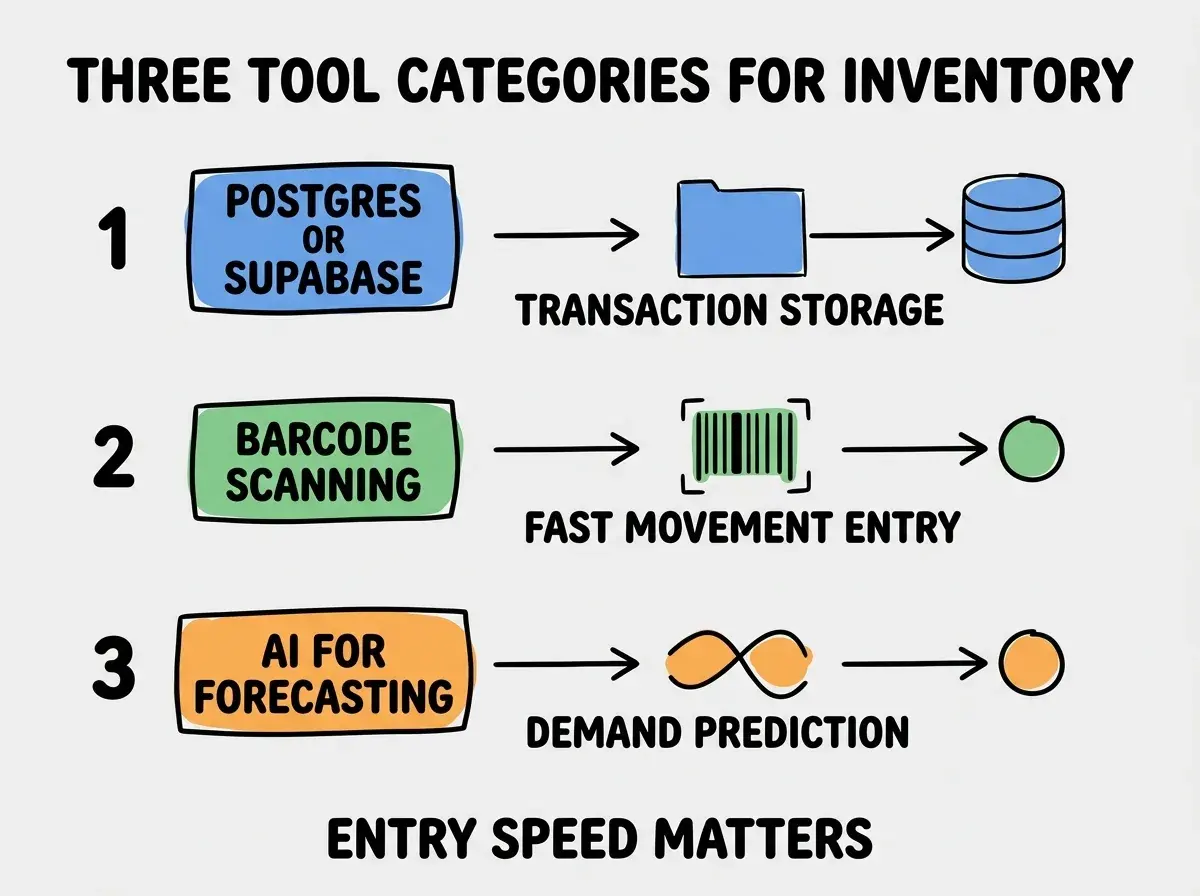
Tool 1, Postgres or Supabase for transaction storage. Items, locations, movements, audit trail. Relational data fits naturally; AI tools generate the schema effectively.
Tool 2, barcode scanning for fast movement entry. Mobile barcode scanning reduces entry time dramatically. Manual SKU entry produces error and friction; barcode scanning eliminates both.
Tool 3, AI for demand forecasting and pattern detection. Claude or GPT analyzes historical patterns and forecasts demand. Better forecasts improve purchasing decisions.
What Makes Inventory Systems Maintain Accuracy
Three patterns separate accurate inventory systems from drifting ones.
Pattern 1, every movement requires explicit logging. Receiving, shipping, transfers, adjustments. Implicit movements produce drift; explicit logging maintains accuracy.
Pattern 2, regular cycle counts catch drift early. Weekly partial counts beat annual full counts. Frequent cycle counts catch drift while it is small; annual counts reveal large drift that is hard to reconcile.
Pattern 3, audit trail enables drift investigation. When discrepancies appear, audit trail reveals what happened. Without audit trail, discrepancies remain mysteries.
The combination produces inventory systems that maintain accuracy over time. Without these patterns, systems drift to inaccurate states that hurt operations.
How to Build Your First Inventory System
Three implementation patterns help first inventory systems succeed.
Pattern A, start with one location, not multi location. Single location validates the model. Multi location from day one often produces incomplete location handling.
Pattern B, start with simple SKU structure. Complex SKU structures produce confusion; simple structures produce clarity. Add complexity later if needed; start simple.
Pattern C, dogfood with internal team before production use. Use the system for low stakes inventory first; reveals UX issues before production accuracy matters.
The combination produces first inventory systems that establish accuracy patterns. Without these patterns, first systems often launch then drift to inaccuracy that requires major reconciliation efforts to recover.
The most damaging inventory system mistake is treating inventory accuracy as something that happens once at launch rather than continuous discipline. Inventory drifts without continuous discipline; the discipline matters more than the initial setup. The fix is to budget ongoing time for cycle counts, audit trail review, and discrepancy investigation; inventory accuracy is a continuous practice rather than a one time achievement. Without continuous discipline, even the best inventory system drifts within months.
The other mistake is overengineering with features no operation needs. Comprehensive inventory platforms produce friction without value for most operations. The fix is to build for your specific operation; generic platforms rarely match operational patterns.
A third mistake is ignoring the human side of inventory management. Inventory accuracy requires operator buy in; punitive accuracy programs produce gaming rather than accuracy. The fix is to make accuracy easy and culturally expected; the combination produces sustained accuracy.
A fourth mistake is failing to handle returns and damaged goods explicitly. Returns and damages happen; inventory systems without explicit handling produce drift through these events. The fix is to design return and damage workflows from the start.
A fifth mistake is treating inventory data as separate from financial systems. Inventory levels affect financial reporting; isolated inventory produces reconciliation problems. The fix is to integrate inventory with financial systems; integration prevents the reconciliation work that isolation requires.
What This Means For You
The inventory management system built with AI tools becomes valuable through accuracy maintenance, fast entry, and demand forecasting. The four phases, alert patterns, and tool combinations produce inventory systems that drive operational decisions.
- If you're a founder running ecommerce: Inventory systems become essential as product complexity grows. Build them as you grow beyond memory based tracking; the transition timing affects business scale.
- If you're an ecommerce operator: Inventory accuracy directly affects customer satisfaction and cash flow. Invest in inventory discipline as a core operational practice.
- If you're a senior dev: AI tools handle inventory implementation effectively. The bottleneck is operational discipline and entry friction reduction, not implementation; invest in those areas more than feature breadth.
Browse more operations tutorials
Read more build tutorials