To build a feature request voting board with AI tools, follow the four phase approach (define what you want users voting on and what you do not, build the voting data model that supports prioritization, design the submission interface that produces high quality requests, and ship with the response patterns that make users feel heard), recognize what separates voting boards that drive product decisions from boards that get ignored, and apply the patterns that produce voting users invest in. The feature request voting board becomes valuable when both users invest in voting and you respond to votes; one without the other produces failure.
This piece walks through the four phases, the response patterns that build trust, the specific tooling, and the four mistakes that produce voting boards users abandon.
Why Feature Request Voting Boards Matter
Feature request voting boards aggregate user demand into prioritization signals. The aggregation matters; without structured voting, the loudest users dominate while quiet users get ignored. Good voting boards give every user voice while showing relative demand clearly.
The 2026 reality is that AI tools accelerate voting board building while AI integration during request handling can deduplicate, categorize, and summarize incoming requests. The combination means small teams can run voting boards matching what enterprises previously paid for as separate SaaS subscriptions.
A 2025 product management survey of 600 SaaS companies found that companies running active voting boards saw 31 percent higher feature satisfaction scores than companies using ad hoc feedback. The structured prioritization signal correlates with shipping features users actually want; ad hoc feedback often produces shipping features the loudest users wanted.
The pattern to copy is the way democracies use elections. Elections aggregate individual preferences into collective decisions; the aggregation produces legitimacy that ad hoc feedback cannot. Voting boards play similar role for product decisions; structured aggregation produces legitimate prioritization that satisfies users beyond just the winners.
The Four Phase Approach
Four phases produce feature request voting boards that drive product decisions.
Phase 1, define what you want users voting on and what you do not. Some features require user input; others require expert judgment regardless of votes. The clarity prevents user disappointment when expert judgment overrides votes.
Phase 2, build the voting data model that supports prioritization. Requests, votes, comments, status updates, tags. AI tools generate the schema effectively given clear specifications.
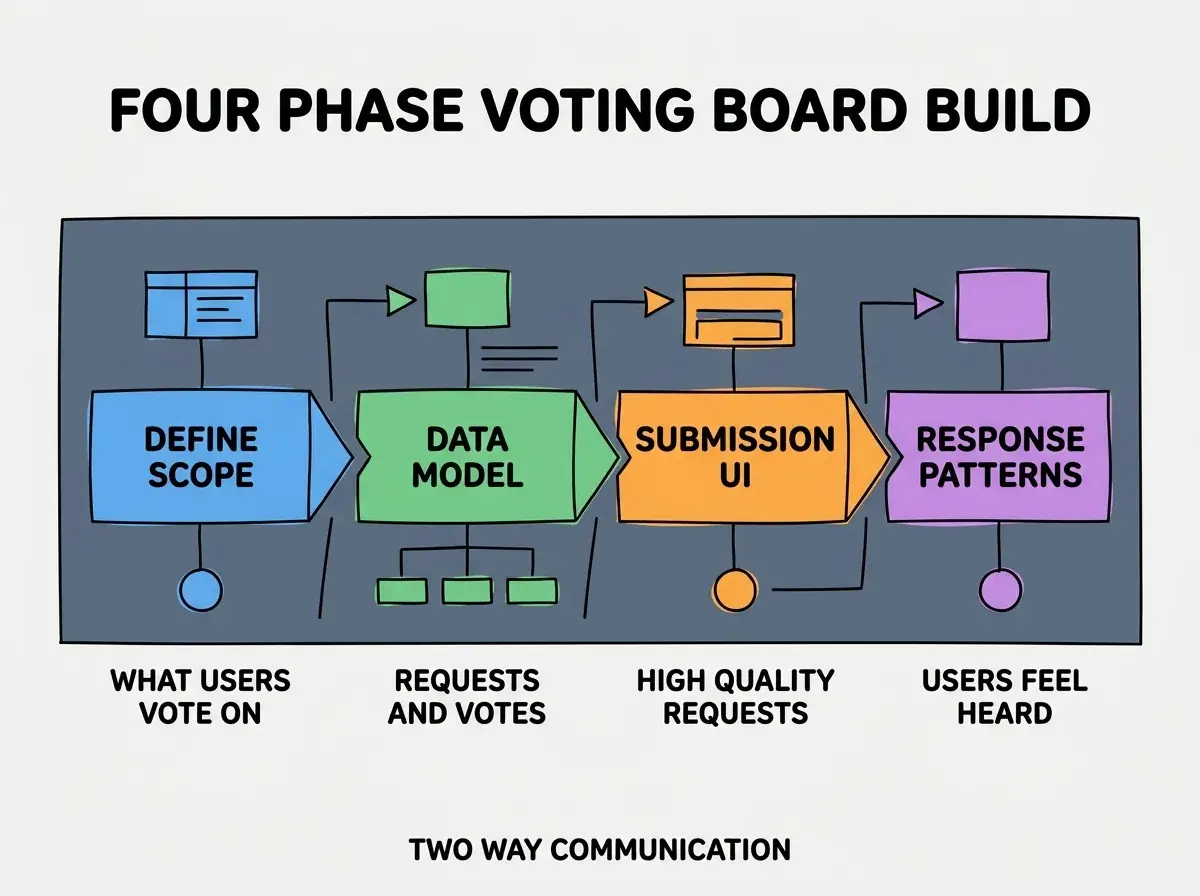
Phase 3, design the submission interface that produces high quality requests. Templates, examples, AI assisted refinement. Quality of submissions determines value of votes; low quality submissions produce low signal voting.
Phase 4, ship with response patterns that make users feel heard. Status updates, transparent rejection reasons, ship notifications. The response loop builds trust; voting boards without response become theater.
The Response Patterns That Build Trust
Three patterns produce response that builds user trust.
Pattern 1, every request gets explicit status. Considered, planned, in progress, shipped, declined. No request stays in limbo; explicit status preserves trust.
Browse more product tutorials
Read more build tutorialsPattern 2, declined requests get clear reasoning. "Not aligned with current focus" beats silent rejection. Clear reasoning preserves trust; silence destroys it.
Pattern 3, shipped features notify voters. When a feature ships, voters get notified. The closure produces validation; voters who never hear back stop voting.
The Specific Tooling That Worked
Three tool categories combine effectively for voting board building.
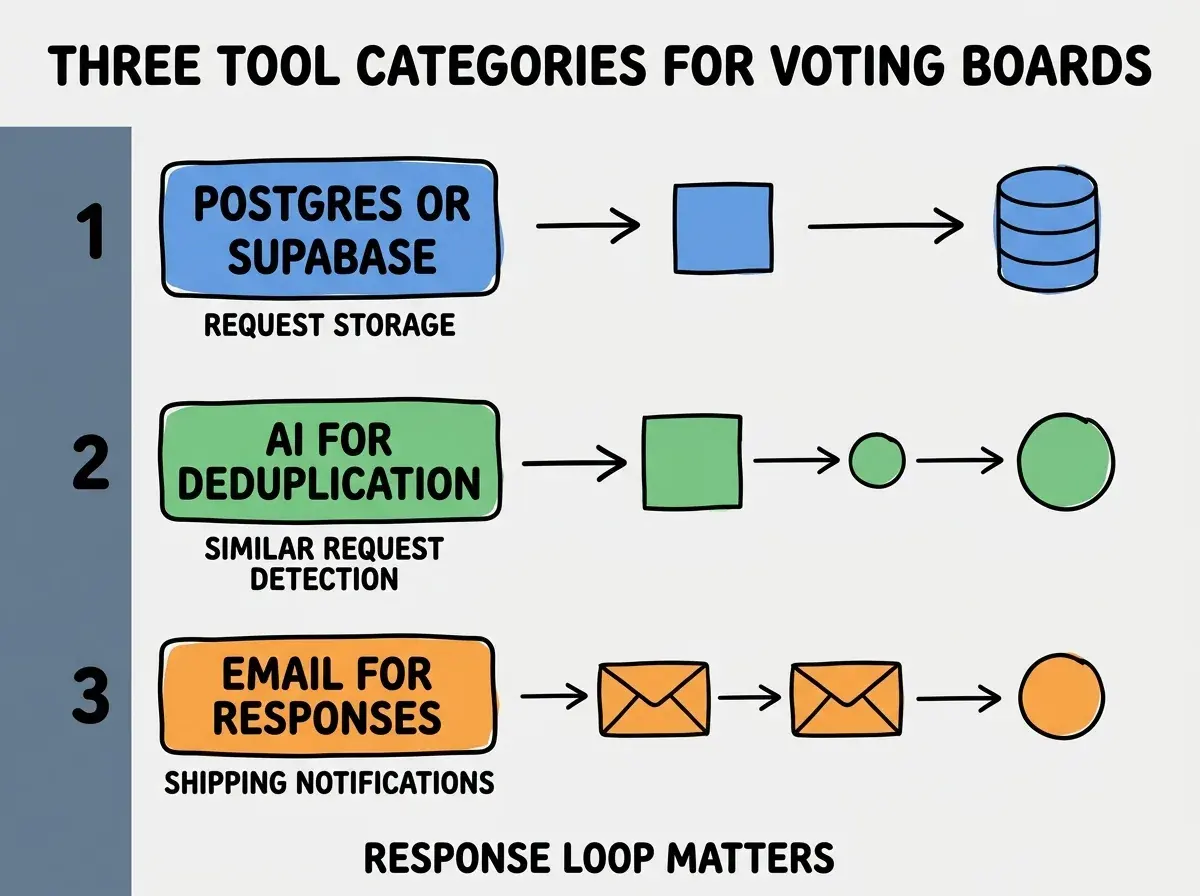
Tool 1, Postgres or Supabase for request storage. Requests, votes, comments, status. Relational data fits naturally; AI tools generate the schema effectively.
Tool 2, AI for deduplication of similar requests. Semantic comparison detects when new requests duplicate existing ones. Deduplication keeps signal high; without it, vote splitting reduces signal value.
Tool 3, email for shipping notifications. Resend or SendGrid for transactional notifications. Voters who get notified when their requests ship feel the closure that produces continued voting.
What Makes Voting Boards Drive Product Decisions
Three patterns separate decision driving boards from ignored boards.
Pattern 1, response time matters more than response content. Quick response of any kind beats slow thoughtful response. Users feel heard through response speed; long silence destroys engagement regardless of eventual response quality.
Pattern 2, transparent prioritization process builds confidence. Sharing how decisions are made beyond just votes preserves trust when votes are not the only factor. Black box decisions feel arbitrary; transparent process feels legitimate.
Pattern 3, public roadmap connects votes to outcomes. Voters see what is shipping and what is not. The connection produces continued engagement; disconnection produces apathy.
The combination produces voting boards that drive product decisions for years. Without these patterns, boards become initial novelty that fades into unused features.
How to Build Your First Voting Board
Three implementation patterns help first voting boards succeed.
Pattern A, start narrow before going broad. One product area first; expand to whole product after the area pattern works. Narrow scope produces successful first board; broad scope often produces incomplete coverage.
Pattern B, seed with existing requests. Ten quality requests at launch produce more voting than empty board. Empty boards rarely attract first submissions; seeded boards produce momentum.
Pattern C, commit to weekly response cadence. Weekly status updates on the top voted requests. Without commitment, response decays; with commitment, response sustains.
The combination produces first voting boards that establish the pattern for sustained user engagement. Without these patterns, first boards often launch with energy and decay within months.
The most damaging voting board mistake is launching without commitment to respond to votes. Voting without response produces user frustration that exceeds the frustration from no voting at all; users feel ignored rather than just not heard. The fix is to commit to weekly response cadence before launch and budget time for responses; response is the work, not voting collection. Boards without response commitment should not launch.
The other mistake is treating votes as the only input. Some features matter strategically beyond user demand; vote based prioritization can miss strategic features. The fix is to be transparent about when votes drive decisions and when they do not; transparency preserves trust even when votes do not win.
A third mistake is allowing low quality submissions to flood the board. Low quality submissions reduce signal value of votes. The fix is to require minimal submission quality; templates and AI assisted refinement produce high quality submissions.
A fourth mistake is hiding declined requests. Declined requests teach users what you will not build; hiding them produces repeat submissions of the same ideas. The fix is to make decline reasoning visible; visibility prevents wasted effort on declined patterns.
What This Means For You
The feature request voting board built with AI tools becomes valuable through structured aggregation, response patterns, and transparent prioritization. The four phases, response patterns, and tool combinations produce boards that drive real product decisions.
- If you're a product manager: Voting boards reduce reliance on loudest user feedback. Build them when product complexity justifies structured prioritization; below that complexity, ad hoc may suffice.
- If you're an indie hacker: Even small product audiences benefit from voting boards. The structured signal reduces decision uncertainty; build a simple board early rather than later.
- If you're a senior dev: AI tools handle voting board implementation effectively. The bottleneck is response commitment, not implementation; invest in response process more than features.
Browse more product tutorials
Read more build tutorials