To build a digital product storefront with AI tools, follow the four phase approach (define what digital product types and buyer patterns the storefront should support, build the data model that handles product variants and license delivery, design the storefront interface that converts browsers into buyers, and ship with the delivery patterns that handle license and download reliability), recognize what separates digital storefronts that convert from storefronts that browse without buying, and apply the patterns that produce sustained creator income. The digital product storefront becomes valuable when it converts traffic to sales while delivering products reliably; without both, traffic produces no income.
This piece walks through the four phases, the conversion patterns, the specific tooling, and the four mistakes that produce storefronts that traffic without sales.
Why Digital Product Storefronts Matter
Digital product storefronts turn creator output into sustainable income streams. The transformation matters; without storefronts, creators rely on platform employment or ad revenue, while storefronts produce direct creator to buyer relationships that compound over time.
The 2026 reality is that AI tools dramatically accelerate storefront building while AI integration during operation can suggest related products, generate marketing copy, and detect fraud faster than manual operations. The combination means individual creators can build storefronts matching what enterprises previously required as expensive ecommerce platforms.
A 2025 creator economy survey of 800 digital product creators found that creators with custom storefronts retained 85 percent of sales revenue compared to 65-75 percent on platform marketplaces like Gumroad. The retention difference compounds; over time the custom storefront economics dramatically exceed platform alternatives.
The pattern to copy is the way independent musicians transitioned from labels to direct sales through Bandcamp and similar platforms. Direct sales captured more revenue per sale and built direct fan relationships; platform sales captured less and built platform relationships rather than fan relationships. Digital storefronts play similar role for creators across all digital product types.
The Four Phase Approach
Four phases produce digital product storefronts that convert sustainably.
Phase 1, define what digital product types and buyer patterns the storefront should support. Ebooks, courses, templates, tools, fonts. Different product types need different delivery and licensing.
Phase 2, build the data model that handles product variants and license delivery. Products, variants, orders, licenses, downloads. AI tools generate the schema effectively given clear specifications.
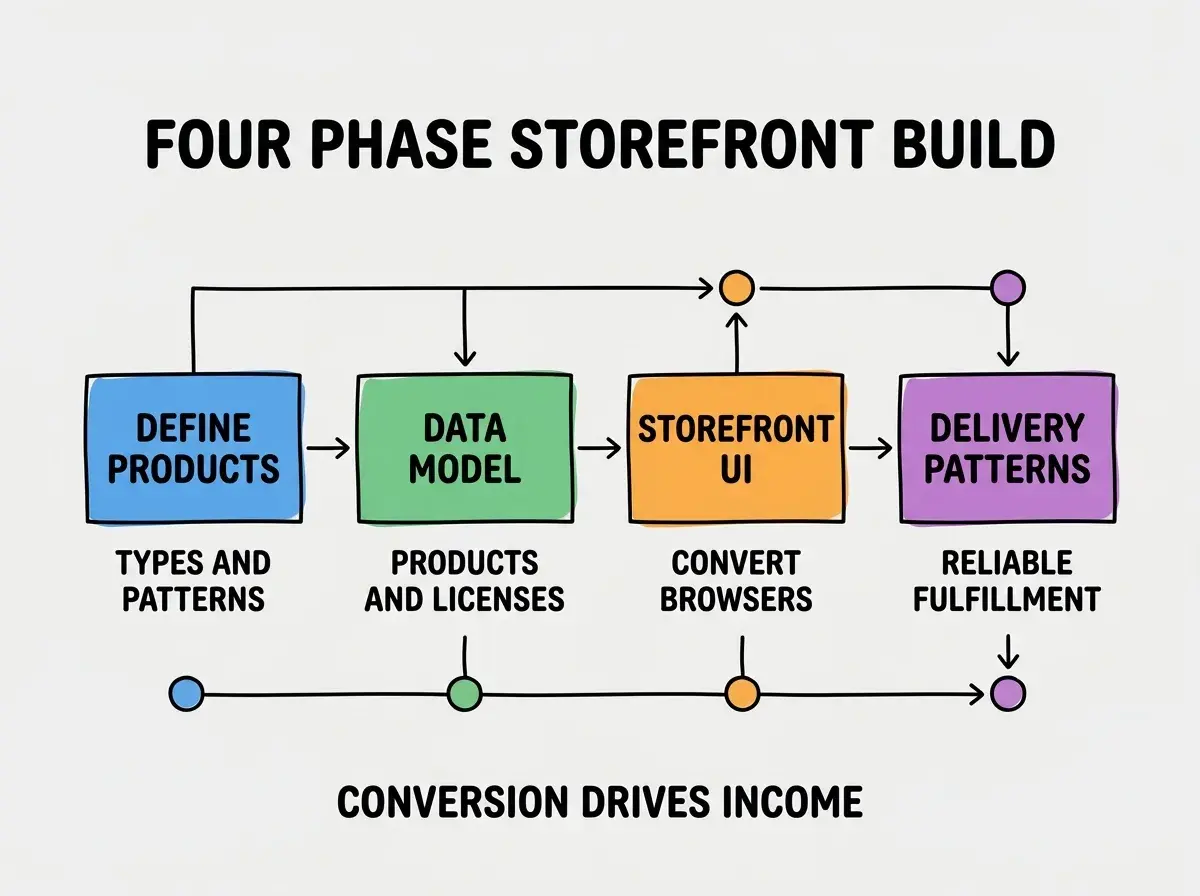
Phase 3, design the storefront interface that converts browsers into buyers. Product pages, social proof, fast checkout. Conversion design determines income; pretty storefronts that do not convert produce no income.
Phase 4, ship with delivery patterns that handle license and download reliability. Email delivery, download links, license keys, refund handling. Delivery reliability produces customer trust; delivery problems produce refunds and reputation damage.
The Conversion Patterns That Drive Sales
Three patterns produce conversion that turns browsers into buyers.
Pattern 1, social proof prominently displayed. Reviews, testimonials, sales counts. Social proof reduces purchase risk; without it, browsers hesitate.
Browse more business tutorials
Read more build tutorialsPattern 2, fast checkout without account creation. Required signup loses sales; guest checkout captures purchases that signup walls would lose.
Pattern 3, money back guarantee for risk reduction. 30 day refund policy reduces purchase hesitation. Refund rates stay low when product quality is high.
The Specific Tooling That Worked
Three tool categories combine effectively for digital storefront building.
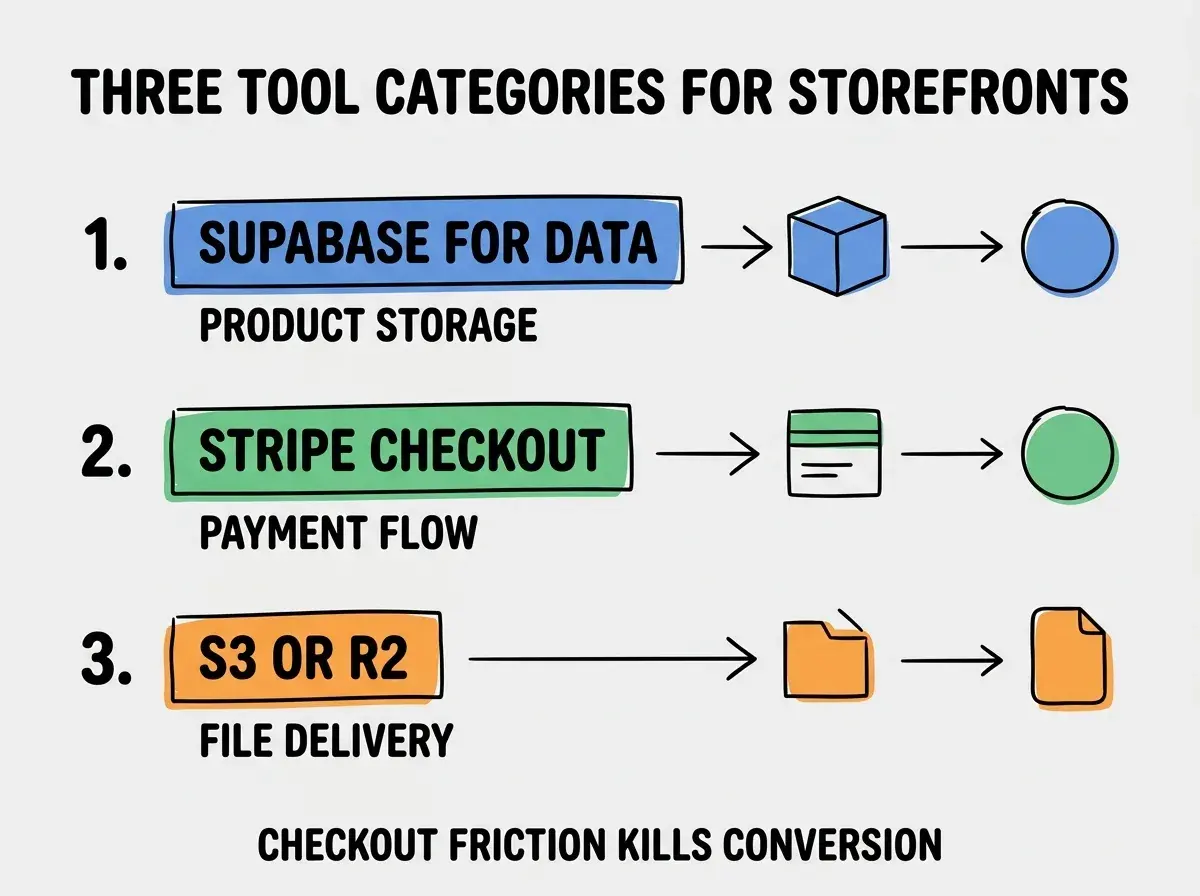
Tool 1, Supabase for product data storage. Products, orders, licenses, customers. Relational data fits naturally.
Tool 2, Stripe Checkout for payment flow. Hosted checkout with low friction and high conversion. Custom checkout flows often produce lower conversion than Stripe Checkout.
Tool 3, S3 or R2 for file delivery. Object storage with signed URLs for secure file delivery. Custom file serving rarely beats object storage with signed URLs.
What Makes Storefronts Get Sustained Sales
Three patterns separate sustained sales storefronts from one time launch storefronts.
Pattern 1, SEO investment for organic discovery. Sustainable sales require sustainable traffic. Paid traffic produces sales but not sustainable economics; SEO produces sustainable traffic.
Pattern 2, email list building from every visitor. Visitors who do not buy today might buy tomorrow. Email capture preserves the relationship.
Pattern 3, ongoing product additions sustain interest. Single product storefronts plateau; storefronts adding products sustain growth. Product velocity matters.
The combination produces storefronts that grow over years. Without these patterns, storefronts often peak at launch then decline.
How to Build Your First Digital Storefront
Three implementation patterns help first storefronts succeed.
Pattern A, start with one product before building general storefront. Single product validates the storefront with real sales. Multi product from day one often produces incomplete platforms.
Pattern B, soft launch to email list before public launch. Email list launches reveal conversion friction with friendly audience. Public launch after email list validation produces better outcomes.
Pattern C, instrument conversion funnel from day one. Where do visitors drop off. Without instrumentation, conversion problems stay hidden.
The combination produces first storefronts that establish conversion patterns. Without these patterns, first storefronts often launch with low conversion that affects business model viability.
The most damaging digital storefront mistake is requiring account creation before checkout. Required signup loses 20-40 percent of sales typically; guest checkout captures these sales while still allowing optional account creation post purchase. The fix is to default to guest checkout with optional signup; the friction reduction produces conversion improvements that justify the slight customer relationship trade off. Storefronts that require accounts often see lower conversion than equivalent products with guest checkout.
The other mistake is overengineering product pages with information that distracts from purchase. Long product pages often convert worse than focused pages. The fix is to focus product pages on purchase decision; supplementary information goes in linked pages.
A third mistake is failing to handle delivery failures. Email delivery sometimes fails; download links sometimes break. The fix is to build robust delivery with self service recovery; customers who can self serve recovery rate higher than customers who need support intervention.
A fourth mistake is missing tax handling for international sales. Digital products have tax implications that vary by jurisdiction. The fix is to use tax services like TaxJar or Quaderno; manual tax handling produces compliance risk.
How Storefront Economics Scale Over Time
Three economic patterns matter for thinking about storefront business sustainability. First, organic SEO traffic compounds over time as search engines index content; storefronts active for years often have substantial unpaid traffic that newer storefronts cannot match. Second, email list size compounds with every visitor capture; established storefronts with large email lists have launch advantages new storefronts lack. Third, customer relationships compound through repeat purchases; storefronts with quality products see customers return for related products, producing economics dramatically better than one time buyer storefronts. The combination produces storefront businesses that grow stronger over years rather than plateau at launch.
What This Means For You
The digital product storefront built with AI tools becomes valuable through conversion focused design, reliable delivery, and ongoing product additions. The four phases, conversion patterns, and tool combinations produce storefronts that sustain creator income.
- If you're an indie hacker: Custom storefronts retain more revenue than platform marketplaces. Build them when sales volume justifies the build effort; below that volume, platforms may suffice.
- If you're a creative: Digital products can become sustainable income streams beyond service work. Build them when you have content worth selling; the storefront mechanics are increasingly accessible.
- If you're a senior dev: AI tools handle storefront implementation effectively. The bottleneck is conversion design and reliable delivery, not implementation; invest in those areas more than feature breadth.
Browse more business tutorials
Read more build tutorials