To build a customer review and rating system that drives sales, you need four parts: a verified-purchase reviews table linked to orders, a rating distribution display (not just an average), a moderation workflow that catches fake reviews and abuse, and prompt timing that requests reviews when customers are most likely to leave them. The whole stack ships in two to three days of vibe coding, and the resulting system typically lifts product page conversion by 12 to 25 percent on stores that previously had no reviews. The architectural decisions also determine whether your reviews stay trustworthy as you scale, which is the gap between systems that drive sales and systems that get gamed.
This piece walks through the schema, the rating display patterns that convert, the fake-review prevention layer, and the four mistakes that turn a good review system into a problem. The patterns work for both standalone e-commerce stores and SaaS products that want customer testimonials on landing pages.
Why Reviews Matter and Why Most Implementations Are Mediocre
Reviews are the single most important social proof element on a product page. A 2025 BrightLocal study found that 87 percent of consumers read reviews before purchasing online, and 79 percent trust reviews as much as personal recommendations. Products with reviews convert at 2 to 3 times the rate of products without reviews, all else equal.
Despite this, most review implementations are mediocre. The default AI-generated review system shows an average star rating, lets anyone post a review, has no moderation, and asks for reviews at random times. This produces low review counts, low quality reviews, vulnerability to fake review attacks, and no real lift in conversion. The architectural difference between mediocre and effective is small but specific.
A 2025 Northwestern study analyzed 100 million product reviews across major retailers and found that products with 1 to 9 reviews converted slightly worse than products with 0 reviews. The reason was that small numbers of reviews are noisy and signal "few customers" rather than "trusted product." Products needed at least 10 reviews to start lifting conversion, and the curve flattened above 50 reviews. Building a system that gets to 10+ reviews per product fast is more important than tuning the display of any single review.
The pattern to copy is the way Amazon designed their review system in the 2000s. Verified purchase badges, distribution histograms instead of just averages, "helpful" voting that surfaces the best reviews, and aggressive moderation against fake reviews. Most of these patterns are now standard, but many vibe-coded stores skip them and reinvent worse versions.
The Schema That Holds Up
The review schema needs to handle five entity relationships cleanly: reviews link to products, reviews link to users, reviews link to orders (for verification), reviews can have media (photos), and reviews can be voted on by other users.
Reviews table. Core fields: ID, product ID, user ID, order ID (nullable for unverified), rating (1-5 integer), title, body, created_at, status (pending, approved, rejected). The status field is critical for moderation.
Review media table. A separate table for photos and videos attached to reviews. One review can have multiple photos. Use R2 or S3 for storage.
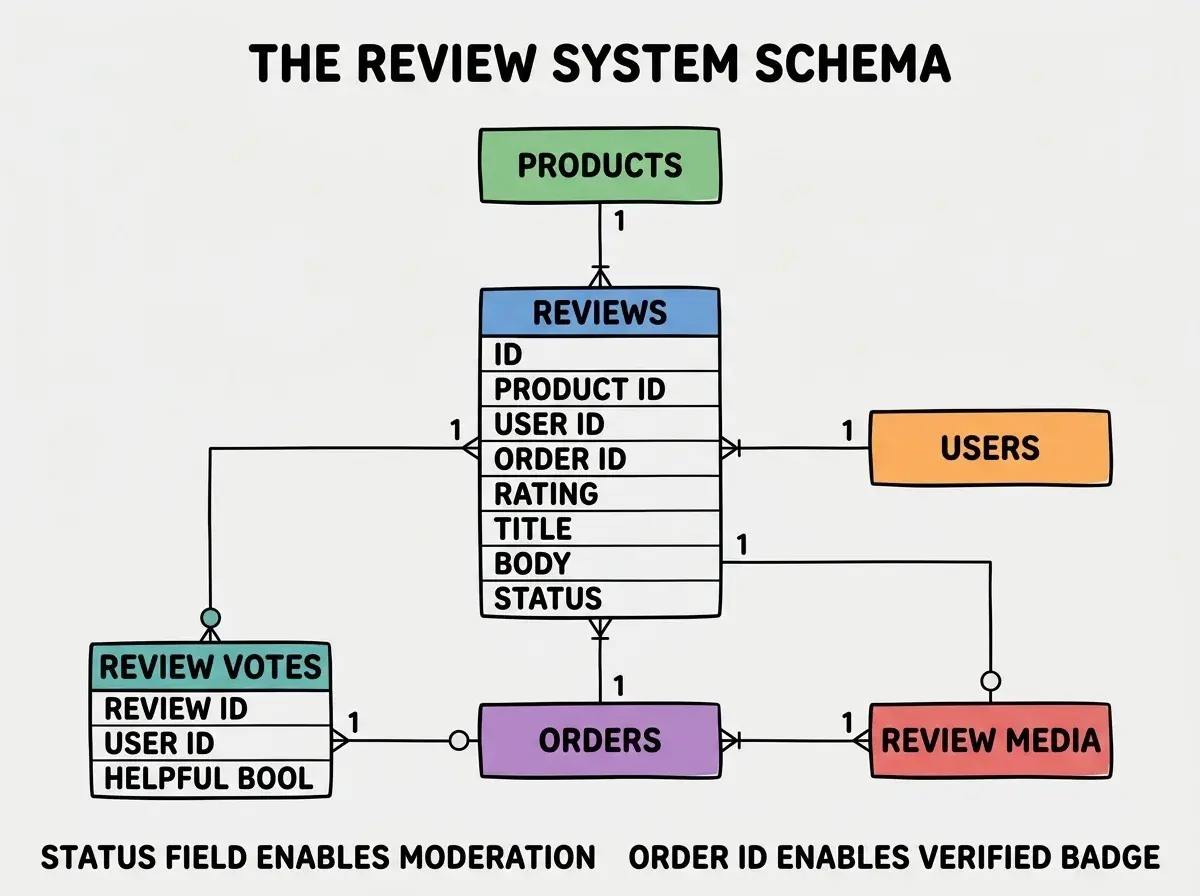
Review votes table. Lets other users mark reviews as helpful or unhelpful. Use this to surface the most useful reviews on the product page rather than showing them in chronological order.
Indexes matter. Index on (product_id, status) for the product page query, on (user_id) for user profiles, and on (created_at) for the moderation dashboard. These three indexes cover 95 percent of queries and prevent the slow-page issues that often appear once review counts cross a few thousand per product.
The Display Patterns That Convert
How you display reviews on the product page is as important as the reviews themselves. Three display patterns convert better than the default chronological list.
Distribution histogram. Show the count of reviews at each star rating (e.g., "47 five-star, 12 four-star, 3 three-star, 1 two-star, 0 one-star"). This is more trustworthy than a single average because customers can see whether opinions are consistent or polarized.
Browse more e-commerce build guides
Read more build articlesVerified purchase badge. Show a badge next to reviews from customers who actually bought the product. This badge increases the trustworthiness of those reviews and is a strong signal that fake reviews are filtered out.
Most helpful first. Surface the reviews that other customers voted most helpful at the top, then show the most recent. Pure chronological ordering buries the best content.
The Fake Review Prevention Layer
Once a store has any meaningful traffic, fake reviews become an issue. Sellers may post fake positive reviews of their own products, competitors may post fake negatives, and bot networks may flood the system. Three defenses cover most of this.
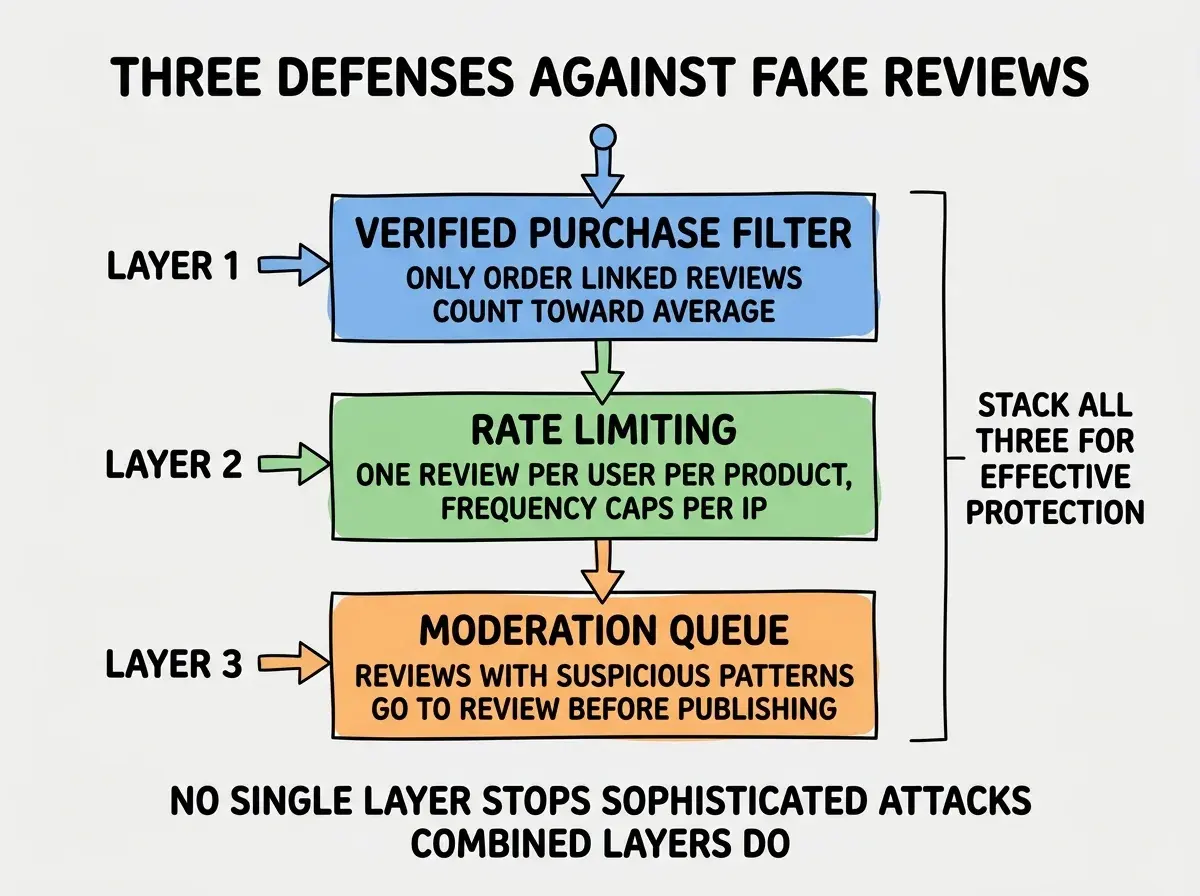
Verified purchase filter. Reviews from users who did not buy the product can still be allowed but should not count toward the average rating shown on the product page. This neutralizes most casual fake reviews.
Rate limiting. One review per user per product. Frequency caps per IP address (e.g., no more than 3 reviews per IP per day). This stops bot floods.
Moderation queue. Reviews with suspicious patterns (very long, very short, contains URLs, posted within minutes of account creation, contains repeated words) go to a moderation queue before publishing. Use heuristics rather than ML for the first version; AI can be added later if volume warrants.
The most expensive review system mistake is showing only the average star rating. A 4.2-star average from 200 reviews tells customers very little; the same 4.2 from a distribution heavily weighted at 5 stars with a few 1-star outliers is a very different signal than 4.2 spread evenly across 3, 4, and 5 stars. Customers read distributions if you show them and infer them imperfectly if you do not. The histogram is one of the highest-leverage display elements on the entire product page.
The other mistake is asking for reviews at the wrong time. Asking immediately after purchase produces low response rates because customers have not used the product yet. Asking 7 to 14 days after delivery (depending on product type) hits the sweet spot when the customer has formed an opinion. Time the request based on shipping data, not order data.
A useful refinement is to send the review request through a transactional email rather than a marketing email. Transactional emails have better deliverability, higher open rates, and higher trust because customers expect them. The wording should be conversational and specific to the product (e.g., "How was your experience with the leather wallet you bought last week?") rather than a generic "Please review your purchase." This small framing change typically lifts review submission rates by 30 to 50 percent.
Dig deeper
A few hand-picked sources if you want to go further.
What This Means For You
A well-built review system is one of the highest-leverage features in e-commerce. The architecture is straightforward, but the small decisions about verification, display, and timing produce most of the conversion lift.
- If you're a founder: Ship reviews early but invest in the moderation and verified purchase layer from day one. Retrofitting trust is much harder than building it in.
- If you're changing careers: Building a review system is a great portfolio project that demonstrates schema design, moderation workflow, and conversion thinking.
- If you're a student: Study how Amazon, Etsy, and Yelp display reviews. The convergence of patterns reflects what actually works at scale.
Browse more e-commerce build guides
Read more build articles