To build an abandoned cart recovery tool that actually works, you need three things: a way to capture cart state including the user's email before they leave, a three-message email sequence sent over 72 hours, and the ability to measure recovery rates so you can tune the sequence over time. The architecture is simple (a database table, a background job, and a transactional email service), and the resulting tool typically recovers 8 to 15 percent of abandoned carts. For a store doing $50,000 per month in sales with a 70 percent cart abandonment rate, this translates to $3,000 to $5,000 per month in recovered revenue with maybe one day of build time.
This piece walks through the three-message sequence, the timing patterns that work, the architecture, and the four mistakes that turn a working recovery system into spam. The patterns apply equally to Shopify-based stores using third-party tools and to fully custom storefronts where you build the recovery logic in-house.
Why Cart Abandonment Is Such a Big Opportunity
Cart abandonment is a constant in e-commerce. The industry-wide rate has been roughly 65 to 75 percent for a decade and is unlikely to change much. People add items to carts during research, get distracted, comparison-shop, or hit a friction point at checkout. Almost none of this is fixable through better checkout UX alone.
What is fixable is the recovery rate. A store with no recovery system loses 100 percent of those abandoned carts. A store with a basic email sequence recovers 8 to 15 percent. A store with a well-tuned sequence with personalization, smart timing, and small incentives can hit 20 percent or higher. The gap between zero and 15 percent is enormous when applied to monthly cart volume.
A 2025 Klaviyo benchmark across 12,000 stores found that the average abandoned cart recovery email sequence drove $5.81 in revenue per recipient. Stores that sent the recommended three-message sequence at 1 hour, 24 hours, and 72 hours recovered 13.4 percent of carts on average. Stores that sent only one email recovered 6.1 percent. The compounding from message two and three more than doubles the recovery rate.
The pattern to copy is the way airlines handle missed flights. The default is "you missed it, too bad." The better airlines have a graceful recovery path (rebook on the next flight, get a credit, get a small comp). The recovery path costs the airline almost nothing and significantly improves customer lifetime value. Cart recovery is the same: small effort, large compounding return.
The Three-Message Sequence That Works
The optimal sequence in 2026 is three messages over 72 hours, with each message having a different psychological frame. This pattern emerged from extensive A/B testing across the industry and converges to roughly the same shape regardless of vertical.
Message 1, the helpful reminder (1 hour after abandonment). Subject line is conversational ("Forgot something?"). Body shows the cart contents, the total, and a clear "Complete your order" button. No discount, no urgency, just a friendly nudge. This recovers about 5 to 7 percent of carts on its own.
Message 2, the social proof reminder (24 hours). Subject line introduces social proof ("These items are popular right now"). Body shows the cart with a small testimonial or review related to one of the products. Still no discount. This adds another 3 to 5 percentage points.
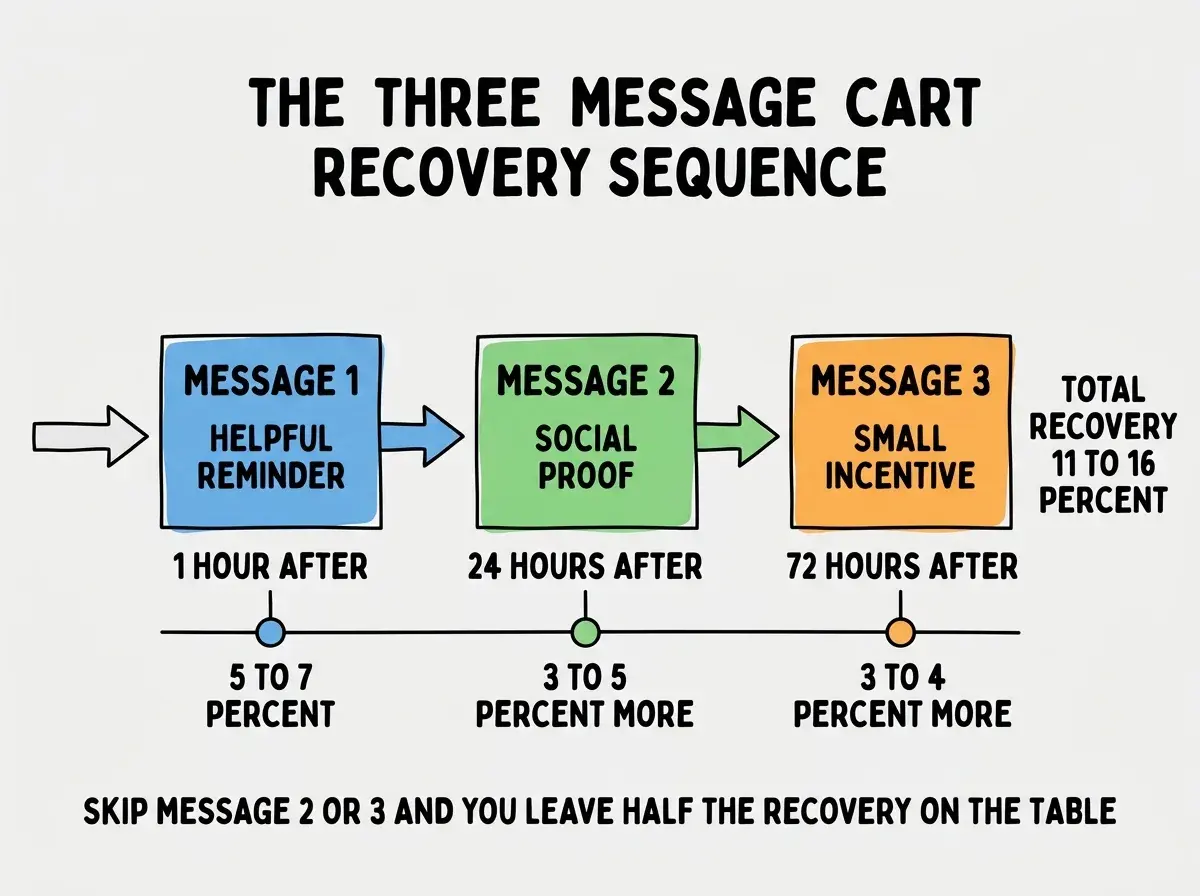
Message 3, the small incentive (72 hours). Subject line introduces the offer ("Here's 10 percent off to finish your order"). Body shows the cart with a discount code that expires in 24 hours. This adds another 3 to 4 percentage points. The discount should be modest because too large a discount trains customers to abandon on purpose.
The Architecture That Ships in a Day
The technical architecture is straightforward. Three components plus a small amount of glue code, and you can ship the whole thing in roughly one day of vibe coding.
Cart capture. Save cart state to a database table whenever a user adds an item or progresses through checkout. Capture the user's email as soon as they enter it (often at the email step before payment). The table needs cart contents, email, last updated timestamp, and a "recovered" boolean.
Browse more e-commerce build guides
Read more build articlesBackground job. A scheduled job (cron, Inngest, or Trigger.dev) that runs every 15 minutes, finds carts that were last updated at the right time intervals, and triggers email sends. The job also marks carts as recovered when the user completes a purchase to avoid sending unwanted messages.
Email service. Resend, Postmark, or SendGrid for sending. Each email is a templated transactional message with the cart contents rendered into the body. Include a deep link back to the cart so one click resumes the checkout flow.
How to Measure and Tune
The hardest part of cart recovery is not building it; it is tuning it over time. The right metrics let you improve the sequence quarterly without breaking what already works.
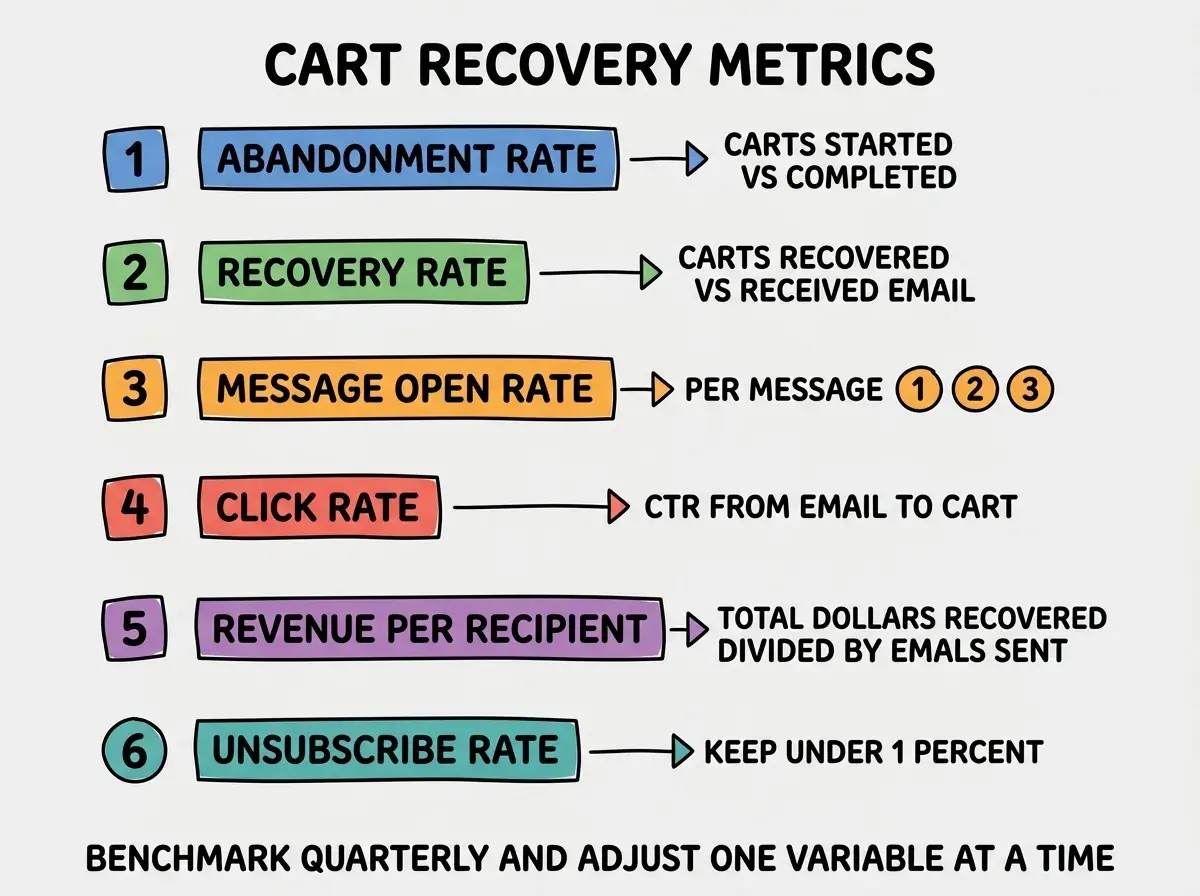
The benchmarks to aim for are 10 to 15 percent recovery rate, 35 to 50 percent open rate per message, 8 to 15 percent click rate, $4 to $8 revenue per recipient, and unsubscribe rate under 1 percent. Anything significantly off these numbers points to a specific issue: low open rate suggests subject line problems, low click rate suggests a weak email body, high unsubscribe suggests over-frequency or too aggressive messaging.
The most damaging cart recovery mistake is sending too many messages. Some teams add a fourth, fifth, or sixth message to the sequence hoping to squeeze more recovery. The data is consistent that messages four and beyond produce diminishing returns and substantially increase unsubscribe rates. Three messages is the sweet spot. If recovery is below benchmark, fix the existing three rather than adding more.
The other mistake is using cart recovery as a marketing channel for unrelated promotions. Customers who abandoned carts opted in for a specific purpose; using their attention for general promotional content burns the channel and trains them to ignore future recovery emails. Keep cart recovery messages strictly about the cart they abandoned.
A useful refinement is to segment recovery messages by cart value. Carts under $50 might get the standard three-message sequence with a 10 percent discount in message three. Carts over $200 might get a slower four-stage sequence with a personal touch (e.g., a real person's signature) and a smaller discount because the absolute discount value matters more. Segmenting by value typically lifts overall recovery rate by 2 to 3 percentage points and keeps the messaging feeling personal across the full price range.
Dig deeper
A few hand-picked sources if you want to go further.
What This Means For You
Cart recovery is one of the highest-ROI projects an e-commerce store can ship. The build is small, the impact is significant, and the tuning compounds over time.
- If you're a founder: Ship cart recovery in your first month of e-commerce. The revenue lift starts immediately and grows as you tune the sequence.
- If you're changing careers: Building a cart recovery system is a great portfolio piece for e-commerce-focused engineering roles. The architecture is small but touches data modeling, background jobs, and email.
- If you're a student: Study real cart recovery emails from major brands. The patterns repeat and the differences between good and great are visible.
Browse more e-commerce build guides
Read more build articles