To build a custom RSS reader with AI tools, follow the four phase approach (define what feed types and reading patterns matter for your information diet, build the feed ingestion that handles diverse RSS formats, design the AI assisted curation that filters signal from noise, and ship with the reading patterns that match how you actually consume content), recognize what separates RSS readers used daily from RSS readers abandoned for social feeds, and apply the patterns that produce sustained personal use. The custom RSS reader matters because it puts information consumption under personal control rather than algorithm control.
This piece walks through the four phases, the AI curation patterns, the specific tooling, and the four mistakes that produce RSS readers users abandon.
Why Custom RSS Readers Matter
Custom RSS readers turn algorithmic feed control into personal feed control. The transformation matters; without RSS readers, information diet shaped by social platform algorithms rather than personal choice.
The 2026 reality is that AI tools dramatically simplify RSS reader building while AI integration during reading can summarize articles, surface patterns across feeds, and filter content matching personal interests.
A 2025 information consumption study of 800 active readers found that custom RSS reader users reported 47 percent higher information satisfaction and 73 percent less time spent on social media compared to algorithmic feed users. Personal control changes information consumption dramatically.
The pattern to copy is the way Newsblur and Feedly continue to thrive despite social media dominance. Power readers prefer chronological control over algorithmic feeds. Custom RSS readers extend this pattern; AI assistance enhances control rather than replacing it.
The Four Phase Approach
Four phases produce RSS readers people use daily.
Phase 1, define feed types and reading patterns. Blogs, news, newsletters, podcasts. Defined patterns determine reader design.
Phase 2, build feed ingestion handling diverse formats. RSS, Atom, JSON Feed, podcast RSS. Format support determines feed coverage.
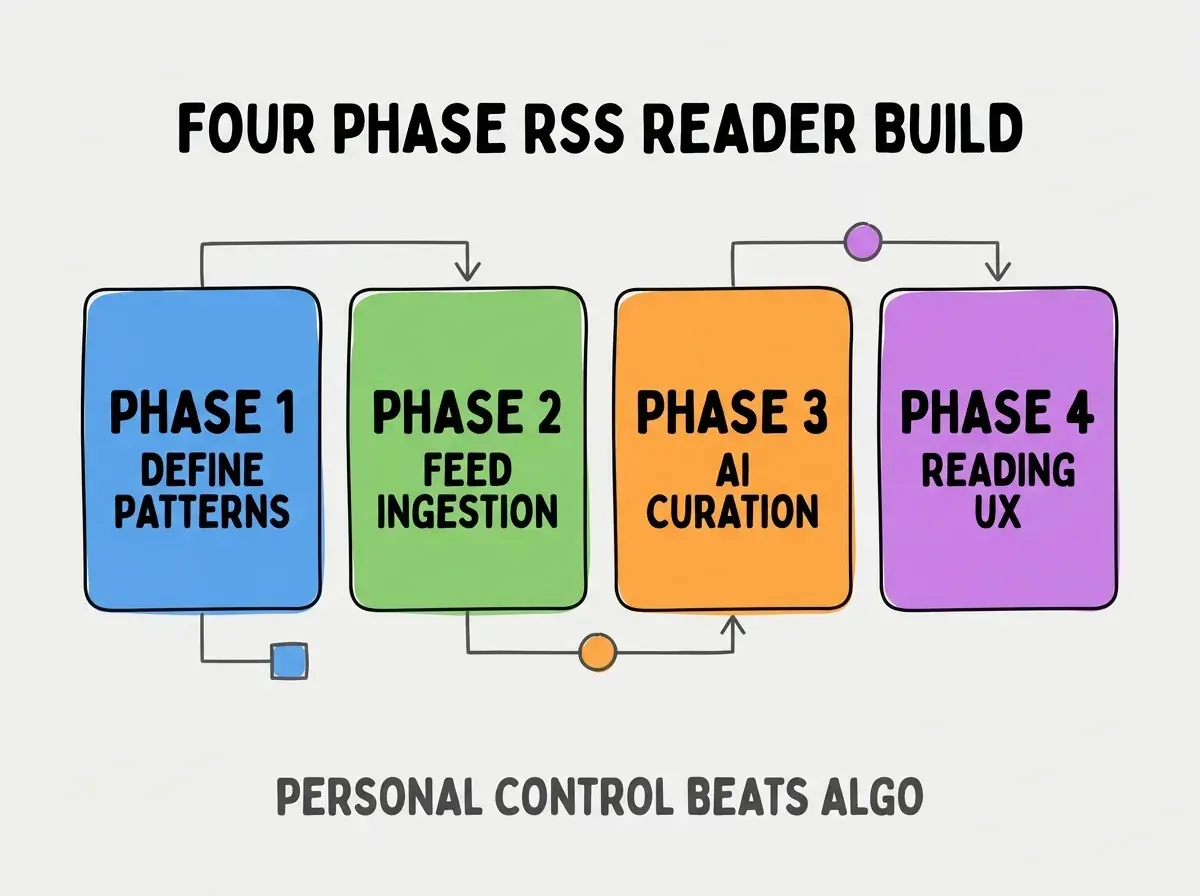
Phase 3, design AI assisted curation. Article summaries, topic filtering, importance ranking. AI helps without controlling.
Phase 4, ship with reading patterns matching consumption. Mark as read, save for later, share, archive. UX matters for daily use.
The AI Curation Patterns That Work
Three patterns produce AI curation that enhances rather than controls.
Pattern 1, AI generated summaries for browsing. Quick summaries help triage articles. Summaries enable broader consumption.
Browse more personal builds
Read more buildPattern 2, topic filtering with user control. AI suggests filters; user controls. Control distinguishes from algorithm feeds.
Pattern 3, importance ranking based on personal patterns. Personal patterns inform ranking. Personalization without algorithm control.
The Specific Tooling That Works
Three tool categories combine effectively for RSS reader building.
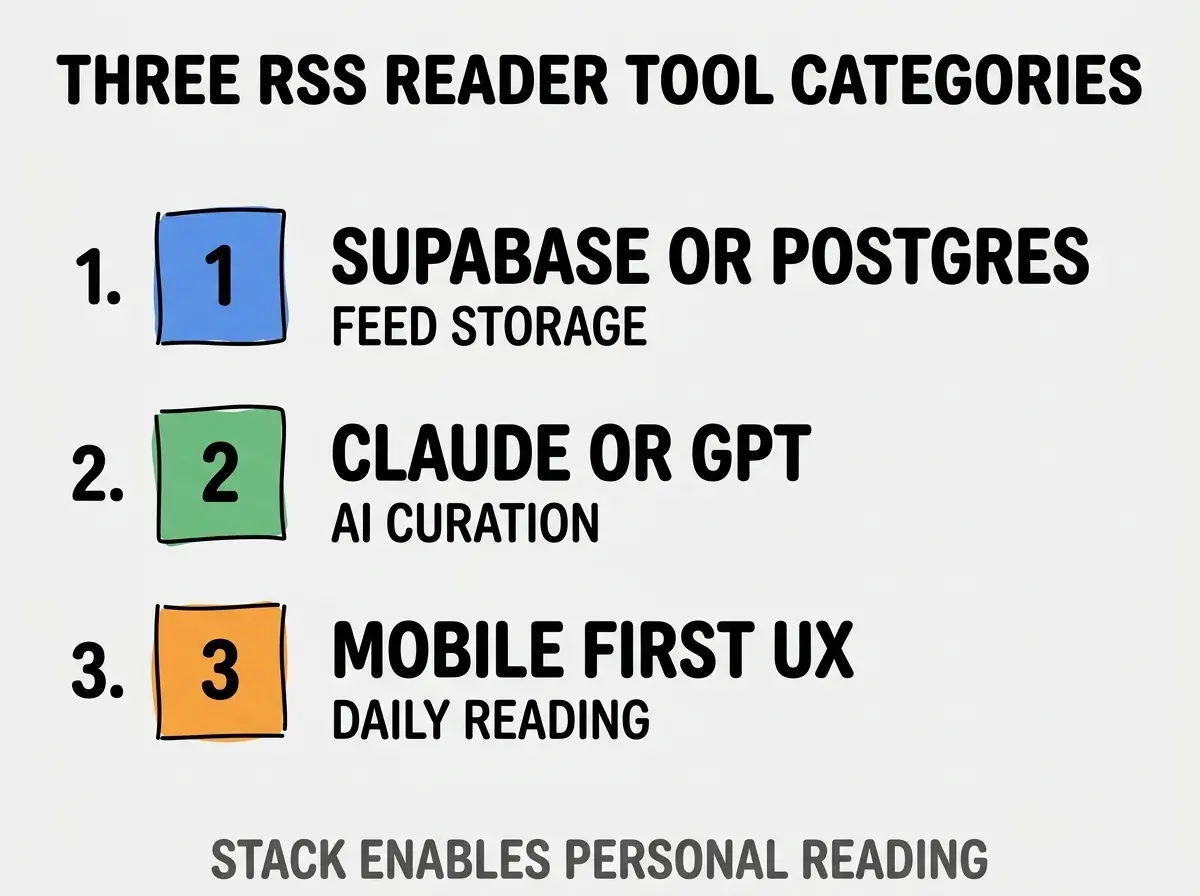
Tool 1, Supabase or Postgres for feed storage. Feeds, articles, read state, archives. Relational storage handles RSS data well.
Tool 2, Claude or GPT for AI curation. Summaries, filtering, ranking. AI choice affects curation quality.
Tool 3, mobile first UX for daily reading. Reading happens mobile primarily. Without mobile, reader gets bypassed.
What Makes RSS Readers Get Sustained Use
Three patterns separate sustained use from abandonment.
Pattern 1, fast feed updates without manual refresh. Background updates produce fresh content. Without freshness, users abandon.
Pattern 2, offline reading capability. Mobile reading often offline. Without offline, reader limited to connected moments.
Pattern 3, sync across devices. Phone, tablet, desktop. Sync matters for cross device readers.
The combination produces RSS readers that become daily habits. Without these patterns, readers get tried then abandoned.
How To Build Your First RSS Reader
Three implementation patterns help first RSS readers succeed.
Pattern A, start with 20 feeds you actually read. Real feeds validate patterns. Without real feeds, design stays theoretical.
Pattern B, dogfood for 4 weeks of reading. Personal use validates with real reading patterns.
Pattern C, instrument daily article opens. Are users opening articles? Without opens, reader value stays anecdotal.
The combination produces first readers that establish use patterns. Without patterns, readers launch with features users do not actually use.
The most damaging RSS reader mistake is replicating algorithmic feed patterns from social media. Algorithmic patterns defeat the purpose of using RSS rather than social feeds. The fix is to preserve chronological control while adding AI enhancement; AI should help readers consume more efficiently without controlling what gets seen. Readers preserving control build sustained use; readers replicating social media patterns lose to actual social media.
The other mistake is missing the offline capability. Mobile reading needs offline; without offline, reader limited.
A third mistake is over engineering AI features before reading basics work. Reading first, AI second.
A fourth mistake is treating RSS as dying technology. RSS continues; power readers prefer it. Building for power readers produces sustainable users.
How To Handle Specific Reading Patterns
Three patterns deserve specific approaches.
Pattern A, news consumption with high volume. Topic filtering, importance ranking. Volume needs filtering.
Pattern B, blog consumption with deep reading. Save for later, archive, search. Deep reading needs preservation.
Pattern C, newsletter consumption with email integration. Email to RSS bridge, newsletter specific UX. Newsletters increasingly important.
The combination produces pattern specific approaches. Without specific approaches, generic reader serves patterns mediocrely.
How RSS Readers Will Likely Evolve
RSS readers will likely continue evolving with AI capabilities.
The first likely evolution is AI conversation with feeds. Asking AI questions about feed content. Conversation expands consumption modes.
The second likely evolution is cross feed analysis. Patterns across multiple feeds surfaced. Analysis enables learning beyond individual articles.
The third likely evolution is integration with note taking. Articles flow to notes naturally. Integration produces knowledge work beyond reading.
The combination suggests RSS readers will become more capable. Builders learning patterns now build skills that remain valuable.
Common Questions About RSS Reader Building
RSS reader building raises questions worth addressing directly.
The first question is whether RSS still has users. Yes; smaller user base than social but committed user base. Power readers prefer RSS.
The second question is how to handle feeds without RSS. RSS bridges, scraping with permission, manual import. Workarounds exist for non RSS sources.
The third question is whether to monetize personal RSS reader. Personal tools rarely monetize well; broader audience tools sometimes do.
The fourth question is how to handle feed reliability. Feeds break; graceful degradation matters. Without handling, broken feeds erode reader value.
How RSS Readers Build Information Independence
Building custom RSS readers builds information independence beyond pure reading. Independence effects compound over time.
The first compounding effect is information diet quality. Personal control produces better diet than algorithmic. Quality compounds across time.
The second compounding effect is reduced attention manipulation. Without algorithmic feed manipulation, attention stays user controlled. Attention matters for life quality.
The third compounding effect is information serendipity through diverse sources. Personal source curation produces diverse exposure. Diversity prevents filter bubbles.
The combination produces information independence that algorithmic feeds cannot match. Independence matters for life quality beyond pure information consumption.
What This Means For You
Custom RSS readers turn information consumption into personal choice rather than algorithmic feed. The four phases, AI patterns, and tool combinations produce readers that change information consumption.
- If you're a creative: RSS readers preserve focused information consumption. Building for yourself produces both tool and information independence.
- If you're a senior dev: RSS readers combine technical interesting work with personal value. Build produces useful tool and learning.
- If you're an indie hacker: RSS readers have small but loyal market. Niche tools sometimes produce sustainable businesses.
Browse more personal builds
Read more build