To build an AI-powered search for your content in 2026, choose between the four search architectures (keyword search with smart ranking, embedding-based semantic search, hybrid keyword plus embeddings, full RAG with LLM responses), generate embeddings for your content using OpenAI or open-source models, store vectors in a managed service like Pinecone or pgvector, and balance relevance with speed and cost based on your specific content type. The build takes 1 to 2 weeks for most content sites and produces search that dramatically beats traditional keyword search on relevance.
This piece walks through the four search architectures, the embedding basics, the cost considerations, and the four mistakes that turn AI search into expensive disappointment.
Why AI Search Beats Keyword Search for Most Content
Traditional keyword search (Elasticsearch, Algolia, plain SQL LIKE queries) requires users to know the right words. Semantic AI search understands intent: a user searching for "how to handle errors" finds articles about "exception management," "fault tolerance," and "graceful degradation" even though the words do not match.
The 2026 advantage is that the tooling for AI search has matured significantly. Embedding generation is fast and cheap. Vector databases are managed services that handle scaling. The infrastructure that previously required ML engineers now runs on commodity managed services accessible to any developer.
A 2025 Algolia user research study of 500 content sites that migrated from keyword to AI-powered search found that average user satisfaction with search increased 41 percent and time-to-find-content decreased 36 percent. The improvements were largest on technical documentation sites and smallest on e-commerce product search (where keyword matching often works well already). AI search is not always the right answer, but for content sites it usually is.
The pattern to copy is the way Google's search evolved from keyword matching to semantic understanding over the 2000s and 2010s. The shift was not a single change; it was many incremental improvements that compounded into qualitatively better search. Modern AI search lets any site achieve in days what took Google decades.
The Four Search Architectures
Different content types and budgets suit different search architectures. Four cover most cases.
Architecture 1, keyword search with smart ranking. Traditional keyword search (Elasticsearch, Algolia) with thoughtful relevance tuning. Cheapest and fastest. Right for product catalogs and simple lookup needs.
Architecture 2, embedding-based semantic search. Convert content to vectors, search by similarity. Better for "what" and "how" questions where intent matters more than exact keywords.
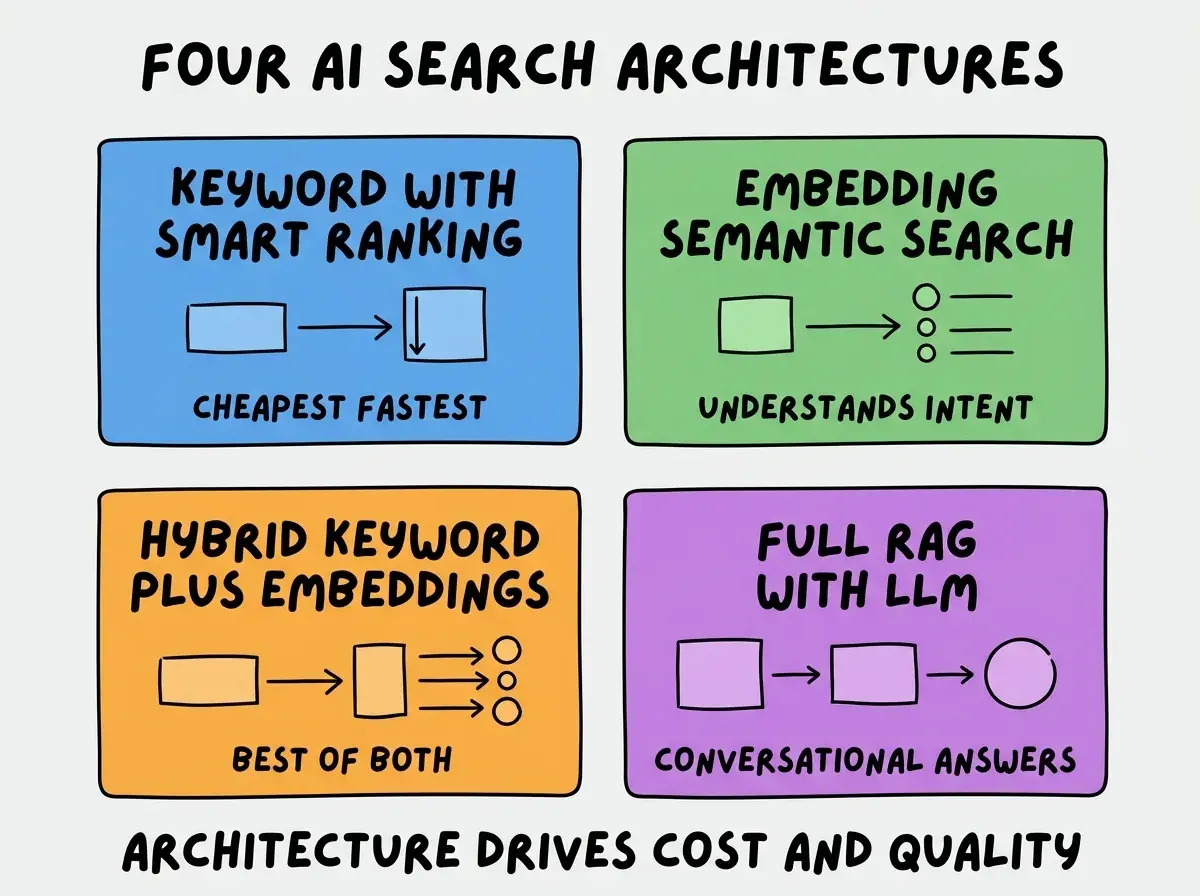
Architecture 3, hybrid keyword plus embeddings. Combine keyword and semantic search. Keyword for precision, semantic for recall. The default for most modern content sites.
Architecture 4, full RAG with LLM responses. Retrieve relevant content, synthesize answers via LLM. Most expensive and slowest, but produces conversational responses. Right for documentation and Q&A sites.
The Embedding Basics
Embeddings are the foundation of semantic and hybrid search. Three concepts matter most.
Concept 1, choose an embedding model. OpenAI text-embedding-3-small is cheap and works well. Anthropic offers similar via Voyage. Open-source options (BGE, E5) work for cost-sensitive deployments.
Browse more AI feature build guides
Read more build articlesConcept 2, chunk your content thoughtfully. Long documents need to be split before embedding. Chunk size affects relevance: 500-1000 token chunks usually work well. Include some overlap between chunks.
Concept 3, choose a vector database. Pinecone, Weaviate, Qdrant for managed services. pgvector on Postgres for self-hosted. The choice affects cost and latency more than capability.
The Cost Considerations
AI search costs money in ways traditional search does not. Three cost categories matter most.
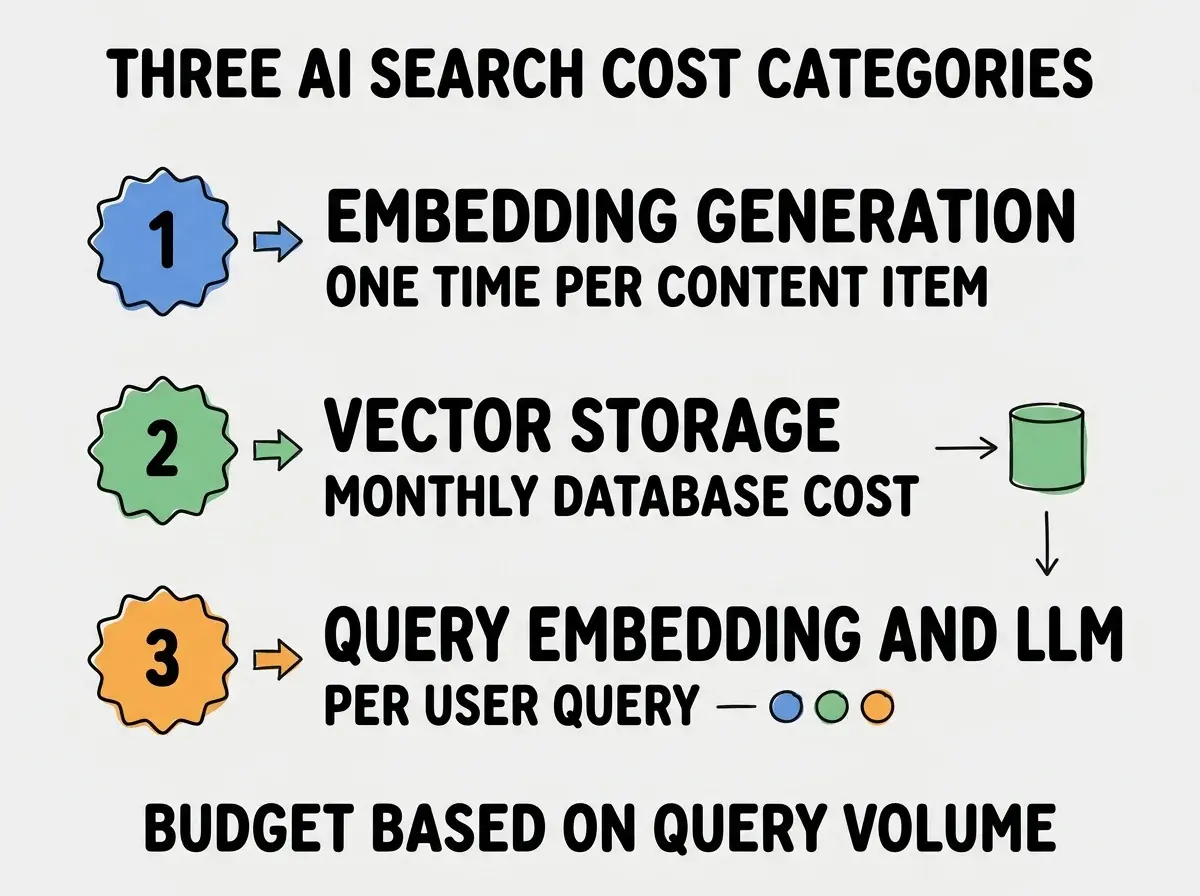
Category 1, embedding generation cost. One-time per content item. Cheap (about $0.02 per million tokens for OpenAI). Re-embed when content changes.
Category 2, vector storage cost. Ongoing monthly cost based on number of vectors and storage tier. Pinecone starts at $70/month for production; pgvector on Postgres can be cheaper for smaller scales.
Category 3, query embedding and LLM costs. Each user query requires an embedding. RAG architectures also call an LLM per query. Adds up at scale; budget based on expected query volume.
The Trade-Off Between Quality and Cost
Higher-quality search usually costs more. Three patterns help find the right balance.
Pattern 1, start with hybrid search. Hybrid keyword plus embeddings produces the best quality-to-cost ratio for most sites. RAG is impressive but expensive; pure keyword leaves quality on the table.
Pattern 2, cache embeddings and frequent queries. Most queries repeat. Caching embedding-generation and query results dramatically reduces ongoing costs. 80% cache hit rate is achievable.
Pattern 3, monitor and tune the relevance. Search relevance is not a one-time setup. Monitor what queries return poor results; iterate on chunking, ranking, and prompts. The tuning is where the long-term value lives.
The combination produces search that scales economically as your site grows. Without these patterns, costs grow faster than usage, which kills the unit economics.
The most damaging AI search mistake is jumping straight to RAG without trying simpler architectures first. RAG is impressive demo material but expensive and slow in production. Many teams over-engineer their search with full RAG when hybrid keyword-plus-embedding would deliver 90 percent of the quality at 10 percent of the cost. The fix is to start with the simplest architecture that meets your quality bar. Add complexity only when measured search quality justifies the additional cost. Most content sites end up at hybrid; few actually need full RAG.
The other mistake is treating search as a "set it and forget it" feature. Search relevance degrades as content grows and user expectations evolve. Without ongoing monitoring and tuning, the search that worked at launch produces worse and worse results over time. Plan for ongoing relevance work as part of the operational cost of running AI search.
Measuring Search Quality Over Time
Search quality has to be measured to be improved. Three measurement patterns work well.
Pattern A, click-through rate on results. Track which results users click for each query. Low CTR on top results signals relevance problems.
Pattern B, "no good result" feedback. Add a "did not find what I needed" button on the search page. Captures the queries where search failed. Direct signal for tuning.
Pattern C, query log review. Periodic manual review of recent queries. Identifies patterns that automated metrics miss. Time-consuming but valuable.
The combination produces ongoing visibility into search quality. Without measurement, search quality drifts unnoticed; with it, the team can prioritize relevance work based on actual user impact rather than guesses.
Indexing Strategies for Different Content Types
Different content types benefit from different indexing strategies. Three patterns cover most cases.
Pattern X, full-text articles. Chunk by paragraph or section. Embed each chunk separately. Combine results at query time. Right for blogs, documentation, knowledge bases.
Pattern Y, structured data (products, listings). Embed key fields (title, description, attributes). Pair with structured filters for faceted search. Right for e-commerce and marketplaces.
Pattern Z, code search. Embed code with surrounding context. Use specialized code embedding models. Different relevance patterns from prose. Right for technical documentation and code search products that need to surface specific functions, patterns, and snippets across large codebases for developer audiences.
What This Means For You
AI-powered search is one of the higher-leverage features any content site can add in 2026. The build cost is now small; the user experience improvement is significant.
- If you're a founder: Add AI search if your site has 100+ pieces of content and users complain about findability. The investment pays back through engagement metrics quickly.
- If you're changing careers into AI engineering: Building AI search teaches embeddings, vector databases, and LLM integration. Highly transferable skills.
- If you're a student: Build AI search for a personal content site as a portfolio project. The combination demonstrates modern AI engineering capability.
Browse more AI feature build guides
Read more build articles