To build an AI powered customer support agent, follow the four capability approach (knowledge base integration that grounds responses in your product documentation, ticket triage routing complex cases to humans, response drafting that humans review before sending, and escalation patterns that handle cases beyond AI capability), recognize what makes AI support agents augment rather than replace human support, and apply the patterns that produce sustained customer satisfaction. The AI support agent matters because it scales support to volumes pure human support cannot match.
This piece walks through the four agent capabilities, what makes AI support effective, the specific tooling, and the four mistakes that produce AI support failure.
Why AI Customer Support Matters
AI customer support matters as products scale beyond manual support capacity. The matter; growing products generate support volume that pure human support cannot match cost effectively.
The 2026 reality is that AI support has matured from chatbot novelty to legitimate support tool. Properly configured AI agents handle substantial support volume; improperly configured agents frustrate customers and damage brand.
A 2025 customer support study of 300 SaaS products found that AI augmented support handled 67 percent of common questions while routing 33 percent to humans, producing 4x support capacity at equivalent satisfaction. The augmentation produces capacity that pure human support cannot match.
The pattern to copy is the way airlines combined self service with agents. Self service handles common cases; agents handle complex cases. Combination handles volume that either alone cannot. AI support follows similar pattern; AI handles common cases while humans handle complex.
The Four Agent Capability Approach
Four capabilities produce effective AI customer support agents.
Capability 1, knowledge base integration. Agent answers grounded in product documentation. Without grounding, agent hallucinates wrong answers.
Capability 2, ticket triage and routing. Agent identifies complex cases needing human attention. Triage prevents complex cases from getting AI only treatment.
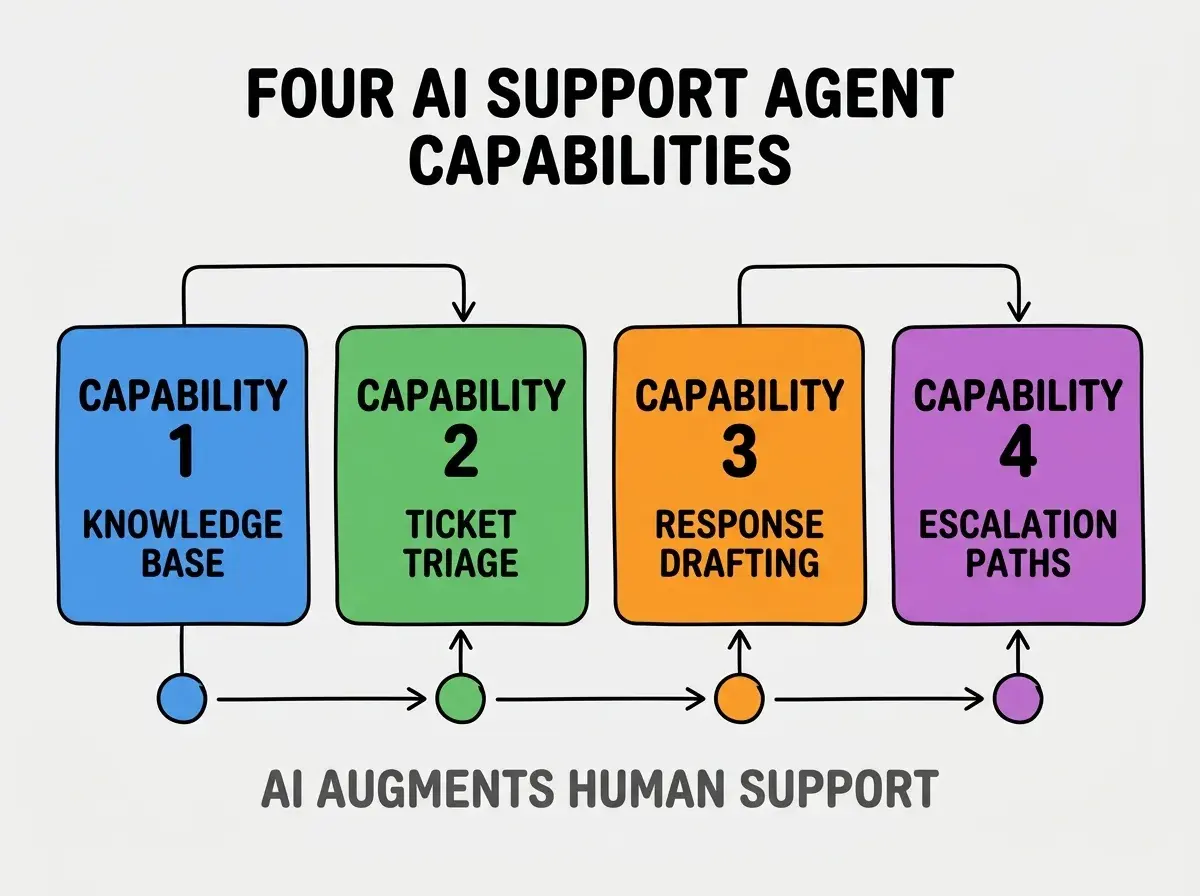
Capability 3, response drafting for human review. Agent drafts responses; humans review before sending for complex cases. Drafting accelerates human responses.
Capability 4, escalation patterns. Cases beyond AI capability route to humans. Without escalation, AI handles cases poorly.
What Makes AI Support Effective
Three patterns characterize effective AI support.
Pattern 1, AI handles common cases well. Common cases benefit from AI consistency and speed. Without focus on common, AI value gets diluted.
Browse more AI features
Read more buildPattern 2, AI defers to humans for ambiguity. Ambiguous cases need human judgment. Without deference, AI produces wrong answers confidently.
Pattern 3, AI learns from human responses over time. Human responses inform AI improvement. Without learning, AI quality plateaus.
The Specific Tooling That Works
Three tool categories combine effectively for AI support.
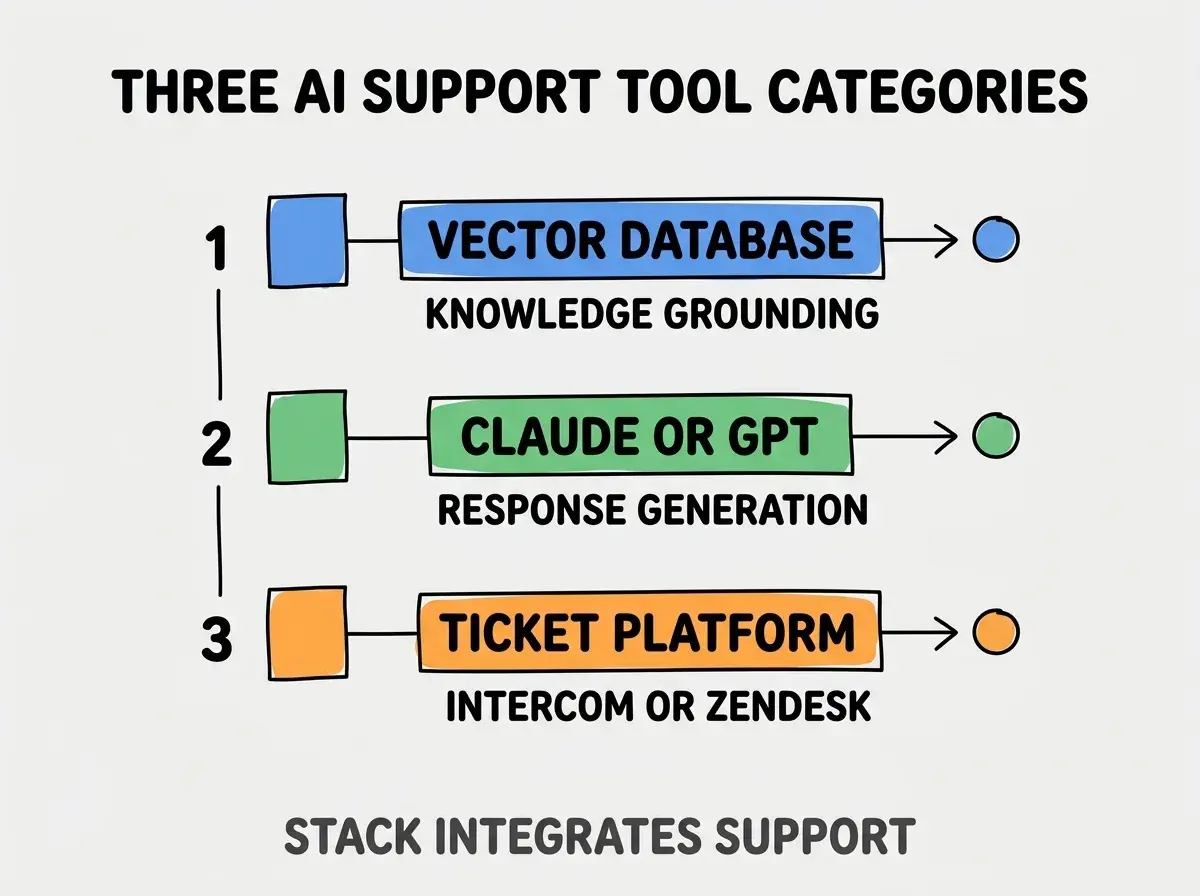
Tool 1, vector database for knowledge grounding. Pinecone, Weaviate, pgvector. Vector database enables semantic knowledge retrieval.
Tool 2, Claude or GPT for response generation. AI generates from retrieved knowledge. Generation quality depends on knowledge quality.
Tool 3, ticket platform for workflow. Intercom, Zendesk, Help Scout. Platform integration handles workflow that AI alone cannot.
What Makes AI Support Sustainable
Three patterns separate sustainable AI support from problematic patterns.
Pattern 1, knowledge base maintained as product evolves. Stale knowledge produces wrong answers; maintenance matters. Without maintenance, AI quality erodes.
Pattern 2, escalation feedback loop improves AI. Escalation patterns inform AI improvement. Without feedback, AI handles same patterns badly repeatedly.
Pattern 3, human review of AI responses for quality. Periodic review catches drift. Without review, AI quality drifts unmonitored.
The combination produces AI support that maintains quality over time. Without these patterns, AI support degrades as product evolves.
How To Configure AI Support For Specific Scenarios
Three scenarios deserve specific approaches.
Scenario A, common questions with documented answers. AI handles directly with high confidence. Direct handling matters for volume.
Scenario B, complex cases requiring product knowledge. AI drafts response; human reviews before sending. Draft assistance accelerates human work.
Scenario C, sensitive cases requiring care. AI flags and escalates immediately. Care matters more than speed.
The combination produces scenario specific configuration. Without specific approaches, generic AI handles scenarios mediocrely.
The most damaging AI customer support mistake is treating AI as replacement for human support rather than augmentation. Replacement framing produces poor outcomes for complex cases that need human judgment. The fix is to position AI as augmentation; AI handles what AI handles well, humans handle what humans handle well, combined they produce capacity that neither alone can match. Companies that augment with AI succeed; companies that replace with AI damage customer relationships.
The other mistake is missing the knowledge base investment. AI quality depends on knowledge quality; without investment, AI generates poor responses. The fix is to invest in knowledge base before AI deployment.
A third mistake is over confidence in AI for ambiguous cases. Ambiguous cases need human judgment; AI confidence misleads.
A fourth mistake is treating AI support as launch and forget. AI support requires ongoing maintenance; without maintenance, quality degrades.
How To Measure AI Support Effectiveness
Three metrics demonstrate AI support value.
Metric 1, deflection rate. Percentage of tickets handled without human intervention. Higher deflection indicates AI capability.
Metric 2, customer satisfaction by channel. AI versus human satisfaction; comparison reveals quality. Difference signals improvement opportunities.
Metric 3, escalation accuracy. Are right cases escalating? False negatives (cases that should escalate but do not) matter most.
The combination produces support effectiveness measurement. Without measurement, AI support value stays anecdotal.
How AI Customer Support Will Likely Evolve
AI customer support will likely continue evolving as AI capabilities mature.
The first likely evolution is multi modal support. AI handling images, screenshots, video. Multi modal handles cases text alone cannot.
The second likely evolution is proactive support. AI identifying issues before customers report them. Proactive prevents support load.
The third likely evolution is voice support integration. AI handling voice calls in addition to text. Voice expands AI support reach.
The combination suggests AI support will become more capable. Builders learning patterns now build skills that remain valuable.
Common Questions About AI Customer Support
AI customer support raises questions worth addressing directly.
The first question is whether to disclose AI to customers. Yes; transparency builds trust. Hidden AI produces frustration when revealed.
The second question is how to handle AI errors. Acknowledge, escalate, learn. Errors handled well preserve trust; errors hidden destroy trust.
The third question is whether AI support works for B2B versus B2C. Both work but require different configuration. B2B often needs more human escalation; B2C often handles more autonomously.
The fourth question is how to handle multilingual support. AI handles common languages well; less common languages may need human handling. Configuration matters per language.
The fifth question is whether AI support reduces support team needs. Augmentation pattern means similar team handles more volume; replacement pattern reduces team but produces worse outcomes.
The sixth question is how AI support handles brand voice consistency. Prompts establish voice; ongoing review maintains it. Voice consistency matters for brand perception.
What This Means For You
AI customer support augments human support to scale capacity. The four capabilities, tool combinations, and metric approaches produce framework for AI support that customers actually appreciate.
- If you're a founder: AI support enables scaling beyond manual support capacity. Plan AI support before support volume exceeds capacity.
- If you're an indie hacker: Solo builders especially need AI support; without it, support consumes time that should go to building.
- If you're a senior dev: AI support implementation requires careful integration. Help product team understand technical considerations.
Browse more AI features
Read more build