Think of autonomous agents for maintenance like a night janitor. The janitor shows up after everyone goes home, empties the trash, mops the floors, fixes the wobbly door handle, and leaves a note on your desk about the ceiling leak they spotted but could not repair themselves. You walk in the next morning to a cleaner building and a short list of things that still need your attention. That is exactly how autonomous AI agents should work for your codebase, and with 92% of developers now using AI tools daily, the question is no longer whether to automate maintenance but which tasks to hand off first.
Software maintenance is the work nobody wants to do but everyone suffers when it gets neglected. Dependency updates pile up. Security advisories go unpatched for weeks. Dead code accumulates like dust bunnies under the couch. Documentation drifts further from reality with every sprint. These are the tasks that autonomous agents handle remarkably well, precisely because they are repetitive, well-defined, and low-ambiguity.
Why Maintenance Is the Perfect Use Case for Autonomous Agents
Most conversations about AI agents focus on building new features. That is the flashy stuff. But maintenance is where agents deliver the highest return on trust because the success criteria are clear and the blast radius is small.
When an agent updates a dependency from version 3.2.1 to 3.2.4, the test suite either passes or it does not. When it removes an unused import, the linter either stays green or it does not. Compare that to asking an agent to design a new authentication flow, where "correct" depends on business requirements, user experience preferences, and architectural decisions that require human judgment. Maintenance tasks have a binary outcome, and that binary outcome is what makes them safe for unsupervised automation.
The night janitor analogy holds here. You would trust your janitor to replace a light bulb without asking permission first. You would not trust them to redesign the office layout. Knowing the difference between those two categories is the entire game.
Autonomous agents work best when success is binary and verifiable. Maintenance tasks like dependency updates, dead code removal, and documentation syncing have clear pass/fail criteria, which makes them ideal candidates for unsupervised automation. Start with these before attempting anything that requires subjective judgment.
Dependency Updates and Security Patching
This is the janitor emptying the trash cans. It needs to happen regularly, nobody wants to do it manually, and the consequences of skipping it compound over time.
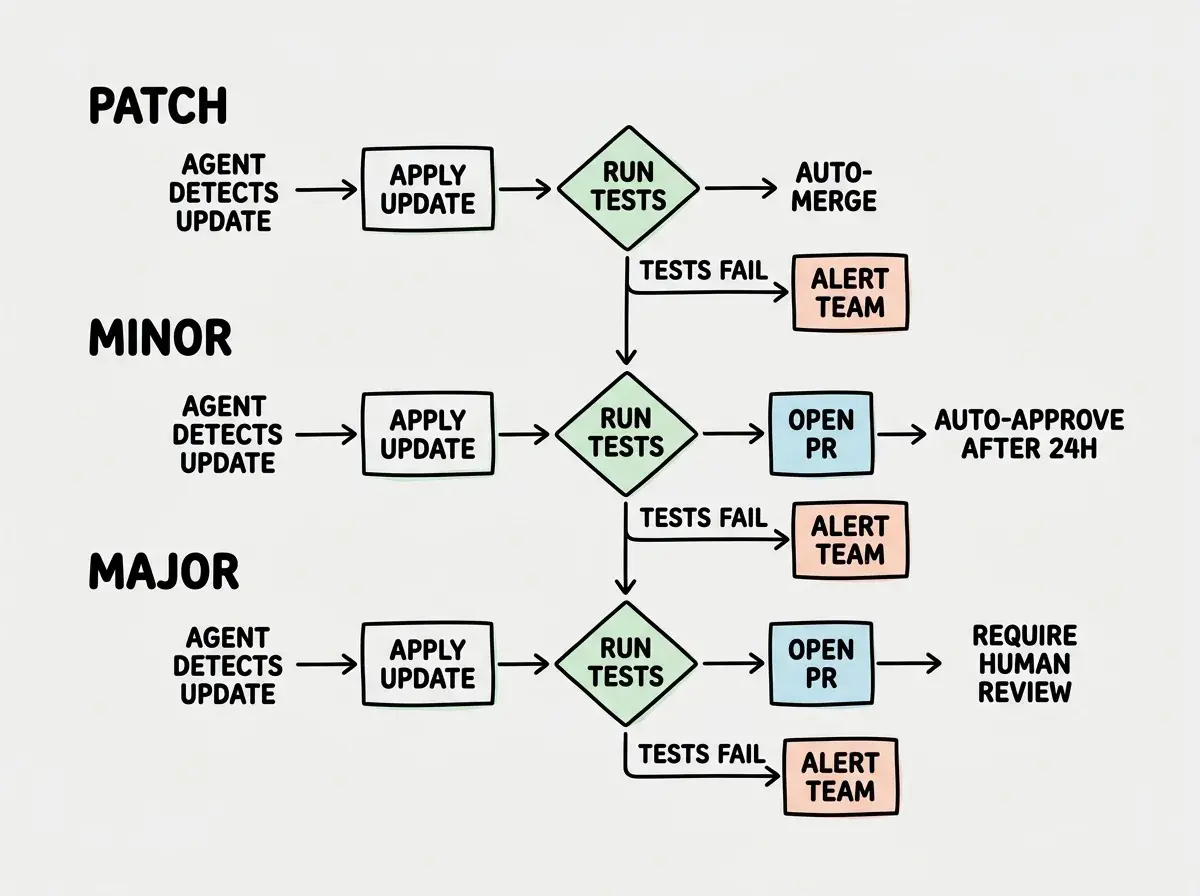
Set up an agent workflow that runs nightly or weekly. The agent checks for outdated dependencies, attempts the update, runs the full test suite, and opens a pull request with a summary of what changed and whether tests passed. Tools like Dependabot already do a simpler version of this, but autonomous agents can go further. They can read the changelog of the updated package, assess whether breaking changes affect your specific usage patterns, and even attempt migration steps before asking for human review.
Security patching follows the same flow but with higher urgency. Configure your agent to treat security advisories differently from routine updates. When a CVE drops for a package you depend on, the agent should immediately create a branch, apply the patch, run tests, and notify your team through whatever channel you use for urgent issues. The janitor does not wait until their next shift to deal with a broken window. Same principle.
Here is the practical setup. Point your agent at your package.json or requirements.txt, give it access to your CI pipeline, and define the rules. Patch-level updates with passing tests can be auto-merged. Minor version bumps get a PR with auto-approval after 24 hours if tests are green. Major version bumps always require human review. That tiered approach matches the risk profile of each update type.
Dead Code Removal and Codebase Cleanup
This is the janitor mopping the floors. Dead code does not actively break anything, but it makes everything harder to navigate, slower to understand, and more confusing for new team members. It is the dust that settles everywhere when nobody is paying attention.
An autonomous agent can scan your codebase for unused exports, unreachable functions, orphaned components, and abandoned feature flags. It can cross-reference import trees, check test coverage data for functions that are never called, and identify files that no other file imports. The agent creates a cleanup PR with each removal isolated into its own commit, so you can cherry-pick if something turns out to still be needed through a path the agent did not detect.
The guardrail here is important. Dead code detection has false positives, especially in codebases with dynamic imports, reflection, or runtime plugin systems. Configure your agent to flag but not auto-merge dead code removals. Let it do the tedious work of finding candidates, but keep a human in the loop for the final call. The janitor leaves a sticky note saying "this closet looks unused" rather than throwing everything inside it into the dumpster.
Documentation Updates and Test Maintenance
Documentation rot is the silent killer of developer productivity. The README says one thing, the code does another, and the onboarding doc references an API endpoint that was renamed six months ago. Autonomous agents can detect this drift by comparing documentation against the actual codebase.
Set up a weekly agent run that scans your docs for references to function names, API endpoints, configuration keys, and file paths. When the agent finds a reference that no longer matches reality, it opens a PR with the corrected information. It can also identify documentation gaps by finding public functions or API routes that have no corresponding documentation entry at all.
Test maintenance follows a similar pattern. Tests break for two reasons. Either the code they test changed, or the test itself became flawed. An agent can identify flaky tests by analyzing CI history for tests that sometimes pass and sometimes fail without code changes. It can flag tests with hardcoded dates that will expire, tests that depend on external services without mocking, and tests that duplicate coverage with other tests. This is the janitor spotting the flickering light and leaving a note that the fixture needs replacing.
Letting agents auto-merge documentation changes without review sounds harmless, but it creates a trust problem. If an agent incorrectly updates docs and nobody catches it, you end up with confidently wrong documentation that is worse than no documentation. Always review doc PRs from agents, even if you review them quickly. A two-minute scan beats silent misinformation every time.
Log Analysis and Anomaly Detection
This is the janitor noticing that the hallway smells like gas and calling someone immediately. Autonomous agents can continuously monitor your application logs, error tracking systems, and performance metrics to surface patterns that humans miss because the volume is too high for manual review.
Configure an agent to run daily log analysis. It should look for error rate spikes, new error types that appeared since the last deploy, slow query patterns that are getting progressively worse, and deprecation warnings from your runtime or framework. The agent does not need to fix these issues. It just needs to surface them in a digestible format, like a morning briefing that tells you "here are three things worth looking at today."
The value here is not in the agent being smarter than your monitoring tools. It is in the agent being persistent. Humans check dashboards when something feels wrong. Agents check every single day regardless of how the team is feeling. They never get busy with a feature sprint and forget to look at error rates for two weeks.
See how autonomous agents fit into the bigger picture of modern software development.
Explore more articlesWhen to Let Agents Run Unsupervised vs With Guardrails
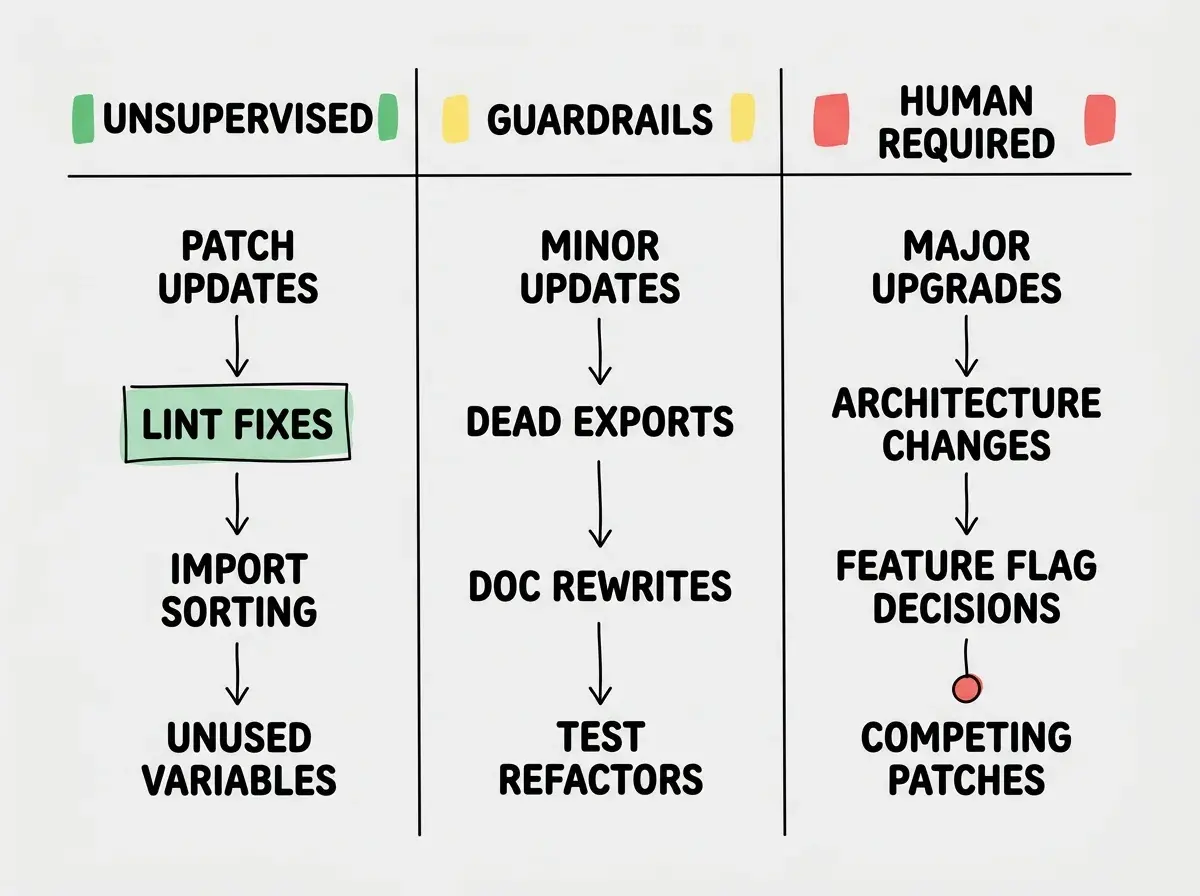
Not every maintenance task deserves the same level of trust. The decision framework is straightforward. Ask two questions about each task. Is the outcome verifiable by automated tests? And what is the blast radius if the agent gets it wrong?
Safe for unsupervised runs. Patch-level dependency updates with passing tests. Linting fixes. Import sorting. Removing obviously dead code like unused local variables. Updating version numbers in lock files. These are light bulb replacements. The janitor handles them without a work order.
Needs guardrails and human review. Minor dependency bumps. Dead code removal for exported functions. Documentation rewrites. Test refactoring. Security patch application when the patch changes API behavior. These are the wobbly door handles. The janitor can fix them, but someone should check the work.
Requires human decision-making. Major version upgrades. Architectural changes to reduce tech debt. Choosing between competing security patches. Removing feature flags for features where the product decision is unclear. These are the ceiling leaks. The janitor writes a note and leaves it on your desk. Do not automate the judgment call.
Setting Up Your First Maintenance Agent
Start small. Pick one task from the unsupervised category and set it up this week. A nightly agent that checks for patch-level dependency updates, runs your test suite, and auto-merges if everything passes is the easiest win. You will wake up to a cleaner package.json and the quiet satisfaction of knowing the janitor did their rounds.
From there, expand gradually. Add dead code scanning as a weekly PR. Add documentation drift detection as a biweekly check. Add log analysis as a daily briefing. Each new task builds your trust in the system and teaches you where the boundaries are for your specific codebase.
The tools that work well for this right now include Claude Code with scheduled tasks, GitHub Actions with AI-powered steps, and dedicated platforms like Sweep or Devin configured specifically for maintenance workflows. The specific tool matters less than the principle. Give the agent a narrow, well-defined task with a clear verification method and a sensible escalation path for anything it cannot handle confidently.
The best maintenance is the kind you never have to think about. Your night janitor should be busy while you sleep, and your desk should have nothing but a short note when you arrive in the morning.
Learn how senior developers are integrating AI agents into their daily toolkit.
Browse all articles