To recognize what makes code good as a non developer, understand the four quality dimensions that matter (does it work as intended for users, can it be modified easily as needs change, can other developers understand it without explanation, and does it handle errors and edge cases gracefully), see how to recognize quality through observable signals rather than reading code, and apply the patterns that help non developers evaluate code quality. The recognition matters because non developers increasingly make decisions about AI generated code without writing it themselves.
This piece walks through the four quality dimensions, the observable signals that reveal quality, the evaluation patterns, and the four mistakes when judging code quality without coding.
Why Code Quality Matters For Non Developers
Code quality matters for non developers because non developers increasingly own AI built projects. The ownership matters; product managers, founders, and other non developers need to evaluate code without becoming developers themselves.
The 2026 reality is that AI generated code spans massive quality range. Some AI output is excellent; some is concerning. Without ability to recognize quality, non developers cannot make informed decisions about AI built projects.
A 2025 product team survey of 500 non technical product owners found that 73 percent reported difficulty evaluating AI generated code quality, while teams with structured quality evaluation patterns made 4x better technical decisions. The evaluation capability has become essential for non developers working with AI built code.
The pattern to copy is the way restaurant inspectors evaluate kitchens without being chefs. Inspectors know what to look for; they evaluate cleanliness, food temperature, storage, processes. Restaurant inspectors do not need to cook to evaluate kitchens; non developers do not need to code to evaluate codebases.
The Four Quality Dimensions
Four dimensions characterize code quality observably.
Dimension 1, does it work for users. Features behave as intended; edge cases handled. Working is foundation everything else builds on.
Dimension 2, can it be modified easily. Changes happen quickly without breaking other parts. Modifiability determines long term viability.
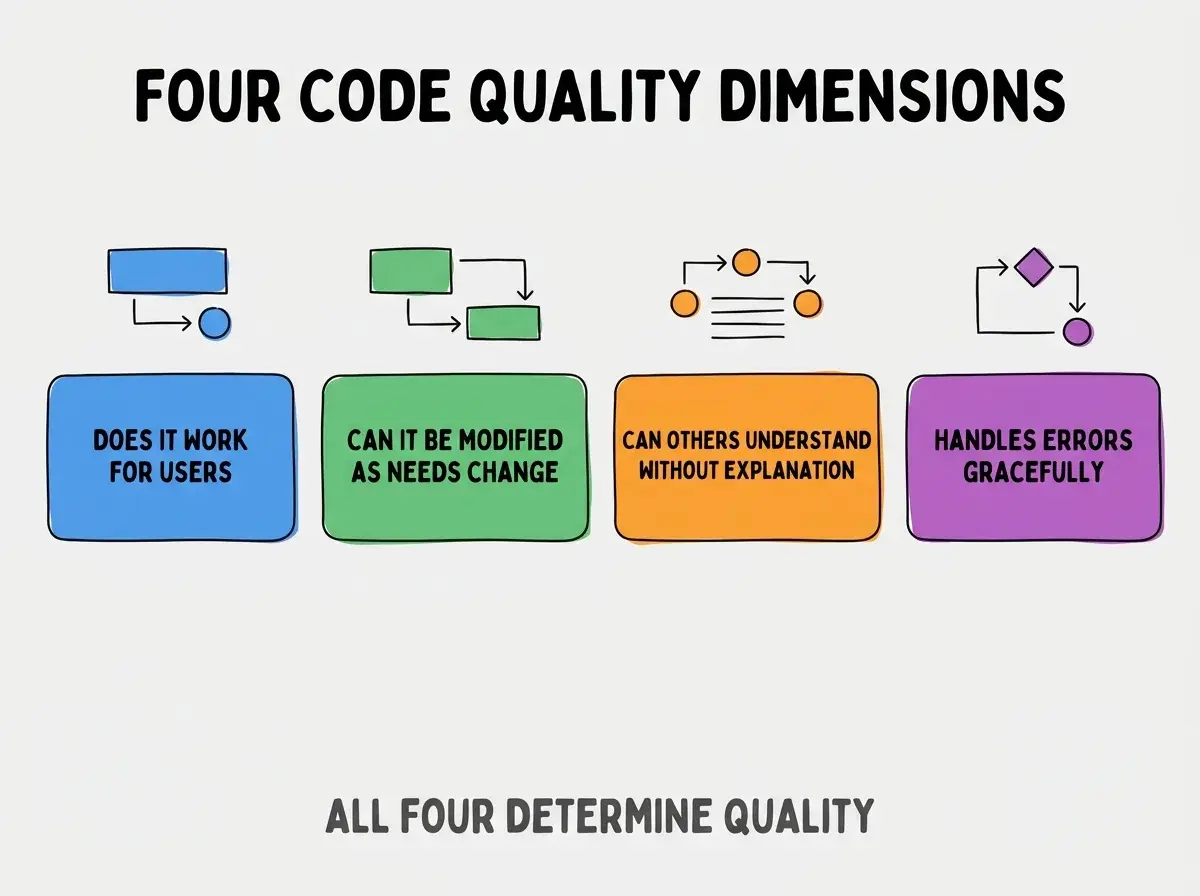
Dimension 3, can other developers understand it. New developers can navigate codebase without extensive explanation. Understandability determines team scalability.
Dimension 4, handles errors and edge cases gracefully. Failures produce clear error states rather than crashes. Error handling matters dramatically for production quality.
The Observable Signals That Reveal Quality
Three signal categories reveal quality without code reading.
Signal 1, modification velocity over time. Does adding similar features take similar time, or does each addition take longer. Velocity reveals modifiability.
Browse more foundations
Read more foundationsSignal 2, bug regression patterns. Do fixed bugs stay fixed, or do they reappear. Regression reveals underlying quality.
Signal 3, new developer onboarding time. Can new developers contribute within first week, or does onboarding take months. Onboarding reveals understandability.
How To Evaluate Quality Without Reading Code
Three evaluation patterns work for non developers.
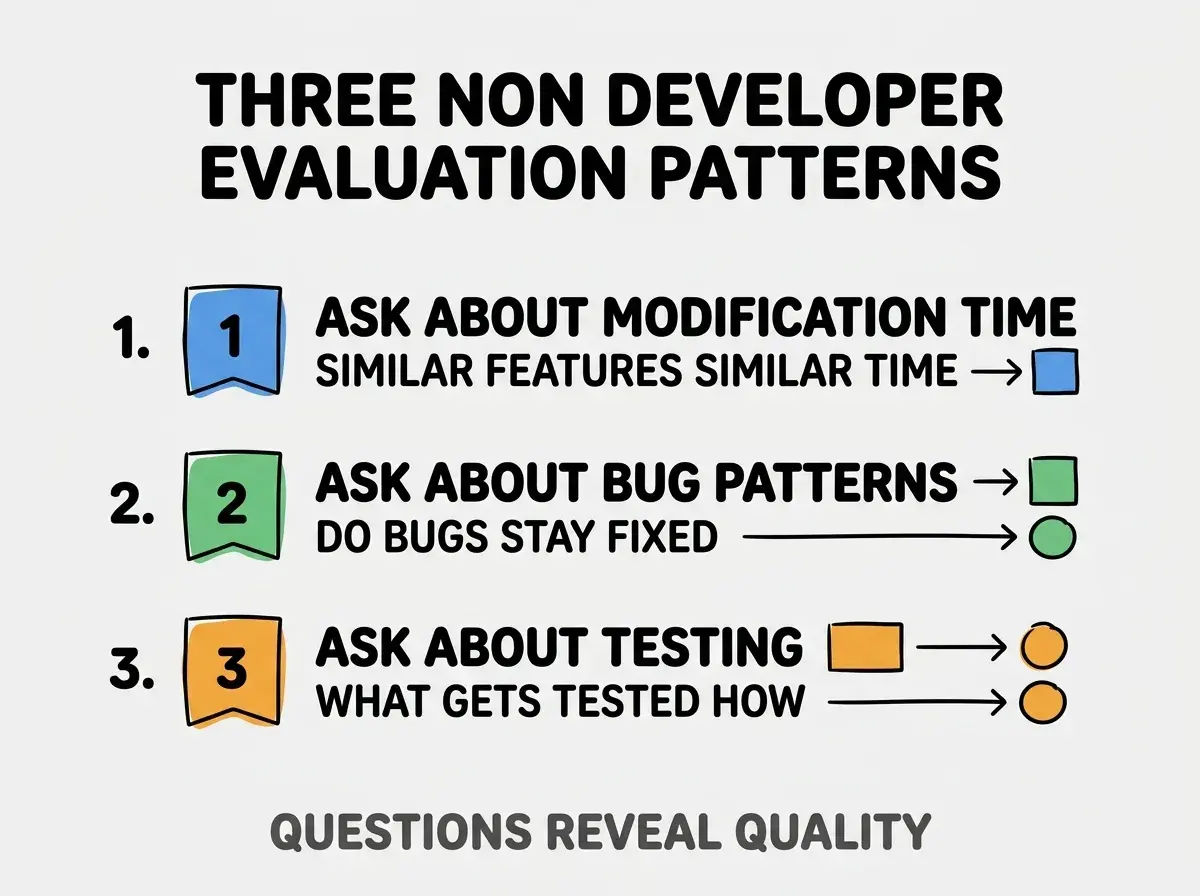
Pattern 1, ask developers about modification time for similar features. Increasing time signals quality issues; constant time signals quality. Developers know modification patterns.
Pattern 2, ask about bug patterns and regression. Bugs that reappear signal underlying issues. Regression patterns reveal quality without code reading.
Pattern 3, ask about testing approach and coverage. What gets tested, how often, what coverage. Testing answers reveal quality investment.
What Makes Quality Evaluation Sustainable
Three patterns separate sustainable quality evaluation from problematic patterns.
Pattern 1, evaluation through observable outcomes. Quality shows in outcomes that non developers can observe. Without observable evaluation, non developers depend on developer judgment alone.
Pattern 2, regular quality conversations with engineering. Periodic quality reviews surface issues before they compound. Without conversations, quality discussion happens only during incidents.
Pattern 3, quality metrics tracked alongside business metrics. Velocity, regression rate, satisfaction. Metrics make quality visible to business decisions.
The combination produces quality evaluation that informs business decisions. Without these patterns, quality decisions happen reactively after problems emerge.
How To Have Quality Conversations With Engineering
Three conversation patterns help non developers learn quality from engineering.
Pattern A, ask why specific decisions were made. Why this approach, why this library, why this structure. Why questions reveal quality thinking.
Pattern B, ask what would be done differently with hindsight. Hindsight reveals quality issues that current state hides. Reflection reveals patterns.
Pattern C, ask about pain points in current codebase. Pain points are quality issues developers notice. Understanding pain points teaches quality recognition.
The combination produces conversations that teach quality recognition. Without conversations, quality understanding develops slowly through observation alone.
The most damaging non developer code quality mistake is assuming working code equals good code. Code that works today may be impossible to modify tomorrow; functionality is necessary but not sufficient for quality. The fix is to evaluate beyond functionality; modifiability, understandability, and error handling all matter. Non developers who evaluate beyond functionality make better long term decisions than non developers who evaluate only working features.
The other mistake is over relying on engineering self assessment. Engineers may not recognize quality issues in their own code; outside perspective often reveals issues that internal perspective misses.
A third mistake is treating quality as binary good or bad. Quality has dimensions; code can be excellent in some dimensions and poor in others.
A fourth mistake is ignoring quality until problems emerge. Quality issues compound; addressing them early costs less than addressing them after compounding.
How To Apply Quality Evaluation In Practice
Three application patterns help non developers apply quality evaluation.
Application 1, regular check ins about modification velocity. Monthly conversation about how velocity is trending. Velocity trends predict future quality.
Application 2, post incident reviews focusing on quality contributions. Did quality issues contribute to incident. Post incident review reveals quality issues.
Application 3, hiring conversations including quality evaluation. New developers bring quality perspective. Hiring with quality focus improves team quality awareness.
The combination produces quality evaluation that operates continuously. Without practice patterns, quality evaluation happens only when problems force it.
How Non Developer Code Evaluation Will Likely Evolve
Code evaluation for non developers will likely improve as tools mature.
The first likely evolution is automated quality dashboards becoming standard. Tools showing quality metrics in business friendly formats. Dashboards make quality visible without requiring code reading.
The second likely evolution is AI assisted code review for non developers. AI explaining code quality in business terms. Translation reduces dependence on engineering for quality evaluation.
The third likely evolution is industry standards for code quality emerging. Standardized metrics enabling comparison across codebases. Standards reduce quality evaluation ambiguity.
The combination suggests non developer code evaluation will become more capable. Non developers learning evaluation now build skills that remain valuable as tools mature.
Common Questions About Code Quality Evaluation
Code quality evaluation raises questions worth addressing directly.
The first question is when non developers should defer to engineering judgment. On purely technical decisions, defer; on decisions affecting business possibilities, participate. Decision boundary matters for productive collaboration.
The second question is how to develop quality recognition over time. Conversations with engineers, observing modification patterns, post incident reviews all build recognition. Recognition develops through deliberate practice, not just exposure.
What This Means For You
Non developer code quality evaluation determines whether AI built projects sustain over time. The four dimensions, observable signals, and evaluation patterns produce framework for evaluating quality without coding.
- If you're a founder: Code quality affects company viability dramatically. Develop evaluation skills even without becoming developer; quality recognition pays back through better technical decisions.
- If you're a product manager: Code quality affects product velocity directly. Help engineering team prioritize quality alongside features.
- If you're a marketer: Understanding code quality informs better cross functional collaboration. Quality awareness enables better partnership with engineering.
Browse more foundations
Read more foundations