Think of vibe coding like learning to drive. For decades, driving meant understanding the clutch, the gear ratios, the physics of braking on wet roads. Then automatic transmission arrived, and suddenly millions of people who never cared about torque converters could get from point A to point B. The stick-shift purists insisted it was not "real driving." The rest of the world got where they needed to go.
Andrej Karpathy's tweet about vibe coding landed the same way. On February 2, 2025, one of the most respected AI researchers alive described a new way of building software, and 4.5 million people stopped to read it. What he described was not a new tool or framework. It was a fundamental shift in the relationship between humans and code, and the debate it sparked is still shaping how we build software today.
What Is Vibe Coding According to Andrej Karpathy
Karpathy's original description was disarmingly casual. He talked about working with Cursor Composer, using SuperWhisper to dictate instructions by voice, and accepting every suggestion the AI offered without scrutinizing it line by line. His exact words capture the spirit perfectly: "I just see stuff, say stuff, run stuff, and copy paste stuff, and it mostly works."
That phrase, "it mostly works," is the key to understanding vibe coding. Traditional software development is built around precision. You write code, you understand every line, you test edge cases, you refactor for clarity. Vibe coding replaces that precision with iteration. You describe what you want, the AI generates it, you run it, and if something breaks, you describe the problem and let the AI fix it. The human shifts from author to director.
This is not Karpathy being lazy. This is a former Tesla AI director and founding member of OpenAI observing that the bottleneck is no longer typing syntax. The bottleneck is knowing what to build and evaluating whether the output is right.
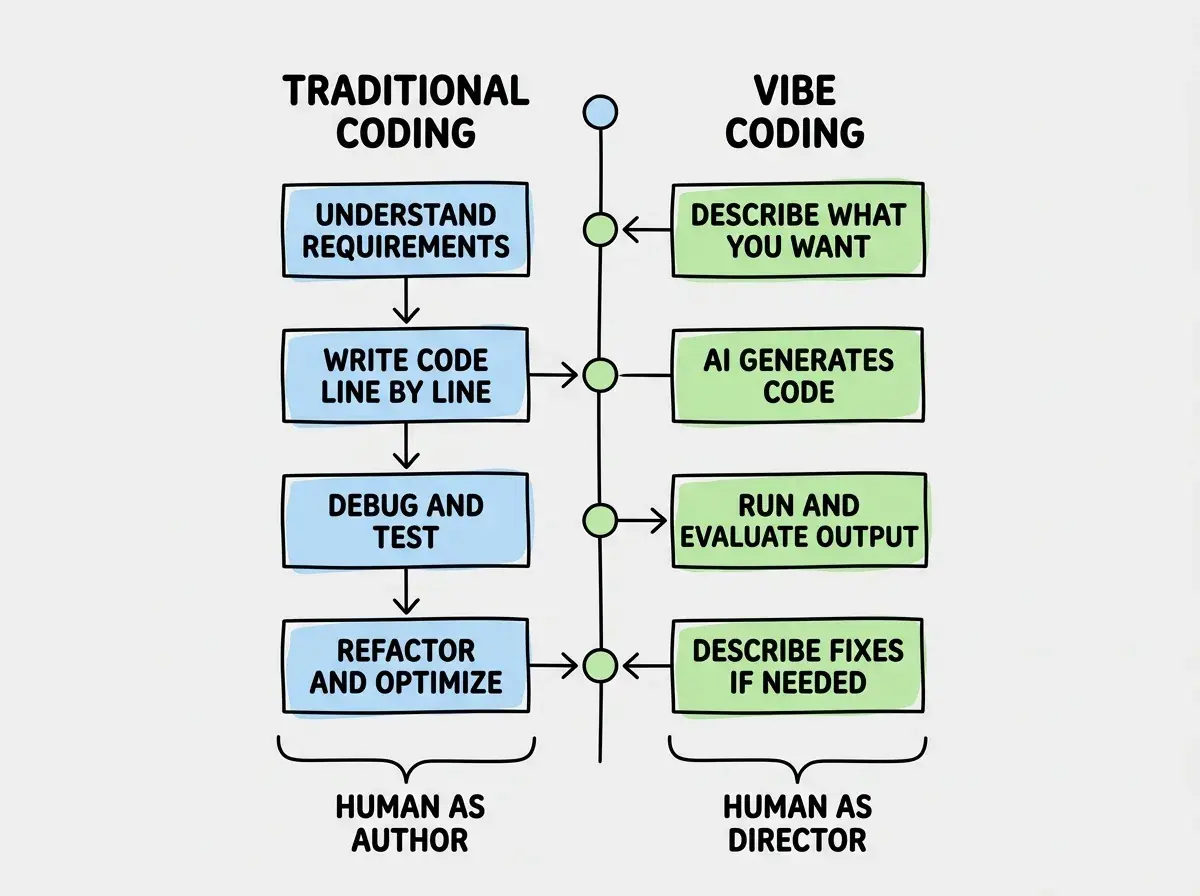
The automatic transmission analogy holds. You still need to know where you are going and recognize when something is wrong. But the mechanical skill of translating intention into syntax is increasingly handled by the machine.
When Did Andrej Karpathy Coin Vibe Coding
The term appeared in a tweet on February 2, 2025. Within weeks, it had been picked up by every major tech publication. By the end of 2025, Collins Dictionary named "vibe coding" their Word of the Year, cementing it as more than a passing meme. The speed of adoption tells you something important about how many people were already doing this but did not have a name for it.
Karpathy did not invent the practice. Millions of people were already using ChatGPT, Cursor, and other AI tools to generate code without deeply understanding every line. What he did was give the practice a name and, most importantly, permission. When someone with Karpathy's credentials says "I do not read the diffs anymore, I just accept," it gives everyone else license to admit they are doing the same thing.
The timing mattered too. By early 2025, models like Claude Sonnet and GPT-4o had reached a capability threshold where vibe coding worked for real projects, not just toy examples. Karpathy's tweet landed at the exact moment the tools caught up to the workflow.
Karpathy did not invent vibe coding. He named something millions of people were already doing but felt slightly guilty about. The term gave the practice legitimacy and forced a real conversation about what "coding" means when AI handles the syntax. The name matters because it created a shared vocabulary for a shift that was already underway.
Is Vibe Coding Actually Coding
This question generates the most heat and the least light. The data clarifies things better than opinions. 92% of US developers now use AI coding tools daily. 46% of all new code committed to repositories is AI-generated. If vibe coding is not "real coding," then nearly half of professional software development is not real either.
The more useful question is what skills matter. You still need architecture sense, because the AI will happily build a fragile system. You still need to evaluate output quality, because "it mostly works" leaves room for security holes and performance problems. You still need domain knowledge, because the AI does not know your users.
What you increasingly do not need is the ability to write syntax from memory. That is the part traditional developers have spent years mastering, which is why the question feels so personal. Nobody argues that Uber drivers in automatic cars are not "real drivers." They navigate traffic, make judgment calls, handle emergencies. They just do not use a clutch.
The Market Reality Behind the Movement
The AI coding tools market hit $4.7 billion in 2025 and is projected to reach $12.3 billion by 2027. Enterprise budgets are moving toward AI-assisted development at a pace that suggests permanent adoption, not a fad.
But here is the complication. Developer trust in AI-generated code dropped from 77% in 2023 to 33% in 2025. More people are using AI coding tools than ever, and fewer people trust the output. That paradox makes sense. In 2023, developers tried AI on simple tasks and were impressed. By 2025, they had used it on production systems and discovered the gaps.
Treating the trust decline as evidence that vibe coding does not work misses the nuance. Trust dropped because developers learned where AI code fails, which is exactly the kind of calibration you want. Early over-trust was dangerous. Current skepticism paired with continued adoption means developers are learning to use AI code selectively, trusting it for routine tasks and scrutinizing it for critical paths. That is maturity, not rejection.
AI coding tools are in their early-automatic phase. Good enough for most tasks, clearly inferior for some, and improving rapidly.
What Karpathy Got Right and What He Left Out
Karpathy nailed the core insight. The relationship between programmer and code is changing, and the tools are good enough that the old workflow is no longer the only workflow.
What he underplayed is the skill ceiling. Karpathy can vibe code effectively because he has deep technical knowledge to fall back on. When the AI generates something subtly wrong, he recognizes it. His vibe coding is informed by decades of expertise, which makes it look more effortless than it is for someone without that foundation.
For beginners, vibe coding is a genuine superpower with real guardrails needed. You can build things that were previously impossible, but you can also build things that look right and fail under load or attack.
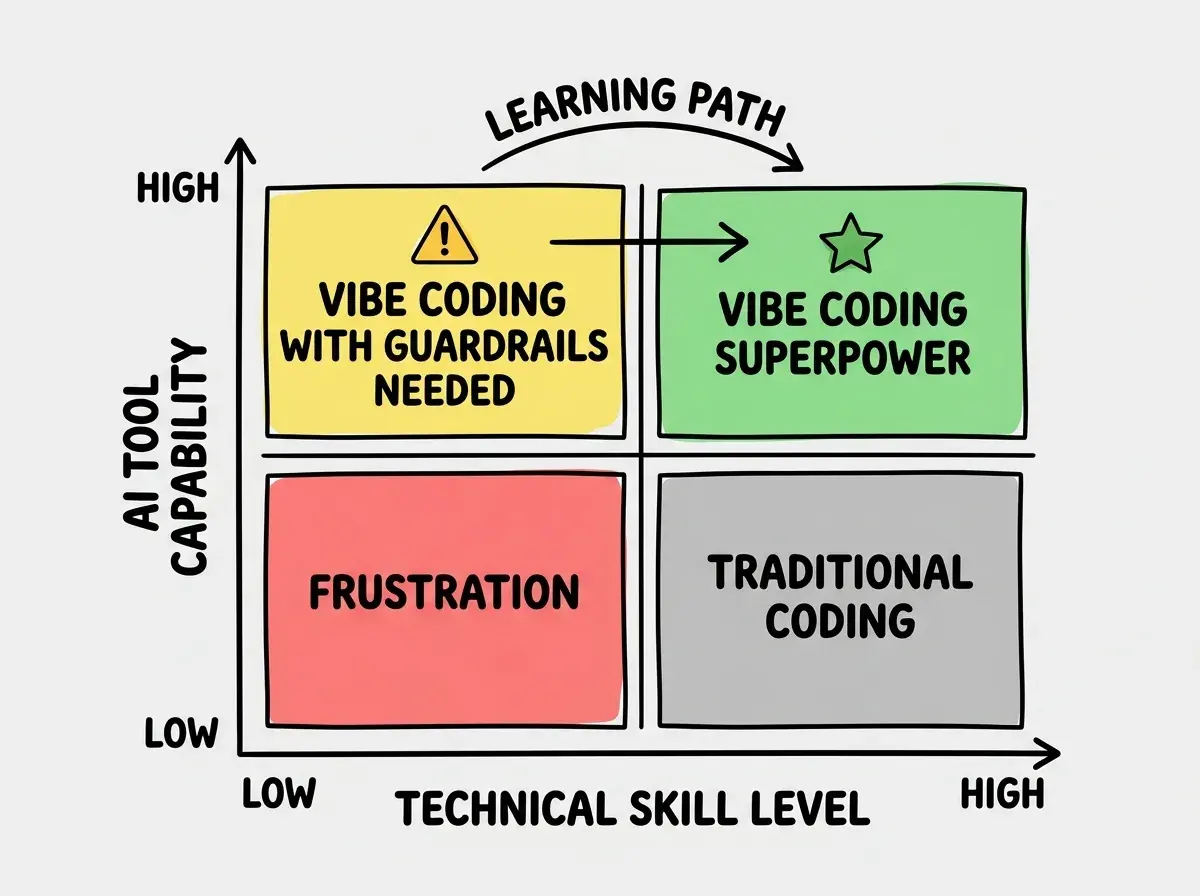
The question is not whether vibe coding will become mainstream. It already is. The question is how the ecosystem adapts to make it safer and more accessible to the millions of people who want to build software but never planned to learn traditional programming.
Where This Goes From Here
The automatic transmission did not kill driving skill. It changed which skills mattered. Parallel parking still requires spatial awareness. Highway merging still requires judgment. The mechanical skill of clutch control just stopped being a prerequisite.
Vibe coding is doing the same thing to software development. Architecture still matters. Security still matters. User experience still matters. Testing still matters. The mechanical skill of writing syntactically correct code in a specific language is just becoming less of a prerequisite.
For developers, your value increasingly comes from what you know about systems, not what you can type. For founders, the barrier to building a first version has never been lower, but the barrier to building a good version has not changed. For students, learning to code now includes learning to direct AI effectively.
Karpathy's tweet was not a manifesto. It was an observation. But the best observations give people language for what they already feel, and "vibe coding" did exactly that.
Start building with AI tools and learn the skills that matter most in 2026.
Explore the guidesThese questions reflect the core tension in vibe coding today. The practice is real, growing, and here to stay. Your job is to use it wisely.
Practical guides for every skill level, from first project to production deployment.
Browse all guides