Algolia vs Meilisearch vs Typesense is the search engine decision that determines how fast your users find what they need, how much you pay per query, and whether you control the infrastructure or hand it to a vendor. With 92% of developers using AI tools daily, your search integration code gets generated in seconds. But the platform choice behind that code has long-term consequences that no AI prompt can fix after the fact.
Think of these three as GPS systems for navigating your data. Algolia is the premium GPS with traffic prediction, live rerouting, and a subscription fee that reflects the polish. Meilisearch is the open-source GPS you install and run on your own phone, with full control over every setting. Typesense is the speed-optimized GPS that calculates the fastest route before the other two finish loading their splash screens.
Quick Verdict
| Algolia | Meilisearch | Typesense | |
|---|---|---|---|
| Best for | Large-scale apps needing enterprise reliability | Self-hosted search with zero licensing cost | Speed-critical apps with tight budgets |
| Price | Free to 10K requests/mo, then pay-per-use | Free forever (self-hosted), cloud from $30/mo | Free forever (self-hosted), cloud from $0.415/hr |
| Strength | Search quality, AI features, analytics | Developer experience, easy setup, full control | Raw query speed, memory efficiency |
| Weakness | Expensive at scale, vendor lock-in | Smaller ecosystem, fewer enterprise features | Smaller community, fewer integrations |
The quick summary hides the nuance. Each of these search engines was built for a different philosophy of how search should work. Algolia assumes you want a managed service that handles everything. Meilisearch assumes you want ownership. Typesense assumes you want speed above all else.
Self-hosted does not mean free. Meilisearch and Typesense eliminate licensing costs, but you still pay for servers, monitoring, backups, and the engineering hours to maintain them. For a solo developer or small team, a $200/mo VPS running Meilisearch can outperform Algolia at a fraction of the cost. For a team without DevOps capacity, Algolia's managed service saves more than it costs. The right answer depends on what kind of time you have, not just what kind of budget.
How Algolia Works
Algolia is a fully managed search-as-a-service platform. You push your data to Algolia's servers, configure ranking rules through a dashboard, and query their API from your frontend. The infrastructure, indexing, replication, and CDN distribution all happen behind the scenes. Your GPS subscription covers the satellites, the maps, and the traffic data.
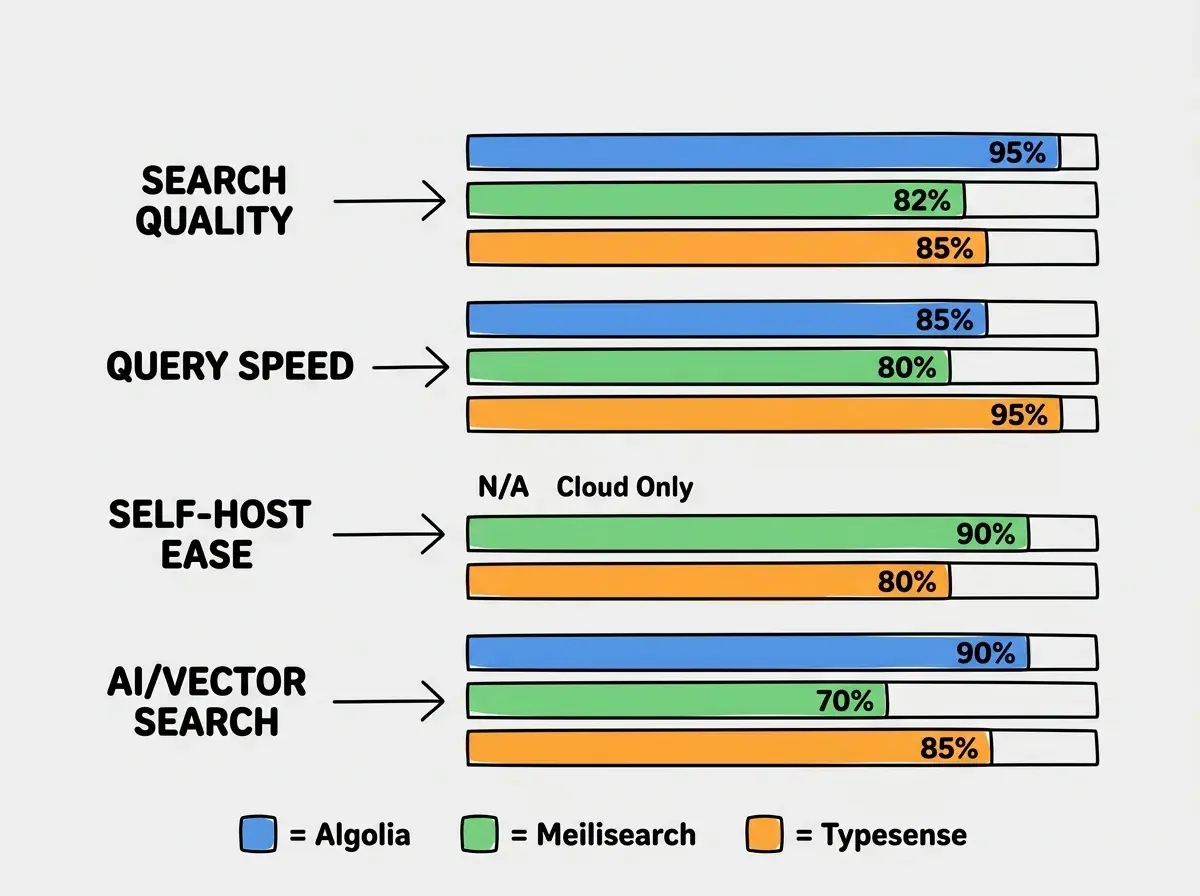
Search quality is Algolia's strongest selling point. Their ranking algorithm handles typo tolerance, synonym matching, geo-search, and custom business rules out of the box. The results feel Google-quality because Algolia has spent over a decade fine-tuning relevance. For e-commerce sites where search directly drives revenue, that quality difference is measurable in conversion rates.
AI search is where Algolia is investing heavily. Their NeuralSearch feature combines keyword matching with vector-based semantic search. Ask for "comfortable work shoes" and Algolia returns results tagged as "ergonomic office footwear" even though no keywords overlap.
The pricing model favors low-volume, high-value use cases. The free tier gives you 10,000 search requests per month, with paid tiers starting around $1 per 1,000 requests. An app making 1 million searches per month can run $500-1,500/mo. For a SaaS charging $50/mo per user, that is fine. For a content site with heavy search traffic, it gets painful fast.
How Meilisearch Works
Meilisearch is an open-source search engine written in Rust. You download the binary, start it on your server, push documents via a REST API, and search against it. There is no vendor, no dashboard you need to sign into, and no meter running on your queries. Your GPS app runs locally, and you control every route calculation.
The developer experience is remarkably polished for an open-source tool. Indexing a collection of documents takes one API call. Search returns results in under 50ms for most datasets under 10 million documents. The default relevance is good enough without any tuning, and SDKs exist for every major language.
Self-hosting gives you predictable costs. A $20/mo VPS handles millions of documents for most use cases. Scaling means adding more RAM, not negotiating with a sales team. Running Meilisearch for 100,000 users often costs under $100/mo, compared to potentially thousands with Algolia.
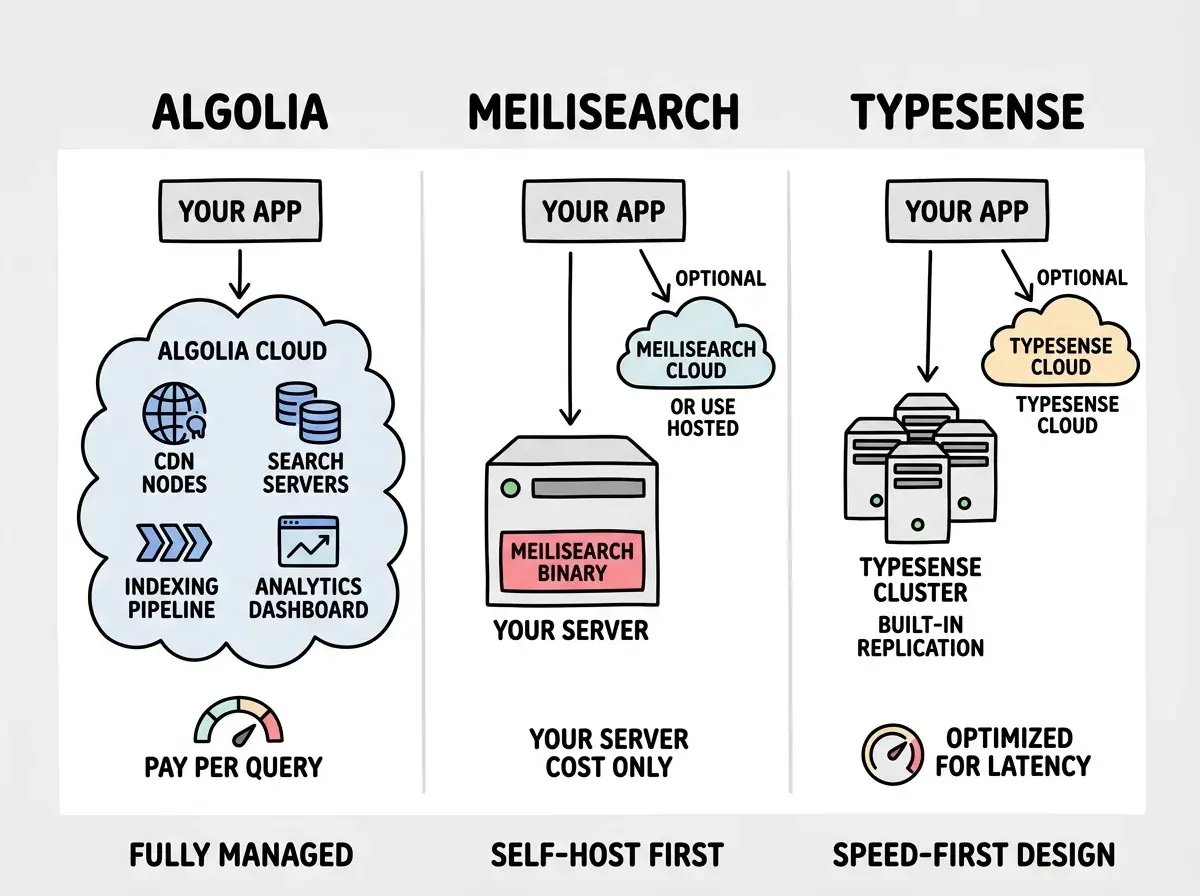
The tradeoff is operational responsibility. You handle backups, monitoring, updates, and scaling. If your search index goes down at 3 AM, there is no support team to call on the free tier. Meilisearch Cloud exists as a hosted alternative starting at $30/mo, but it has fewer features and less maturity than Algolia's managed offering.
How Typesense Works
Typesense is an open-source search engine built specifically for speed. Also written in C++, it stores the entire search index in memory for sub-millisecond query times. Where Meilisearch focuses on developer experience and Algolia focuses on search quality, Typesense focuses on raw performance. Your GPS calculates the route before you finish typing the destination.
Memory-first architecture has real advantages. Typesense consistently benchmarks faster than both Algolia and Meilisearch for raw query latency. For applications where every millisecond of search delay costs engagement (autocomplete, real-time filtering, instant search on mobile), Typesense's architecture delivers measurably better performance.
Built-in high availability sets it apart from Meilisearch. Typesense supports multi-node clustering natively. Run a three-node cluster where any node serves queries and data replicates automatically. Meilisearch requires more manual setup for replication.
Vector search is production-ready. Typesense supports storing embeddings alongside documents and combining vector similarity with keyword filtering in a single query. This hybrid approach rivals Algolia's NeuralSearch without the managed service cost.
The community is smaller but growing. Typesense has fewer tutorials, fewer Stack Overflow answers, and fewer integrations than Algolia or Meilisearch. AI tools are more likely to generate Algolia or Meilisearch examples, so Typesense integrations sometimes require more manual adjustment.
Pricing at Scale
The cost picture changes dramatically as your application grows. Here is what each solution looks like at different scales.
| Scale | Algolia | Meilisearch (self-hosted) | Typesense (self-hosted) |
|---|---|---|---|
| 10K searches/mo | $0 (free tier) | $20/mo (VPS) | $20/mo (VPS) |
| 100K searches/mo | ~$100/mo | $20/mo (VPS) | $20/mo (VPS) |
| 1M searches/mo | $500-1,500/mo | $50-100/mo (larger VPS) | $50-100/mo (larger VPS) |
| 10M searches/mo | $3,000-8,000/mo | $200-400/mo (dedicated) | $200-400/mo (dedicated) |
The self-hosted options flatten the cost curve. Once your VPS can handle the load, additional queries cost nothing. Algolia's costs scale linearly with usage, which means your search bill grows with your success.
Choosing Algolia for a side project because it has the best free tier, then discovering you are locked into their API patterns when you need to migrate. Algolia's query syntax, ranking configuration, and InstantSearch UI widgets create coupling that makes switching to Meilisearch or Typesense a significant rewrite. If cost is likely to become a concern, start with an open-source option and avoid the migration pain entirely.
AI and Vector Search Capabilities
All three engines are racing to add AI-powered semantic search, but their approaches differ.
Algolia NeuralSearch combines keyword and vector search at the infrastructure level. You do not manage embeddings yourself. Algolia generates and stores them automatically. This is the most hands-off approach, but it is a black box you cannot inspect or tune at the vector level.
Meilisearch vector search is newer. You generate embeddings yourself (using OpenAI, Cohere, or any model), store them in Meilisearch, and query with hybrid search. More control, more setup work.
Typesense vector search is the most mature open-source option. It supports storing embeddings alongside documents and combining vector similarity with keyword filtering in a single query. The implementation is clean and well-documented.
Get the foundation right before choosing a search engine.
Start with the basicsIntegration With AI-Generated Code
When you ask your AI coding tool to add search, the generated code typically targets Algolia first. Algolia's InstantSearch library has the most representation in training data. Meilisearch integrations generate correctly about 80% of the time. Typesense integrations are less common in training data and may require more manual adjustment.
For all three, the basic integration pattern is the same. Push documents to an index, query the index from your frontend, display results. The differences show up in ranking customization, faceted filtering, and advanced features like geo-search or analytics.
Who Should Use What
Use Algolia if you:
- Need enterprise-grade search quality without tuning
- Have budget for managed search and want zero operational burden
- Are building e-commerce where search directly impacts revenue
- Want AI-powered semantic search without managing embeddings
Use Meilisearch if you:
- Want full ownership of your search infrastructure
- Are on a tight budget and can manage a VPS
- Value developer experience and fast setup over maximum features
- Are building a content site, documentation search, or internal tool
Use Typesense if you:
- Need the fastest possible query response times
- Want built-in clustering and high availability
- Are comfortable with a smaller community and fewer tutorials
- Need production-ready vector search without vendor lock-in
The right search engine depends on your app's scale and architecture.
Explore more comparisonsWhat This Means For You
Going back to our GPS analogy, the premium Algolia GPS works perfectly if someone else is paying for the subscription. The open-source Meilisearch GPS is ideal if you enjoy tinkering with settings and want to own the hardware. The speed-optimized Typesense GPS is the right call when every millisecond of route calculation matters more than having the fanciest map UI.
For most indie developers and small teams, Meilisearch or Typesense will serve you better than Algolia. The cost savings compound over time, and the search quality gap has narrowed dramatically in the last two years.
If you are building at enterprise scale, Algolia remains the most complete solution. Its analytics, A/B testing, and NeuralSearch features justify the premium when search is a core revenue driver.
Start with the deployment model that matches your team. If you have DevOps capacity, self-host. If you do not, use managed. The search engine you choose today will process millions of queries before you revisit the decision. Make it count.