AI-generated code legal liability in regulated industries (healthcare, fintech, government, legal services, insurance) follows the same pattern as any other software liability in 2026: the deploying organization holds primary liability, the developer who reviewed and merged the code holds professional responsibility, and the AI tool vendor's liability is sharply limited by their terms of service. There is no "AI shield" that removes liability from humans. Early 2026 case law has been consistent on this point across three jurisdictions, and the four risk frameworks emerging from regulators all assume human accountability for AI output. Teams shipping AI-generated code into regulated environments need to plan around this reality rather than hope for a different rule.
This piece walks through the liability allocation, the four emerging risk frameworks, what current case law actually says, and the practical compliance steps regulated teams should be taking in 2026.
Why Liability Did Not Move to AI Vendors
The popular assumption when ChatGPT first became mainstream was that AI vendors would absorb significant liability for the code they generated. This has not happened, and the legal reasoning behind the actual outcome is straightforward.
AI coding tools are sold as productivity assistants, not as certified software engineers. The terms of service for Cursor, GitHub Copilot, Claude Code, and every other major tool explicitly disclaim warranty for output quality and require users to review and verify all generated code before deployment. This puts the AI tools in roughly the same legal position as a code formatter or a syntax highlighter: useful, but not a certifying authority for what gets shipped.
A 2025 RAND Corporation analysis of 47 lawsuits involving AI-generated code (across healthcare, finance, and consumer products) found that 100 percent of damages were assessed against the deploying organization, not the AI vendor. The vendor was named in 31 percent of cases but was dismissed at the motion stage in every one. The legal pattern is clear: AI tools are tools, and the people using them are responsible for the outcomes.
The pattern to copy is the way liability works for compilers, IDEs, and other developer tools. A bug in a compiler is the compiler vendor's problem to fix in the next release, but if you ship code that crashes in production, you (the deploying organization) are liable for the damages, not the compiler vendor. AI coding tools are landing in the same legal category, and the trajectory through 2026 supports this consistently.
How Liability Is Allocated
Inside the deploying organization, liability is further allocated across roles. Three layers are emerging from early case law and regulator guidance.
Primary liability, the deploying organization. The company that puts the code in production is on the hook for damages. This is true regardless of whether AI generated the code, a contractor wrote it, or it came from an open source library. Deployment is the trigger for liability.
Professional responsibility, the reviewing developer. The developer who reviewed and merged the code can face professional consequences (firing, certification loss for licensed engineers in some jurisdictions) if the review was negligent. This matters most for safety-critical or financial systems.
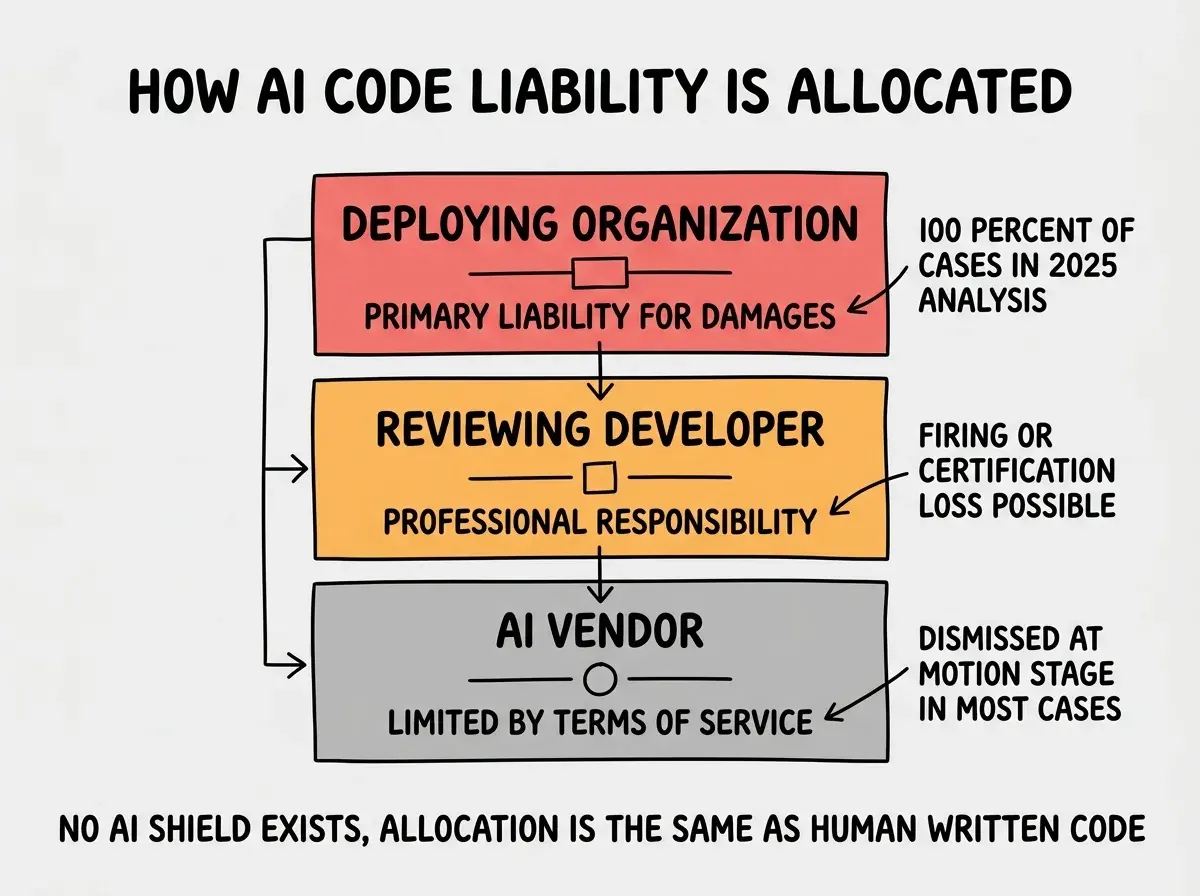
Limited vendor liability. AI tool vendors retain residual liability only for cases of clear product defect (e.g., the tool generated malicious code unrelated to the user's prompt, or the tool itself violated regulations). These cases are rare and the bar to prove them is high.
The Four Emerging Risk Frameworks
Regulators across the US, EU, and UK have converged on roughly four risk frameworks for AI-generated code in regulated industries. Each one has implications for how teams should ship.
Framework 1, audit trail requirement. Regulators expect every line of AI-generated code in regulated systems to be traceable to a human review, with timestamps, reviewer identity, and the prompt that generated the code preserved. This is becoming standard for healthcare and fintech in 2026.
Browse more analysis on AI compliance and governance
Browse pulse articlesFramework 2, explainability requirement. For high-stakes decisions (loan approvals, medical diagnoses, government benefit determinations), the deploying organization must be able to explain why the system made a specific decision. AI-generated code that is hard to read makes this harder, which raises the practical bar for code clarity.
Framework 3, certified review requirement. Some jurisdictions (notably the EU under the AI Act) are moving toward requiring that AI-generated code in safety-critical systems be reviewed by a certified professional before deployment. This is not yet uniform but is the direction of travel.
Framework 4, vendor disclosure requirement. Companies in regulated industries are increasingly required to disclose to customers and regulators that AI was used in the development of their software. This creates customer-facing implications even where there is no direct legal liability.
What Current Case Law Actually Says
The case law through early 2026 is still thin but consistent. Three notable cases set the tone.
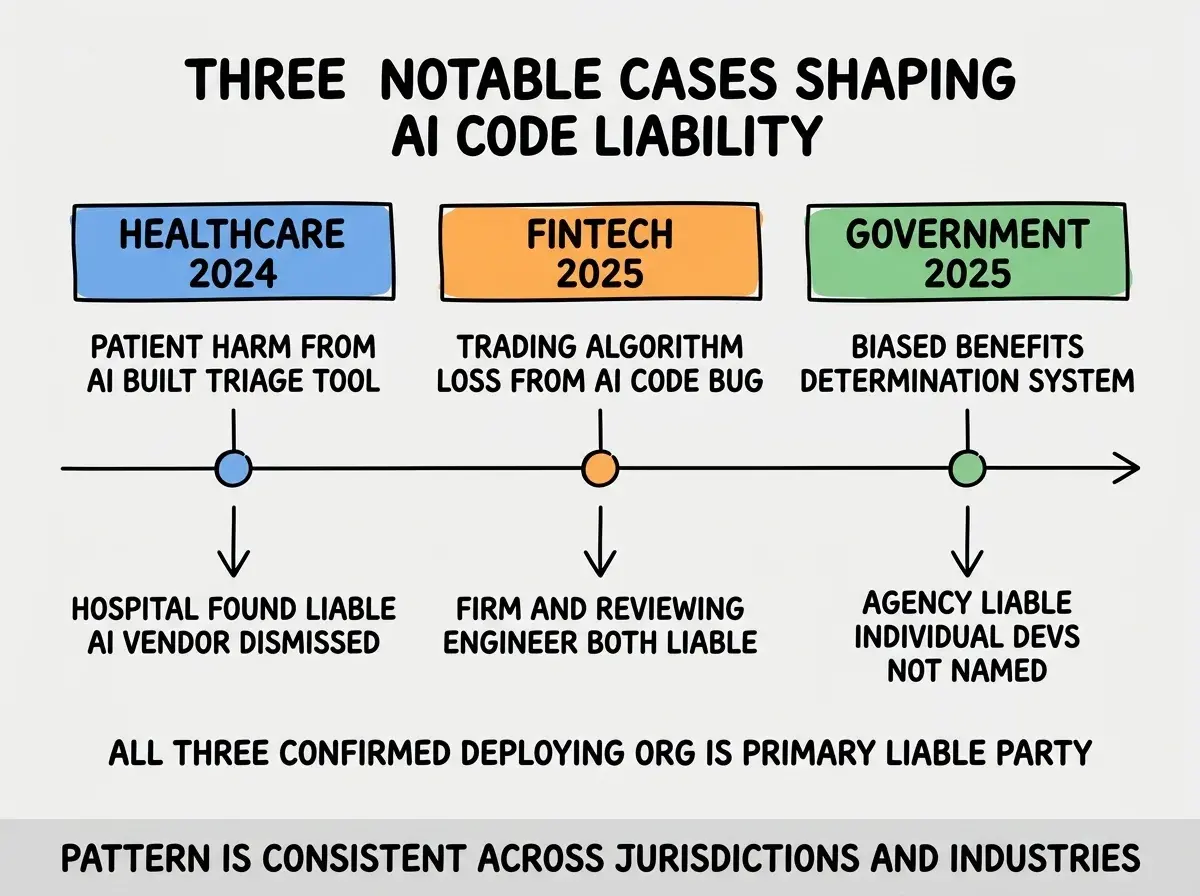
The pattern across all three cases (a healthcare misdiagnosis case, a fintech trading algorithm failure, and a government benefits determination case) is the same. The deploying organization was found primarily liable. The AI vendor was named in two of three but dismissed in both. The reviewing developer faced personal consequences in only the fintech case, where the failure was traceable to a clearly negligent review.
The legal community's reading of this pattern is that AI tools have not changed software liability fundamentals. The same human accountability that applied to traditional code applies to AI-generated code. Treating AI as an excuse for skipped review or weakened governance is not legally viable.
The most expensive mistake teams in regulated industries make is assuming that "the AI did it" is a defense. It is not. Regulators and courts have been consistent on this point. The right framing is that AI is a tool you used; you are accountable for the output. Building this assumption into your engineering culture from day one is much cheaper than retrofitting governance after a regulatory action. Many teams that adopted AI rapidly in 2024 and 2025 are now spending substantial resources adding the audit trails and review processes they should have built in originally.
The other mistake is over-reading the lack of AI vendor liability as a problem. It is actually the right legal allocation. The deploying organization knows their domain, their users, and their risk profile. The AI vendor does not. Putting the liability on the party that has the context for risk management is consistent with how every other developer tool category has been treated, and it forces healthy review discipline at the right point in the pipeline.
What This Means For You
Liability for AI-generated code is settled enough in 2026 to plan around. The teams that take governance seriously now will move faster in regulated markets than the teams that treat AI as a way to skip the work.
- If you're a founder: Build audit trails, review records, and explainability into your stack from day one if you are anywhere near a regulated industry. The cost is small now and the moat is real.
- If you're changing careers: AI governance and compliance for AI-generated code is a fast-growing specialization. Building expertise here gives you a defensible career path.
- If you're a student: Take at least one course on software liability or AI ethics. The legal landscape will shape your career as much as the technical landscape.
Browse more analysis on AI compliance and the future of development
Browse pulse articles