Knowing when to abandon an AI project is one of the hardest decisions a builder can make. With 92% of developers now using AI tools daily and 41% of AI-generated code eventually getting reverted, the question is not whether your project will hit a wall. It is when, and whether pushing through is the right move or whether starting fresh will get you there faster.
The METR research group found that developers using AI tools were 19% slower on real-world tasks despite believing they were faster. A consistent pattern has emerged across AI-assisted projects: somewhere around the 400-hour mark, builders hit exhaustion where forward progress becomes nearly impossible. These five stories are about builders who made the difficult choice to start over and discovered something surprising on the other side.
Story 1. The "Just One More Feature" Spiral
Marcus was building a project management tool for freelancers. He started with Cursor and had a working prototype in three days. Task creation, basic scheduling, a clean dashboard.
Then the additions began. Time tracking? Twenty minutes. Client invoicing? An hour. Gantt charts? Maybe two prompts. Marcus kept saying yes because the cost of each individual feature seemed negligible.
By week eight, the application had 67 features. None worked well together. The time tracking conflicted with scheduling logic. The invoicing module assumed a different user model than the authentication system. Every bug fix created cascading failures elsewhere.
Marcus hit his breaking point during a demo for a potential investor. The app crashed three times in ten minutes. He spent the weekend staring at 52,000 lines of AI-generated code and realized he could not explain what half of it did.
The restart: Marcus deleted everything and rebuilt with a strict rule. Five features, maximum. No new features until the existing ones were solid. The rebuild took eleven days. It handled roughly 20% of what the original attempted, but that 20% actually worked. He launched to paying customers within a month.
What he did differently: Before every AI prompt, he asked himself whether a freelancer would actually pay for this feature. If the answer was not an obvious yes, he did not build it.
Story 2. The Architecture That Could Not Scale
Priya and her co-founder used Lovable to build a marketplace connecting local chefs with home diners. The AI-generated codebase worked beautifully with their test group of fifteen chefs and fifty customers. Orders flowed through. Payments processed. Reviews appeared on profiles.
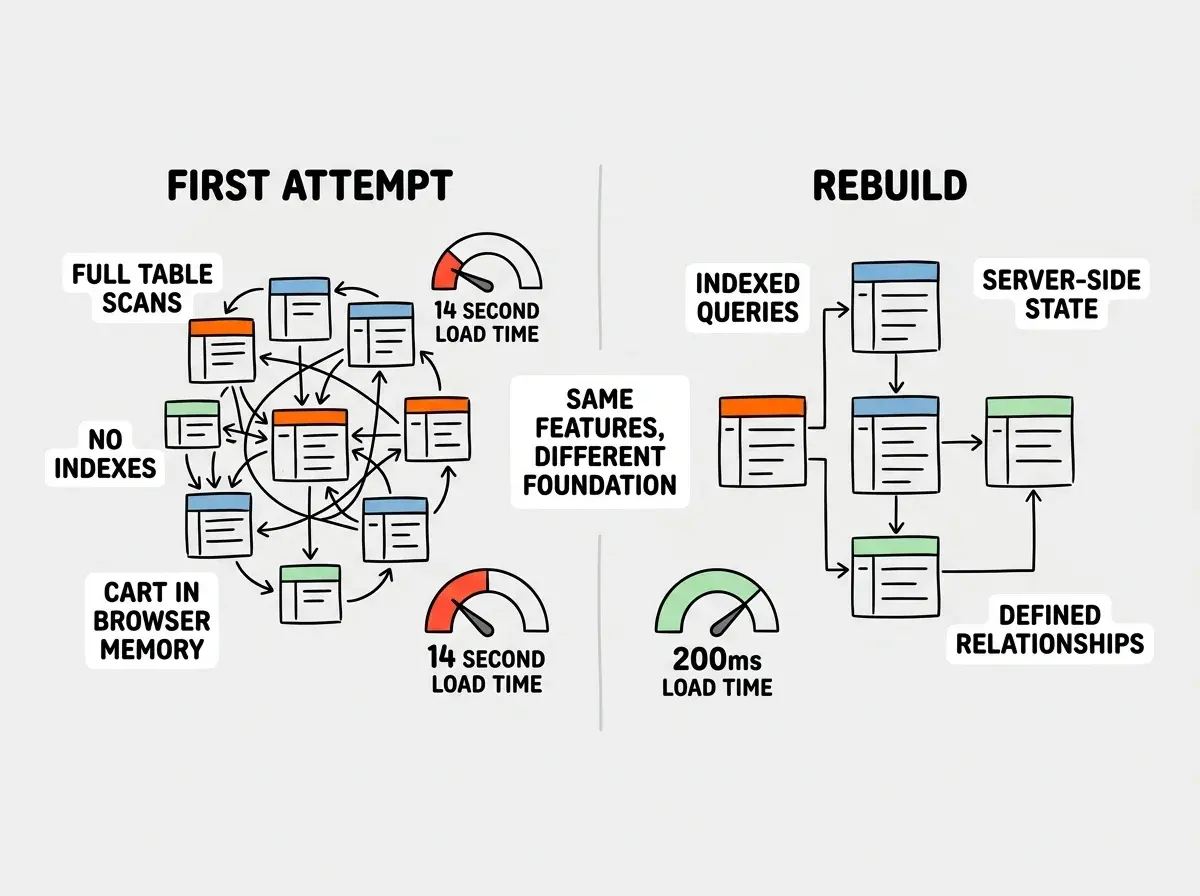
Then they got featured in a local news article. Traffic increased tenfold overnight. The application collapsed. The AI had generated a database schema that performed a full table scan on every search query. With fifty users, that scan took milliseconds. With five thousand users, it took fourteen seconds. The checkout flow stored cart state in browser memory with no server-side persistence, meaning every page refresh emptied a customer's cart.
They spent three weeks trying to patch the architecture. Each fix introduced new performance bottlenecks. The AI kept suggesting solutions that optimized individual queries without addressing the fundamental schema design.
The restart: Priya brought in a database consultant for a single four-hour session. He sketched an architecture on a whiteboard. Then they rebuilt the application from scratch using that architecture as the foundation, letting AI handle the implementation details rather than the structural decisions. The rebuild took three weeks, handled 50x the traffic, and cost less to host because the queries were efficient.
What they did differently: They separated architectural decisions from implementation work. Humans designed the structure. AI filled in the code within that structure.
Story 3. The AI Tool Lock-In Trap
Jordan built a customer support ticketing system inside Replit over four months. Email integration, analytics dashboards, automated response suggestions. It worked well inside Replit's environment.
The problems started when Jordan tried to leave. Replit's infrastructure had become deeply embedded in the application. Environment variables were hardcoded for Replit's hosting. The database used Replit's built-in storage with no standard migration path. Dozens of AI-generated utility functions relied on Replit-specific APIs.
Jordan needed to move because Replit's pricing had climbed to over $600 per month for what was essentially a small application. He spent six weeks attempting to extract the application from Replit's ecosystem. Each extraction attempt broke something else. The AI-generated code was so tightly coupled to the platform that there was no clean boundary between application logic and platform dependencies.
The restart: Jordan accepted the loss and rebuilt on a standard Next.js stack with a standard PostgreSQL database. He used the old application as a specification document, screenshotting every feature and writing clear requirements before generating any code. The rebuild took five weeks. His hosting costs dropped to $40 per month.
What he did differently: He treated the AI tool as an implementation helper, not as the foundation. Every database call went through an abstraction layer. Every platform-specific function was isolated behind an interface. If he ever needed to move again, the migration would be a weekend project, not a six-week ordeal.
Platform lock-in is invisible until you try to leave. If you cannot export your data, your database, and your deployment configuration to a different hosting provider within a single day, you are locked in. The time to build escape hatches is at the beginning of a project, not when the bill forces your hand.
Story 4. The Security Debt Mountain
A two-person team built a healthcare appointment scheduling app using AI tools. MVP in two weeks. Beta users in a month. Real patient data flowing through the system in six weeks.
Then they hired a security consultant before their Series A fundraise. The audit found 23 critical vulnerabilities. SQL injection in search. Unencrypted patient data at rest. API endpoints that returned other patients' records if you modified request parameters. Session tokens that never expired.
The AI had generated code that worked perfectly from a functional standpoint. Appointments got booked. Reminders got sent. But the security posture was catastrophic for an application handling protected health information.
The team spent two months trying to patch vulnerabilities incrementally. Every patch revealed deeper problems. The authentication system was architecturally incompatible with security requirements. Patient data was scattered across the codebase in ways that made encryption-at-rest impossible without a complete data layer rewrite.
The restart: They scrapped the codebase and started with a security-first architecture. HIPAA compliance requirements were written into their AI prompts from the first line of code. They generated the authentication and data access layers first, tested them against the security checklist, and only then built features on top. The rebuild took six weeks. The follow-up audit found zero critical vulnerabilities.
What they did differently: Security requirements became the first prompt, not an afterthought. They built the walls before they built the rooms.
Security cannot be bolted on after the fact. Get the foundations right from day one.
Read the security fundamentalsTreating security as a feature you add later rather than a foundation you build on. AI tools will happily generate functional code that is completely insecure because security constraints are rarely part of a feature prompt. If your prompt says "build a login page," the AI builds a login page. It does not build a secure login page unless you explicitly require it.
Story 5. The "It Works But Nobody Wants It" Pivot
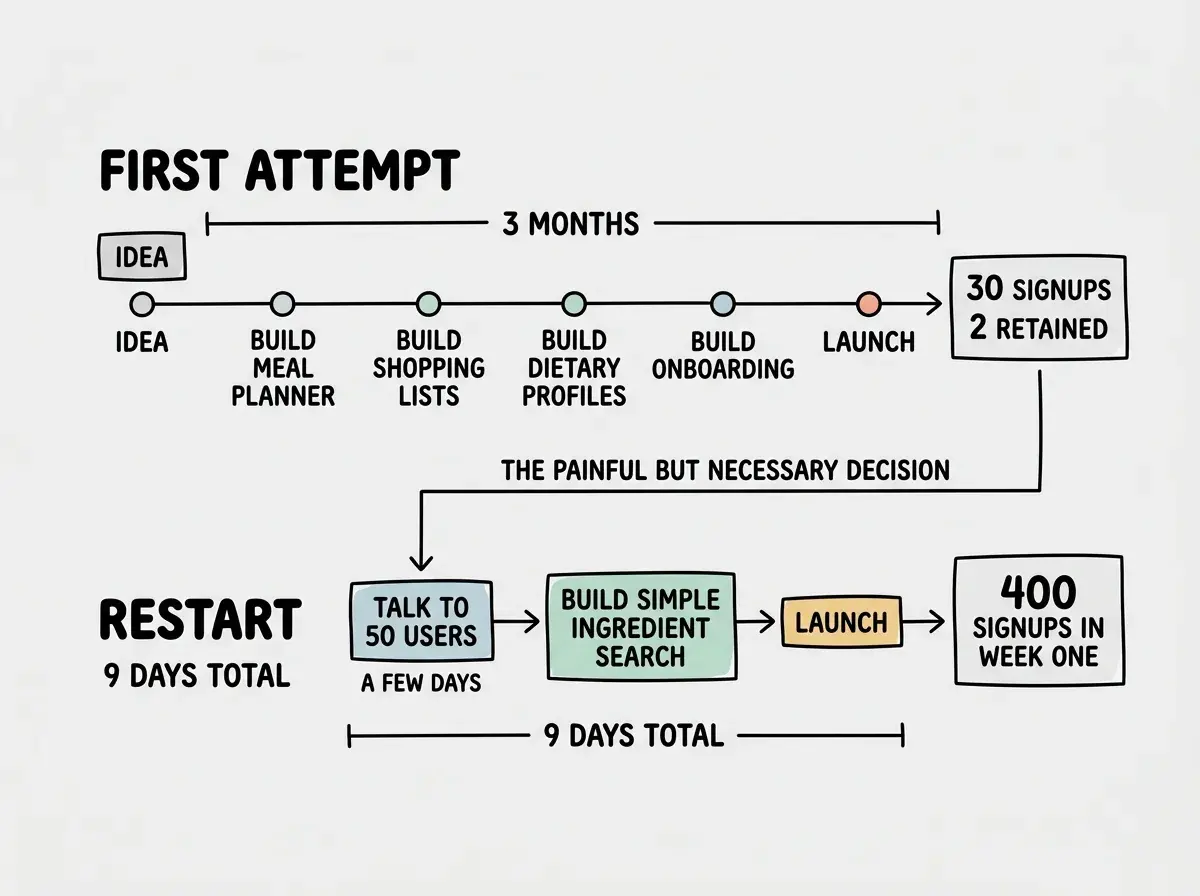
Aisha spent three months building an AI-powered meal planning app. It analyzed dietary preferences, generated weekly meal plans, created shopping lists, and adjusted portions based on household size. The code was clean. The app was stable.
She launched to crickets. Thirty signups in the first month. Two retained after sixty days. Aisha had spent three months building a sophisticated solution to a problem most people solved by scrolling Instagram food accounts and keeping a simple grocery list.
Walking away felt like throwing away months of her life. The meal database, the nutritional API integrations, the onboarding flow.
The restart: Aisha talked to fifty potential users before writing a single line of code. She discovered that people did not want meal planning. They wanted quick dinner ideas based on ingredients they already had. She rebuilt in nine days. A simple interface where you type what is in your fridge and get three dinner suggestions. No weekly plans. No shopping lists.
The simplified app got 400 signups in its first week.
What she did differently: She validated the problem before building the solution. AI tools made building so fast that she had skipped the most important step, confirming anyone actually needed what she was building.
The Five Warning Signs
Across these stories, a pattern emerges. Here are the signals that restarting will get you to the finish line faster than pushing forward.
Your feature count is growing but your user count is not. The problem is not missing features.
You cannot explain the codebase to a new person in thirty minutes. The maintenance burden will only increase.
Fixes take longer than features. The architecture has accumulated more debt than it can service.
You are locked into a single tool or platform. If migrating would take more than a few days, that dependency will only worsen.
You have not talked to users in more than two weeks. AI tools make this trap easy to fall into because building feels so productive.
Sometimes the bravest thing a builder can do is start fresh with better foundations.
Explore the fundamentalsWhat This Means For You
Starting over is not failure. It is a decision. Every builder in these stories shipped something better the second time, not because they were more skilled, but because they knew what to build and what to skip.
The second attempt was faster every single time. Marcus rebuilt in eleven days what took eight weeks. Priya rebuilt in three weeks. Jordan in five weeks. The healthcare team in six. Aisha in nine days.
The common thread is not that AI tools are unreliable. It is that AI tools are so fast at building that they can outrun your understanding of what should be built. When that happens, the bravest and most productive thing you can do is stop, step back, and start again with clarity about what actually matters.
If something in these stories feels uncomfortably familiar, pay attention to that feeling. The sunk cost is real. But the data is clear: builders who restart with better foundations ship faster than builders who keep patching something built on the wrong ones.