To understand the case study of a freelancer tripling output with AI assisted development, recognize the four phase journey he navigated (developed AI tool fluency over 3 months while maintaining client work, restructured client engagements around AI assisted delivery, raised rates as output velocity proved reliable, and built recurring revenue from clients who valued the speed advantage), see what freelancer perspective brought to AI tool adoption that employed engineers might have missed, and consider how the patterns apply to other freelancers contemplating similar transitions. The case study shows how AI tools change freelancer economics by changing the time per project equation.
This piece walks through the four phases, the freelancer specific advantages, the rate evolution, and the four mistakes freelancers make when adopting AI tools.
Why Freelancer AI Adoption Matters
Freelancer AI adoption demonstrates what AI tools enable for individual contractors beyond employed developers. The demonstrations matter; freelancers convert productivity directly into income, while employed developers convert productivity into either company profit or unused capacity.
The 2026 reality is that AI tool fluent freelancers are increasingly outcompeting both AI agnostic freelancers and traditional agencies. The case study documents one specific freelancer's journey through this transformation; the patterns apply to other freelancers contemplating similar paths.
A 2025 Upwork freelancer survey of 4,000 contractors found that AI tool fluent freelancers earned median 2.4x more per year than freelancers not using AI tools effectively. The income gap correlates with output gap; freelancers shipping more in less time can charge more per project while delivering faster.
The pattern to copy is the way photography moved from film to digital workflow during the 2000s. Photographers who adopted digital workflows early shipped more work, charged competitively, and outcompeted photographers stuck with film. AI tools play similar role for development freelancing; the early adopters compound advantages over slow adopters.
The Four Phase Journey
Four phases characterized the freelancer's output tripling.
Phase 1, developed AI tool fluency over 3 months while maintaining client work. Evening practice with personal projects. Fluency built through deliberate practice rather than client billable time; the separation preserved client trust during the learning curve.
Phase 2, restructured client engagements around AI assisted delivery. Shorter timelines, more iteration cycles, faster mockup to delivery. The restructuring matched AI productivity rather than fighting it.
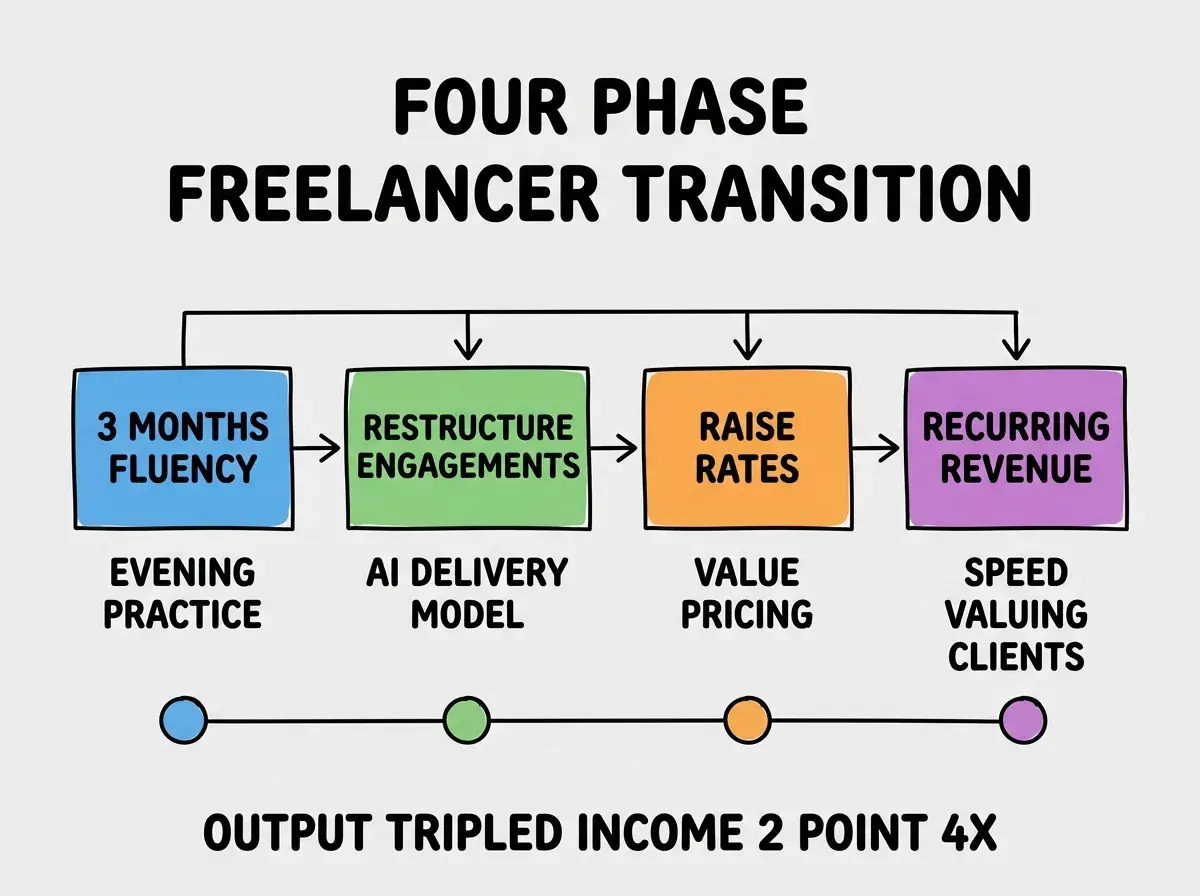
Phase 3, raised rates as output velocity proved reliable. First raised 25 percent at month 4, another 25 percent at month 8. Rate raises matched value delivery; without proven velocity, rate raises would have lost clients.
Phase 4, built recurring revenue from clients who valued the speed advantage. Retainer clients who needed iteration speed. Recurring revenue stabilized income that one off projects could not.
What Freelancer Perspective Brought
Three patterns from freelancer background produced advantages over employed developer AI adoption.
Pattern 1, direct income alignment with productivity. Every hour saved was income gained. The alignment produced motivation to learn AI tools that employees often lack.
Browse more freelancer case studies
Read more pulse articlesPattern 2, ability to choose tool stack without committee approval. Freelancers can adopt tools immediately when they prove valuable. Employees often wait for procurement and security review.
Pattern 3, client relationship preservation through transparent AI use. Honest disclosure of AI use built trust; hiding AI use destroyed trust when discovered. Transparency became the freelancer's moat.
The Rate Evolution Pattern
Three patterns characterized the freelancer's rate evolution.
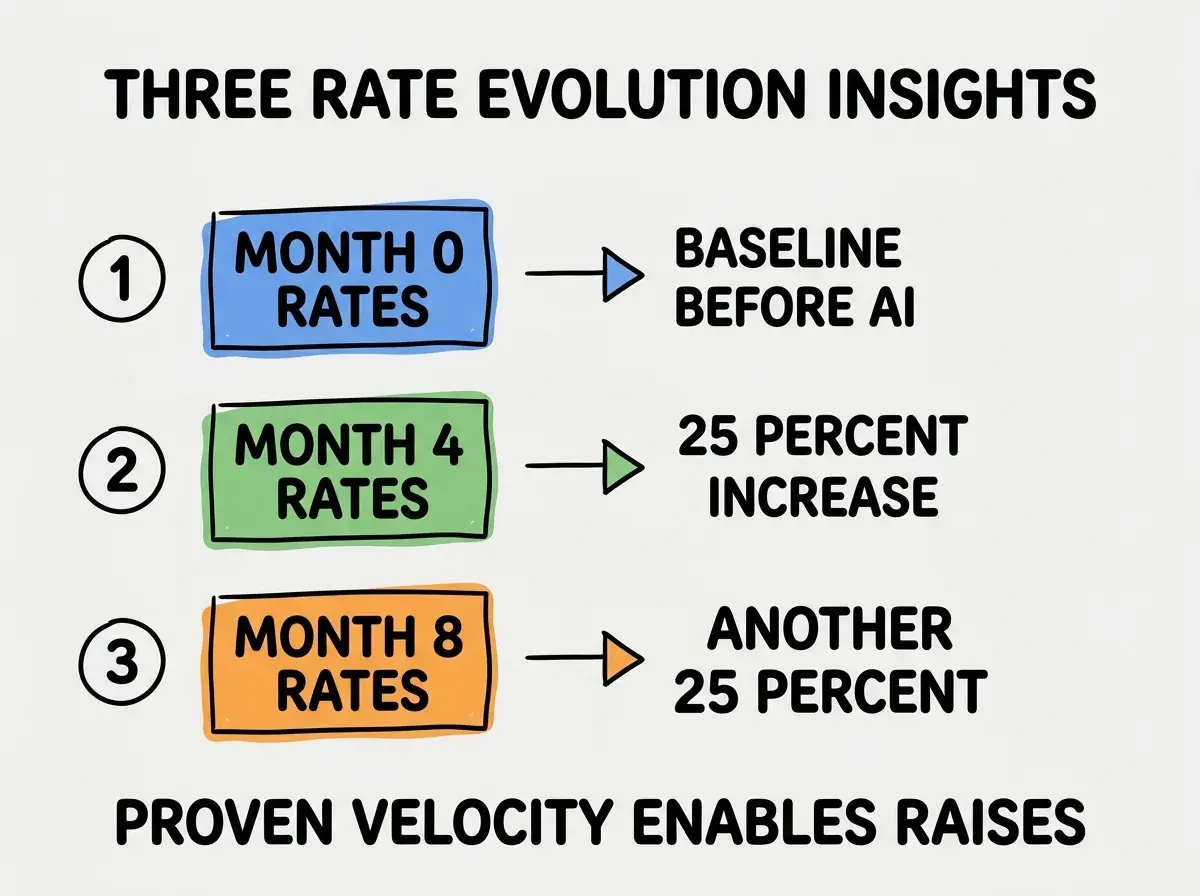
Insight 1, baseline rates before AI established the starting point. The freelancer had to know prior rates to measure increase; without the baseline, raises become arbitrary.
Insight 2, first raise at month 4 was 25 percent. Sustainable raise that clients accepted given visible delivery improvements. Larger raises at this stage would have lost clients.
Insight 3, second raise at month 8 was another 25 percent. Compound effect produced 56 percent total increase by month 8. Rate evolution compounded with output evolution.
How Other Freelancers Can Apply These Lessons
Three application patterns help freelancers attempt similar transitions.
Pattern A, separate learning time from billable time. Practice AI tools on personal projects before client work. Client billable time should not include the learning curve.
Pattern B, raise rates incrementally as velocity proves out. First raise at 3-4 months. Second at 8-9 months. Compounding produces substantial income increases without losing clients.
Pattern C, target clients who value speed over price. Some clients prefer slow expensive work; others value fast iteration. AI fluent freelancers should target speed valuing clients.
The combination produces successful freelancer transitions. Without these patterns, freelancers sometimes adopt AI tools, fail to monetize the velocity, and continue at prior rates while other freelancers pull ahead.
The most damaging freelancer AI mistake is hiding AI use from clients. Hidden AI use eventually surfaces; surfacing destroys trust when discovered. The fix is to be transparent about AI use from project start; honest disclosure builds the trust that hidden use destroys. Clients who would refuse AI use should self select out before project start, not discover and feel deceived during project.
The other mistake is failing to raise rates as output velocity improves. Same rates with higher output produces lower hourly equivalent for the freelancer; clients capture all the AI productivity gain. The fix is deliberate rate increases that share the productivity gain between freelancer and clients.
A third mistake is using AI to ship more lower quality work. Quality matters for repeat business; lower quality work loses clients regardless of speed. The fix is to use AI for productivity while maintaining quality; speed plus quality produces the freelancer reputation that compounds.
A fourth mistake is failing to invest in business development as output increases. Output without new clients produces capacity gaps. The fix is to invest some of the freed time in business development; the investment ensures the velocity translates into sustained income rather than occasional billing peaks.
How the Income Math Worked
Three income math insights from the freelancer's journey deserve attention. Year one income increased 56 percent through rate raises plus increased project capacity from velocity gains. Year two income increased another 60 percent as recurring revenue stabilized monthly income and rates raised again. Year three income increased 40 percent more as the freelancer became selective about clients, taking only high value engagements that paid well. The compound effect produced 2.4x year over year compared to baseline income before AI tool adoption; the trajectory suggests continued growth as AI tools improve.
The freelancer also reported significantly improved work life balance despite higher income. Output per hour increased dramatically; the higher hourly equivalent meant fewer billable hours produced same income, and the freed time produced both rest and business development. The combination of higher income and better balance is rare; AI tool adoption produced both for this freelancer.
What This Means For You
The freelancer tripling output with AI assisted development represents the new freelancing economic model in 2026. The four phases, freelancer specific patterns, and rate evolution produce sustainable income increases for committed freelancers.
- If you're a freelancer: AI tool adoption is the dominant freelancer competitive factor in 2026. Invest in fluency; the investment compounds into income increases that AI agnostic freelancers cannot match.
- If you're a career changer: Freelancing with AI tools is a viable entry path. The reduced time per project means new freelancers can compete on speed even without years of experience.
- If you're a founder hiring freelancers: AI fluent freelancers deliver dramatically faster than AI agnostic freelancers. Hire deliberately for AI fluency when project speed matters; the hire choice often determines project success.
Browse more freelancer case studies
Read more pulse articles