The Ghostty AI code ban made waves because it was not subtle. Mitchell Hashimoto, co-founder of HashiCorp and creator of the Ghostty terminal emulator, announced that the project would no longer accept AI-generated code contributions. The reason was straightforward: AI-generated pull requests were wasting maintainer time with low-quality submissions that contributors themselves did not understand.
That decision, from someone with deep credibility in the open-source world, crystallized a tension that has been building across the entire ecosystem. AI makes it trivially easy to generate a pull request. It does not make it trivially easy to generate a good one.
The Problem That Triggered the Ban
Ghostty is a GPU-accelerated terminal emulator written in Zig, a language with a small but technically rigorous community. The project attracted contributors who saw an opportunity to use AI tools to generate patches, fixes, and feature additions without deeply understanding the codebase or, in some cases, the language itself.
The pattern was consistent. A contributor would feed Ghostty's code into an AI tool, ask it to fix an issue or improve a function, and submit the resulting output as a pull request. The PR would look structurally reasonable. It would use real function names, reference actual files, and follow a plausible logic. But when Hashimoto reviewed the code, it fell apart.
The changes often introduced subtle bugs. They misunderstood Zig-specific memory management patterns. They "fixed" things that were not broken. And when maintainers asked follow-up questions, the contributors could not explain their own submissions, because they had not written them and did not understand what the code did.
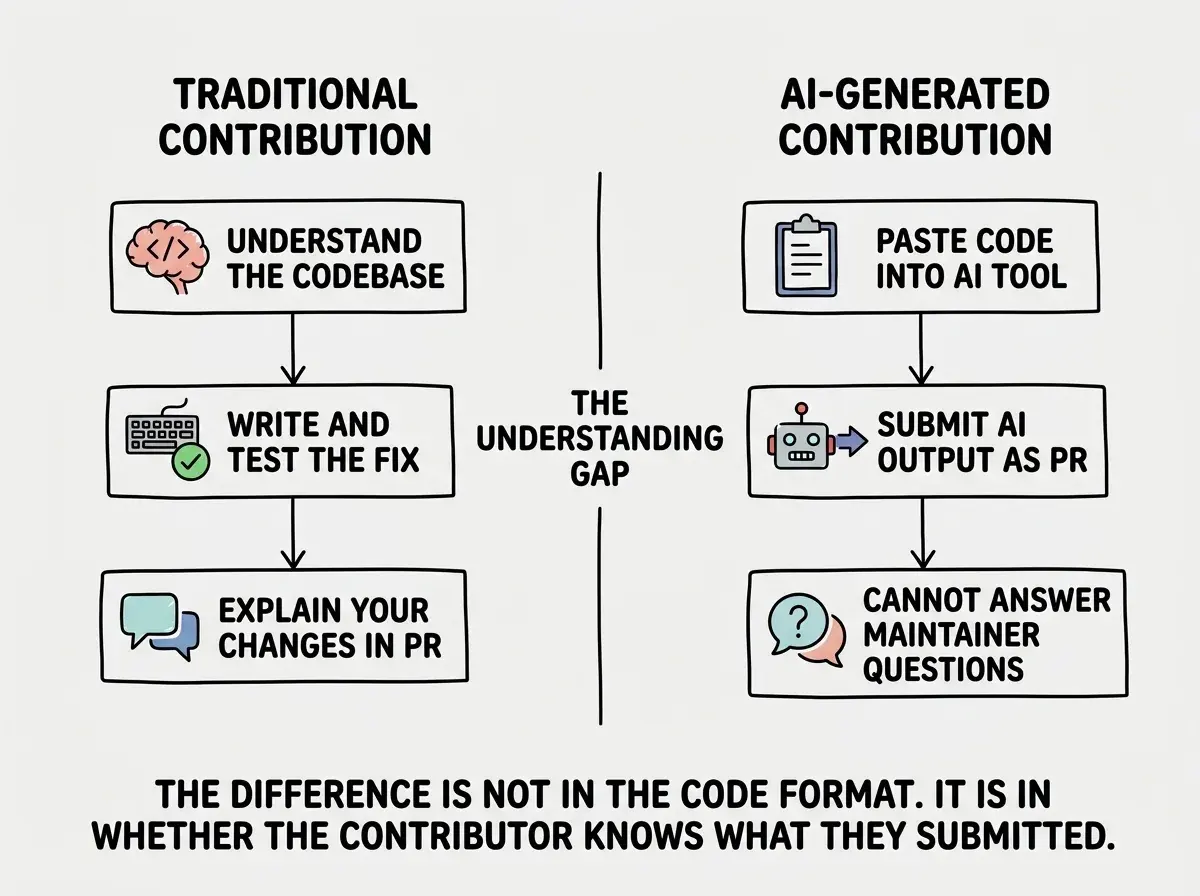
This was not a volume problem in the way cURL's bug bounty flood was a volume problem. It was a quality problem. Each individual PR consumed significant review time because the code appeared plausible enough to warrant careful examination. Maintainers could not dismiss them at a glance. They had to read, reason about, and test changes before concluding that the submission did not hold up.
Why Understanding Matters More Than Output
The core issue behind the Ghostty AI code ban is deceptively simple. A contribution is not just the code in the diff. It is also the reasoning behind the code, the testing that validates it, the ability to iterate when reviewers have questions. AI tools can produce the first part. They cannot reliably produce the rest.
When a human contributor writes a patch, they carry context. They know why they chose one approach over another. They can explain trade-offs. They can respond to review comments with adjustments that reflect understanding, not just regenerated output. When an AI-generated contribution gets review feedback, the contributor often has to go back to the AI tool, feed in the feedback, and submit whatever comes out next. This creates a loop where the maintainer is effectively reviewing AI output through a human proxy, doing more work, not less.
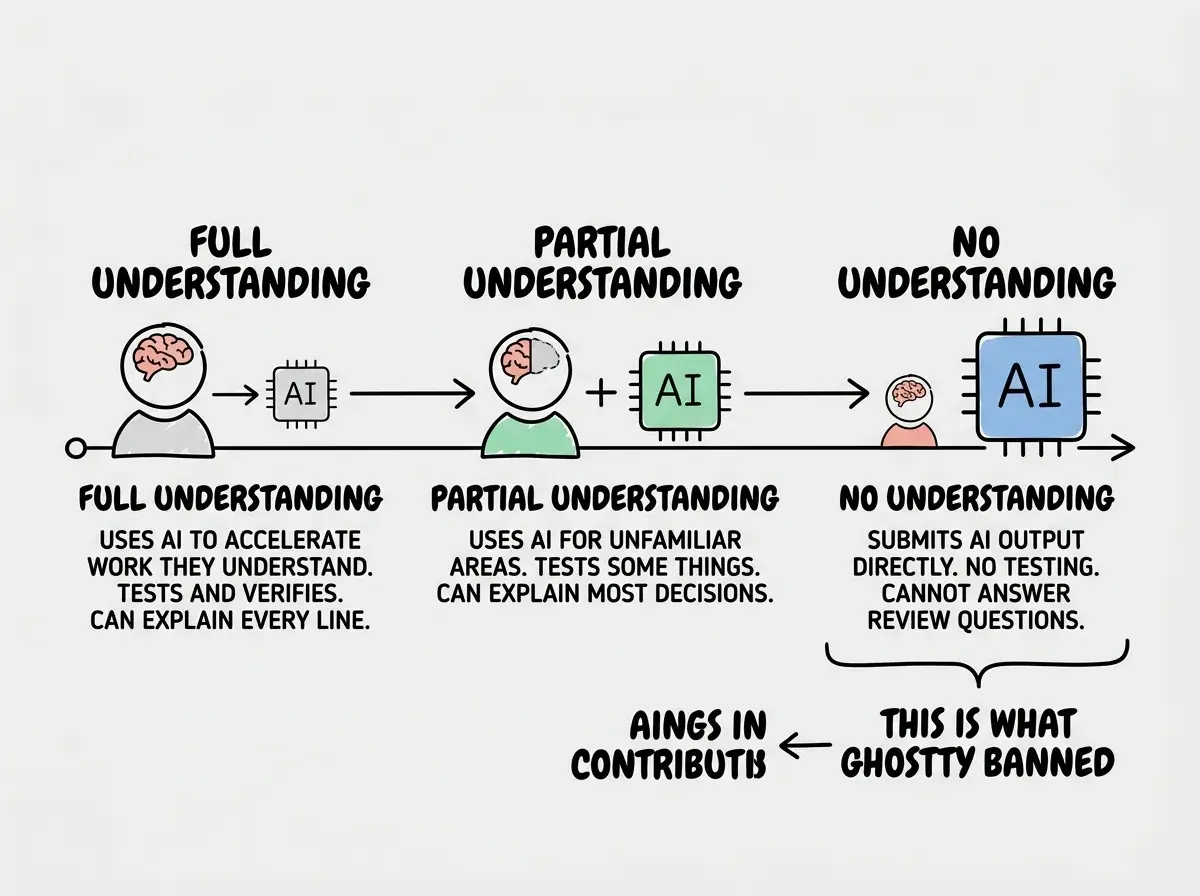
Hashimoto's frustration was not with AI tools themselves. It was with contributors using AI tools as a substitute for understanding rather than a supplement to it. There is a meaningful difference between a developer who uses AI to accelerate work they already understand and a developer who uses AI to produce work they could not do on their own.
The Ghostty ban targets a specific behavior, not a technology. Submitting code you cannot explain is the problem, regardless of whether AI generated it. The ban exists because AI made that behavior dramatically more common and harder to detect at submission time.
The Broader Pattern Across Open Source
Ghostty is not alone in this frustration. The pattern of low-quality AI-generated contributions has surfaced across the open-source landscape, from the Linux kernel mailing list to smaller projects that lack the maintainer bandwidth to absorb the review cost.
The dynamic is consistent. AI tools lower the barrier to generating a contribution while doing nothing to lower the barrier to generating a good contribution. The result is that projects receive more submissions that consume more review time while delivering less value. Maintainers, who are already the most constrained resource in open source, bear the entire cost.
Some projects have responded with explicit bans like Ghostty's. Others have added friction through stricter contribution guidelines, required test coverage, or mandatory issue discussion before PRs are accepted. A few have tried automated detection of AI-generated code, though this remains unreliable.
The common thread is that every defense against low-quality AI contributions also adds overhead for legitimate contributors. The careful developer who uses AI to draft code they fully understand and thoroughly test gets caught in the same net as the drive-by contributor who pastes AI output without reading it.
The Trust Paradox in Practice
This situation connects directly to a broader pattern in the industry. Surveys show that 92% of developers use AI coding tools, but only 33% trust the output. That gap between usage and trust explains exactly why projects like Ghostty end up with problematic contributions.
Contributors are using AI tools they do not fully trust to generate code they submit to projects maintained by people who have even less reason to trust it. The trust deficit gets exported from the contributor's environment (where they might review and revise AI output for their own projects) to the maintainer's environment (where they have no visibility into how much human judgment shaped the submission).
When you use AI to write code for your own project, you carry the risk yourself. If the code is wrong, you find out and fix it. When you submit AI-generated code to someone else's project, you transfer that risk to the maintainer. The Ghostty ban is, at its root, a refusal to accept that transferred risk.
Assuming that AI-generated code is "good enough" for a contribution because it compiles and looks reasonable. In open source, the bar is not whether code works in isolation. It is whether the contributor can defend the code under review, explain its trade-offs, and iterate on feedback. AI output that passes a build check can still fail every human aspect of the contribution process.
What Responsible AI-Assisted Contributing Looks Like
The Ghostty ban does not mean AI tools have no place in open-source contribution. It means that the contribution process demands more than what AI alone provides. Developers who use AI responsibly in their contributions follow a different pattern than the one Ghostty banned.
They start by understanding the codebase before generating any code. They use AI to explore approaches or draft implementations, not to produce final submissions. They read and modify every line of AI output, ensuring they can explain each decision. They write their own tests. They respond to review feedback from their own understanding, not by re-prompting a model.
This approach treats AI as a drafting tool, not a contributing tool. The contribution still comes from the human. The AI just makes the drafting phase faster. This distinction matters enormously to maintainers, who can tell within a few review comments whether a contributor understands their own submission.
Learning when AI accelerates your work and when it replaces your judgment is the skill that matters most.
Explore moreThe Signal for the Industry
The Ghostty AI code ban is a leading indicator, not an anomaly. As AI tools become more capable and more widely used, the volume of AI-generated contributions to open-source projects will increase. The quality bar from maintainers will not decrease to match. The gap between those two trends will define the next phase of open-source contribution culture.
Projects will increasingly need to distinguish between contributions where AI was a tool and contributions where AI was the author. That distinction is not about policing technology. It is about maintaining the trust that makes collaborative software development work.
For the industry at large, Ghostty's decision highlights something fundamental about AI-assisted development. The value of AI tools is real, but it is realized only when paired with human understanding. AI without understanding is not contribution. It is noise.
What This Means For You
The Ghostty situation carries different lessons depending on where you sit.
- If you contribute to open-source projects, treat AI as a research assistant, not a ghostwriter. Use it to understand unfamiliar code, explore possible approaches, and draft implementations. Then make the contribution yours by reading every line, writing tests, and ensuring you can answer any question a reviewer might ask. If you cannot explain a change, do not submit it.
- If you maintain an open-source project, consider explicit contribution guidelines that address AI-generated code. You do not necessarily need an outright ban. Requiring contributors to explain their changes in their own words, provide test coverage, and respond substantively to review comments will filter out the worst AI-generated submissions naturally.
- If you are building products with AI tools, the Ghostty lesson applies to your own codebase too. Every piece of AI-generated code in your project is code someone needs to understand, maintain, and debug. If nobody on your team can explain why a function works the way it does, you have the same problem Ghostty's maintainers faced, just without the option to reject the PR.
The developers and builders who thrive in this environment will be the ones who use AI to move faster without sacrificing understanding. Speed without comprehension is not productivity. It is debt with a delayed invoice.
Understanding the gap between output and quality is what separates builders from button-pressers.
Read more