To do five fun weekend projects for teen vibe coders in 2026, pick projects that span different skills (a personal site, a small game, a useful tool, a creative experiment, a social-feature app), use AI assistance to ship each one in a weekend, ship every project to a public URL the teen can share, and reflect on what was learned after each project before starting the next. Five weekends produces five real projects, dramatically more skill than five abandoned ambitious ones, and a portfolio that opens doors.
This piece walks through the five projects in order, the prompt patterns that work for each, the portfolio-building habits that compound, and the four mistakes that turn weekend projects into months of frustration.
Why Weekend Projects Beat Big Ambitions
Teens often want to build "the next big app" or "a YouTube alternative" as their first project. The ambition is admirable; the execution is doomed. Big projects require planning, architecture, and persistence skills that come from doing smaller projects first. Skipping the small-project phase is the single most common reason teens quit programming.
Weekend projects flip the dynamic. Each weekend produces a finished thing the teen can show off, learn from, and build on. The completion rate is dramatically higher, and the skill development is dramatically faster. Five finished weekend projects teach more than one half-finished ambitious project.
A 2025 GitHub Education survey of 12,000 teen programmers found that those who completed 5+ small projects in their first three months were 4.1x more likely to still be programming after one year compared to those who started with one ambitious project. The completion rate matters because it builds the confidence that sustains long-term learning. AI tools amplify this effect by making completion realistic for previously-too-hard projects.
The pattern to copy is the way young athletes train. They do not start with marathon training; they do shorter runs that build endurance over months. The constraint of finishing within reasonable time is what builds the long-term capacity. Teens who treat each weekend as a complete training session build programming endurance the same way.
The Five Projects in Order
The order matters. Each project teaches something the next project builds on. Following the sequence produces faster skill growth than jumping around.
Weekend 1, personal site. A site about you: who you are, what you like, what you build. Static HTML/CSS/JavaScript. Teaches the fundamentals: page structure, styling, deployment.
Weekend 2, small game. Wordle clone, snake, or memory match. Teaches state, input handling, game loops. The first interactive project.
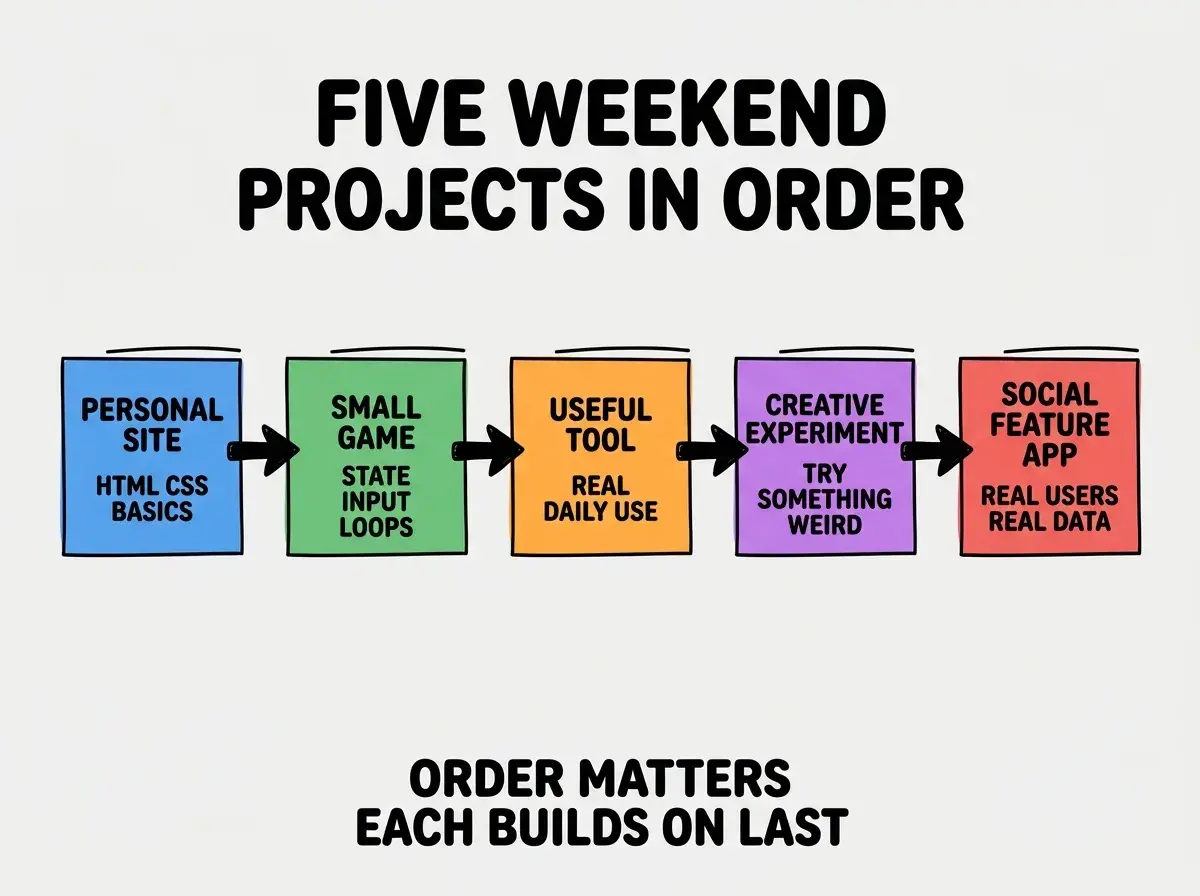
Weekend 3, useful tool. A study planner, timer with sounds, flashcard app, or calculator that does something specific. Tool you actually use yourself. Teaches you to think about user experience.
Weekend 4, creative experiment. Generative art, music sequencer, color palette generator, weird text manipulator. Pure creativity, no utility required. Teaches you that programming is creative.
Weekend 5, social feature app. Something that uses real data: a polling app, comment system, or quiz that saves results. Adds backend complexity. Teaches data persistence.
The Prompt Patterns for Each Project Type
Different project types benefit from different prompting approaches. Three patterns work across all five.
Pattern 1, start with the data structure. Before asking AI to build features, define what data the project handles. "I'm building a flashcard app. The data is an array of cards, each with question, answer, and difficulty." Forces clear thinking.
Browse more beginner guides
Read more foundations articlesPattern 2, build one feature at a time. Do not ask for the whole project in one prompt. Ask for the data setup, then the rendering, then the input, then the saving. Each prompt should produce code you can test.
Pattern 3, deploy after each milestone. Do not wait until the project is "done" to deploy. Deploy after the basic version works, then iterate on the deployed version. Forces shipping habits.
How to Build a Portfolio That Opens Doors
The five projects are not just exercises; they are the start of a portfolio. Three habits make the portfolio actually useful.
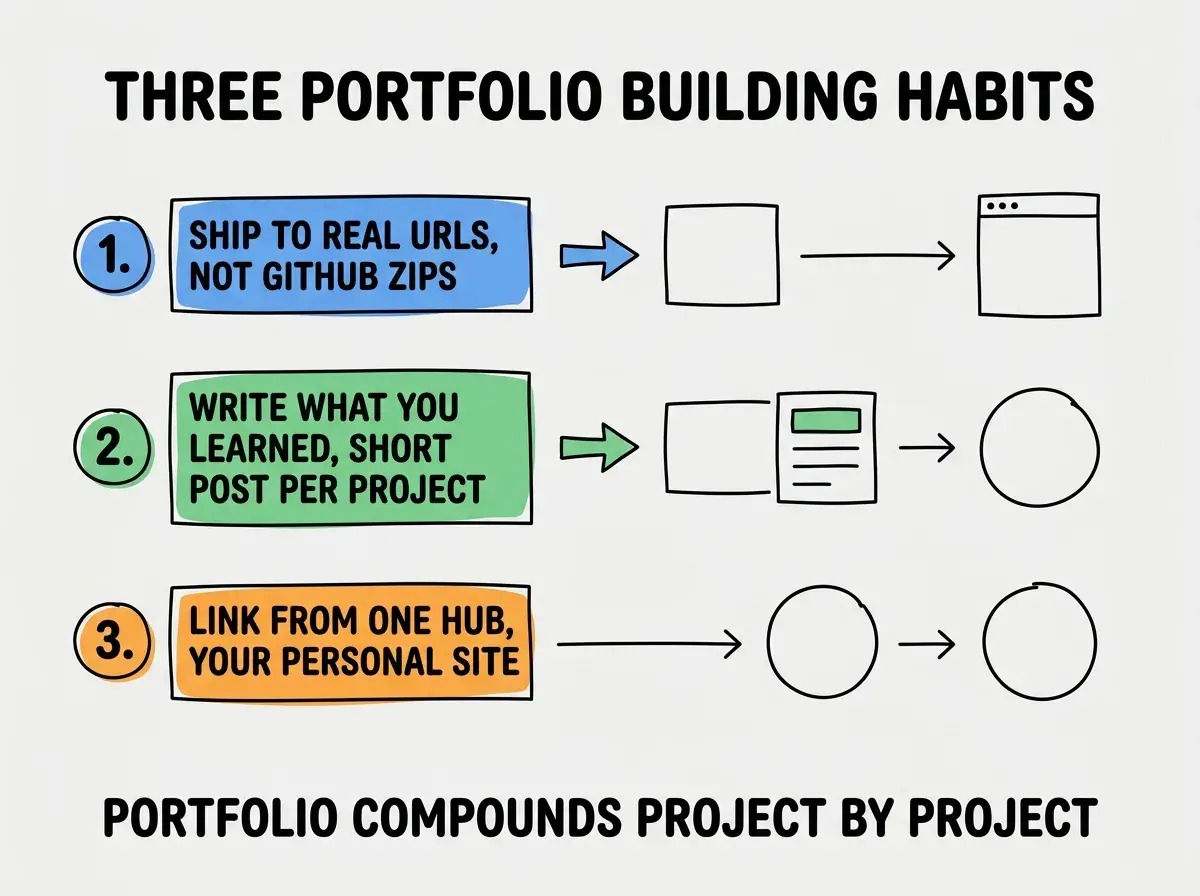
Habit 1, ship to real URLs. Every project goes to a free hosting URL (Vercel, Netlify, GitHub Pages). A working URL beats a GitHub zip every time. Future you and future employers can click and play.
Habit 2, write what you learned. A 200-word post per project explaining what you built, what was hard, what you would do differently. Teaches reflection, builds writing skills, creates a body of intellectual work.
Habit 3, link from one hub. Your personal site (project 1) becomes the hub that links to all the others. One URL to share with anyone who asks "what have you built."
What to Build Beyond the Five
After five weekends, teens have momentum, skill, and a portfolio. The next 5-10 weekends should mix three patterns.
Pattern A, deeper version of a project you loved. If the game from week 2 was your favorite, build a more ambitious game with multiplayer or AI opponents. Depth on something you care about.
Pattern B, project that uses an external API. Weather app, GitHub stats viewer, music recommender. Teaches working with data you do not own. Significant skill expansion.
Pattern C, something useful for your school or community. Tournament tracker for the chess club, schedule app for the band, fundraising tracker for a cause. Real users, real impact, real portfolio piece.
The fastest growth comes from rotating across all three patterns rather than getting stuck in one. Variety keeps motivation high; depth comes from the specific project you choose to take seriously.
How to Maintain Momentum Across Months
Five weekends is the start, not the end. Maintaining momentum across months and years is what turns a hobby into a career or college admissions advantage. Three patterns help.
Pattern X, schedule the time. Saturday morning becomes "project time." Same time every week. Removes the decision of when to code and makes the practice automatic.
Pattern Y, share publicly. Tweet about your projects, post in Discord servers for teen builders, share with friends. The accountability of public commitment helps you finish.
Pattern Z, find a buddy. Another teen builder who you compare progress with. Accountability from a peer beats accountability from a parent because peers do not feel like obligation.
The combination of scheduled time, public sharing, and a peer accountability buddy is the most reliable formula for sustained teen programming practice. Pick a Saturday morning, share your weekend project on Sunday evening, and find one other teen who does the same. Six months in, you will have built dozens of projects.
The most damaging teen vibe coding mistake is comparing yourself to professionals on social media. Twitter and YouTube are full of polished projects from people who have been programming for 10 years; comparing your weekend project to their year-long projects produces the wrong takeaways. The fix is to compare yourself only to your previous self. The project from week 5 should be better than the project from week 1; that is the metric that matters. Comparison to strangers is poison; comparison to past self is fuel.
The other mistake is over-investing in tools and setup before building anything. Teens sometimes spend a whole weekend "researching the best framework" or "setting up the perfect editor" before writing a line of code. The right approach is to start with whatever AI tool is in front of you and build something. Tool choice matters far less than building habit.
Dig deeper
A few hand-picked sources if you want to go further.
What This Means For You
Five weekend projects in five weekends is one of the highest-impact programming starts available in 2026. The projects compound, the skills transfer, and the portfolio opens doors.
- If you're a founder: Have your teen do the five-project sequence. The skills they build are the same ones your engineering team uses.
- If you're changing careers: Do the five-project sequence yourself. Adapted for adults, the same approach works for any age.
- If you're a student: Do the five projects this semester. The portfolio you build is more valuable than most coursework on your future job applications.
Browse more beginner guides
Read more foundations articles