To build a school project with AI assistance from idea to presentation in 2026, follow four phases (idea generation and scoping, AI-assisted building, refinement and personal touch, presentation preparation), use AI for the parts where it shines (generating boilerplate, exploring options, polishing language) while keeping your own thinking visible in the final result, document your process so you can explain what you learned, and prepare a clear presentation that connects the project to the assignment goals. The approach works for projects from elementary through high school.
This piece walks through the four phases, the AI workflow that produces good projects, the presentation patterns that earn top grades, and the four mistakes that turn AI-assisted projects into academic integrity issues.
Why School Projects With AI Are Different From Personal Projects
Personal projects with AI focus on shipping working products fast. School projects have additional constraints: assignment requirements, learning demonstration, originality expectations, and presentation grading. The AI workflow needs to adapt to these constraints.
The 2026 reality is that AI use in school projects is increasingly normal but inconsistently regulated. Some teachers explicitly allow AI assistance; others ban it entirely; most fall somewhere in between with vague guidelines. Students need to navigate the gray zone thoughtfully.
A 2025 EduCause survey of 5,000 high school students found that 71 percent had used AI to help with school projects in the past year, but only 23 percent had a clear sense of what their teachers considered acceptable AI use. The gap between practice and clarity creates risk for students. Knowing how to use AI for school projects responsibly (and how to talk about that use) is increasingly important academic literacy.
The pattern to copy is the way professional research uses citations. Researchers freely use other people's ideas as long as they cite the source. Students using AI for school projects benefit from the same disposition: use AI freely, document the use, take credit for your own contributions, give AI credit for its contributions. Honesty about process is the protective practice.
The Four Phases That Work
Four phases produce school projects that earn good grades and demonstrate real learning.
Phase 1, idea generation and scoping. Use AI to brainstorm project ideas; pick one based on your interests and the assignment requirements. Refine the scope so it is achievable in the timeline.
Phase 2, AI-assisted building. Use AI to handle the technical work (writing code, generating boilerplate, exploring options). Stay engaged: review every output, understand the choices, modify when needed.
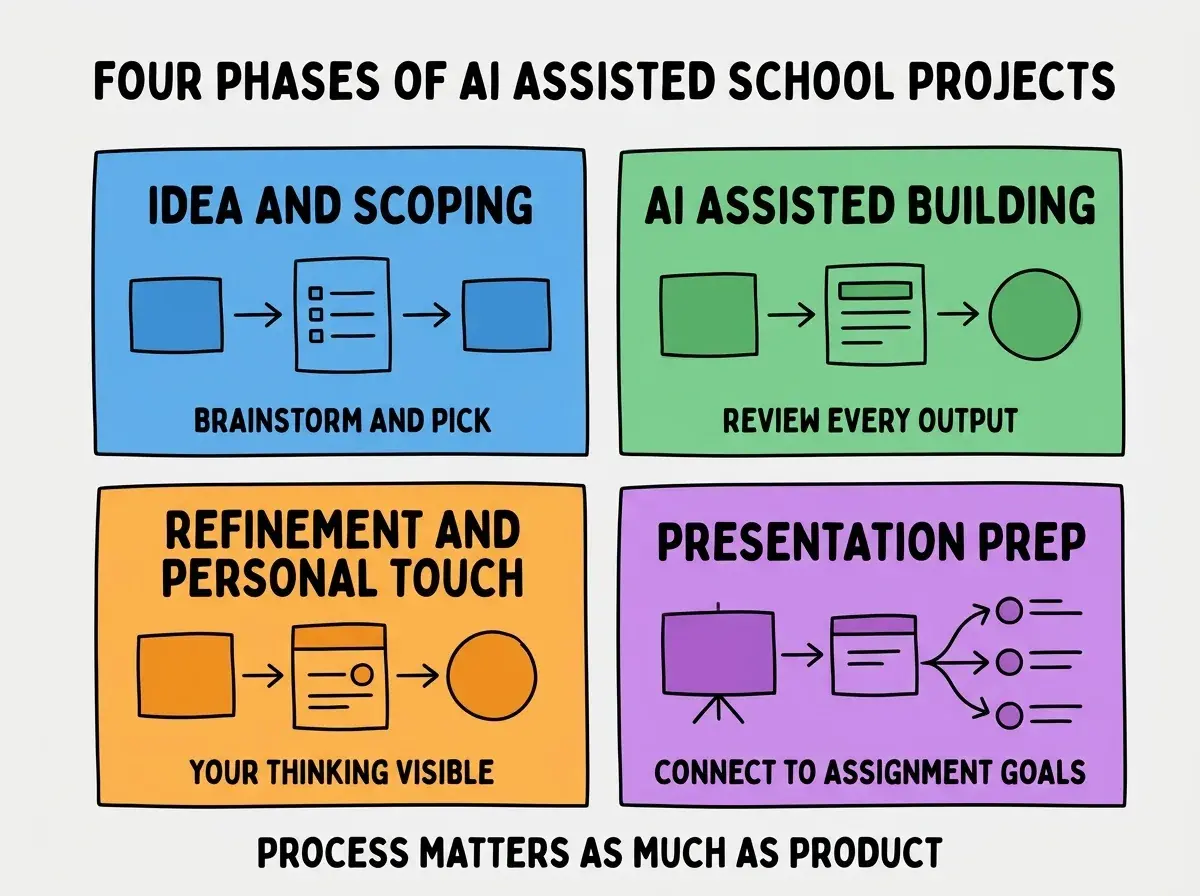
Phase 3, refinement and personal touch. Take the AI-generated baseline and add your own thinking. Personalize the design, write your own commentary, customize for your specific interests.
Phase 4, presentation preparation. Plan how you will present the project. Connect it explicitly to the assignment goals. Prepare for questions about your process.
The AI Workflow That Produces Good Projects
Three workflow patterns separate good AI-assisted projects from problematic ones.
Pattern 1, AI as starting point not endpoint. Use AI to generate first drafts; iterate from there with your own judgment. AI output is rarely the final answer.
Browse more student guides
Read more foundations articlesPattern 2, document your process. Keep notes on what AI helped with, what you decided differently, what you learned along the way. The process record becomes your defense if AI use is questioned.
Pattern 3, focus on understanding. After each AI-generated piece, make sure you understand it. If you cannot explain it, do not include it. Understanding is what makes the project yours.
The Presentation Patterns That Earn Top Grades
Presentation matters as much as the project itself. Three patterns consistently earn top grades.
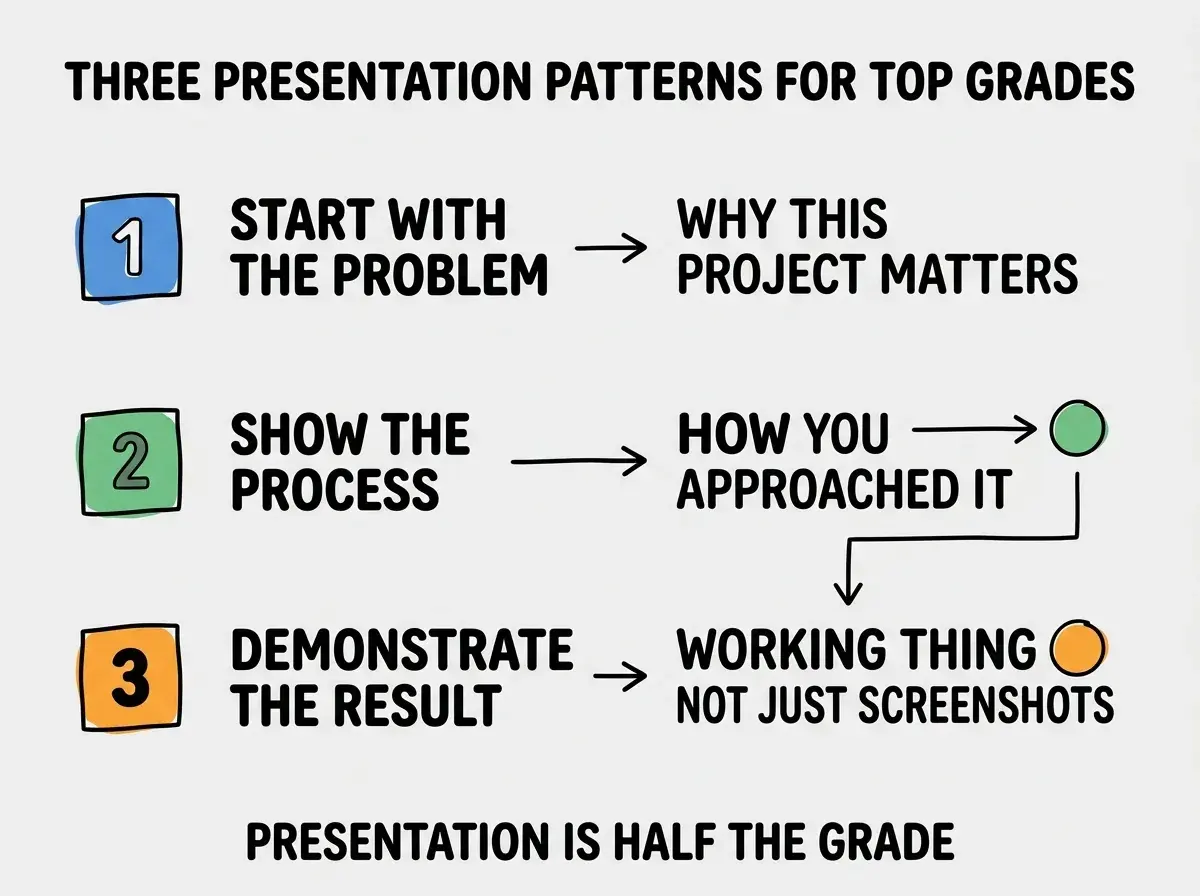
Pattern 1, start with the problem. Open with what problem the project solves, why it matters, who would use it. Frames the work as purposeful rather than as random tinkering.
Pattern 2, show the process. Walk through how you approached the work, what challenges came up, how you solved them. Demonstrates learning, not just output.
Pattern 3, demonstrate the result. Live demo of the working thing rather than just screenshots. Shows the project actually works, builds confidence.
How to Talk About AI Use in Presentations
The "did you use AI" question is increasingly common. Three responses serve students well.
Response 1, lead with what AI helped with. "I used AI to help generate the initial code for the data display. Then I customized the design and added the features the assignment required."
Response 2, demonstrate understanding. Be ready to explain any part of the project. If a teacher asks how a function works, explain it clearly. The understanding is what protects you.
Response 3, share what you learned. "Working on this project taught me X, Y, Z about how this kind of system works." Shows that AI assistance enabled deeper learning, not less.
The combination produces an honest framing that most teachers respond positively to. Trying to hide AI use creates suspicion; framing AI use thoughtfully demonstrates academic maturity.
The most damaging school project mistake with AI is submitting AI-generated work as entirely your own. Some students paste AI output directly into projects without modification or understanding. This is academic dishonesty under most school policies and creates risks if AI use is detected. The fix is to always personalize and refine AI output, always understand what you submit, and always be honest about the AI's role in your process. The honest approach is also the higher-grade approach because it reflects deeper engagement with the work.
The other mistake is over-using AI to the point where the project does not reflect your skills or interests. A perfect AI-generated project that does not match your stated skill level raises immediate red flags. The right approach is to use AI to help you do your work better, not to replace your work. The result should look like your work elevated, not like AI's work submitted under your name.
Time Management Across Phases
The four phases need different time allocations than students often expect. Three patterns help with planning.
Pattern X, allocate 25 percent to scoping. Most students rush scoping and over-build. Spending the first quarter of project time on idea generation and scope definition produces dramatically better outcomes.
Pattern Y, allocate 50 percent to building. The technical work, including refinement. With AI assistance, this phase compresses, but it still requires the most time.
Pattern Z, allocate 25 percent to presentation prep. Students who under-invest in presentation get lower grades than students who under-invest in features. Presentation matters more than students typically realize.
The combination produces projects that present well and demonstrate clear thinking. Students who skip scoping or rush presentation produce technically interesting but poorly-graded work.
How to Pick a Project Topic
Topic selection drives the rest of the project. Three approaches work well.
Approach 1, solve a personal annoyance. Pick something you struggle with daily (homework tracking, study session planning, chore reminders). Personal motivation sustains effort through hard parts.
Approach 2, help a peer or family member. Build something for a sibling, parent, or friend. Real user feedback during development. Concrete person to present "this helped X" stories.
Approach 3, extend something you already know. If you love a video game, build a tool around it (stat tracker, build calculator). If you love a sport, build something for the team. Domain knowledge beats generic projects.
The combination of approaches produces topics that the student can sustain interest in for the project duration. Topics picked from generic lists produce projects students lose interest in halfway through.
Dig deeper
A few hand-picked sources if you want to go further.
What This Means For You
AI-assisted school projects are an increasingly normal part of student life in 2026. Knowing how to use AI responsibly and present the work confidently is increasingly valuable academic literacy.
- If you're a founder: Help your kids learn this approach early. The thinking patterns transfer to every future learning context.
- If you're changing careers via school programs: Apply these patterns to your coursework. Adult learners benefit from the same approach.
- If you're a student: Practice the four phases on small assignments before high-stakes ones. The discipline pays back across every future project.
Browse more student guides
Read more foundations articles