Vibe coding for healthcare HIPAA compliance in 2026 is genuinely possible and substantially less painful than the early reputation suggests, as long as you make the right infrastructure choices upfront. The eight-item compliance checklist covers the work: HIPAA-eligible cloud with signed BAA, encryption at rest and transit, audit logging for all PHI access, role-based access controls, secure backups with BAA coverage, employee access training, breach notification process, and an annual security risk assessment. The application code itself can be AI-assisted like any other web app; the compliance work is concentrated in the infrastructure and process layers around the code.
This piece walks through the eight checklist items in detail, the order to tackle them, the realistic time and cost investment, and the four myths about HIPAA that delay most vibe-coded healthcare projects by months and that founders should disregard early.
The same patterns apply whether you are building a clinic appointment app, a telemedicine platform, a patient communication tool, or a clinical workflow product. The compliance baseline is the same; the application logic on top varies.
Why HIPAA Has a Worse Reputation Than It Deserves
Founders considering healthcare apps often hear that HIPAA compliance takes 6 months and $50,000+ in legal fees before you can ship. This is true for some compliance approaches and dramatically wrong for others. The difference is whether you build on HIPAA-friendly infrastructure from day one (in which case compliance is a 1 to 2 week setup) or try to retrofit compliance onto a non-compliant platform (in which case it really does take 6 months).
The bad reputation comes from teams that built on Vercel or Heroku and then tried to retrofit HIPAA later. The migration alone takes weeks. The retrospective audit of any patient data that touched the original platform takes more weeks. The legal cleanup of vendor relationships that did not have BAAs takes more weeks. None of this is necessary if you start on the right platform.
A 2025 healthcare tech founder survey by Rock Health found that startups that adopted HIPAA-eligible infrastructure from day one spent an average of 12 days on initial compliance setup. Startups that tried to retrofit compliance after launching on non-eligible platforms spent an average of 4.7 months. The gap is entirely about the order of decisions, not about the inherent difficulty of HIPAA compliance.
The pattern to copy is the way commercial real estate handles building codes. A building designed for residential use cannot be easily converted to commercial; the codes are different and retrofitting is expensive. Building it right from the start is straightforward. HIPAA compliance is the same; designed-in is cheap, retrofit is expensive.
The Eight Item Checklist
Each item is a specific compliance requirement with a specific implementation. Working through them in order takes 1 to 2 weeks for a small team.
Item 1, HIPAA-eligible cloud with signed BAA. Pick AWS, GCP, or Azure (the three big clouds all support HIPAA). Sign their BAA before any patient data touches the system. This is a process, not a feature; allow a few business days.
Item 2, encryption at rest and in transit. Verify that your databases encrypt at rest (most managed services default to this) and that all network connections use TLS 1.2 or higher.
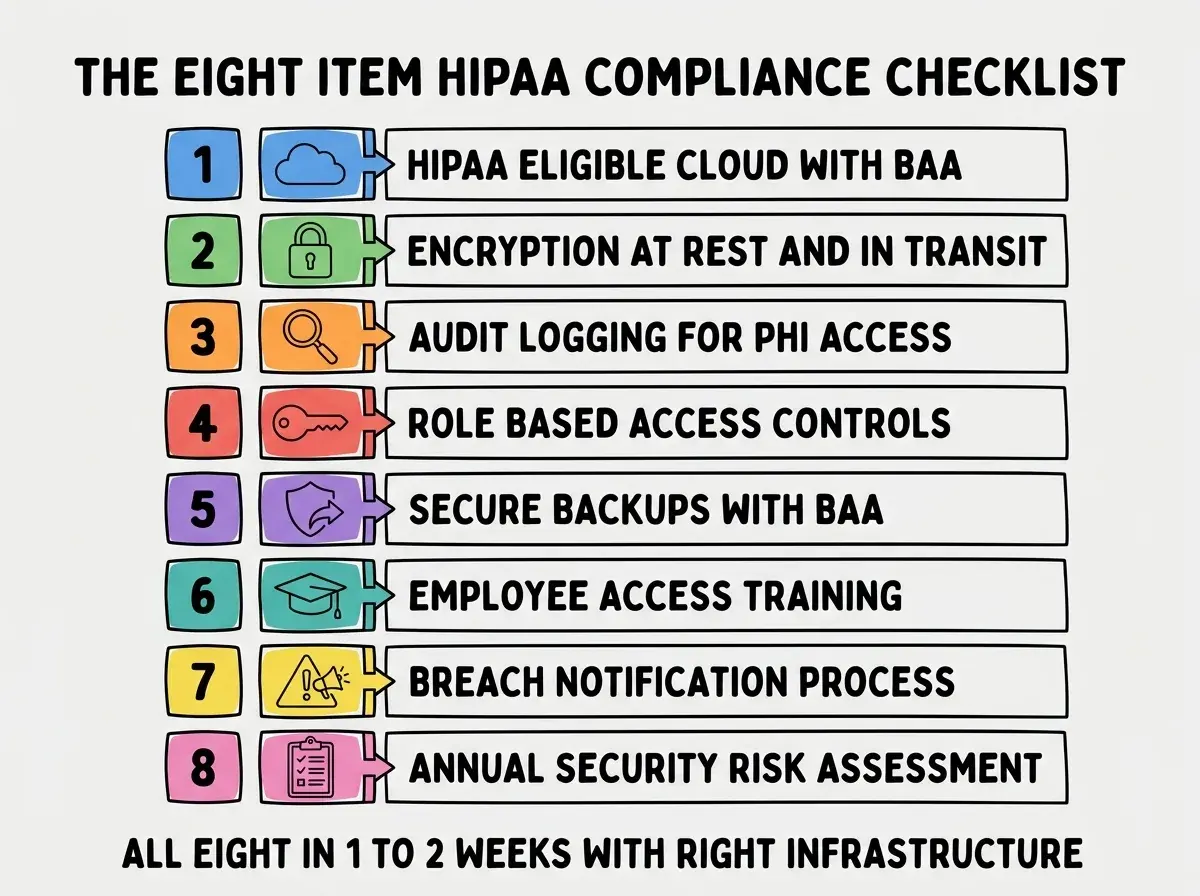
Item 3, audit logging for PHI access. Every read and write of PHI logged with timestamp, user, action, source IP. CloudTrail (AWS) or GCP Audit Logs handle the infrastructure layer; your app needs to log application-level access.
Item 4, role-based access controls. Users only see the PHI they need to do their job. Implement at the app layer and verify at the database layer.
Items 5 Through 8
The remaining four items are slightly less technical but no less important.
Item 5, secure backups with BAA coverage. Backups must be encrypted, stored on HIPAA-compliant infrastructure, and covered by a BAA. The common mistake is backing up to personal cloud storage; this is a violation.
Browse more analysis on regulated industry compliance
Browse pulse articlesItem 6, employee access training. Every employee with access to PHI must complete HIPAA training annually. Tools like KnowBe4 or HIPAA Secure Now offer turnkey programs.
Item 7, breach notification process. Document what you would do if PHI was exposed. Who do you notify, when, and how. The process must be in writing before any breach occurs.
Item 8, annual security risk assessment. A formal review of your security posture done annually. Can be done internally for small teams using free templates or via a HIPAA consultant for $5,000 to $15,000 if you want a more authoritative output to show to enterprise customers and audit teams.
The Realistic Time and Cost
For a small team starting fresh on a healthcare app in 2026, the realistic compliance investment is:
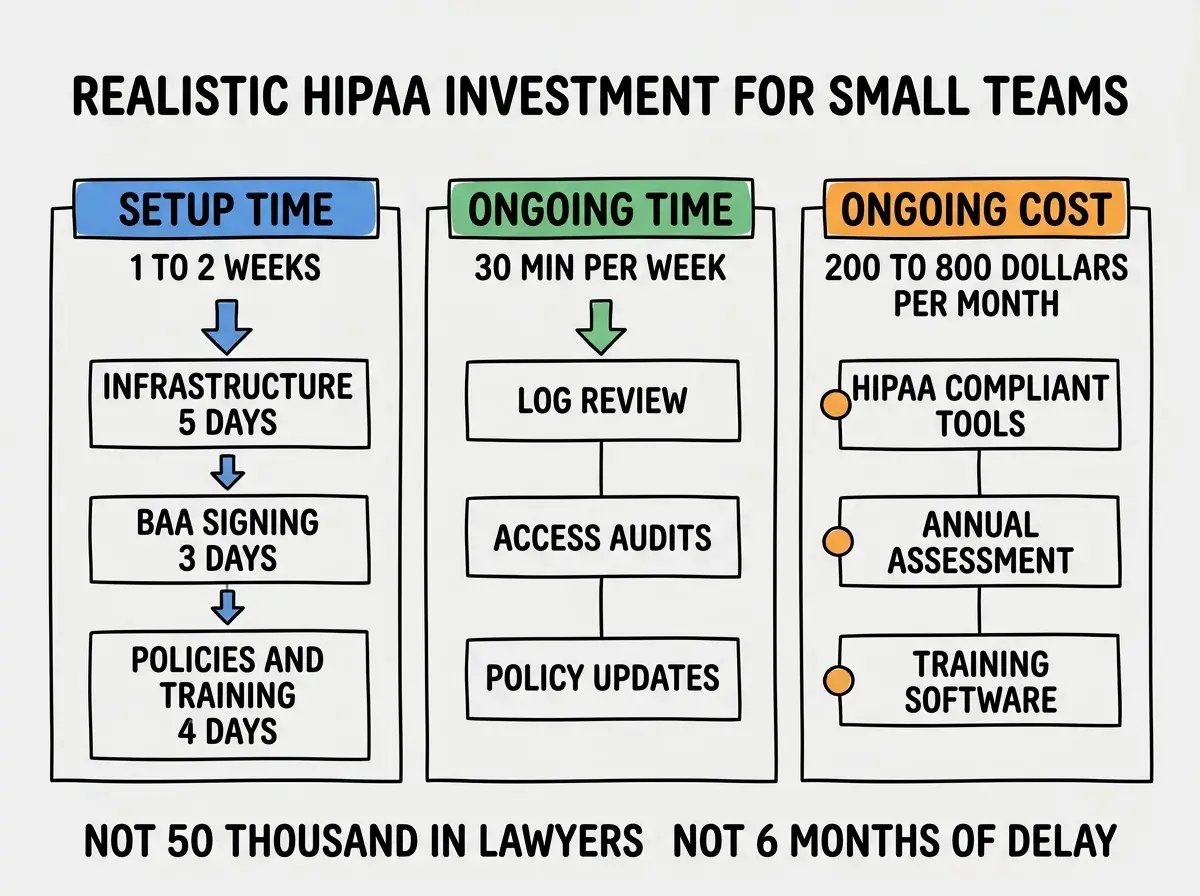
Setup time. 1 to 2 weeks of focused work covering all eight checklist items.
Ongoing time. Roughly 30 minutes per week for log reviews, access audits, and policy updates. The annual security risk assessment is a separate 1 to 2 day project.
Ongoing cost. $200 to $800 per month covering HIPAA-compliant versions of common tools (Twilio, SendGrid, etc.), training software, and annual assessment fees. The infrastructure cost is roughly the same as non-HIPAA infrastructure.
These numbers are dramatically smaller than the often-quoted "$50,000 in lawyers" figure, which comes from teams that retrofit compliance or that build on platforms that require complex workarounds.
The most damaging HIPAA myth is that you can "add compliance later" once the product gains traction. Every patient record that touches a non-HIPAA-eligible platform creates a violation, and the cleanup is dramatically more expensive than starting on the right platform. If there is any chance your app will eventually handle PHI, build on HIPAA-eligible infrastructure from the first commit. The cost of starting on AWS or GCP versus Vercel is small; the cost of migrating later is enormous.
The other myth is that vibe coding tools cannot produce HIPAA-compliant code. They can. Cursor, Claude Code, and similar tools generate code that meets HIPAA requirements when given the right context (encryption, audit logging, access controls). The compliance work is in the infrastructure and process layers; the application code is just code.
A useful pattern is to maintain a HIPAA-context document in your repo (HIPAA.md or similar) that captures your specific compliance posture: which BAAs you have signed, which encryption is in place, where audit logs flow, what access controls apply. The AI loads this on every session and writes code that respects your specific compliance setup. Without this document, the AI generates generic code that may not match your specific controls and creates work to retrofit afterward.
What This Means For You
HIPAA compliance for vibe-coded healthcare apps is more accessible in 2026 than the reputation suggests, but only if you set up the infrastructure correctly from day one. The eight-item checklist is achievable in 1 to 2 weeks of focused work.
- If you're a founder: Decide whether your app will ever handle PHI before you write the first line of code. If yes, start on HIPAA-eligible infrastructure immediately.
- If you're changing careers: Healthcare tech is friendly to engineers who learn HIPAA basics. The compliance specialization is in demand and well-paid.
- If you're a student: Read the HIPAA Security Rule once. The principles are clearer than the reputation suggests, and knowing them is a credential in healthcare interviews.
Browse more analysis on regulated industries
Browse pulse articles