Cloudflare Pages wins on price and performance at scale. Vercel wins on developer experience for Next.js apps. Netlify is the simplest option for static sites and Jamstack projects. The right choice depends on what you are building, how fast it is growing, and whether you have been surprised by a hosting bill before.
Quick Verdict
| Vercel | Netlify | Cloudflare Pages | |
|---|---|---|---|
| Best for | Next.js apps, polished DX | Static sites, simple deploys | Cost-sensitive apps at scale |
| Price | Free tier, Pro $20/user/mo | Free tier, Pro $19/mo (flat) | Free tier, Workers Paid $5/mo |
| Strength | Best-in-class Next.js integration | Simplest setup and deploy flow | Cheapest at volume, fastest edge |
| Weakness | Costs escalate fast past free tier | SSR and serverless support lags | Rougher DX, fewer guardrails |
You might think the free tiers make this decision irrelevant until you scale. But actually, the platform you choose on day one shapes your architecture and deploy workflow, and determines how painful the bill gets when your AI-built app starts getting real traffic.
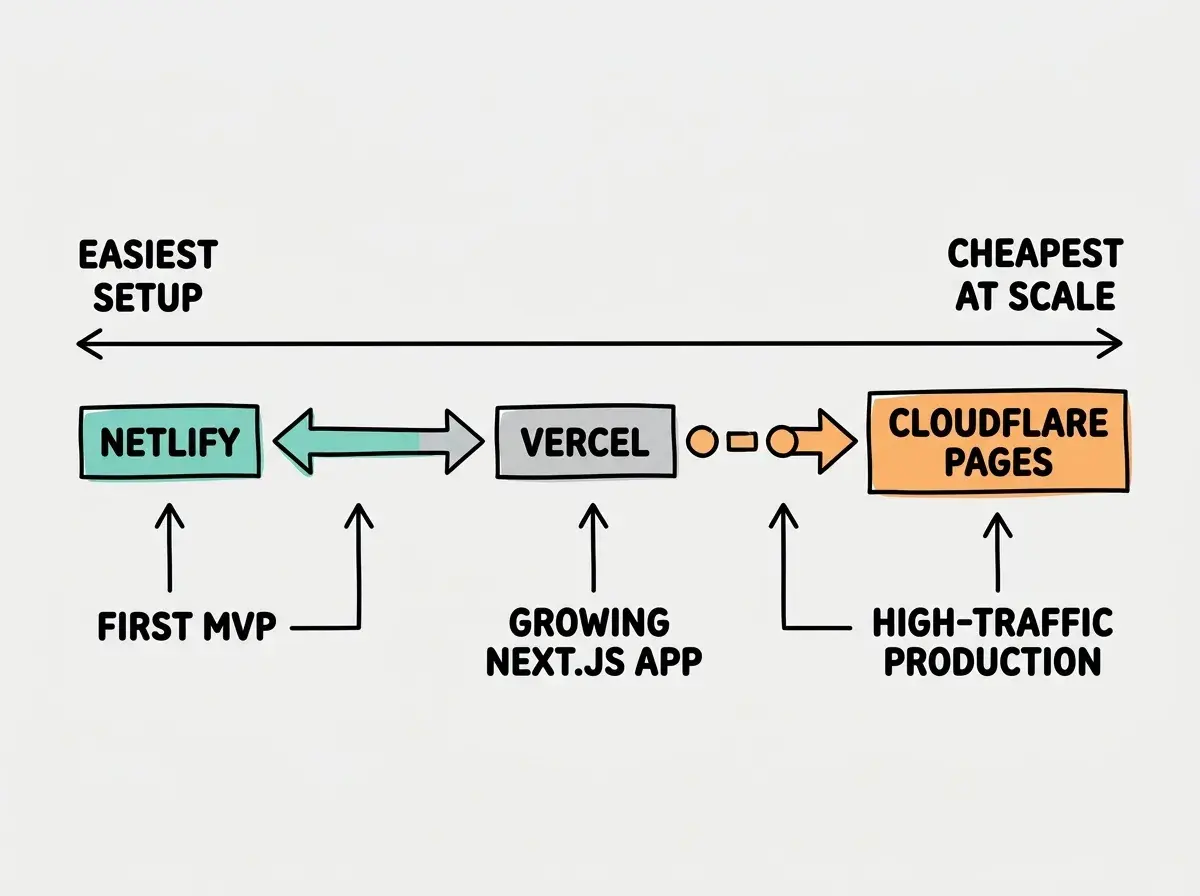
The platform that is easiest to start with is not always cheapest to stay with. Vercel's free tier is generous, but a single viral moment can turn a $0 bill into a $500+ surprise. Cloudflare Pages is harder to set up, but your bill barely moves no matter how much traffic you get. Choose based on where your app is heading, not just where it is today.
What Vercel Does Well
The best developer experience for Next.js, period. Vercel built Next.js, so everything works together seamlessly. Push to GitHub, your app deploys in seconds with zero configuration. Preview deployments, instant rollbacks, server components, edge functions, image optimization, and ISR all work out of the box. If you are vibe coding a Next.js app with Cursor or Claude Code, Vercel removes an entire category of deployment friction.
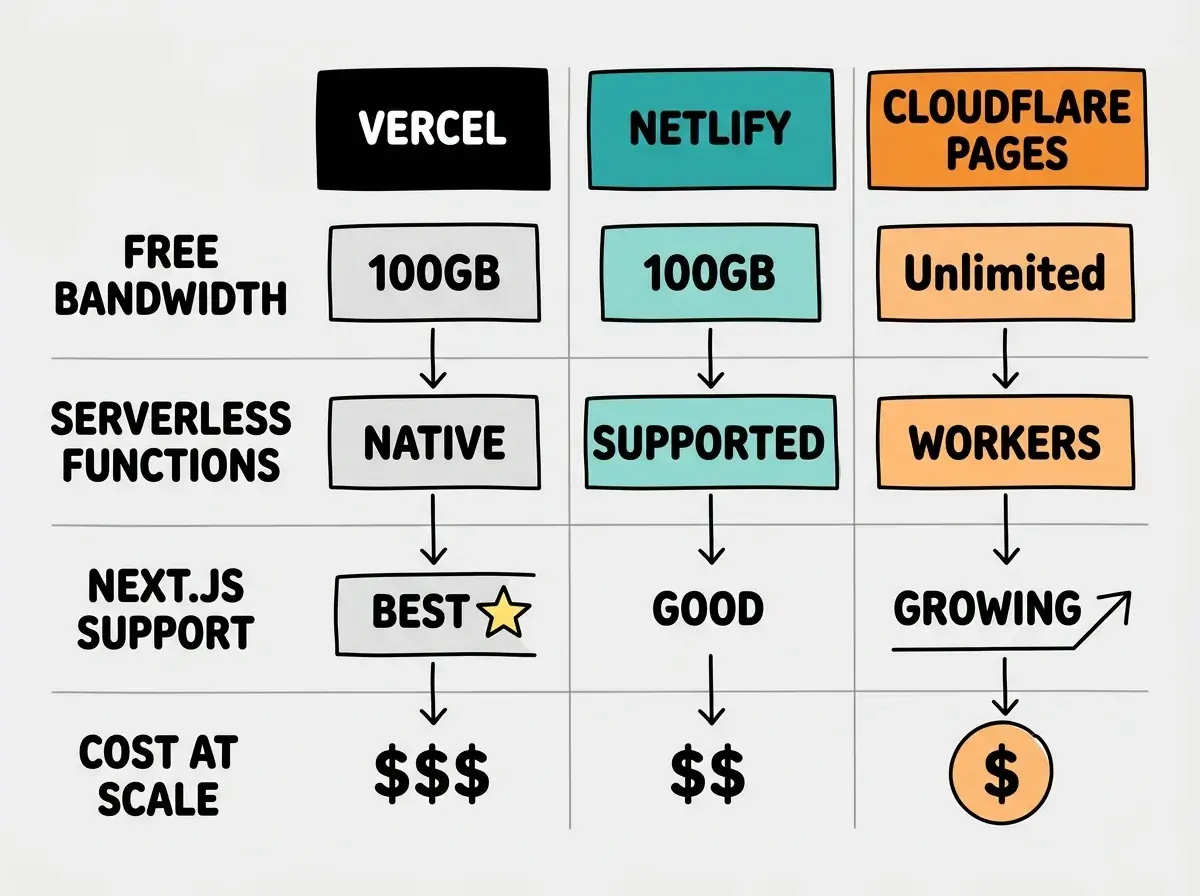
Generous free tier for validation. The Hobby plan gives you 100 GB of bandwidth, serverless functions, edge functions, and analytics. For a side project getting a few thousand visitors a month, you will not pay a cent.
Preview deployments that change how you work. Every pull request gets its own live URL. When you are vibe coding with an AI tool that generates entire features in a single session, you can push to a branch, get a preview URL, test it on your phone, and merge or trash it. The feedback loop between "AI generated this" and "I verified it works" shrinks to minutes.
What Netlify Does Well
The simplest deploy workflow that exists. Connect your repo, pick a branch, and you are live. Netlify pioneered the "git push to deploy" model that everyone else copied. Build settings auto-detect your framework, deploy previews work instantly, and the dashboard is clean. For someone who just vibe coded their first app, Netlify has the lowest barrier to entry.
Flat pricing that is easy to understand. Netlify Pro is $19/mo per team, not per user. That includes 1 TB of bandwidth and 25,000 serverless function invocations. Compared to Vercel's per-seat pricing at $20/user/mo, Netlify is significantly cheaper for small teams.
Build plugins and built-in services. Need redirects, header injection, or Lighthouse audits on every build? Netlify has plugins for it. They also bundle Forms and Identity for contact forms and authentication without separate services. Limited compared to dedicated solutions, but for an MVP they eliminate integration overhead.
What Cloudflare Pages Does Well
Unlimited bandwidth on the free tier. This is the headline number that makes the other two platforms nervous. Cloudflare Pages gives you unlimited bandwidth, 500 builds per month, and access to Workers on the free plan. No bandwidth overages. No surprise bills when your app gets posted on Hacker News.
The fastest global edge network. Cloudflare operates data centers in over 300 cities. Your assets and edge functions run physically closer to your users than on any other platform. TTFB benchmarks show Cloudflare delivering pages 20-40ms faster for international users.
Workers cold-start in under 5ms. Cloudflare Workers run on V8 isolates, not containers, so traditional serverless cold-starts of hundreds of milliseconds do not apply. The Workers Paid plan at $5/mo includes 10 million requests, orders of magnitude more than Vercel or Netlify include at comparable price points.
R2 storage eliminates egress fees. Cloudflare R2 gives you S3-compatible object storage with zero egress fees. On AWS S3, transferring 1 TB out costs roughly $90. On R2, it costs $0.
Learn the fundamentals of deploying vibe-coded projects.
Read the basicsHead-to-Head on What Matters
Developer Experience
Vercel wins by a wide margin. Dashboard, CLI, and GitHub integration are all polished. Error messages are clear and the experience of pushing code and watching it go live feels genuinely good.
Netlify is a close second. Clean dashboard, simple deploys, gentle learning curve. It falls behind in the details: serverless function debugging is rougher, and framework detection occasionally misconfigures projects.
Cloudflare Pages is functional but unpolished. The documentation is fragmented between Pages, Workers, and the broader Cloudflare ecosystem. You will spend time troubleshooting configuration issues that simply do not exist on Vercel. For senior devs, this is fine. For someone shipping their first app, it is a real barrier.
Pricing at Scale
This is where the comparison gets uncomfortable for Vercel. Here is what happens when your app starts growing.
Vercel: Pro at $20/user/mo includes 1 TB of bandwidth and 1,000 GB-hours of serverless execution. Bandwidth overages cost $40/100 GB. A moderately successful SaaS with 50,000 monthly users can hit $200-500/mo. Reddit threads are filled with $500+ surprise bills after traffic spikes. Remember the developer who got a $607 bill from Replit after an AI-built app went unexpectedly viral? Cost surprises are real in this space, and usage-based pricing is where they happen.
Netlify: More predictable. Pro at $19/mo (flat, per team) includes 1 TB of bandwidth. Overages are $55/100 GB. The flat team pricing makes it cheaper than Vercel for teams of 2+, but bandwidth overages can still sting.
Cloudflare Pages: The free tier has unlimited bandwidth. Workers Paid at $5/mo gives you 10 million requests. After that, $0.15 per million. An app serving 100,000 users per month might cost $5-15/mo on Cloudflare versus $100-300/mo on Vercel. The math is not close at scale.
Choosing a hosting platform based on its free tier and assuming costs will scale linearly. They do not. Vercel's free-to-Pro jump is manageable, but Pro-to-heavy-usage is where bills spike. Always model your expected traffic against each platform's overage pricing before committing. A $0 bill today does not mean a $0 bill next month.
Performance
All three platforms serve static assets fast. The differences show up in dynamic content.
Cloudflare wins on raw edge performance with the largest network and fastest cold starts. If your users are spread across continents, Cloudflare delivers noticeably faster responses.
Vercel wins on optimized Next.js performance. ISR, streaming server components, and edge middleware are first-class features that Vercel has spent years tuning. For Next.js specifically, your app performs better on Vercel without manual optimization.
Netlify performs well for static content but lags on dynamic workloads. Serverless functions run on AWS Lambda under the hood, meaning 200-500ms cold starts.
AI-Tool Compatibility
This category matters most for vibe coders and does not exist in most comparison articles.
Vercel integrates with v0 (their AI UI generator) and the Vercel AI SDK. If you are using Cursor, Claude Code, or Bolt to generate Next.js apps, Vercel's deploy pipeline handles the output with zero friction.
Netlify works with AI-generated code but has no AI-specific features. What it does have is simplicity. If your AI tool generates a static site or a basic framework app, Netlify deploys it without configuration. The lack of complexity is itself a feature when you are shipping fast.
Cloudflare Pages requires the most setup for AI-generated apps, especially those using SSR. The @opennextjs/cloudflare adapter works for Next.js, but adds a configuration layer that does not exist on Vercel. Workers AI lets you run inference at the edge, a unique capability, but not something most vibe coders need on day one.
Frequently Asked Questions
Who Should Use What
Use Vercel if you:
- Are building with Next.js and want zero-friction deploys
- Value developer experience and polished tooling above all else
- Want preview deployments for rapid iteration during vibe coding sessions
- Are comfortable with usage-based pricing and plan to monitor your bill
Use Netlify if you:
- Are deploying static sites, Jamstack apps, or simple framework projects
- Want the simplest deploy process with the gentlest learning curve
- Have a small team and want flat, predictable pricing
- Are shipping your first AI-built project and want the fewest moving parts
Use Cloudflare Pages if you:
- Are cost-sensitive and expect your app to get real traffic
- Need unlimited bandwidth without worrying about overages
- Want the fastest edge performance for a global audience
- Are comfortable with rougher DX in exchange for lower costs
Step-by-step guides for shipping your AI-built app on any platform.
See deployment guidesWhat This Means For You
The hosting decision is really about time horizon. Today's free tier does not tell you what next year's bill looks like.
- If you are an indie hacker testing an idea: Start with Vercel for the DX or Netlify for the simplicity. Both free tiers are generous enough for validation. But the moment your app gets consistent traffic, model your costs on Cloudflare. Moving platforms is annoying, but it is cheaper than paying 10x more per month for the convenience of staying put.
- If you are a senior dev building for production: Cloudflare Pages with Workers gives you the best cost-to-performance ratio at scale, and the DX gap is closing fast. The money you save goes into building your product instead of paying your hosting bill.
- If you are building a Next.js app specifically: Vercel is the path of least resistance. The framework integration is unmatched. Just set billing alerts. Seriously. Set them on day one, before your app gets its first user. A $20/mo budget can become $500 overnight if you are not watching.
The best platform is the one that lets you stop thinking about hosting and start thinking about what you are building. For most vibe coders starting out, that is Vercel or Netlify. At scale, that is Cloudflare. Plan your move before you need to make it.