To do user segmentation for targeted features in 2026, focus on the four segmentation dimensions that consistently produce actionable cohorts (behavioral patterns based on actions taken, lifecycle stage from new to power user, business attributes for B2B contexts, intent signals from session activity), instrument your product to capture the data needed for each dimension, and operationalize segmentation through feature flags and audience-targeted messaging. Effective segmentation transforms generic product launches into focused experiments that produce measurable results per segment.
This piece walks through the four segmentation dimensions, the data instrumentation needed, the operational patterns, and the four mistakes that turn segmentation into a vanity exercise rather than a growth tool.
Why Segmentation Matters More for AI-Built Products
AI-built products often serve diverse user bases from day one because the broad reach of AI tools brings in users from many backgrounds and use cases. Without segmentation, product decisions optimize for an "average user" who often does not exist; features serve nobody well.
The 2026 reality is that the tooling for segmentation has matured significantly. PostHog, Mixpanel, Amplitude all make behavioral segmentation accessible at indie scales. The infrastructure that previously required dedicated data engineers now runs on managed services accessible to any team.
A 2025 ProductLed report tracked 800 SaaS products and found that products doing active segmentation had 38 percent higher feature adoption rates and 29 percent better retention compared to products treating users uniformly. The mechanism was straightforward: targeted features land better with users who actually wanted them; generic features dilute attention. Segmentation is not a tactic; it is a fundamental operating discipline.
The pattern to copy is the way modern marketing operates. Mass marketing was the default for most of the 20th century; targeted marketing dominates today because it works dramatically better. Product development is on the same trajectory: generic products are being replaced by segment-specific products, even when the underlying tool is one product.
The Four Segmentation Dimensions
Four dimensions consistently produce actionable segments. Each captures a different aspect of user variation.
Dimension 1, behavioral patterns. What actions users take, how often, in what sequence. The most powerful segmentation dimension because it reflects actual usage rather than declared intent.
Dimension 2, lifecycle stage. New users, activated users, regular users, power users, churning users. Each stage has different needs.
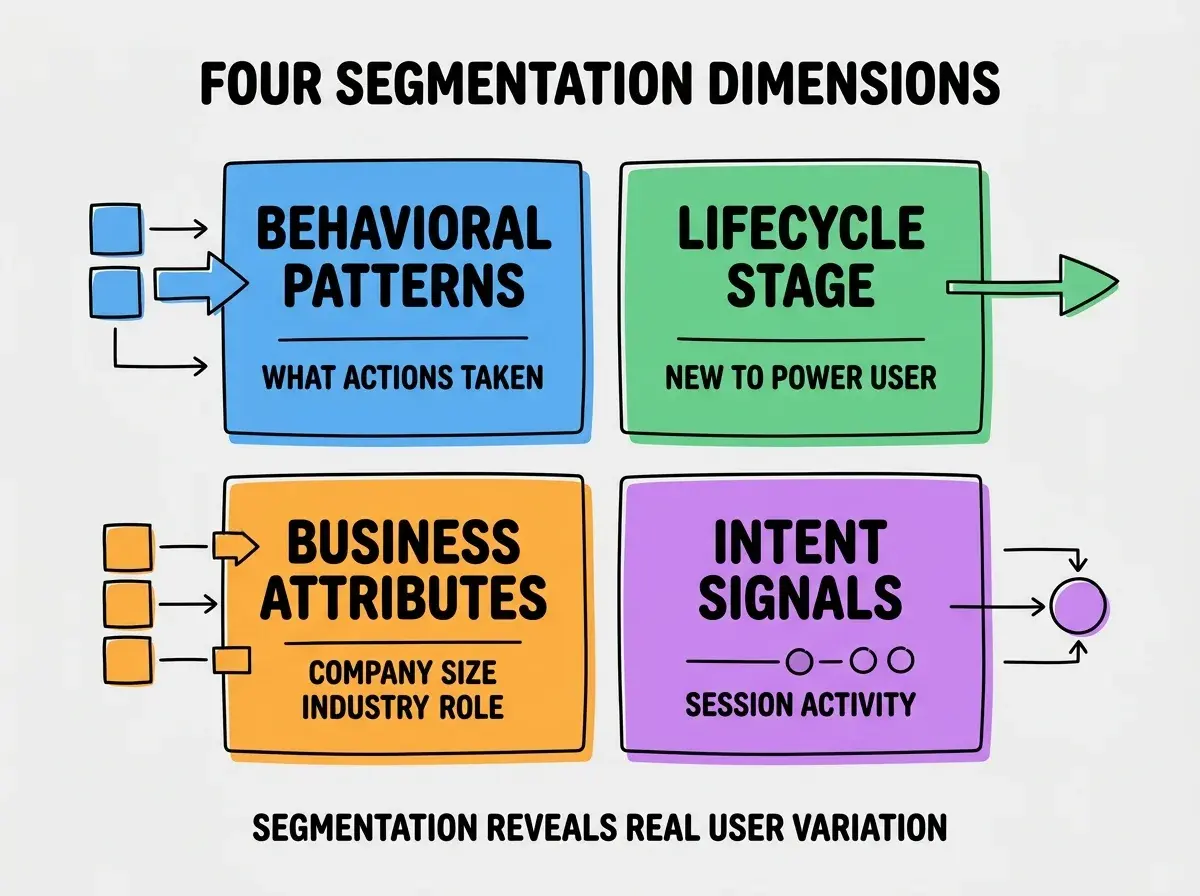
Dimension 3, business attributes. For B2B products: company size, industry, role, technology stack. Drives feature relevance and pricing.
Dimension 4, intent signals. What users seem to be trying to accomplish in a session. High-intent vs low-intent shapes how the product should respond.
The Data Instrumentation Needed
Effective segmentation requires capturing the right data. Three instrumentation patterns cover most needs.
Pattern 1, event tracking for behavioral data. Track meaningful actions (signup, first feature use, conversion, etc.) with relevant properties. PostHog and similar tools handle this with low setup overhead.
Browse more growth guides
Read more grow articlesPattern 2, user properties for stable attributes. Company info, role, signup source, plan tier. Set on signup; update as needed. Used for joining behavioral data with business context.
Pattern 3, session metadata for intent. Device type, time of day, referrer, time-on-task. Captures how users are engaging in real-time.
How to Operationalize Segmentation
Segmentation produces value only when it changes what the product does. Three operational patterns make segmentation actionable.
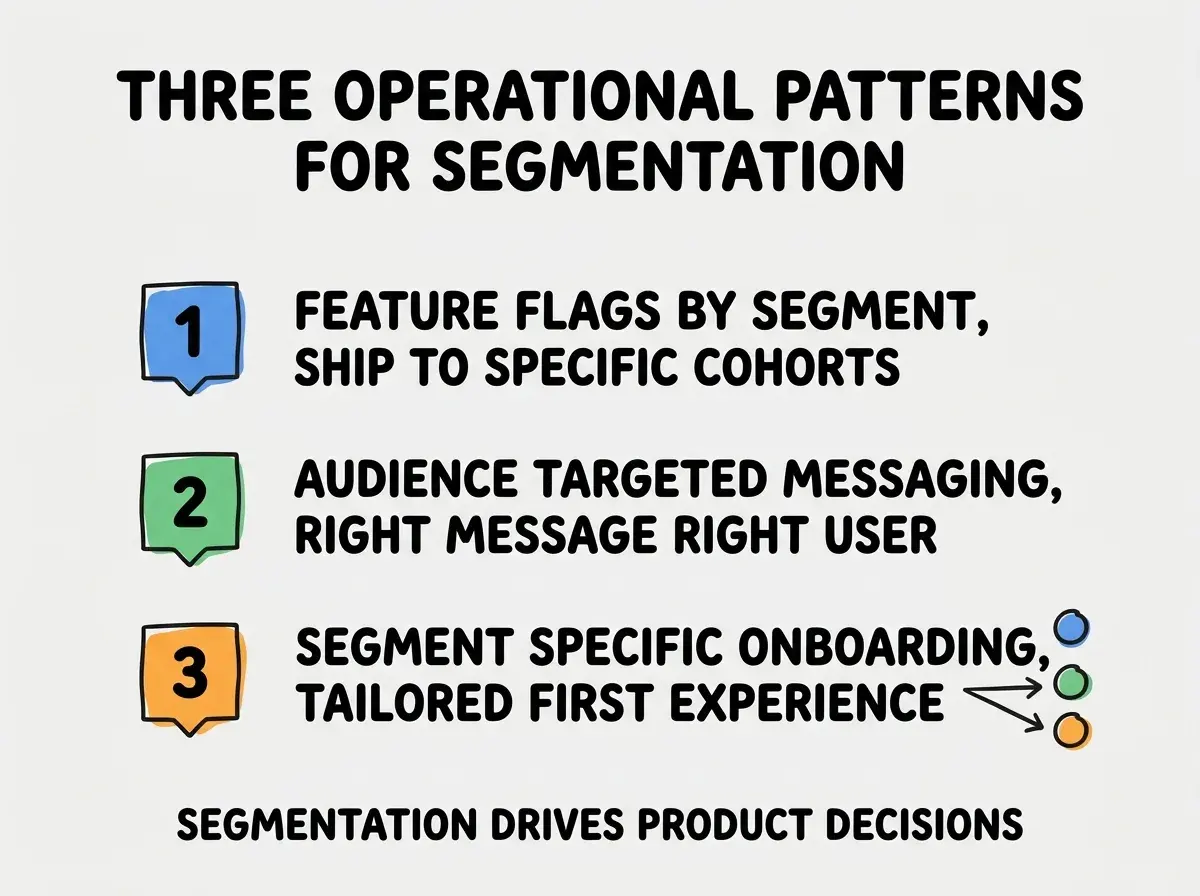
Pattern 1, feature flags by segment. Ship new features to specific segments first. Test with the most relevant cohort; expand based on results.
Pattern 2, audience-targeted messaging. In-app messages, email campaigns, notifications targeted to specific segments. Right message at right time to right user.
Pattern 3, segment-specific onboarding. Different first-time experiences for different segment types. Founders need different onboarding than enterprise users.
How to Avoid Segmentation Theater
Segmentation can become a vanity exercise that produces reports nobody acts on. Three patterns prevent this.
Pattern A, every segment ties to a product decision. If you cannot articulate "what we will do differently for this segment," do not create the segment. Reports without action are dashboard decoration.
Pattern B, limit the number of active segments. 5-7 segments is plenty for most products. More segments mean more analysis paralysis. Pick the segments that produce the most distinct insights.
Pattern C, review segment health quarterly. Are segments still relevant? Have they grown or shrunk? Are decisions actually being made differently? Quarterly review prevents stale segmentation that no longer reflects user reality.
The combination keeps segmentation focused on producing better outcomes rather than generating more data. Without this discipline, segmentation becomes a costly hobby that consumes analyst time without affecting the product.
The most damaging segmentation mistake is creating too many segments early on, before you have the data to maintain them or the bandwidth to act on them differently. A startup with 12 customer segments and 200 users has segments of 17 users each, which is too small for statistical significance and too many for the team to handle. The fix is to start with 3-5 segments, prove they drive better decisions, then add more as your scale and capacity grow. Segmentation maturity should match team and user-base maturity; running ahead of either produces costly noise.
The other mistake is treating segmentation as a one-time setup rather than as an ongoing practice. User behavior evolves, your product evolves, and segments need to evolve with both. Quarterly review and refinement keep segmentation aligned with current reality. Without ongoing maintenance, segmentation drifts into irrelevance within a year.
Common Segmentation Patterns Across Product Categories
Three patterns recur across product categories. Knowing them accelerates segment design for new products.
Pattern A, free vs paid behavior splits. Free users behave differently from paid users in nearly every product. Different onboarding, different feature emphasis, different retention strategies. Almost universal pattern.
Pattern B, single user vs team usage. B2B products serve both. Single users want different features than team users. Often justifies different pricing tiers and onboarding flows.
Pattern C, integration depth. Users who connect 5 integrations behave differently from users with zero integrations. Often correlates with retention and willingness to pay.
Segmentation and AI Personalization
AI is increasingly enabling per-user personalization, which raises the question of whether broader segments still matter. Three considerations matter.
Consideration 1, segments still drive product decisions. AI personalizes within features; teams still need to decide which features exist. Segments inform those team decisions.
Consideration 2, hybrid approach is winning. Segments for product strategy; AI personalization for runtime experience. Each layer does what it does best.
Consideration 3, watch for segment drift from AI changes. AI personalization can shift how segments behave. Periodic re-analysis catches segment drift before it becomes invisible.
The combination of segment-level strategy and AI-level personalization is increasingly the operating model for sophisticated product teams. Pure segment thinking misses individual variation; pure AI personalization misses the strategic decisions that segments inform. The hybrid approach captures the strengths of each layer without sacrificing what either does well, and product teams that adopt the hybrid model in 2026 are positioning themselves for the next several years of competitive advantage.
What This Means For You
User segmentation is one of the higher-leverage growth practices for any product team in 2026. The discipline of treating users as distinct cohorts (rather than as an undifferentiated mass) produces dramatically better product decisions and growth outcomes.
- If you're a founder: Build segmentation into your product analytics from day one. The investment is small; the payback is significant.
- If you're changing careers into product or growth: Segmentation literacy is increasingly expected for senior roles. Practice with public datasets if your current role does not provide opportunities.
- If you're a student: Study how successful companies segment their users. The patterns transfer across product categories.
Browse more growth guides
Read more grow articles