To run A/B testing in production effectively in 2026, focus on the four test types that consistently produce learnings (UI changes for conversion optimization, copy changes for messaging clarity, feature flag rollouts for safe deployment, pricing tests for revenue impact), use a proper experimentation tool like PostHog, GrowthBook, or Statsig rather than rolling your own, calculate sample size before running tests so you know when to stop, and resist the temptation to peek at results mid-test. Rigorous methodology produces real learnings; sloppy methodology produces confident wrong answers.
This piece walks through the four test types, the tooling options, the methodology basics, and the four mistakes that turn A/B testing into noise that wastes engineering time.
Why A/B Testing Matters More for AI-Built Products
AI-built products often have founders who optimize based on intuition rather than data. This worked when teams were tiny and stakes were low; as products grow, intuition increasingly leads astray. A/B testing is the discipline that replaces "I think this will work" with "the data says this works."
The 2026 reality is that A/B testing tooling has matured to the point where indie products can run rigorous experiments without building infrastructure. PostHog, GrowthBook, Statsig, LaunchDarkly all provide experimentation as a feature. The infrastructure that previously required dedicated platform teams now runs on managed services.
A 2025 Microsoft Research analysis of 10,000 A/B tests across products found that only 10-20 percent of tested ideas produced meaningful positive results. The implication is that intuition is wrong 80-90 percent of the time about what works. Without A/B testing, founders ship the bad ideas alongside the good ones, diluting overall product quality. A/B testing is what separates the wins from the misses systematically.
The pattern to copy is the way pharmaceutical companies test drugs. Drug companies do not ship medications based on the inventor's intuition; they run rigorous trials because the cost of being wrong is too high. Software has lower stakes per decision but higher decision frequency; A/B testing brings the rigor of trials to product decisions.
The Four Test Types That Matter
Different test types serve different purposes. Four types cover what most product teams need.
Test type 1, UI changes for conversion. Button colors, layout variations, page structure. Classic A/B testing territory. Quick to set up, often produces small-but-meaningful lifts.
Test type 2, copy changes for messaging. Headlines, CTA text, value propositions. Often produces larger lifts than UI changes because messaging is high-leverage.
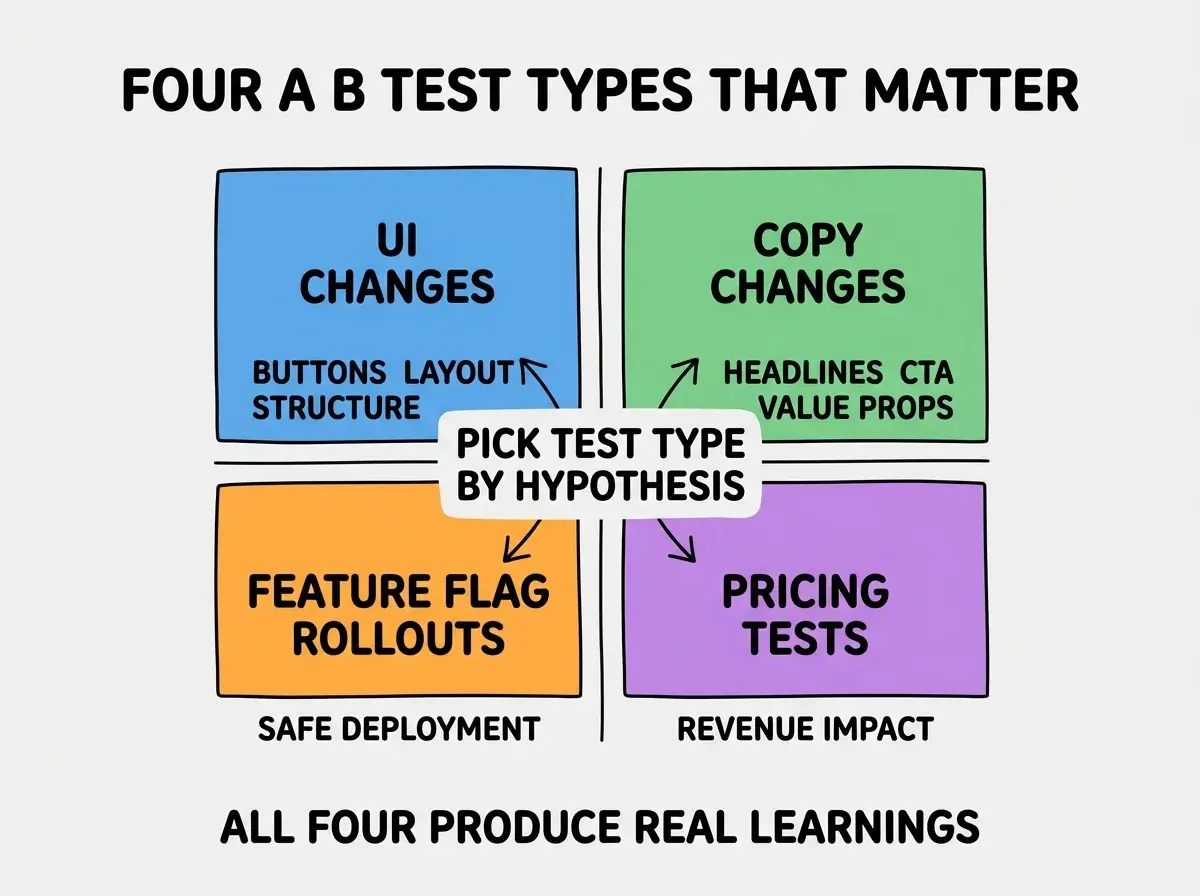
Test type 3, feature flag rollouts. Ship new features to a small percentage first; expand if metrics hold. Both safety mechanism and gradual experiment.
Test type 4, pricing tests. Test different price points, packaging, free trial lengths. Highest stakes (real revenue impact); requires careful methodology and longer test windows because pricing decisions take time to play out across the customer lifecycle.
The Tooling Options
Three categories of tools cover most A/B testing needs. Pick based on team size and complexity needs.
Tool 1, PostHog. All-in-one product analytics with built-in feature flags and experiments. Free tier generous. Right for indie hackers and small teams.
Browse more experimentation guides
Read more grow articlesTool 2, GrowthBook. Open-source experimentation platform with strong statistical methodology. Right for teams that want rigor without enterprise pricing.
Tool 3, Statsig or LaunchDarkly. Enterprise-grade experimentation. More expensive but more powerful. Right for teams running many experiments simultaneously.
The Methodology Basics
Three methodology principles separate rigorous A/B testing from random number generation.

Principle 1, calculate sample size first. Before starting a test, calculate how many users you need to detect the lift you care about. Stopping early produces false positives; running too long wastes opportunity.
Principle 2, do not peek mid-test. Looking at results mid-test creates the temptation to stop early at a "winning" point that is actually random. Wait for the predetermined sample size.
Principle 3, one variable at a time. Testing two changes simultaneously means you cannot attribute the result to either. Keep tests focused on one variable so you know what caused the lift.
How to Choose What to Test
Three principles help pick which tests to run when you cannot test everything.
Principle 1, prioritize by traffic and impact. Test pages that get the most traffic; lifts on high-traffic pages compound dramatically. Test changes that affect the conversion event; UI changes far from conversion produce smaller business impact.
Principle 2, test where you have hypotheses, not where you do not. A specific hypothesis about why something might lift produces a meaningful test. Random "let us see what happens" tests usually produce noise. Hypothesis quality predicts test quality.
Principle 3, test things that would change behavior if true. Testing two button colors that both work fine produces small lifts at best. Testing a fundamentally different value proposition produces large lifts or large losses; either outcome teaches something. Bigger swings produce bigger learning.
The combination produces a test pipeline that consistently produces meaningful results. Without these principles, A/B testing becomes a treadmill of small tests that prove nothing definitive.
How to Interpret Results Honestly
Three patterns help interpret A/B test results without falling for common pitfalls.
Pattern 1, look at confidence intervals, not just p-values. A "winning" test with a wide confidence interval might actually be noise. Narrow confidence intervals indicate real effects.
Pattern 2, segment results by user type. A test that wins overall might lose for specific segments. The aggregate hides important variation; segmentation reveals it.
Pattern 3, post-test follow-up. After shipping the winner, monitor for several weeks. Some lifts decay; some compound. Long-term tracking confirms the test was real, not noise. Set a calendar reminder 30 days post-ship to verify the lift held; surprising decay is a common pattern that catches teams who do not check.
The combination produces results you can trust enough to ship. Without rigorous interpretation, A/B testing becomes confidence theater that ships changes based on weak evidence.
The most damaging A/B testing mistake is running too many small tests instead of fewer big tests. Teams that run 20 tests per quarter often produce no significant winners because each test had insufficient sample size. The fix is to focus on bigger tests with bigger expected lifts. 4 well-powered tests per quarter that each test meaningful changes produce dramatically more learning than 20 underpowered tests on minor variations. Concentration beats fragmentation for A/B testing program impact.
The other mistake is testing things that do not actually matter. A/B testing button colors when the value proposition is unclear is optimizing the wrong layer. The fix is to test the highest-uncertainty hypotheses, not the most-convenient hypotheses. If you have a strong hypothesis that messaging is wrong, test messaging, not button placement.
A third mistake is treating every test result as a permanent conclusion. Markets change, audiences shift, competitors move; what tested true 18 months ago may no longer be true today. Re-test important conversion elements every 12-18 months even if the original test was conclusive. The teams that maintain test discipline over time produce far better outcomes than those who treat A/B test results as written in stone.
What This Means For You
A/B testing in production is one of the higher-leverage growth disciplines for any product team in 2026. The discipline of testing rather than guessing produces dramatically better outcomes over time.
- If you're a founder: Adopt A/B testing once you have meaningful traffic (typically 10K monthly visitors minimum). Below that, intuition has to do the work.
- If you're changing careers into product or growth: A/B testing fluency is increasingly expected for senior roles. Practice with public tools and datasets.
- If you're a student: Read "Trustworthy Online Controlled Experiments" by Kohavi to understand the methodology that the major tech companies use.
Browse more growth guides
Read more grow articles