To understand time to ship benchmarks comparing AI assisted versus traditional development in 2026, recognize the four project type patterns the benchmarks organize into (greenfield MVPs where AI assistance produces 3-5x faster shipping, feature additions to existing codebases where AI assistance produces 1.5-2.5x faster shipping, refactoring projects where AI assistance produces 2-3x faster shipping, and complex integration projects where AI assistance produces 1.2-1.8x faster shipping), see what the benchmarks reveal about where AI assistance helps most and least, and consider what the patterns mean for project planning. The benchmarks reveal that AI assistance impact varies dramatically by project type.
This piece walks through the four project type patterns, what the benchmarks reveal, the implications for project planning, and the four mistakes when interpreting velocity benchmarks.
Why Time to Ship Benchmarks Matter
Time to ship benchmarks matter for project planning beyond rough estimates. The benchmarks matter; product managers and engineering leaders make commitments based on time estimates, and understanding where AI assistance helps most produces better commitments than generic productivity assumptions.
The 2026 reality is that benchmark data exists but varies dramatically by project type. Aggregate velocity statistics mislead when applied to specific projects; project type specific benchmarks produce more accurate planning.
A 2025 engineering benchmarks study of 400 projects across 50 companies found that AI assistance improved time to ship by 3.4x for greenfield MVPs but only 1.4x for complex enterprise integrations. The 2.5x range across project types reveals that aggregate benchmarks mislead for specific project planning.
The pattern to copy is the way construction industry uses cost per square foot benchmarks differently for different building types. Office buildings, hospitals, and warehouses have dramatically different costs; aggregate cost benchmarks mislead for specific project planning. Software projects benefit from similar specificity; project type matters dramatically.
The Four Project Type Patterns
Four project type patterns organize time to ship benchmark variance.
Pattern 1, greenfield MVPs. AI assistance produces 3-5x faster shipping. New projects without existing constraints benefit most from AI generation; the patterns are well represented in AI training data and the constraints are minimal.
Pattern 2, feature additions to existing codebases. AI assistance produces 1.5-2.5x faster shipping. Existing code patterns provide context but also constraints; benefits exist but are smaller than greenfield.
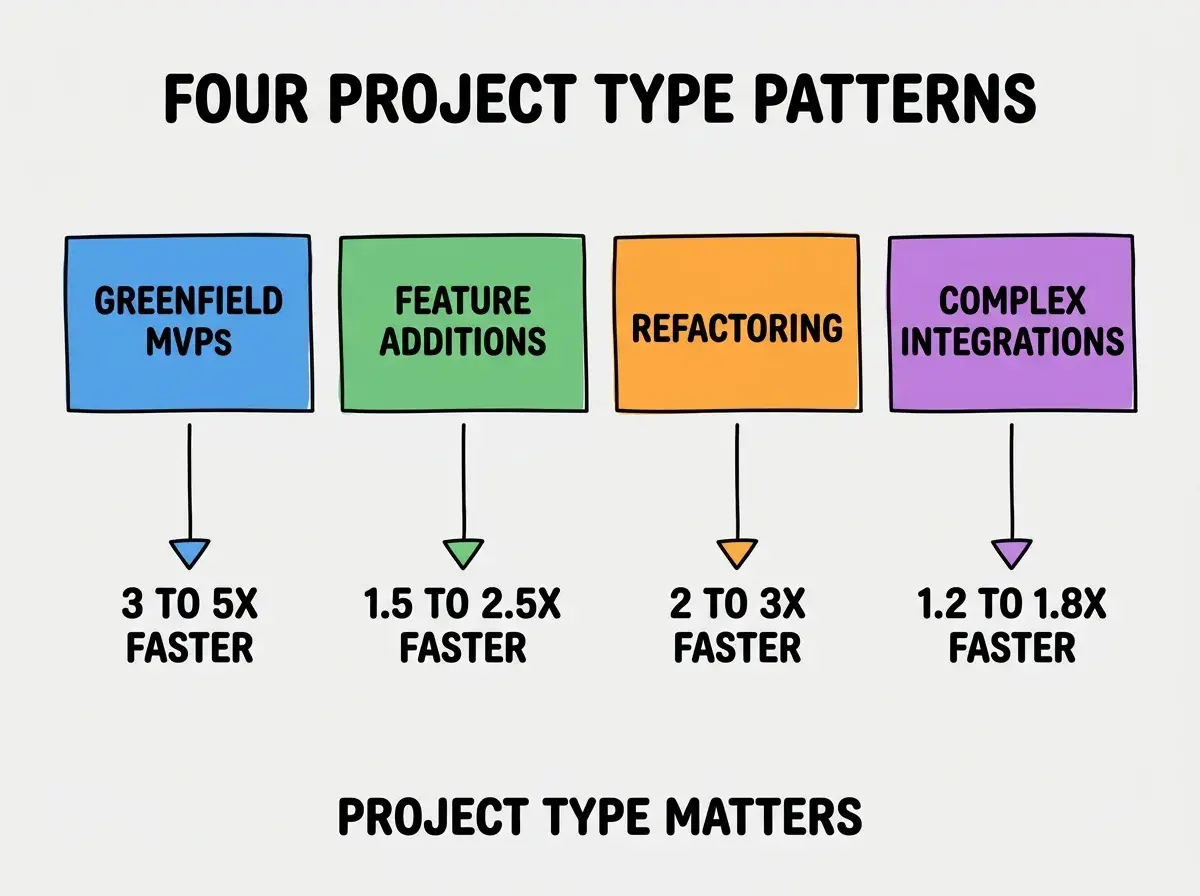
Pattern 3, refactoring projects. AI assistance produces 2-3x faster shipping. Refactoring benefits from AI's pattern recognition; mechanical refactoring particularly benefits.
Pattern 4, complex integration projects. AI assistance produces 1.2-1.8x faster shipping. Integration complexity often involves coordination, testing, and edge cases that AI generation handles less well; benefits exist but are smaller.
What the Benchmarks Reveal
Three patterns from the data reveal where AI assistance helps most.
Pattern 1, AI assistance helps most where patterns are common. Common patterns are well represented in AI training data; AI generation is better at common patterns than novel patterns. This explains why greenfield MVPs benefit most.
Browse more engineering analysis
Read more pulse articlesPattern 2, AI assistance helps least where coordination dominates. Complex integrations involve coordination across teams, services, and stakeholders that AI cannot accelerate. Coordination overhead dominates implementation time in these projects.
Pattern 3, refactoring benefits more than expected by many teams. Many teams underestimate AI refactoring benefits; the pattern recognition for systematic transformations is dramatic. Teams that include refactoring AI use see substantial gains.
What Benchmarks Mean For Project Planning
Three implication patterns matter for project planning with AI assistance.
Implication 1, project estimates should account for project type. Generic AI productivity multipliers produce wrong estimates. Type specific multipliers produce better commitments.
Implication 2, complex integrations should not assume same speed gains as greenfield work. Teams that planned ambitious integration timelines based on greenfield experience often miss timelines. Realistic integration timelines respect project type differences.
Implication 3, refactoring becomes more attractive as AI assistance multiplies it. Refactoring projects that previously seemed too expensive now become viable. The shift in refactoring economics produces strategic implications for technical debt management.
How Project Managers Should Apply These Benchmarks
Three application patterns help project managers apply benchmarks correctly.
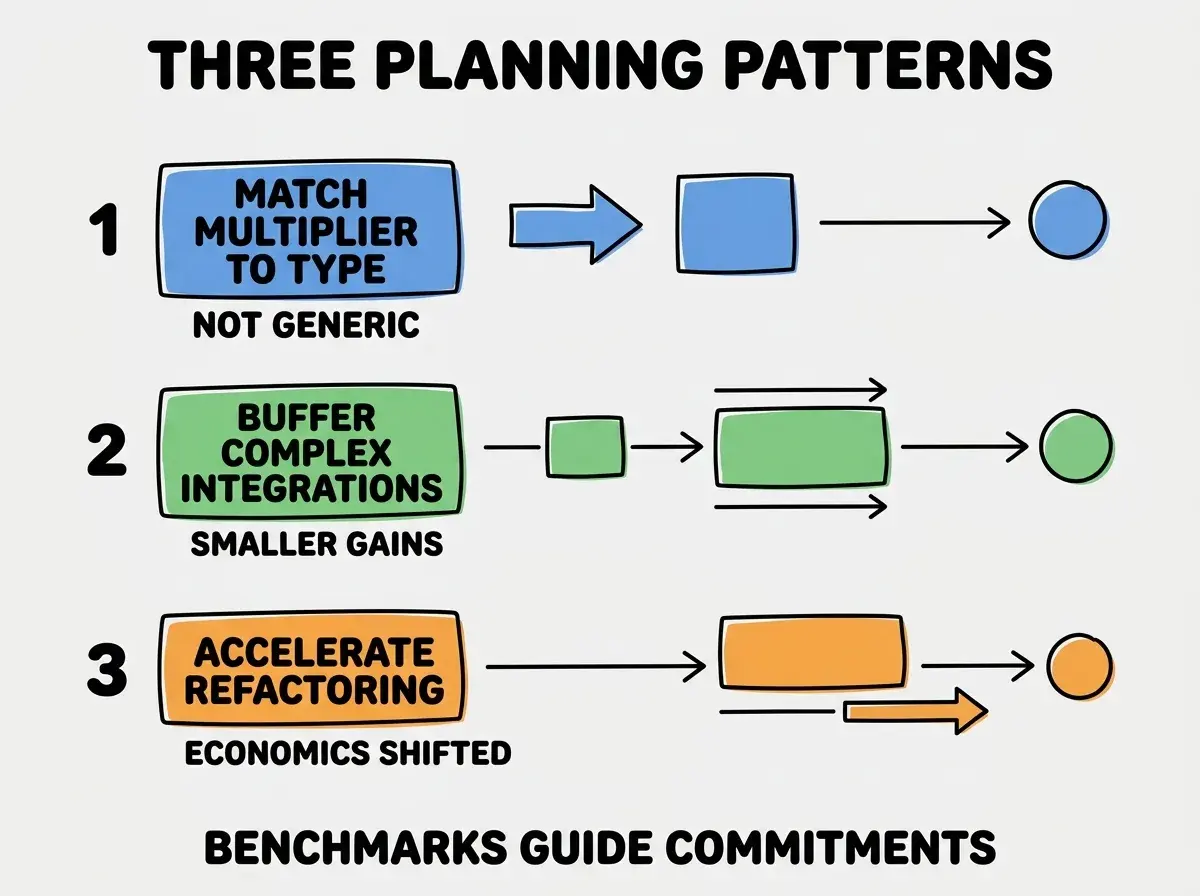
Pattern 1, match velocity multiplier to project type. Greenfield projects use 3-5x; complex integrations use 1.2-1.8x. Type specific multipliers produce accurate estimates.
Pattern 2, buffer complex integration estimates appropriately. AI assistance helps but does not eliminate the coordination overhead that dominates these projects.
Pattern 3, accelerate refactoring projects that AI economics now make viable. Strategic refactoring that previously seemed too expensive becomes possible with AI assistance.
The combination produces project planning that respects AI assistance variance. Without these patterns, project managers either over commit or under utilize AI assistance.
The most damaging benchmark interpretation mistake is using aggregate AI productivity multipliers for specific project planning. Aggregate multipliers obscure dramatic variance by project type; using them for specific projects produces wrong estimates. The fix is to use type specific multipliers based on what kind of project you are planning; the type specificity produces dramatically more accurate estimates than aggregate generic numbers. Most project planning failures with AI assistance come from generic multiplier application.
The other mistake is treating benchmarks as predictions rather than as planning anchors. Specific projects vary from benchmarks; benchmarks should inform planning but not replace project specific judgment.
A third mistake is missing the team experience dimension. Teams new to AI tools see lower benchmarks than experienced teams. The fix is to adjust expectations based on team AI fluency level.
A fourth mistake is ignoring the quality dimension when comparing speeds. Faster shipping at lower quality is not actual productivity gain. The fix is to consider both speed and quality when evaluating AI assistance benefits.
How Benchmarks Will Likely Evolve
Three benchmark evolution predictions matter for thinking about future planning. First, benchmark ranges will likely narrow as AI tools standardize; current variance reflects tool quality differences that will reduce as tools converge. Second, complex integration benchmarks will likely improve more than greenfield benchmarks; the room for improvement is larger where current gains are smaller. Third, longitudinal benchmarks measuring quality alongside speed will become standard; current speed only benchmarks miss the maintenance dimension that affects long term productivity dramatically.
The benchmark evolution matters for project planning across multi year horizons. Plans that account for likely benchmark improvements produce different decisions than plans that assume current benchmarks are permanent.
Engineering leaders should also recognize that benchmark improvements are not uniform across organizations. Teams with deeper AI fluency capture benchmark improvements faster than teams catching up; the velocity gap between AI fluent and AI agnostic teams may grow rather than shrink as tools improve.
What This Means For You
The time to ship benchmarks reveal AI assistance variance by project type. The four patterns, planning applications, and project manager implications produce framework for project planning with AI assistance.
- If you're a product manager: Project type matters more than generic AI productivity assumptions. Use type specific multipliers when planning timelines; the specificity produces better commitments.
- If you're a senior dev: Project type benchmarks inform where AI assistance helps your work most. Match AI tool investment to project types where benefits are largest.
- If you're a founder: Project type patterns inform technology strategy. Greenfield velocity benefits favor MVP focused strategies; complex integration constraints affect enterprise software strategies.
Browse more engineering analysis
Read more pulse articles