The agentic engineering roadmap after vibe coding will unfold across four phases through 2027 and beyond (chat-based AI assistance evolving to background agents, supervised agent workflows replacing solo coding sessions, multi-agent teams handling complex projects, autonomous engineering for well-defined tasks), with developers shifting from "writing code with AI help" to "directing AI teams toward outcomes." The transition is well underway in 2026; understanding the trajectory helps developers position their skills for what comes next.
This piece walks through the four phases, the developer role evolution, the skills that grow in value, and the four mistakes that leave developers stranded as the field evolves.
Why Vibe Coding Is the Beginning, Not the End
Vibe coding (chat-based AI assistance for code generation) is a milestone, not a destination. The pattern of "human prompts, AI generates, human reviews and accepts" is dramatically more productive than pure manual coding but still bottlenecked by human attention. The next phase is agentic engineering, where AI agents work in the background on bounded tasks with periodic human review.
The 2026 reality is that agentic engineering tools are emerging but not yet dominant. Devin, Codex, and similar agents handle some tasks autonomously; most coding still happens with human-in-the-loop AI assistance. The transition is gradual; the trajectory is clear.
A 2025 GitHub Octoverse report tracked 50,000 active development teams and found that 23 percent had at least one workflow that ran "fully autonomously" (AI agent completes a defined task without per-step human approval). The 23 percent figure is up from 4 percent in 2024 and projected to reach 60+ percent by 2027. The transition from chat-based assistance to agentic workflows is the dominant trend in development tooling for the next 2-3 years.
The pattern to copy is the way agriculture transitioned from manual to mechanized to automated over the 20th century. Each transition produced new roles even as it eliminated others. Farming did not disappear; it changed. Software engineering is on the same trajectory: agentic tools change what engineers do, but the role evolves rather than disappears.
The Four Phases of the Transition
Four phases describe the trajectory from current vibe coding to mature agentic engineering. We are mid-Phase 2 in 2026.
Phase 1, chat-based AI assistance (2023-2024). Developers chat with AI to generate code. Human reviews and accepts every output. The pattern that introduced AI to mainstream development.
Phase 2, supervised agent workflows (2025-2026). Agents complete bounded tasks (write tests for this function, refactor this file, fix this bug) under developer supervision. Less per-step interaction; periodic review.
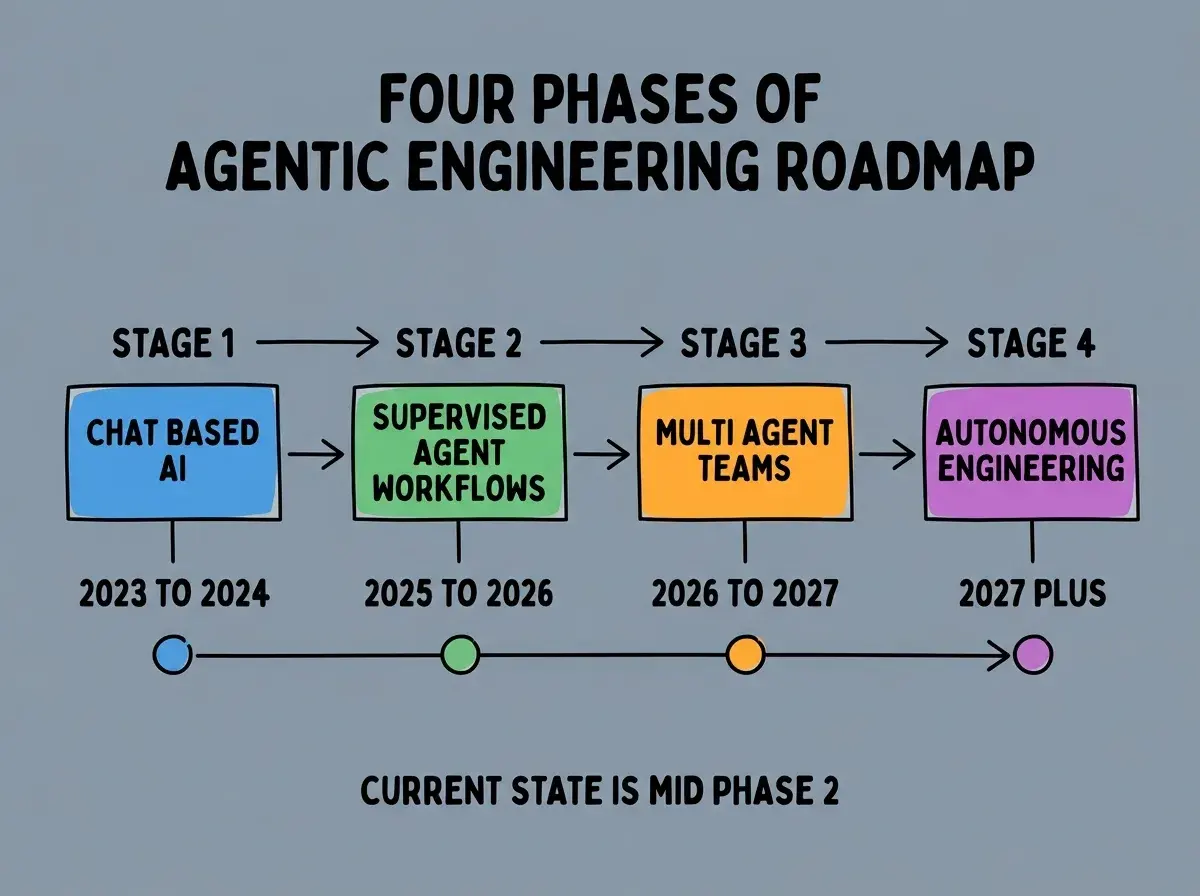
Phase 3, multi-agent teams (2026-2027). Multiple AI agents collaborate on complex tasks. One agent writes code, another reviews, a third deploys. Developer orchestrates the agent team.
Phase 4, autonomous engineering for well-defined tasks (2027+). Some categories of work (CRUD apps, well-specified migrations, routine maintenance) become fully autonomous. Developer specifies outcome, agent delivers.
The Developer Role Evolution
The developer role evolves through each phase. Three role transitions matter most.
Transition 1, from typist to reviewer. Phase 1 still requires significant typing. Phase 2 requires more reviewing than typing. By Phase 3, reviewing is the dominant activity.
Browse more future of dev guides
Read more pulse articlesTransition 2, from solo to orchestrator. Phase 1 is mostly solo work with AI as tool. Phase 3 involves orchestrating multiple agents. The skill set shifts toward coordination and direction.
Transition 3, from coding to specifying. Phase 4 makes coding largely automated for well-defined tasks. Developer's primary value moves to specifying what should be built and verifying it works correctly.
The Skills That Grow in Value
Some skills become more valuable as agentic engineering matures. Three skill categories grow most.
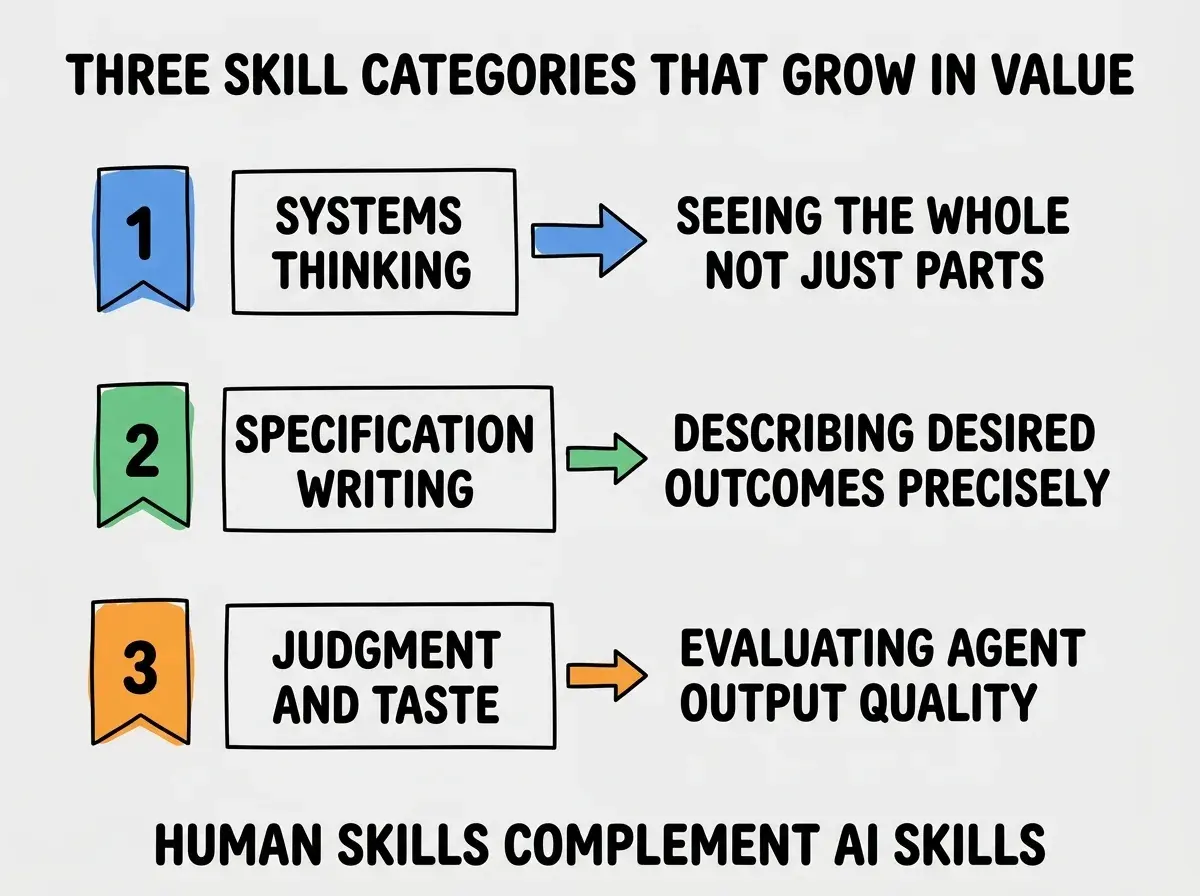
Category 1, systems thinking. Understanding how components fit together, where complexity lives, what fails in production. Agents handle pieces; humans see wholes.
Category 2, specification writing. Describing desired outcomes precisely enough that agents can deliver them. The skill of "telling AI exactly what you want" becomes increasingly central.
Category 3, judgment and taste. Evaluating whether agent output is good enough, identifying subtle problems, knowing when to insist on better. The qualitative judgment that AI cannot replicate.
The Skills That Decline in Value
Some skills become less valuable as the field evolves. Three categories matter to acknowledge.
Category A, syntax memorization. AI handles syntax; humans rarely need to type semicolons in the right places. Memorizing language-specific quirks loses value.
Category B, framework configuration trivia. Setting up Webpack, configuring TypeScript, wiring up dependencies. Agents handle this without human attention. The trivia becomes irrelevant.
Category C, manual code translation. Converting code from one language to another, porting between frameworks, mechanical refactoring. Agents do this faster and more accurately than humans.
The skills declining in value were never the most important parts of engineering; they were just the most visible. Their decline frees attention for the higher-leverage skills that grow in value.
The most damaging mistake developers make about agentic engineering is assuming current skills will remain equally valuable indefinitely. The developer who masters CRA + Express + manual debugging will find those skills decline in value over the next 3-5 years. The developer who invests in systems thinking, specification writing, and judgment will find those skills appreciate. The fix is to actively rebalance your skill investment toward what grows in value, not just toward what is currently in demand. Career investing requires a 3-5 year horizon; what is hot today may be commoditized by then.
The other mistake is treating agentic engineering as a threat rather than as an opportunity. Developers who fight against agents (refusing to use them, criticizing their output reflexively) lose ground rapidly to developers who learn to direct agents effectively. The agents are coming whether you embrace them or not; embracing them positions you to capture the upside.
What Companies Are Doing Now to Prepare
Forward-looking companies are restructuring to capture the agentic engineering opportunity. Three patterns are emerging.
Pattern 1, dedicated agent orchestration roles. Companies like Anthropic, Vercel, and others now have engineers whose primary job is designing agent workflows. The role did not exist in 2023; it is real and well-paid in 2026.
Pattern 2, internal agent platforms. Companies build internal platforms for safely running agents on internal tasks. Treat agents as employees with bounded permissions and audit trails.
Pattern 3, agent-friendly codebases. Refactoring codebases to be more amenable to agent work: clear documentation, smaller modules, comprehensive tests. The investment pays back as agentic work increases.
The companies that invest in these patterns now will have significant operational advantages by 2027-2028. The investment is real but the payoff is large.
How to Stay Current Through the Transition
The field moves fast. Three habits help developers stay current without burning out.
Habit A, follow the labs not the influencers. Anthropic, OpenAI, Google publish technical updates that matter. Influencer content often lags or misrepresents. Direct sources are better.
Habit B, build with new tools quarterly. Each quarter, build something with a new tool you have not tried. Hands-on experience teaches more than reading announcements.
Habit C, write about what you learn. Public writing forces synthesis and signals expertise. Blog posts, threads, conference talks. The writing builds your understanding and your reputation simultaneously.
What This Means For You
The agentic engineering roadmap matters because the trajectory is clear and the implications are significant. Developers who position for what comes next will benefit dramatically.
- If you're a founder: Plan your engineering team around the assumption that agentic workflows will dominate by 2027. Hire for systems thinking and judgment, not for typing speed.
- If you're changing careers into engineering: Lean into the skills that grow in value (specification writing, systems thinking) rather than into the skills that are declining.
- If you're a student: The skills you build now matter for the next decade. Bias toward judgment and systems thinking; AI handles the syntax.
Browse more future of dev guides
Read more pulse articles