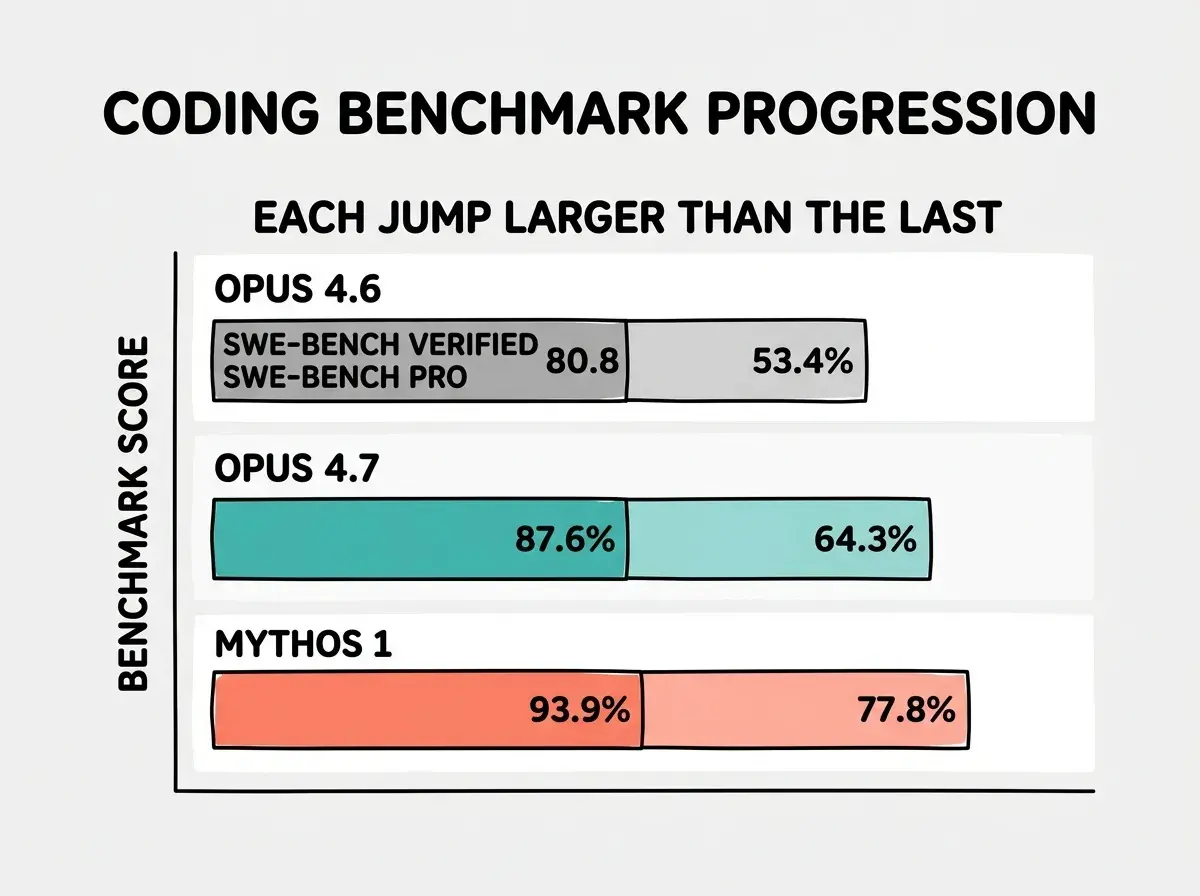
On May 23, Claude Code users briefly saw a "Mythos 1" toggle appear in the model selector for a few minutes before it vanished. The model string claude-mythos-1-preview was simultaneously found in the client source code. Anthropic's most capable model, scoring 93.9% on SWE-bench Verified versus Opus 4.7's 87.6%, is actively being prepared for Claude Code access.
The toggle sighting was not a glitch. It appeared one day after Anthropic published an official Project Glasswing update reversing its April position of "no public release" and committing to a general release "in the near future, once we've developed the far stronger safeguards we need." Mythos 1 is heading to the tool in your terminal, and the benchmark gap between it and today's Opus 4.7 is large enough to notice in daily work.
Why This Benchmark Jump Is Different From Previous Ones
Most model upgrades in 2025 and early 2026 produced incremental benchmark improvements: a few percentage points here, a few there. The jump from Opus 4.6 to Opus 4.7 brought SWE-bench Verified from 80.8% to 87.6%, which was the largest single leap vibecoders had seen in a Claude release. Mythos blows past it.
SWE-bench Verified at 93.9% means Mythos autonomously resolves almost nineteen out of twenty real GitHub issues from verified repositories, ones that a professional engineer had to manually review to confirm as genuinely fixed. SWE-bench Pro, a harder variant requiring end-to-end fixes in production-grade codebases, went from 64.3% for Opus 4.7 to 77.8% for Mythos. That 13.5-point gap on the harder benchmark is the number that matters most for vibecoders who push agentic sessions to completion.
Terminal-Bench 2.0, which measures how well a model executes long shell and coding tasks autonomously without handholding, went from 69.4% for Opus 4.7 to 82.0% for Mythos. For anyone running Claude Code in a long session on a real feature branch, that improvement translates to fewer failed tool calls, fewer mid-task derailments, and more complete diffs on the first pass.
The SWE-bench Pro gap between Opus 4.7 (64.3%) and Mythos (77.8%) is 13.5 percentage points, larger than the entire spread that separated GPT-4 from Opus 4.6 twelve months earlier. On agentic coding benchmarks that mirror what vibecoders actually do (long multi-step tasks, production codebases), Mythos is not a marginal upgrade. It is a full generation ahead of the model you are using today.
Anthropic's pricing signal for Project Glasswing partners is also informative. Partners pay $25 per million input tokens and $125 per million output tokens, five times Opus 4.7's cost. That is the pricing you would set for a model whose output is qualitatively different, not merely incrementally better. When Mythos reaches Claude Code subscriptions, it will almost certainly arrive as a gated premium tier, and Max or Team plan holders should expect to see it first.
How the Benchmarks Translate to Real Coding Work
The jump from 87.6% to 93.9% on SWE-bench Verified sounds like a stat, but it maps to something concrete in daily vibecoder sessions. SWE-bench issues come from real pull requests in repositories like Django, Flask, SQLAlchemy, and scikit-learn, projects with test suites, CI gates, and the kind of tangled dependency graphs that break agentic models. At 87.6%, Opus 4.7 already handles most straightforward bug-fix sessions well. The gain Mythos makes happens at the harder end: multi-file refactors, issues requiring changes across the test suite, and tasks where the model must first trace a bug through several layers before writing a fix.
Terminal-Bench 2.0 matters separately from SWE-bench. It tests whether a model can navigate a real shell environment, running test suites, reading logs, modifying files, re-running tests, without a human in the loop. Opus 4.7 at 69.4% still requires occasional nudges on longer sessions. Mythos at 82.0% closes a meaningful portion of that gap. Developers who have hit the wall where Claude Code completes 80% of a session correctly and then loses the thread are experiencing exactly what Terminal-Bench measures. Mythos extends that thread by roughly twelve points.
What the Toggle Sighting Tells Us
The brief appearance of a Mythos 1 toggle in Claude Code on May 23 is more than a curiosity. Anthropic does not accidentally ship model selection UI to production. Toggles appear in production interfaces when they have been built and are being tested against real user traffic. The toggle's reported prompt language, "Mythos 1 (Preview)" with a note about cybersecurity use restrictions, suggests a throttled access model is already engineered and not merely on a roadmap slide.
Analysis and updates for vibecoders on every major release
Read more pulse postsThe "cybersecurity restrictions" language is the key constraint to understand. Anthropic has been direct about why Mythos is not generally available: the model found over 10,000 high and critical-severity zero-day vulnerabilities in its first month of Project Glasswing deployment, including a 27-year-old OpenBSD TCP SACK remote code execution bug and a 17-year-old FreeBSD NFS RCE now tracked as CVE-2026-4747. A model that capable at autonomous vulnerability discovery requires careful guardrails before anyone with a Claude Code subscription can point it at arbitrary codebases.
The reversal in Anthropic's position, from "no public release" in April to "near future general release" in the May 22 Project Glasswing update, signals that those guardrails are actively being built. Opus 4.7 was deliberately released with reduced cybersecurity capability to serve as a safeguard testing vehicle at scale. The playbook is test the safeguards on the less dangerous model at scale, then apply hardened guardrails to Mythos before broader release.
The Safeguards Problem and the Timeline
Understanding why Mythos has been restricted helps set realistic expectations for when vibecoders will actually see it in their daily sessions. Anthropic's public position is unambiguous: "no company, including Anthropic, has developed safeguards strong enough to prevent such models from being misused and potentially causing severe harm." The dual-use ceiling is real. The same capability that makes Mythos exceptional at debugging complex codebases also makes it exceptional at finding exploitable vulnerabilities in them.
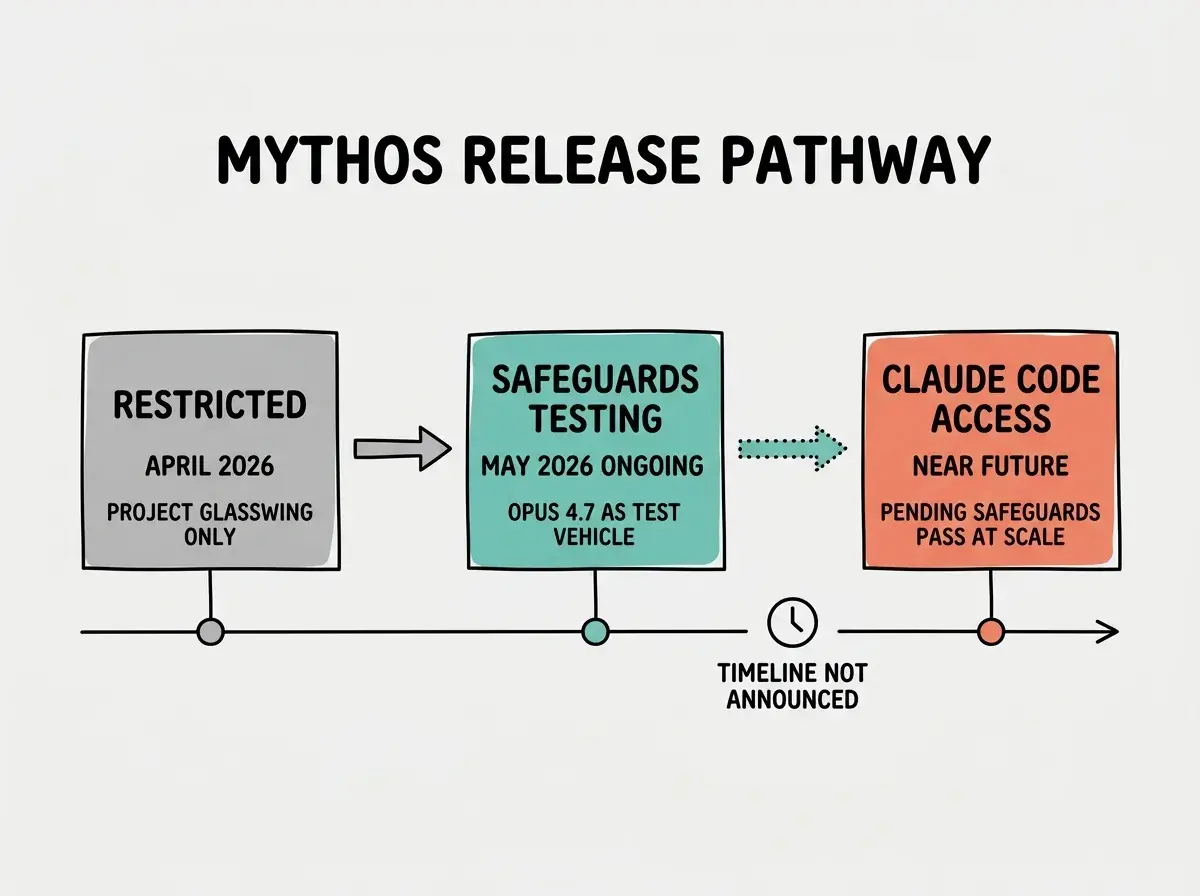
The practical question for vibecoders is not whether Mythos is coming to Claude Code. The toggle sighting and the public statement make that clear. The question is what the access tier will look like. Based on the Project Glasswing pricing and the existing Claude Code tier structure, the most likely scenario is a gated model selector available to Max and Team subscribers with additional terms of service around cybersecurity use, similar to how OpenAI gated o1 preview access in late 2025.
No public timeline has been announced. Anthropic's "near future" language is intentionally vague. Based on the speed of the Opus 4.7 safeguards rollout (released April 16, roughly five weeks after Glasswing restrictions were established in early March), a Claude Code preview toggle that stays live, rather than disappearing within minutes, is plausible within one to three months from today.
The mistake to avoid is treating the Mythos benchmark jump as purely a security story and ignoring its coding implications. The 77.8% SWE-bench Pro score is the single most relevant number for vibecoders: it means Mythos handles a category of agentic coding task that Opus 4.7 still fails roughly one-third of the time. When Mythos reaches Claude Code, sessions that currently require the most human intervention (complex multi-file refactors, tracing bugs across dependency layers, completing test suites without guidance) will succeed far more often on the first pass. Plan your workflows around that capability, not just its security context.
The other mistake is assuming Mythos access will cost dramatically more than your current Claude Code plan. Anthropic has consistently subsidized model costs on subscription tiers even when API pricing is high. The $125 per million output token Project Glasswing pricing reflects unsubsidized partner API access, not what Max subscribers will pay when the toggle goes live permanently.
The gap between the model you are using today and the one about to enter your terminal is the largest in Claude's history. The toggle appeared and disappeared in minutes. It will not stay hidden much longer.
What This Means For You
Mythos 1 arriving in Claude Code will not require you to change how you work. The improvement lands under the same interface you use today. But knowing what is coming affects decisions you make now.
- If you are on Pro and considering upgrading: Max or Team is where Mythos lands first. If your work involves complex agentic sessions that frequently stall in the last third, the upgrade window is approaching.
- If you build on top of Claude Code via the API: Watch the model list for
claude-mythos-1. When it appears, benchmark it against your specific workflows before your next infrastructure cost review. - If you are shipping a product with agentic code generation: Mythos's Terminal-Bench improvement (69.4% to 82.0%) directly maps to fewer failed tool calls and more complete outputs in production. Factor in a model tier change when pricing your service.
- If security review is part of your workflow: The Project Glasswing findings are a preview of what Mythos will do for your own codebase when it arrives with Claude Security integration. The same model that finds 10,000 zero-days in critical infrastructure can review your app before you ship it.
Analysis and updates for vibecoders on every major release
Read more pulse posts