SpaceX confirmed on June 16, 2026 that it will acquire Anysphere, the company behind Cursor, for $60 billion in an all-stock transaction. The deal is expected to close in Q3 2026 pending regulatory approval. For vibecoders who use Cursor every day, the immediate impact is zero, but Q3 is the inflection point when model access, data handling, and product direction could all shift under new ownership.
Nothing in Cursor changes before the Q3 2026 deal close. Claude, GPT-4o, and the Composer model family all remain accessible at current pricing today. The decision you need to make now is not whether to switch tools but whether you understand your own dependency well enough to act quickly if model support changes after close. That preparation takes an afternoon. Finding out you cannot replicate your workflow under a deadline costs significantly more.
The acquisition sits at the intersection of two trends that have been building throughout 2026: the rapid consolidation of AI coding tools under major tech platforms, and the intensifying race to train coding-specific models that can displace the general-purpose frontier models currently powering most IDEs. SpaceX is buying Cursor for both, and the two goals will pull the product in directions the Anysphere founding team alone would never have chosen.
What did SpaceX actually acquire on June 16
Anysphere is the Delaware corporation behind Cursor, an AI code editor that grew from roughly $100 million in annualized recurring revenue in early 2025 to more than $4 billion by June 2026, according to Yahoo Finance. That growth trajectory, combined with an estimated four million active developers, is why SpaceX paid what amounts to the largest acqui-hire price in the history of developer tooling.
CEO Michael Truell issued a statement the same day the deal was announced: "We are excited to share that SpaceX has exercised their option to acquire Cursor in an all-stock transaction with the goal of building the world's most useful AI models. We look forward to working closely with the SpaceX team to advance our frontier AI capabilities and continue to work closely with our customers and partners."
The phrase "exercised their option" indicates a prior arrangement existed before the June 16 announcement. TechCrunch reported that SpaceX and Cursor have been jointly training an AI coding model on xAI's Colossus supercomputing infrastructure for several months. That model is expected to ship inside both Cursor and xAI's Grok platform once complete. The public announcement came just four days after SpaceX's record IPO, which raised $75 billion on Nasdaq under the ticker SPCX. SpaceX needed publicly tradeable stock to use as acquisition currency, and Cursor was the first major deal after the IPO window opened.
The four co-founders of Anysphere, all MIT graduates, are CEO Michael Truell, Aman Sanger, Sualeh Asif, and Arvid Lunnemark. Each carries an estimated $2.7 billion in paper gains from the deal. There is no financial pressure on any of them to remain in operating roles after close, which is a meaningful uncertainty for a product where the founding team's product sensibility has been a key differentiator.
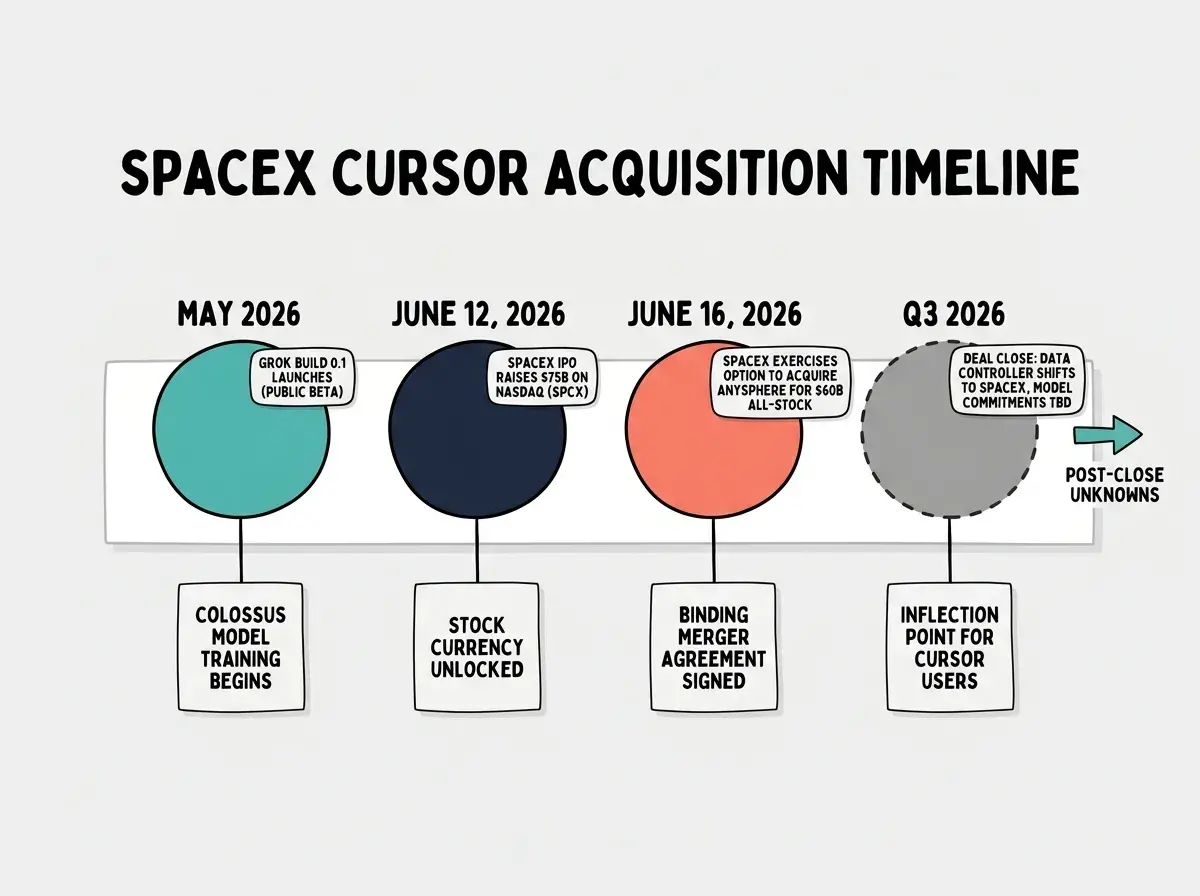
The deal structure itself signals SpaceX's confidence in its own stock price holding through regulatory review. An all-stock deal at a $60 billion valuation means Anysphere shareholders are betting that SPCX stays above the implied price through Q3. If SpaceX's stock falls materially before close, the effective deal value drops with it, which gives Anysphere shareholders and the founding team reason to care about SpaceX's performance between now and then.
What is SpaceX actually building by combining xAI and Cursor
SpaceX's move is fundamentally about the model war, not the IDE itself.
xAI, which merged with SpaceX earlier in 2026, entered the coding market with Grok Build 0.1 in May 2026. That product launched in public beta as a coding agent and CLI aimed at professional software engineering. It had no enterprise footprint at launch and no existing user base to speak of. Cursor gives xAI something Grok Build cannot build quickly from scratch: four million developers already using the product daily, an enterprise sales motion with thousands of paying team accounts, and a training signal from billions of real code edits made by working developers.
The jointly trained model that SpaceX and Cursor have been building on Colossus is the strategic payload of the acquisition. Cursor's model family, starting with Composer 2.5, has been the engine behind the IDE's most recent quality gains, including the 90-second Bugbot reviews and the pre-push /review command. The Colossus-trained model may supplement or replace Composer. If it outperforms what Cursor ships today, the product gets better for users. If xAI's model proves weaker than Claude or GPT on the tasks developers actually use, SpaceX faces a choice between product quality and financial incentive.
That financial incentive is significant. xAI reported a $6.35 billion operating loss in 2025. Every API call Cursor routes to Anthropic or OpenAI generates revenue for Cursor's direct model competitors while reducing xAI's margin. After close, SpaceX controls the routing. The path of least financial resistance is to push that revenue toward Grok rather than Claude or GPT.
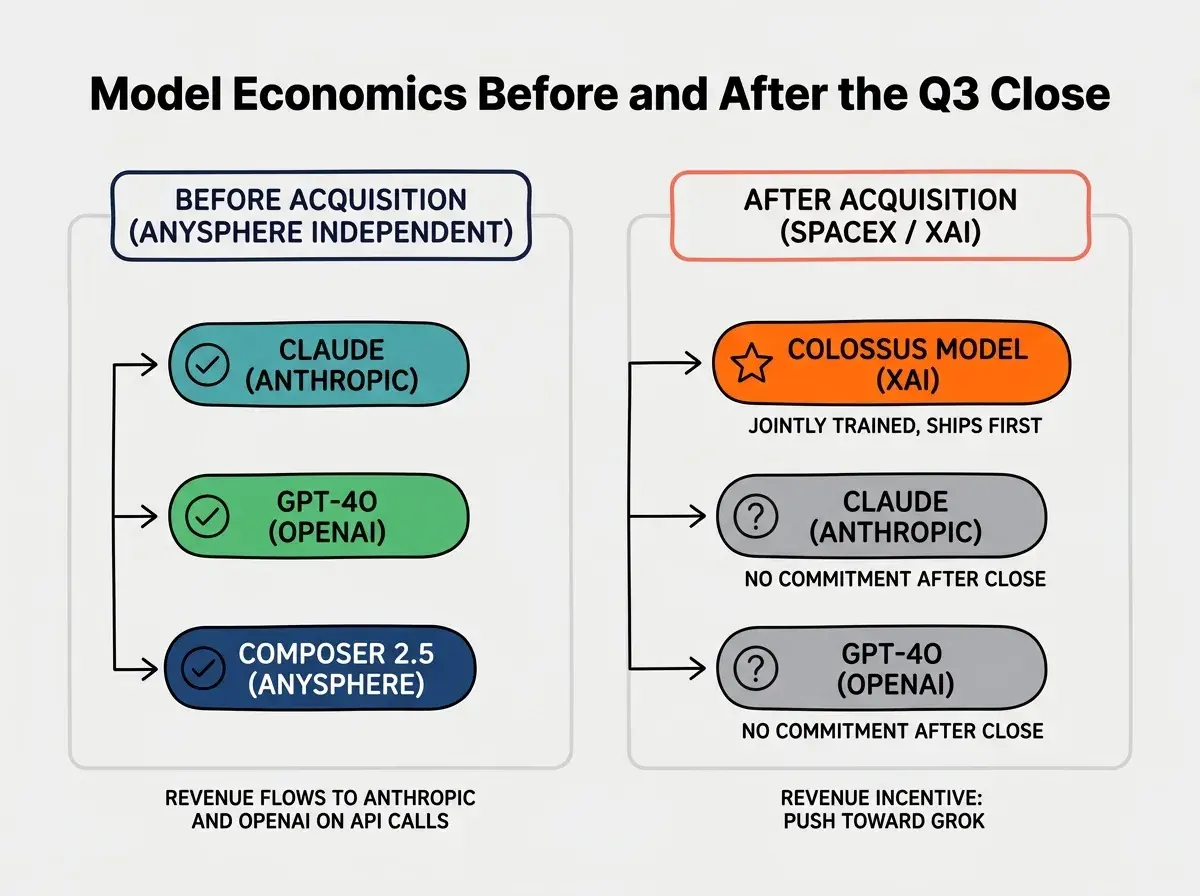
The developer community has taken notice. Neither SpaceX nor Anysphere has issued a public statement confirming that Claude and OpenAI model support will continue unchanged after the Q3 close. The absence of that commitment is itself a signal.
What changes for Cursor users once the deal closes in Q3 2026
Three areas are worth watching closely as Q3 approaches.
Model access. The most immediate concern is whether Claude and GPT-4o remain available in Cursor after close at current pricing. A tiered structure, where xAI's Colossus model is default and Claude or GPT require a premium add-on, is one plausible outcome. A harder scenario removes third-party models from Cursor's standard offering entirely, consolidating around Grok. No announcement has been made. The risk is real and unaddressed.
Data handling. When the transaction closes, SpaceX becomes the data controller for Cursor's entire user base, including all code telemetry and session history. Cursor's current privacy policy was written under Anysphere's ownership. Enterprise teams operating under GDPR, SOC 2, or sector-specific compliance frameworks should flag the Q3 close as a date to re-evaluate their data handling documentation.
Product direction. The four co-founders hold substantial incentive to stay through some vesting period, but they are not obligated to remain in product leadership indefinitely. Features built to serve independent developers may deprioritize in favor of enterprise and platform features that serve SpaceX's revenue model. That is speculative, but it is a predictable outcome of a $60 billion acquisition by a publicly traded company with investor return expectations.
Assuming that the Cursor you use today is the Cursor you will use in Q4 2026. The Q3 close is not a distant theoretical risk; it is a concrete date within the next two to three months. Teams that run Cursor on enterprise accounts, route sensitive code through it, or depend on a specific model for a specific capability should treat the close like an infrastructure change: audit your dependency now, document your configuration, and test one alternative before you need it. Discovering a workflow gap under deadline pressure is avoidable with a day of preparation today.
The practical preparation does not require abandoning Cursor. It requires knowing what you would do if one or two things changed, and having enough familiarity with alternatives to make that transition smoothly.
The Vibe Coder Blog covers model releases, tool acquisitions, and workflow changes for builders who ship with AI.
Browse All PostsThe broader consolidation context also matters for how you frame this. As of June 2026, the four tools that dominate the AI coding market are each now aligned with a different platform owner. GitHub Copilot operates within Microsoft's Azure and GitHub ecosystem. Codex and Devin Desktop (formerly Windsurf) sit inside OpenAI. Cursor is now heading into the SpaceX and xAI ecosystem. Claude Code is the only top-tier AI coding tool whose parent company, Anthropic, is not itself a platform operator with interests beyond AI models. That structural position is not automatically better, but it means different incentives apply.
How should vibecoders respond to the acquisition today
The right move is not to switch tools on June 18. It is to reduce single-tool dependency before Q3.
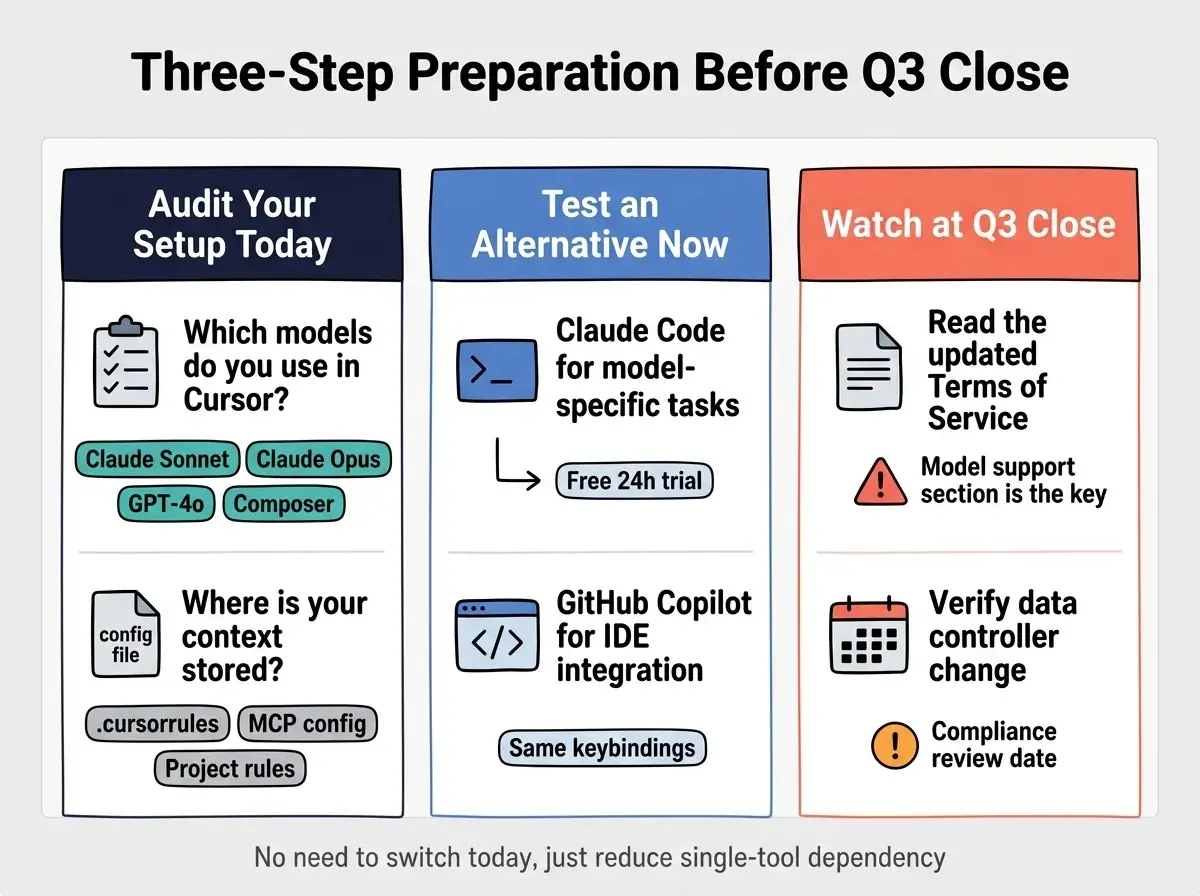
Start by identifying which Claude-specific behaviors you rely on inside Cursor. If you use long-context reasoning, specific instruction-following characteristics, or a particular Claude model version for a specialized task, test whether that need is met by Claude Code directly. Anthropic's CLI has shipped significant capabilities this quarter, including nested subagent support, parameterized permission rules, and fallback model routing. For many workflows it is now a viable primary tool, not just a fallback.
Then document your Cursor setup. Rules files, .cursorrules, MCP integrations, and project context are largely portable. Your workflow is embedded in those configuration files more than in the IDE itself. Knowing what you have makes any future transition faster.
Finally, watch the Q3 close announcement closely. When SpaceX files the deal completion, Cursor will update its terms of service and privacy policy. The model support section of those updated documents will tell you whether third-party Claude and GPT access is being preserved, tiered, or removed. That document is the clearest signal available on what Cursor becomes under SpaceX's ownership.
The SpaceX acquisition does not make Cursor a worse product today. It introduces a governance change that creates meaningful uncertainty for developers whose workflows depend on model choice and data neutrality. For solo vibecoders building personal projects, the near-term risk is low. For teams handling sensitive code, operating under compliance requirements, or deeply dependent on a specific non-Grok model, the Q3 close is a date worth treating as a planning milestone now.
The full SpaceX acquisition announcement and TechCrunch coverage contain additional detail on the deal structure and SpaceX's stated strategic rationale.
The Vibe Coder Blog covers acquisitions, model releases, and workflow changes for builders who ship with AI.
Read More Posts