A technical SEO checklist for a vibe coded app is the 15-item walk-through that takes a fresh build from "Google does not know we exist" to "we rank for the keywords we care about and surface in AI overviews." The pattern repeats across most vibe coded SaaS, the AI generated working code but skipped most of the SEO scaffolding, and the founder is now wondering why traffic is flat. The fix is short, predictable, and finishable in a focused day. The only ingredient most builders are missing is the checklist.
This guide walks through the 15 items in priority order, the specific time each one takes, the tool you use to verify it, and the surprisingly large effect of doing all 15 instead of just half.
Why SEO Matters More Than Ever for Vibe Coded Apps
The conventional wisdom that SEO is dead has been wrong for a decade and is wronger now. AI overviews on Google, AI search engines like Perplexity, and traditional search results all rely on the same underlying SEO signals. An app that does not surface in any of them is invisible to the largest distribution channel on the web.
The specific shift in 2026 is that AI overviews surface content from sites that have strong technical SEO and high-quality content, even when the site is small. A vibe coded SaaS with good SEO can compete for AI overview slots against established competitors much more effectively than it could compete in traditional search results. The opportunity is real, but only for sites that have the technical foundation in place.
A 2025 Search Engine Journal study of 1,200 small SaaS sites found that the median app was missing 8 of 15 fundamental technical SEO items, and that fixing all 15 produced a median traffic lift of 3.2x within six months. The intervention required no new content, just technical scaffolding.
The pattern to copy is the way commercial real estate handles foundation work. A new building does not skip the foundation because it is not visible to the eventual tenant. The foundation determines what can be built on top, and skimping on it is the most expensive mistake a developer can make. Technical SEO is the same, the foundation determines what marketing efforts can be built on top.
The 15 Item Checklist
The list below is in priority order. Items 1 through 5 are non-negotiable. Items 6 through 10 are strongly recommended. Items 11 through 15 are advanced but worth doing.
Item 1, robots.txt. Make sure you have one and that it does not accidentally block your entire site. AI generated apps frequently ship with no robots.txt or one that blocks pages you wanted indexed. Check at yourdomain.com/robots.txt and review the rules.
Item 2, sitemap.xml. A current sitemap of all indexable pages, submitted to Google Search Console. Most frameworks have plugins (next-sitemap, gatsby-plugin-sitemap) that auto-generate this. Verify the sitemap is correct and lists all the pages you want ranked.
Item 3, Google Search Console verified. Sign up, verify ownership, and submit your sitemap. This is the dashboard you will use for the next 12 months to monitor SEO health, and it has to exist before any other monitoring works.
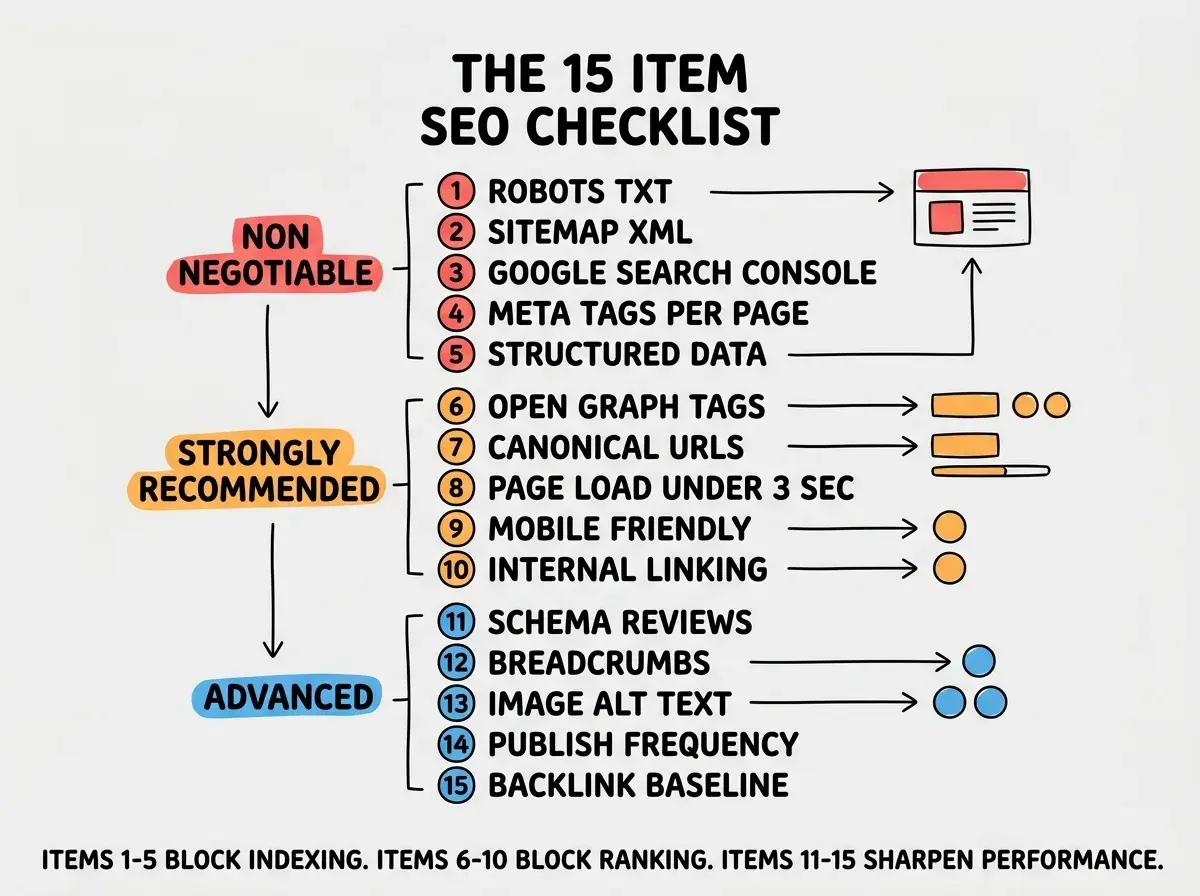
Item 4, meta tags per page. Every page needs a unique title tag (50 to 60 characters) and meta description (150 to 160 characters). AI generated apps often inherit a single set of meta tags from a layout file, leaving every page with identical tags. The fix is to set them per-page using your framework's metadata API.
Item 5, structured data (JSON-LD). Articles, products, organizations, and FAQs should all have JSON-LD markup. This is what makes your content eligible for rich results and AI overviews. Most frameworks support easy JSON-LD insertion, and AI tools can generate the correct schema for your content type.
The Strongly Recommended Layer
Item 6, Open Graph tags. Each page needs og:title, og:description, og:image, and og:type tags so links shared on social media render with the right preview. Without these, your shared links look broken on LinkedIn, Twitter, Slack, and elsewhere.
Item 7, canonical URLs. Each page should have a canonical link tag pointing to its preferred URL. This prevents duplicate content issues when your site is reachable from multiple URLs (with and without trailing slash, with and without query parameters).
Item 8, page load under 3 seconds. Use PageSpeed Insights to measure. The target is "Good" on Largest Contentful Paint (under 2.5 seconds). Almost every vibe coded app fails this on first launch and improves dramatically with image optimization and CDN setup.
Read more SEO and growth guides for vibe coded apps
Browse the grow categoryItem 9, mobile-friendly design. Google's Mobile-Friendly Test (now part of Search Console) flags issues. Most modern frameworks default to mobile-friendly, but specific issues (tap targets too small, text too small, viewport not configured) still slip through.
Item 10, internal linking. Pages should link to other pages on your site with descriptive anchor text. The structure helps search engines understand what your site is about and gives Google a path to crawl new content. Aim for at least three internal links per content page.
The Advanced Items
Item 11, schema for reviews and FAQs. If your app has reviews or FAQ pages, the corresponding schema (Review, FAQPage) makes them eligible for star ratings and answer boxes in search results. The lift is substantial, often 30 to 60 percent more clicks for the same ranking.
Item 12, breadcrumb navigation. Visible breadcrumbs plus BreadcrumbList schema help users and search engines understand site hierarchy. The visual effect is small, the SEO effect is meaningful.
Item 13, image alt text. Every meaningful image needs descriptive alt text, both for accessibility and for image search ranking. AI generated alt text is often generic ("image of a dashboard"), the fix is to write specific alt text per image.
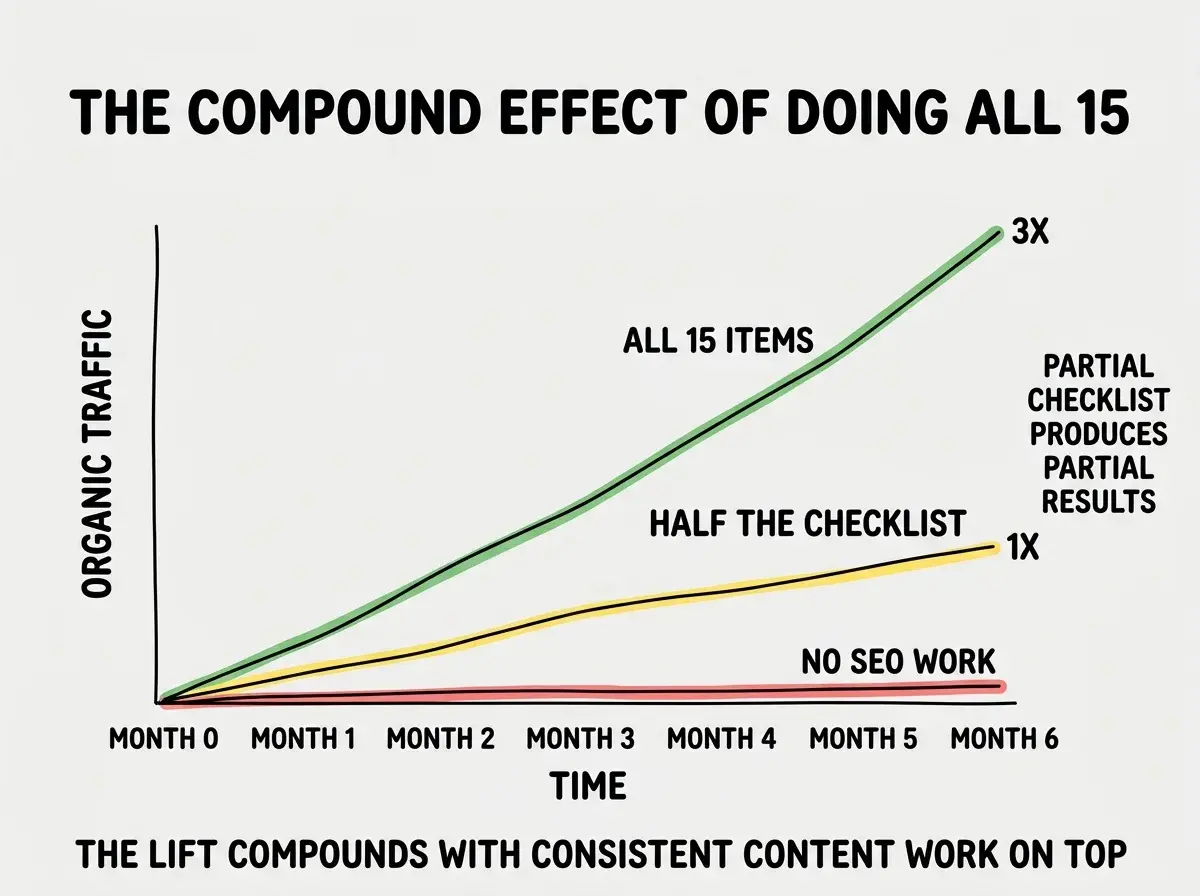
Item 14, publish frequency. Search engines reward sites that publish consistently. A blog with 1 post per week for 6 months ranks better than a blog with 24 posts in 1 week and nothing for 5 months. Set a publishing rhythm you can sustain and stick to it.
Item 15, backlink baseline. Track which sites link to yours using Search Console or Ahrefs. The first 10 backlinks are the hardest, and they usually come from manual outreach (guest posts, podcast appearances, founder interviews). After 10, the next 100 come more naturally as your content gets discovered.
The most expensive technical SEO mistake is treating items 1-5 as optional. A vibe coded app with no robots.txt and no sitemap is genuinely invisible to search engines. The traffic numbers can be confusing because you might still get some traffic from referrals or social, but the organic baseline will never grow. Fix the foundational items first, then everything else has room to compound.
The corollary is that you cannot compensate for missing foundational SEO with great content. Excellent blog posts on a site with broken indexing will never rank, no matter how good they are. The compound effect goes both ways, weak foundation cancels strong content.
What This Means For You
Technical SEO for a vibe coded app is one of the highest-leverage afternoons a founder can spend. The compounding effect over six months is dramatic compared to the one-time time investment.
- If you're a founder: Run the full 15-item checklist this week. The first deploy after fixing them will produce visible improvements in Search Console within 2 to 4 weeks.
- If you're changing careers: Knowing technical SEO is a strong addition to a marketing or growth-engineering role. The patterns are universal and the demand is steady.
- If you're a student: Build any small project, deploy it, run the checklist, and watch the indexing happen in Search Console. The exercise teaches more than reading SEO guides.
Browse more SEO and growth tutorials
Read more grow guides