Content marketing for vibe-coded products in 2026 is one of the highest-ROI growth channels for solo builders and small teams because the costs are mostly time, the compounding is real, and the bar for "good enough" is lower than founders fear. The four content types that consistently drive growth are educational tutorials (teach your target audience how to do something), comparison content (head-to-head with alternatives or competitors), case studies (real customer stories with concrete outcomes), and SEO landing pages (long-tail keyword pages that capture specific search intent). The realistic time investment is 4 to 8 hours per week of focused work, and the results compound over 6 to 12 months.
This piece walks through each of the four content types, the realistic time investment patterns, the AI-assisted workflow that makes content marketing feasible for solo builders, and the four mistakes that turn promising content programs into abandoned blogs within a quarter or two.
Why Content Marketing Works for Vibe Coded Products
Vibe-coded products often serve niche audiences that are also actively searching for solutions. The right content positioned for the right search intent can drive substantial qualified traffic over time. The compounding effect is particularly favorable for small teams because each piece of content keeps generating traffic for years if it ranks.
The 2026 advantage is that AI tools dramatically reduce the cost of producing content. A solo founder can ship 2 to 4 quality pieces per week with AI assistance, where the same person could ship maybe 1 piece per week without AI. The content quality bar has stayed roughly constant; the cost to clear it has dropped substantially.
A 2025 ConvertKit analysis of 500 SaaS products tracked content marketing ROI over 12 months. Products that published consistently (1+ pieces per week) saw average organic traffic growth of 340 percent in the first year. Products that published sporadically (less than 1 per month) saw 35 percent growth. Consistency mattered more than quality of any single piece, and the AI-assisted teams shipped consistently because the cost per piece was low.
The pattern to copy is the way restaurants build local reputations. A great single dish does not build a reputation; consistent quality over months and years does. Content marketing is the same. Single viral pieces are nice; consistent publishing is what builds the audience and the search rankings that compound over time.
The Four Content Types That Drive Growth
Each type serves a different stage of the buyer journey and a different search intent. A balanced content program uses all four.
Type 1, educational tutorials. Teach your target audience how to do something they want to do. Focus on tasks adjacent to your product so readers find it naturally. Long-form, SEO-optimized.
Type 2, comparison content. "Tool A vs Tool B" pages, "Best alternatives to X" pages. High commercial intent searches that convert well. Surprisingly underused by smaller products.
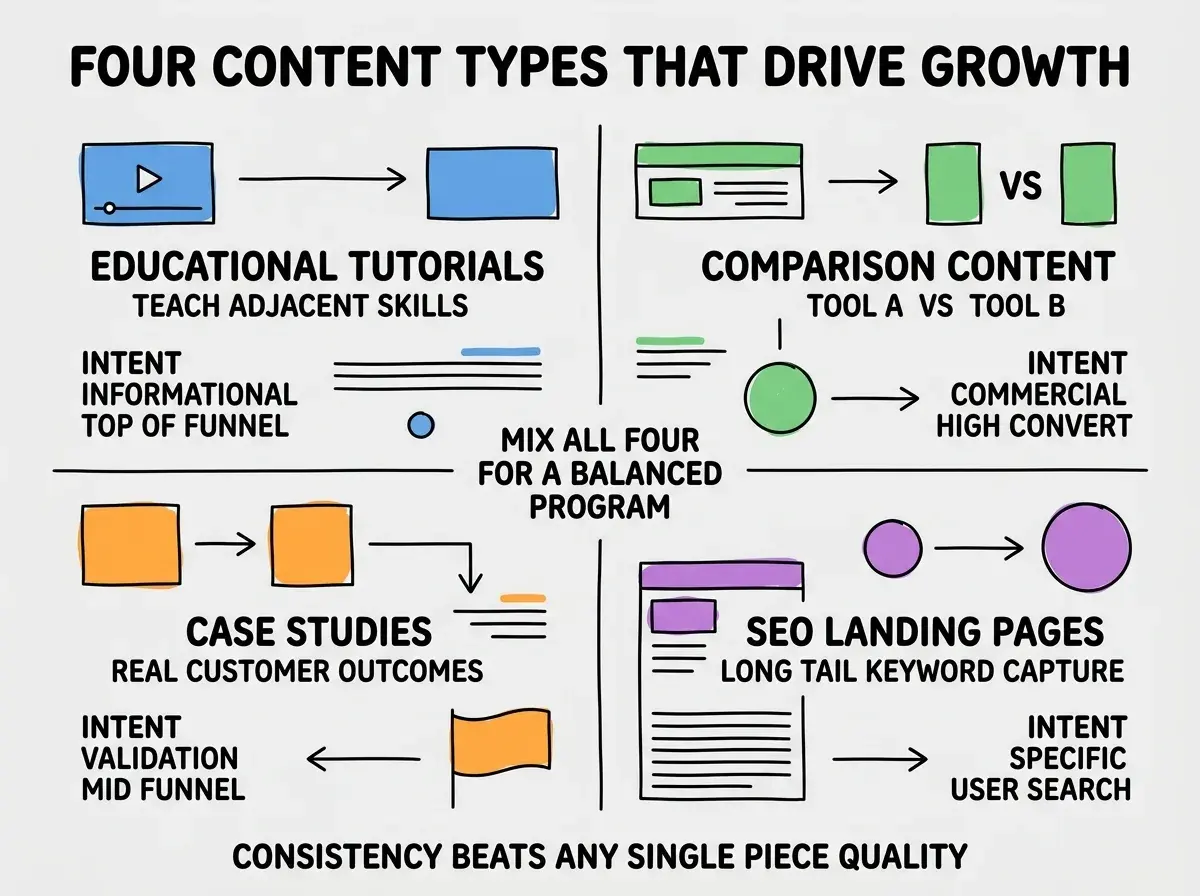
Type 3, case studies. Real customer stories with specific outcomes. Hard to write because you need real customers, but converts at high rates because social proof is powerful.
Type 4, SEO landing pages. Specific pages targeting long-tail keywords. "How to do X with Y" or "Best [tool] for [use case]". Each one captures a small but predictable amount of search traffic.
The Realistic Time Investment
Most founders overestimate how much time content marketing requires and underestimate how long it takes to compound. Both miscalibrations cause founders to give up too early.
Weekly time budget. 4 to 8 hours per week is sustainable for a solo founder. This produces 2 to 4 pieces depending on length and complexity, and is the minimum viable consistency for compounding.
Browse more growth and marketing guides
Read more grow articlesCompounding timeline. First 3 months are slow (you are building the foundation). Months 4 to 6 see modest organic traffic growth. Months 7 to 12 are when the compounding really starts. Most founders give up at month 3 because they expected results faster.
Diminishing returns. Beyond 8 hours per week, marginal value drops sharply. Better to invest the extra time in product or distribution than in writing more content. The eighth hour produces less value than the first hour, and the tenth hour often produces negative value because exhausted writers ship lower-quality content that reflects badly on the brand.
The AI-Assisted Content Workflow
The workflow that makes 4 pieces per week feasible for a solo builder uses AI heavily but humans where it matters.
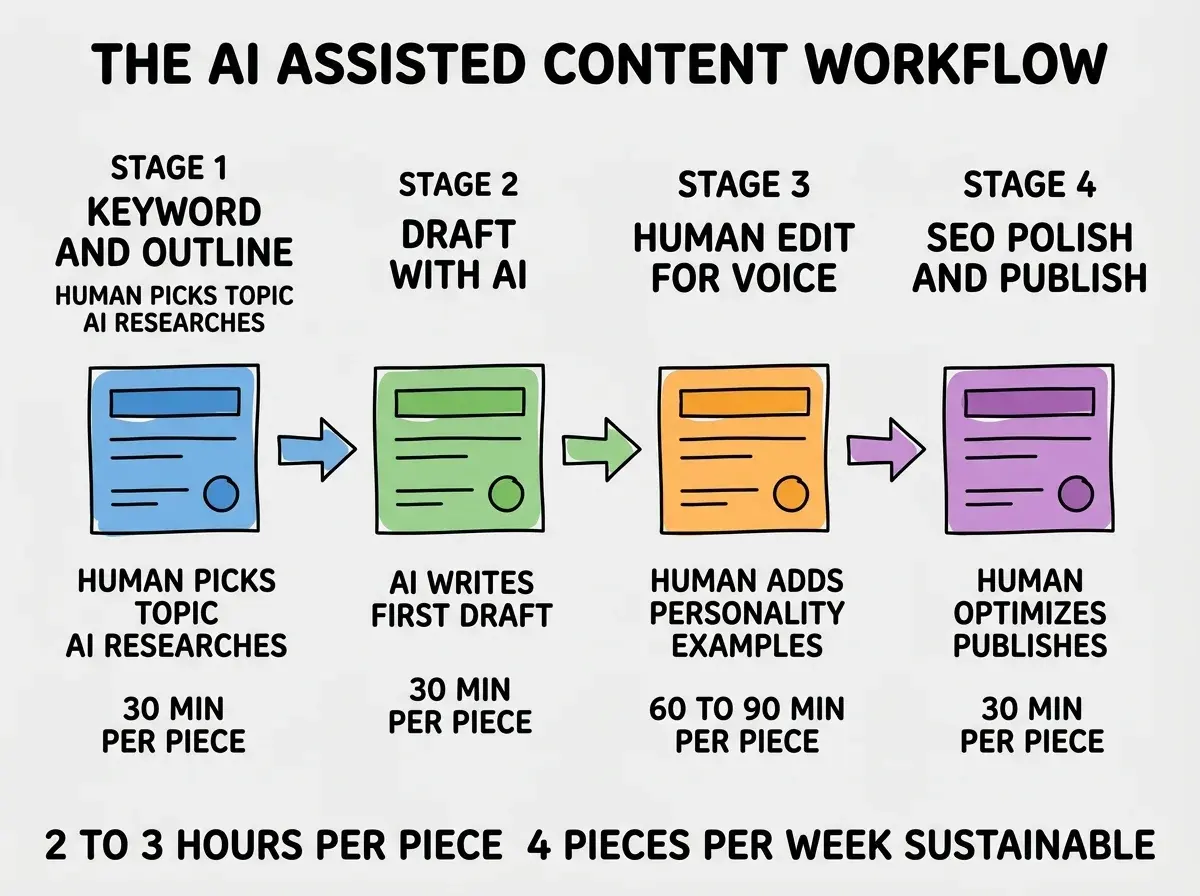
Stage 1, keyword and outline. Human picks the topic based on strategy. AI does keyword research and produces a structured outline. About 30 minutes.
Stage 2, AI first draft. AI writes a complete first draft from the outline. About 30 minutes including iteration on quality.
Stage 3, human edit for voice. Human reads, edits for voice, adds personal examples and unique angles. About 60 to 90 minutes. This is where the content gets its differentiation.
Stage 4, SEO polish and publish. Title, meta description, internal links, image alt text, schema markup. About 30 minutes including image generation.
The most damaging content marketing mistake is publishing AI drafts without human editing. AI-generated content reads as generic, lacks differentiation, and increasingly gets penalized by search engines that detect it. The right approach is AI as a drafting tool followed by substantial human editing for voice, examples, and unique perspective. The 60 to 90 minutes of human editing is what separates content that ranks and converts from content that joins the noise. Skipping this step produces high volume of mediocre content that does not move the needle.
The other mistake is choosing topics by what the founder finds interesting rather than by what the audience searches. Content marketing is a service to your audience, not a place to write about your hobbies. The keyword research stage is what aligns content with audience demand; skipping it produces content that founders enjoy writing and nobody reads.
A useful discipline is to maintain a content calendar at least 4 weeks ahead. Without a calendar, founders default to writing whatever feels timely, which produces inconsistent topic coverage and weak SEO. With a calendar, the topics are planned around audience demand and the writing becomes execution rather than improvisation.
A second discipline is to track which pieces actually drove traffic and which did not. After 6 months you have data on what works and the topic selection becomes data-driven rather than intuition-driven. Most failed content programs lacked this measurement, which is why they kept writing pieces that did not work.
A third refinement is to repurpose the best pieces across formats. A long blog post becomes a Twitter thread, a LinkedIn article, a YouTube video script. The same idea reaches multiple audiences with marginal extra effort, which improves the ROI of every piece you write.
What This Means For You
Content marketing remains one of the highest-leverage growth channels for vibe-coded products in 2026, and AI tools have made it more accessible than ever for solo founders.
- If you're a founder: Commit to 4 hours per week for 6 months minimum. The compounding only happens with consistency.
- If you're changing careers: Content marketing is a great way to build a personal brand alongside the technical skills. Both compound.
- If you're a student: Start a personal blog about what you are learning. The discipline of writing weekly compounds across your career.
Browse more growth and marketing guides
Read more grow articles