To bridge from HTML/CSS to full-stack development with AI assistance in 2026, follow the four steps that work for designers and front-end builders making this transition (add JavaScript fundamentals, layer in a modern framework like Next.js with AI help, integrate a database via a managed service, deploy and iterate). The progression takes 6 to 12 weeks of focused part-time work, builds on what you already know rather than starting from scratch, and produces shipping-capable full-stack skills without years of formal CS education.
This piece walks through the four steps, the AI-assisted learning patterns, the project sequence that builds confidence, and the four mistakes that derail HTML/CSS-to-fullstack transitions.
Why HTML/CSS to Full-Stack Is Now a Direct Path
HTML/CSS designers have always been close to development; they just lacked the JavaScript and backend pieces. The traditional path required learning JavaScript deeply (months), then learning a framework (more months), then learning backend concepts (months more). Full-stack capability was a 1-2 year journey.
In 2026, AI assistance changes the timeline dramatically. The "what code do I write" knowledge that used to require years of accumulation is now on-demand. The HTML/CSS designer brings the visual judgment and HTML structure knowledge; AI handles the JavaScript and backend code generation. The combination produces full-stack capability in weeks rather than years.
A 2025 freeCodeCamp survey of 8,000 career changers from design backgrounds found that those using AI assistance for the HTML/CSS-to-fullstack transition reached "ship a real app" capability in 8 weeks on average, compared to 14 months for similar career changers learning without AI. The 7-8x acceleration is not hype; it reflects the dramatic productivity gain when conceptual learning meets AI execution support. The path from designer to full-stack is newly viable.
The pattern to copy is the way photographers transitioned to digital photography in the 2000s. The compositional knowledge transferred directly; the new tools (digital cameras, editing software) added capabilities without requiring photographers to learn from scratch. HTML/CSS-to-fullstack with AI follows the same pattern: existing knowledge plus new tools equals expanded capability.
The Four Steps That Work
The progression works because each step builds directly on the previous. Skipping or reordering produces worse outcomes.
Step 1, JavaScript fundamentals. Variables, functions, conditionals, loops, arrays, objects. The minimum to read and modify code AI generates. About 2 weeks of focused practice.
Step 2, Next.js with AI assistance. Pick Next.js as your framework (most learnable for HTML/CSS folks). Build small projects with AI generating most of the code. About 3 weeks.
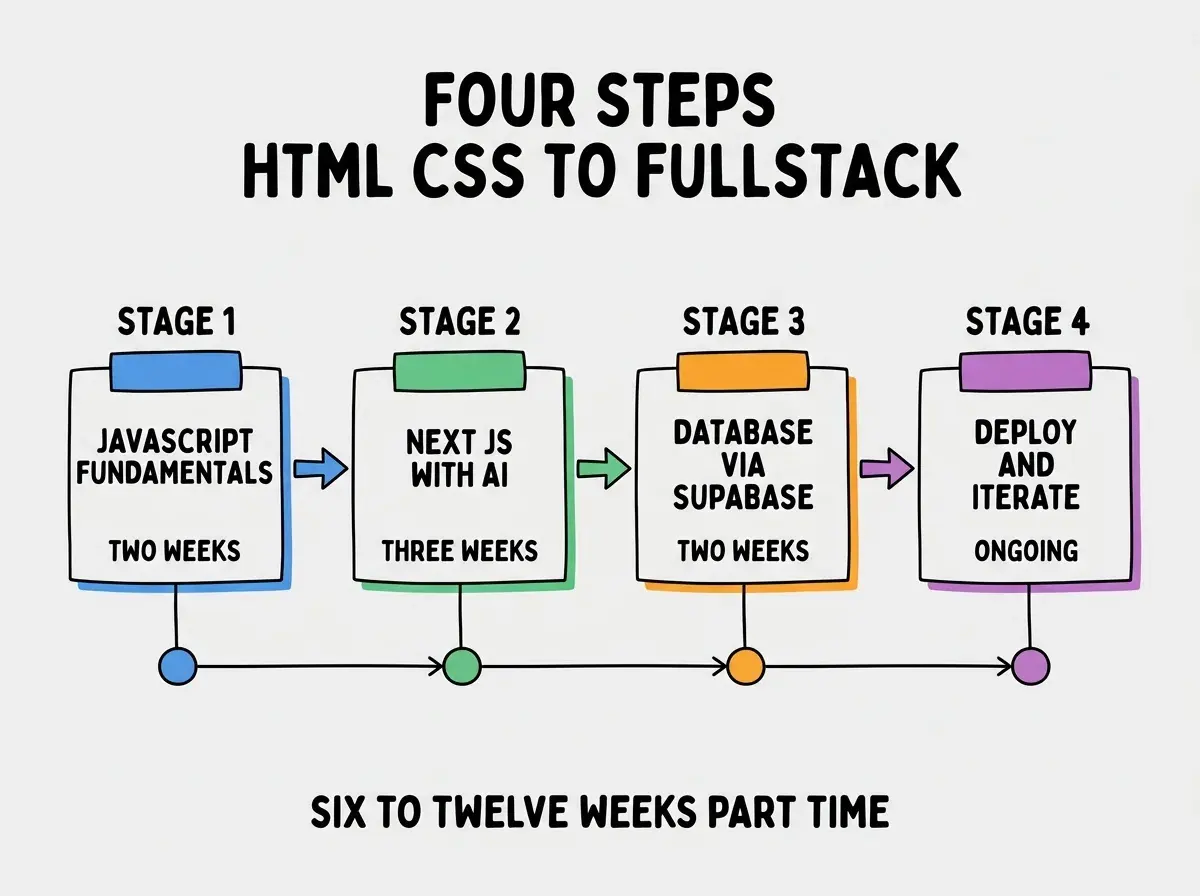
Step 3, database via Supabase. Learn database concepts by using a managed service that handles the hard parts. Build apps with real persistence. About 2 weeks.
Step 4, deploy and iterate. Vercel deployment, real users, real feedback. The shipping discipline that separates capability from skill. Ongoing.
The AI-Assisted Learning Patterns
Three patterns make AI assistance particularly effective for this transition.
Pattern 1, "explain this like I know HTML/CSS" prompts. Frame your prompts to leverage your existing knowledge. AI understands and adapts. Saves time over generic explanations.
Browse more career changer guides
Read more foundations articlesPattern 2, modify existing code rather than write from scratch. Ask AI to generate a working app, then modify it. Reading code is easier than writing code; modification is the bridge.
Pattern 3, ship small things weekly. Each week, ship something small. The discipline of shipping (deployment, real URLs, real feedback) compounds the learning faster than tutorials alone.
The Project Sequence That Builds Confidence
A specific project sequence builds confidence as you progress through the four steps.
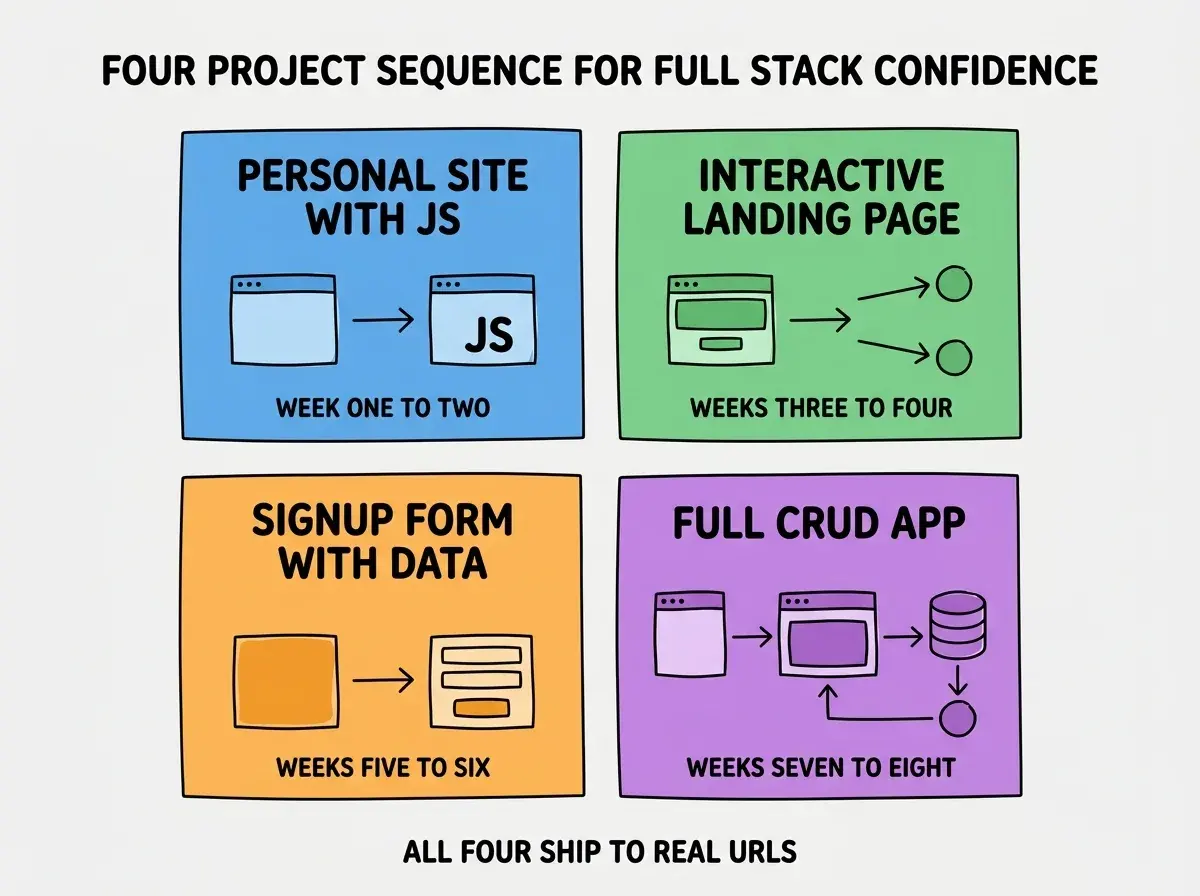
Project 1, personal site with JS interactivity. Add small JavaScript features (smooth scroll, dark mode toggle, simple form validation) to a static site. Practices JS fundamentals.
Project 2, interactive landing page. Add features like animations, A/B test variants, conditional content. Uses Next.js and React patterns.
Project 3, signup form with persistence. Form that saves submissions to a database. Email confirmation. Basic admin view. Introduces backend integration.
Project 4, full CRUD app. Multi-user app with auth, data, dashboard. The "I am a full-stack developer now" project.
What to Skip in the Transition
Three areas can be safely skipped initially, even though traditional CS curricula emphasize them.
Skip 1, deep CS theory. Algorithms, data structures, big-O analysis. Useful eventually but not for shipping working products. Skip in the bridging phase.
Skip 2, multiple frameworks at once. Pick Next.js and stick with it for the first 3 months. Adding Vue, Angular, or other frameworks dilutes learning.
Skip 3, custom backend infrastructure. Use managed services (Supabase, Vercel) until you have a specific reason to roll your own. The initial path is much smoother.
The combination of these omissions keeps the bridging phase focused on shipping rather than on theoretical breadth. Theoretical depth comes later if needed.
The most damaging mistake HTML/CSS designers make in the bridging transition is trying to learn JavaScript "properly" before touching frameworks or AI tools. The "learn JavaScript thoroughly first" path takes months and often results in burnout because pure JavaScript without a framework or AI assistance is significantly harder than working with the modern stack. The fix is to learn JavaScript fundamentals (a couple weeks of basics) and then immediately start building with Next.js + AI assistance. The framework abstracts away the hardest parts of JavaScript; AI handles the parts you have not yet learned. Capability comes faster through use, not through pre-study.
The other mistake is comparing your work to senior engineers' work and feeling inadequate. Senior engineers have years of accumulated patterns; bridging designers have weeks. The comparison is unfair. Compare yourself to your past self (what you could not do six weeks ago) rather than to engineers who have been doing this for ten years.
How to Position Your New Skills
Beyond building capability, three positioning patterns help full-stack-capable designers find appropriate opportunities.
Pattern 1, design engineer titles. "Design engineer" is the increasingly-recognized title for designers who can also build. Use it on LinkedIn and in job applications. Communicates the hybrid skill set clearly.
Pattern 2, portfolio that shows both halves. Your portfolio should demonstrate design judgment AND working products. Side-by-side: Figma mockup, then live working app. Demonstrates the complete skill set.
Pattern 3, public writing about hybrid practice. Blog posts or threads about how design and development inform each other in your work. Builds visibility in both communities.
The combination produces opportunities that pure designers and pure engineers cannot access. The hybrid skill set is increasingly valued and increasingly compensated above either pure track. Companies like Vercel, Linear, and Stripe explicitly hire design engineers at premium compensation; smaller companies follow the trend as the talent gets validated by the leaders, which means the opportunities will continue expanding for years to come and the bridging investment looks better in retrospect than it feels in the moment.
What This Means For You
The HTML/CSS-to-fullstack transition with AI assistance is one of the most achievable career evolutions available in 2026. The bar that used to take 1-2 years now takes 6-12 weeks of focused part-time work.
- If you're a founder with HTML/CSS skills: The bridge is achievable while running your business. Block 5-10 hours per week; you will ship full-stack capability within a quarter.
- If you're changing careers from design: This path is significantly faster than CS bootcamps. The combination of design background and full-stack capability is rare and valuable.
- If you're a student with HTML/CSS: Make the bridge during your degree, not after. The capability multiplies the value of every other skill you build.
Browse more career changer guides
Read more foundations articles