To design referral systems that produce viral loops for AI-built products in 2026, focus on the four loop types that consistently work (rewards-based referrals where both sides benefit, content-sharing loops where output is shareable, collaboration loops where users invite others to use the tool together, network effects where each user makes the product better for others), measure your viral coefficient honestly, and optimize the friction points that determine whether loops compound or decay. Most AI-built products are well-suited to at least one of these loop types; identifying which fits your product is the first step.
This piece walks through the four loop types, the viral coefficient math, the friction patterns that kill loops, and the four mistakes that turn referral programs into dead weight.
Why Referral Loops Matter More for Indie Products
Paid acquisition is increasingly expensive across most channels in 2026. Indie products that depend on paid acquisition struggle to compete with venture-funded competitors who can outbid them. Referral loops are the alternative: each user brings other users, reducing dependence on paid channels.
The 2026 advantage is that AI-built products often have natural sharing surfaces (generated content, shared sessions, collaborative features) that make viral loops easier to design than for traditional SaaS. The opportunity is real but requires deliberate design.
A 2025 First Round Capital growth study of 600 indie SaaS products found that products with active referral loops had 3.4x higher 12-month revenue growth than products that depended primarily on paid acquisition. The mechanism was straightforward: referrals scale better than paid acquisition because they get cheaper with growth (more users referring) while paid acquisition gets more expensive at scale. Viral loops are not just nice-to-have; they are increasingly the difference between sustainable growth and stalled startups.
The pattern to copy is the way Dropbox built their viral growth. They did not invent referrals; they made the rewards meaningful (free storage for both sides) and the friction tiny (one click to invite). Most modern viral loops still draw from this playbook because the playbook works.
The Four Loop Types That Work
Different products suit different loop types. Four types cover most successful viral mechanics.
Loop 1, rewards-based referrals. Both referrer and referee get something valuable (credit, free month, premium features). The Dropbox model. Works when the reward has clear value to both sides.
Loop 2, content-sharing loops. Users create content with your product that gets shared externally; new users discover the product through the shared content. Canva, Calendly, Notion all use this pattern.
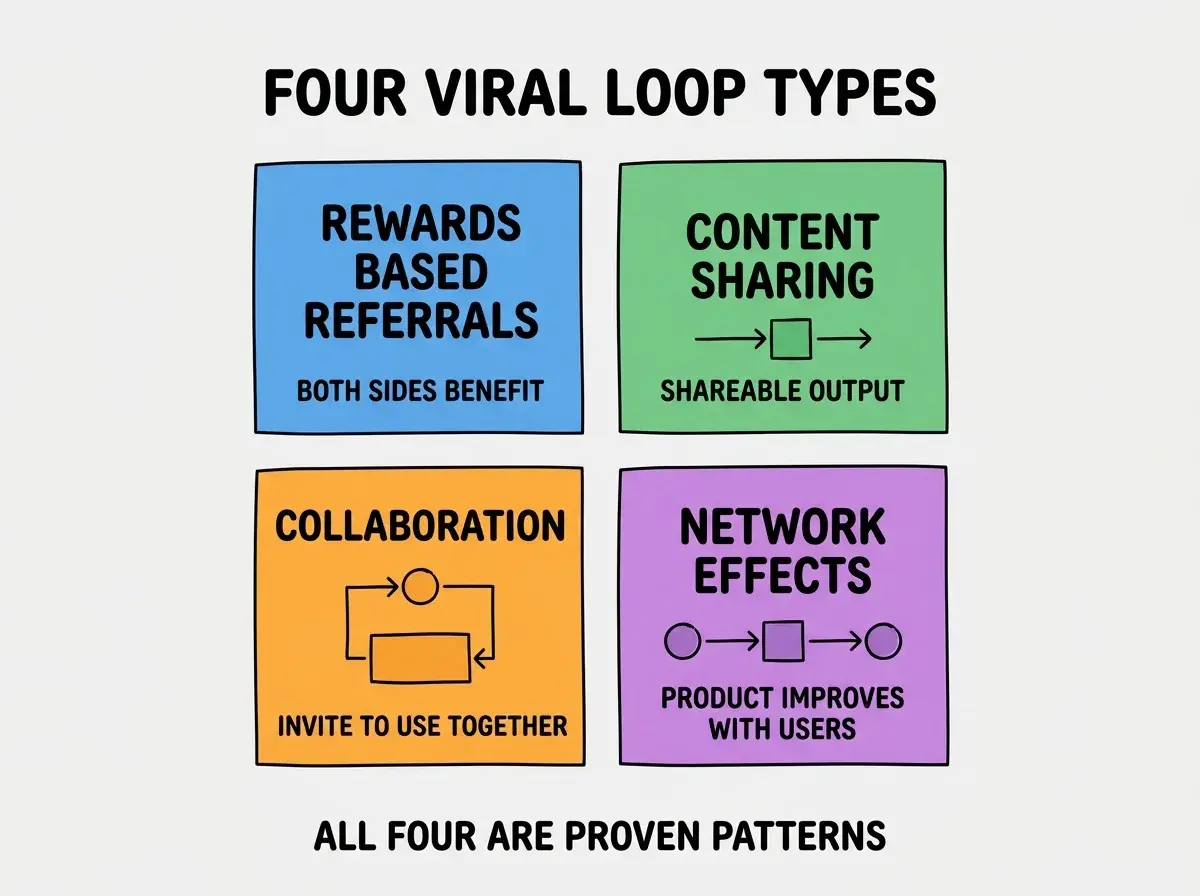
Loop 3, collaboration loops. Product is more valuable when used with others; users invite collaborators because the tool needs them. Slack, Figma, Linear all use this pattern.
Loop 4, network effects. Each user makes the product more valuable for other users. Marketplaces, social networks, communication tools. Strongest loop type but hardest to bootstrap.
The Viral Coefficient Math
Viral loops are governed by simple math. Three concepts matter most for understanding whether your loop is working.
Concept 1, viral coefficient (k). Average new users brought by each existing user. k > 1 means exponential growth; k < 1 means decay. Most loops in 2026 have k between 0.1 and 0.5.
Browse more growth guides
Read more grow articlesConcept 2, cycle time. How long between a user joining and bringing in their referrals. Shorter cycles produce faster compounding even at lower k values.
Concept 3, retention rate. What percentage of referred users stick. High k with low retention produces churn; lower k with high retention produces sustainable growth.
The Friction Patterns That Kill Loops
Three friction patterns consistently kill referral loops that should otherwise work.
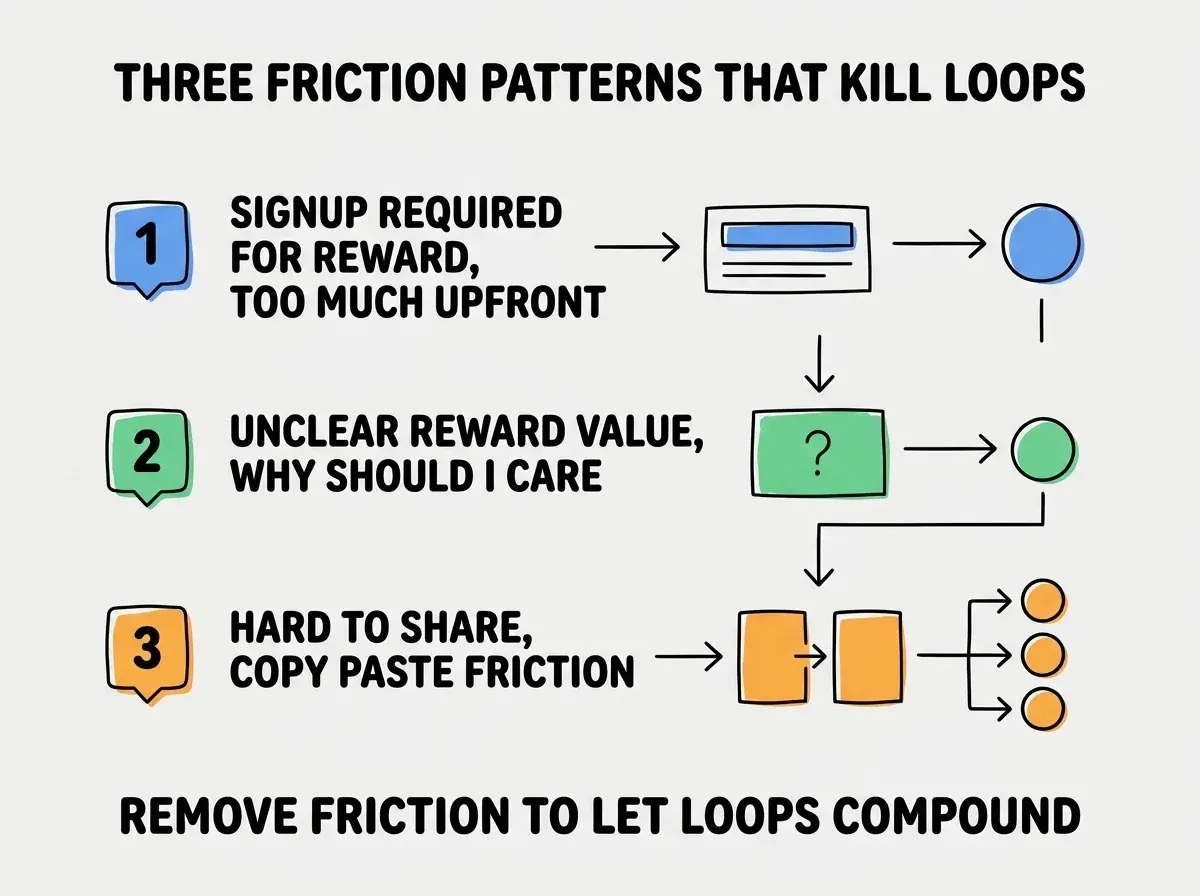
Friction 1, signup required for reward. Asking users to sign up before they understand the value kills early-stage loops. Reward usage first; lock features behind signup later.
Friction 2, unclear reward value. "$5 credit" is unclear; "1 month of premium" is concrete. The reward has to be valuable enough that users want it AND clear enough that they understand it.
Friction 3, hard to share. Copy-paste referral links, manual invite flows, friction at every step. One-click sharing through native channels (iMessage, WhatsApp, email) dramatically improves loop participation.
How to Test and Optimize Loops
Three patterns help iterate on referral loops based on real data.
Pattern 1, instrument the funnel. Track each step: invite sent, link clicked, signup completed, first action taken, retained at 7 days. Drop-offs reveal where to optimize.
Pattern 2, run small experiments. A/B test reward sizes, invite copy, sharing channels. Small tests produce real signal; "let's redesign the whole loop" rarely produces measurable improvement.
Pattern 3, watch retention of referred users. Referred users sometimes have worse retention than organic users. If so, fix the onboarding mismatch; do not just keep referring more bad-fit users.
The combination produces loops that improve over months rather than launching once and decaying. Without iteration, loops typically degrade as the easy wins get harvested and harder optimization work is needed.
The most damaging referral system mistake is launching with rewards too small to motivate sharing. Founders worry about the cost of generous rewards and end up with rewards that do not move the needle. The fix is to be generous with the reward in the early phase when growth matters most. A 30-percent-off-first-month reward that produces actual signups is better than a 5-percent reward that nobody uses. As growth solidifies, you can taper the reward; in the launch phase, generous beats stingy by significant margins.
The other mistake is treating referral systems as a marketing tactic rather than a product feature. Marketing tactics get ignored once they ship; product features get refined over time. Treat referral systems as a first-class part of the product (with PM ownership, design attention, ongoing iteration) and they produce sustainable growth contribution.
Examples of Loops That Worked
Three short case studies show how the four loop types play out in practice.
Case 1, Calendly content sharing. Users share scheduling links externally; recipients sign up to schedule with them; recipients become users themselves for their own scheduling. Pure content-sharing loop with high participation.
Case 2, Notion collaboration. Users invite teammates to docs; teammates become users; some teammates become solo users for their own work. Collaboration loop with secondary expansion.
Case 3, Superhuman rewards-based. Users invite others with personal endorsement; both sides get $30 referral credit. Rewards-based loop with social proof amplification.
The combination of these case studies illustrates that successful loops always fit the product naturally rather than being bolted on. The loop type that works for your product depends on what your product naturally produces and how users naturally engage with each other through it.
Avoiding Common Anti Patterns
Three anti-patterns consistently appear in failed referral programs. Recognizing them upfront prevents them.
Anti-pattern 1, gating the reward behind too many conditions. "Get $50 when 3 friends sign up AND each makes a purchase." Each condition reduces participation multiplicatively.
Anti-pattern 2, requiring a minimum referrer status. "You must have used the product for 30 days before you can refer." Defeats the purpose of catching users when motivation is high.
Anti-pattern 3, hidden referral mechanics. Buried in settings, mentioned in tiny footer text. Programs need visibility to work; visibility comes from product placement.
Avoiding these three anti-patterns produces referral programs that have a chance to compound. Including any of them produces programs that look good in the launch announcement and produce nothing measurable in the months that follow.
What This Means For You
Referral systems and viral loops are increasingly central to indie product growth in 2026. The right loop type, well-executed, can be the difference between sustainable growth and stalled startups.
- If you're a founder: Pick one loop type that fits your product naturally and execute it well. One excellent loop beats three mediocre ones.
- If you're changing careers into growth: Loop design is one of the highest-leverage growth skills. The combination of analytical thinking and product judgment is rare.
- If you're a student: Study existing successful loops (Dropbox, Calendly, Notion) and identify what made them work. The patterns transfer.
Browse more growth guides
Read more grow articles