Predictions for vibe coding in 2027 should be grounded in current trajectories rather than headline-friendly extrapolations. Six shifts are likely based on the data visible in late 2026: agentic engineering replaces vibe coding as the dominant frame, AI coding tools become enterprise standard rather than individual choice, the senior premium continues to grow, IDE consolidation accelerates, regulated industry adoption surges, and one or two non-US labs ship competitive frontier models. Three commonly predicted shifts (developer extinction, fully autonomous coding agents shipping production code unsupervised, and language-agnostic AI tools) are unlikely to happen by 2027.
This piece walks through each likely shift with the underlying signal, names the predictions that are overhyped, and gives builders a concrete planning framework for the next 12 to 18 months.
Why 2027 Will Look More Like 2026 Than 2026 Looked Like 2024
The most important thing to understand about predictions is that the rate of change in tooling has compressed, but the rate of change in workflow adoption has not. The frontier models will improve through 2027, but the bottleneck for impact is no longer model capability. It is institutional adoption, training, and integration with existing engineering practices.
This means that predictions framed as "AI will do X by 2027" are usually wrong, because AI could already do most of those things in 2026. The right framing is "X workflow pattern will become standard by 2027." That is a much more grounded set of predictions and one that turns out to be predictable from current adoption curves.
A 2026 GitHub State of the Octoverse data point: 92 percent of companies that had not adopted AI coding tools by end of 2025 cited "training and process change" as the primary blocker, not model capability. Only 8 percent cited the AI itself. This is the single most useful number for grounding 2027 predictions. The frontier is moving faster than institutions are adapting, and that gap will define the year.
The pattern to copy is the way cloud computing adoption played out from 2010 to 2015. Cloud was technically capable in 2010, but most enterprises did not adopt seriously until 2014. The intervening years were spent on training, security review, integration, and governance. The pattern looks identical for AI coding tools, just compressed into a 3-year window instead of 5.
Six Shifts That Are Likely
Each prediction below is grounded in data already visible in 2026. The probability of each is roughly 70 to 85 percent based on current trajectories.
1. Agentic engineering replaces vibe coding as the dominant frame. Simon Willison's vibe engineering distinction has been gaining ground throughout 2026. By 2027, the popular term will probably shift again, with "agentic engineering" or similar replacing "vibe coding" in serious technical discourse. The casual term will linger for one-off prototypes.
2. AI coding tools become enterprise standard. By end of 2027, more than 80 percent of Fortune 500 companies will have a sanctioned AI coding tool deployed organization-wide, up from roughly 35 percent in 2026. The procurement cycles for enterprise tools predict this confidently.
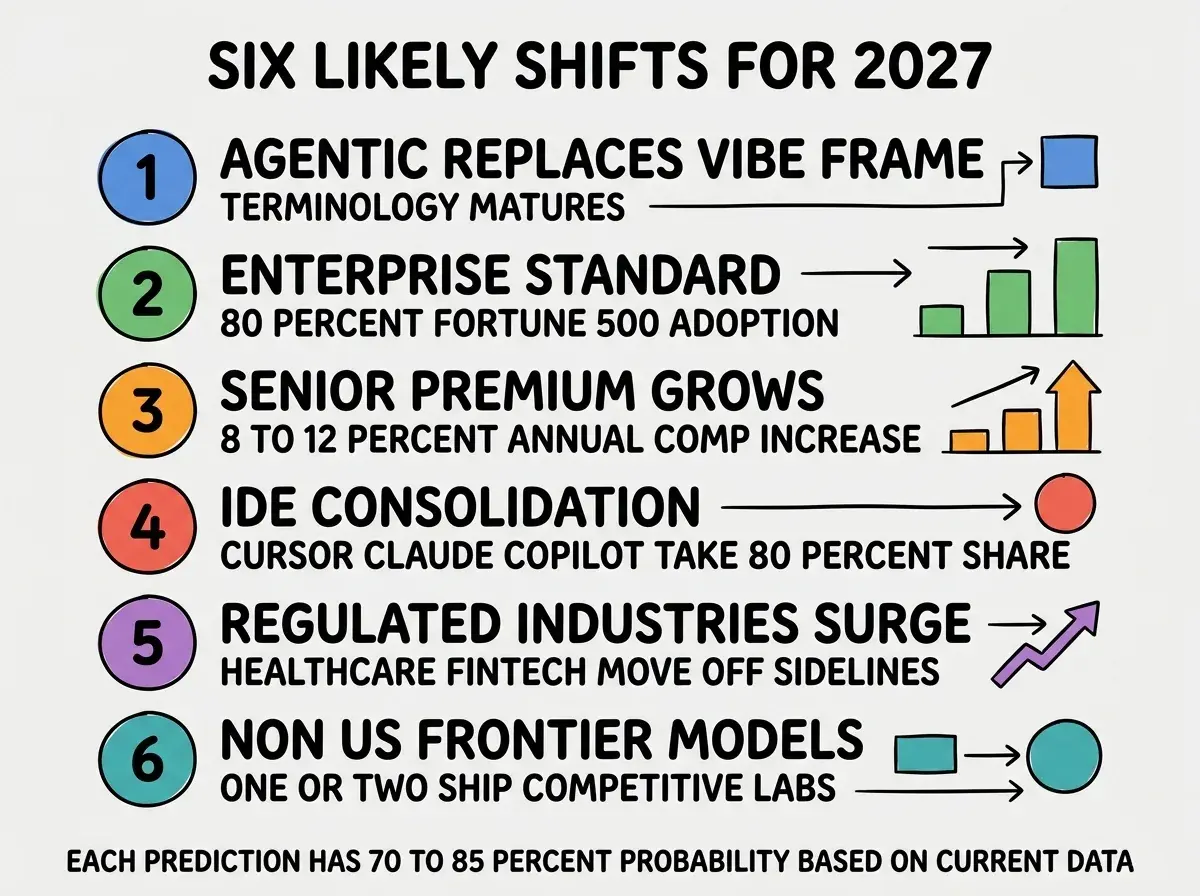
3. Senior premium continues to grow. Total compensation for senior engineers with strong AI workflow skills is on track for another 8 to 12 percent annual increase through 2027. This is the most reliable prediction in the list.
4. IDE consolidation accelerates. Cursor, Claude Code, and GitHub Copilot will collectively hold roughly 80 percent of the AI-assisted IDE market by end of 2027. The long tail of smaller tools will consolidate or fail.
Predictions 5 and 6 Plus What Builders Should Plan For
The remaining two predictions are slightly less certain but still likely based on current data. After these, the builder planning framework matters most.
5. Regulated industry adoption surges. Healthcare, fintech, government, and legal will move off the AI sidelines in 2027 as compliance frameworks (SOC 2 for AI use, HIPAA guidance, PCI DSS clarification) catch up. This unlocks a large segment that has been waiting for institutional cover.
Browse more analysis on the future of AI development
Browse pulse articles6. Non-US frontier models ship competitively. At least one or two non-US labs (most likely from China, with possible entrants from France or the UK) will ship a frontier-tier model that competes credibly with US labs on coding tasks. The geopolitical implications will dominate the second half of 2027.
What Builders Should Plan For
The six shifts above translate into concrete planning decisions for any team building products or careers in this space. Three planning moves are worth making in early 2027.
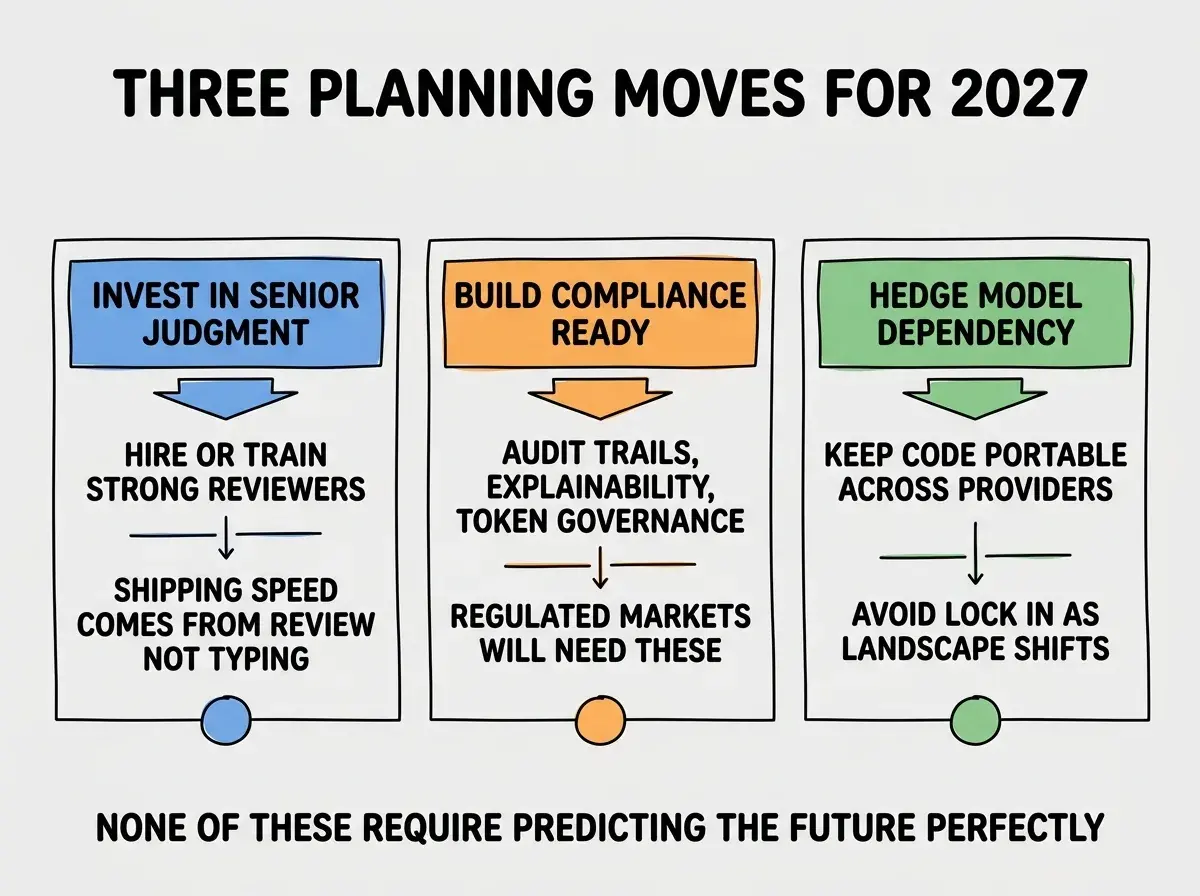
Invest in senior judgment. Hire or train strong code reviewers. The premium for review skill is going to grow, and the bottleneck on shipping speed is increasingly review rather than generation.
Build compliance-ready. Even if your product is not in a regulated industry today, build with audit trails, explainability, and token-level governance. The infrastructure overlap with regulated industry needs is high, and being ready when the wave hits is much cheaper than retrofitting.
Hedge model dependency. Keep your code portable across model providers. The competitive landscape will shift more in 2027 than it did in 2026, and lock-in to a single provider is increasingly risky as new entrants emerge.
Three Predictions to Ignore
Some predictions repeat in every "future of AI" article and consistently fail to materialize. Three are particularly worth ignoring through 2027.
"Developers go extinct." Total developer employment grew through 2026 and the trajectory is steady. Predictions of mass developer unemployment have been wrong every year since 2023 and will be wrong again in 2027.
"Fully autonomous coding agents ship production code unsupervised." Agents will get better, but production deployment without human review is unlikely to be standard practice by 2027. Liability, security, and trust gaps remain large.
"Language-agnostic AI coding tools." AI tools will not converge on a "speak any language, get any code" model by 2027. The English bias for technical documentation, error messages, and library names will persist for at least another 3 to 5 years.
The most expensive prediction mistake is to plan for the headline-grabbing extrapolations rather than the data-grounded shifts. Companies that bet on "developers go extinct" by hiring fewer engineers in 2024 and 2025 are now scrambling to rebuild teams. Companies that bet on "agents do everything" by shipping autonomous deployment in 2026 are dealing with production incidents. Ground your planning in the actual hiring data, the actual capability data, and the actual adoption curves, not in the loudest tweets.
The other mistake is to ignore predictions entirely because they are uncertain. Some level of forward planning is necessary for hiring, product roadmap, and skill investment. The right approach is to pick the predictions with the strongest data support, plan for them, and avoid betting on the extrapolations.
What This Means For You
The 2027 picture is more predictable than the headlines suggest. The frontier will improve, but the bigger shifts will come from institutional adoption catching up to current capability.
- If you're a founder: Build compliance-ready and hedge model dependency. Both moves cost little now and pay off across multiple possible 2027 scenarios.
- If you're changing careers: Bet on senior judgment skills. Review, debugging, and system design are growing in value regardless of which specific predictions land.
- If you're a student: Stay flexible on tools and frameworks. The IDE landscape will consolidate, and skills tied to a single tool age fast.
Browse more analysis on the future of AI development
Browse pulse articles