PlanetScale MySQL is what happens when the team behind YouTube's database infrastructure decides the rest of us deserve the same technology. Built on Vitess, the open-source system that has handled YouTube's MySQL traffic since 2011, PlanetScale takes the hardest parts of scaling a relational database and turns them into managed workflows. With 92% of developers now using AI tools daily, the database under your AI-built app needs to handle unpredictable growth without requiring you to become a DBA overnight.
Think of PlanetScale as a highway system. A traditional MySQL server is a two-lane road. It works fine when traffic is light, but one viral moment and everything grinds to a halt. PlanetScale, through Vitess, handles traffic increases by adding lanes automatically. Your queries still travel the same road, speak the same MySQL protocol, use the same SQL syntax. But the infrastructure underneath can expand from a quiet residential street to an eight-lane interstate without you rewriting a single query.
The Vitess Foundation
Vitess is not some experimental project that PlanetScale invented for marketing. It is a CNCF graduated project, the same maturity level as Kubernetes and Prometheus. Google built it internally to solve MySQL scaling at YouTube scale, then open-sourced it in 2012. Companies like Slack, GitHub, Square, and HubSpot run production workloads on Vitess. PlanetScale packages this battle-tested infrastructure into a managed service with a dashboard, CLI, and API.
What Vitess actually does is sit between your application and multiple MySQL instances, routing queries to the right shard transparently. Your app thinks it is talking to one database. In reality, Vitess is distributing your data across multiple MySQL nodes, handling connection pooling, query rewriting, and failover. The highway analogy holds here too. Vitess is the traffic management system that decides which lane each car should take, monitors congestion, and reroutes traffic when a lane closes for maintenance.
This matters for AI-built projects specifically because AI tools generate straightforward MySQL queries. They write SELECT * FROM users WHERE id = ? and expect it to work. With PlanetScale, it does work, whether you have 1,000 rows or 100 million. The Vitess layer handles the complexity that would otherwise require manual sharding logic scattered throughout your codebase.
Deploy Requests and Safe Migrations
The feature that separates PlanetScale from every other managed MySQL service is deploy requests. If traditional database migrations are merging directly to main and hoping nothing breaks, deploy requests are pull requests for your schema.
Here is how the workflow operates. You create a branch of your database schema, just like a Git branch. You make your changes on that branch, maybe adding a column, creating an index, or modifying a table structure. PlanetScale analyzes the diff between your branch and production, checks for conflicts, validates that the migration is non-blocking, and shows you exactly what will change. You review it, approve it, and PlanetScale applies the migration to production with zero downtime.
This is not a small deal. Traditional MySQL migrations with tools like ALTER TABLE on a large table can lock it for minutes or hours. PlanetScale uses Vitess's online DDL capabilities to apply schema changes without locking tables. Your users keep reading and writing data while the migration runs in the background. For a highway system, this is the equivalent of adding a new lane while traffic continues flowing, no road closures, no detours.
For teams where AI generates the initial schema and you iterate from there, deploy requests add a critical safety net. Your AI tool suggests adding a column. Instead of running that migration directly against production and crossing your fingers, you branch, test, review, and deploy with confidence.
PlanetScale's deploy requests bring the pull request workflow to database schema changes. Branch your schema, review the diff, deploy with zero downtime. This is especially valuable in AI-assisted development where schema changes happen frequently during rapid iteration. Every migration gets reviewed before it touches production data.
Horizontal Sharding Without the Pain
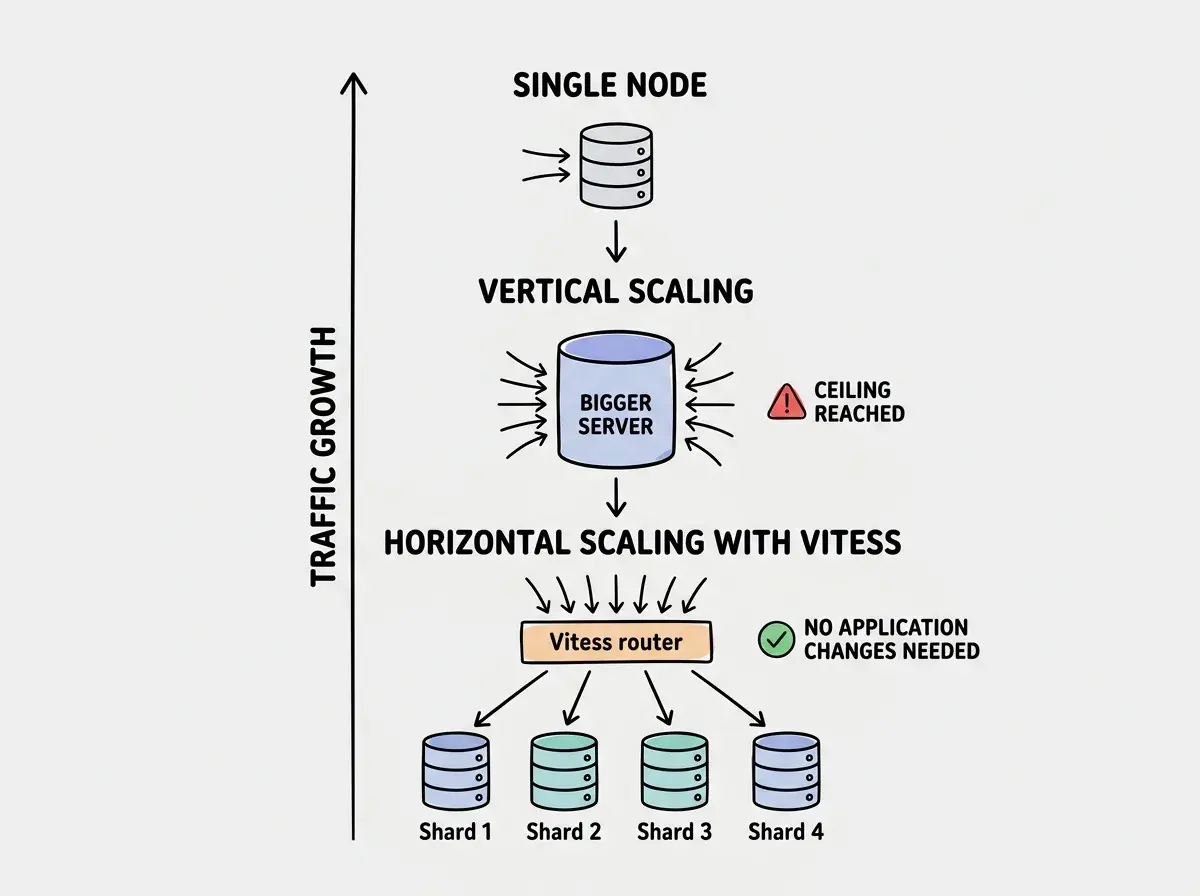
Horizontal sharding is where PlanetScale's highway system really proves itself. Vertical scaling, giving your database a bigger server, has a ceiling. At some point you cannot buy a bigger machine. Horizontal scaling, splitting your data across multiple servers, has no ceiling but traditionally requires rewriting your application to be shard-aware.
PlanetScale handles this through Vitess's VSchema configuration. You define sharding rules that tell Vitess how to distribute data, usually by a key like user_id or tenant_id. Vitess then routes each query to the correct shard automatically. Your application code does not change. The same INSERT INTO orders (user_id, product_id, amount) VALUES (?, ?, ?) statement works identically whether you have one shard or fifty.
Most AI-built projects will never need sharding. But the confidence that your database can scale horizontally if needed is worth something. It means the highway was built with expansion joints from day one. When traffic grows, adding capacity is an infrastructure decision, not an application rewrite.
When MySQL Makes Sense Over Postgres
The PostgreSQL community is loud and passionate in 2026, and for good reason. Postgres is an incredible database. But MySQL still powers the majority of web applications worldwide, and there are legitimate reasons to choose it.
MySQL's read performance on simple queries is exceptionally fast. If your application is read-heavy with straightforward lookups, joins, and aggregations, MySQL often outperforms Postgres. The query optimizer takes different approaches, and for typical web application patterns, MySQL's optimizer tends to produce efficient execution plans with less tuning required.
MySQL's replication story is more mature. Primary-replica replication in MySQL has been production-tested for decades across millions of deployments. Vitess builds on this foundation, which is why horizontal sharding works so reliably. Postgres has excellent replication too, but MySQL's head start means the tooling ecosystem around replication is deeper.
The pragmatic answer, though, is that MySQL makes sense when PlanetScale's specific features solve your problems. If you need zero-downtime migrations, horizontal sharding, and a branching workflow for schema changes, PlanetScale delivers these with MySQL. The equivalent PostgreSQL tooling exists but is more fragmented across multiple services and tools.
PlanetScale vs Neon vs Supabase
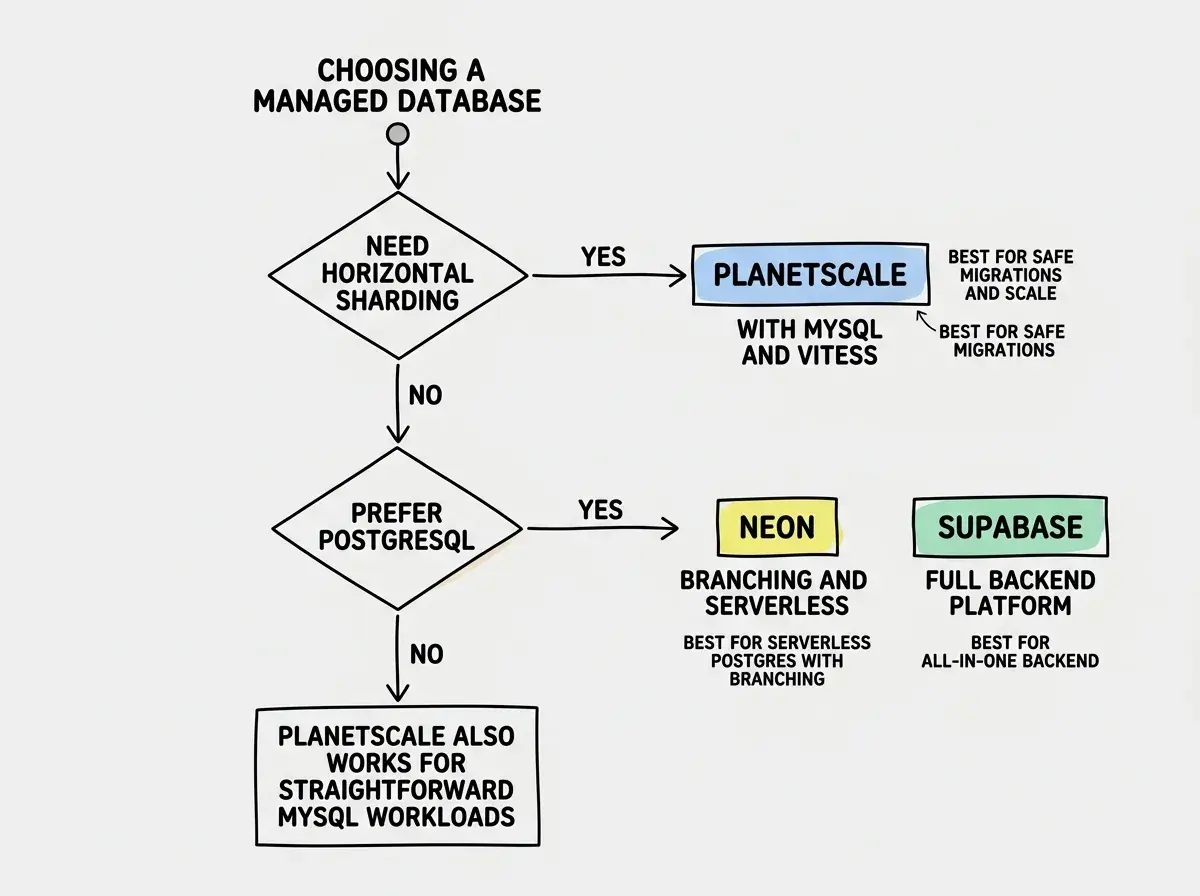
All three are managed database platforms, but they solve different problems.
Neon is serverless Postgres with branching. It shares PlanetScale's philosophy of database branching for development and preview environments, but built on PostgreSQL instead of MySQL. Neon's branching uses copy-on-write storage, making branches nearly instant and storage-efficient. If you want the branching workflow but prefer Postgres, Neon is the closest equivalent. However, Neon does not offer horizontal sharding. You scale vertically, and Neon's autoscaling handles fluctuating workloads well, but there is still a ceiling.
Supabase is a full platform that includes Postgres, authentication, storage, edge functions, and realtime subscriptions. It is not just a database. If you need only a database with excellent scaling characteristics, Supabase includes more than you need and ties your database to a broader ecosystem. If you want an entire backend platform, Supabase's bundled approach might save you from stitching together multiple services.
PlanetScale is laser-focused on the database layer. It does MySQL, it does it with Vitess, and it does schema management better than anyone else. The tradeoff is that it is only a database. You still need separate services for authentication, storage, and everything else.
Choosing PlanetScale solely because of horizontal sharding when your app has 500 users and a single Postgres instance would handle the load for years. Premature database scaling optimization is real. Start with whatever database your AI tool scaffolds, whether that is Supabase Postgres or PlanetScale MySQL, and only invest in scaling infrastructure when your metrics actually demand it.
The Free Tier Story
PlanetScale made waves in 2024 when it removed its free tier, then partially restored it in a different form. This matters because many vibe coders and indie hackers relied on it for hobby projects and prototypes.
The current situation is that PlanetScale offers a Scaler plan starting at $39/month with generous resource allocations. There is no permanently free tier for production databases. For developers who need a free MySQL database for prototyping, options like Railway, Aiven, or a simple Docker container running MySQL locally fill that gap. PlanetScale's pricing positions it as a tool for projects that have outgrown free tiers, not for weekend experiments.
This is a reasonable business decision, but it changes who PlanetScale is for. If you are validating an idea and every dollar matters, start with a free database elsewhere. When your application has paying users and needs safe migrations and scaling headroom, that is when PlanetScale's pricing makes sense against the engineering time it saves.
Learn what a database is and how your application stores and retrieves data before diving into scaling strategies.
Read the fundamentalsLimitations Worth Knowing
Foreign key support has a complicated history. Vitess historically did not support foreign key constraints because they complicate sharding. If a row in the orders table references a row in the users table via a foreign key, and those rows live on different shards, the database cannot enforce that constraint efficiently. PlanetScale added foreign key support in 2023, but with caveats. Foreign keys work within a single shard but add complexity in sharded environments. Many PlanetScale users enforce referential integrity in application code instead, which is a legitimate pattern but requires discipline.
You are locked into MySQL. If your team decides to switch to Postgres later, that is a migration project, not a configuration change. Your schema, queries, stored procedures, and ORM configuration all need updating. MySQL and Postgres have different SQL dialects, different type systems, and different behavior around things like case sensitivity and transaction isolation.
The Vitess query compatibility layer is not 100% MySQL. Most standard queries work perfectly. But some advanced MySQL features, certain subquery patterns, window function edge cases, or specific stored procedure behaviors, may hit Vitess limitations. For typical web application queries generated by AI tools and ORMs, this is rarely an issue. For complex analytical queries, test carefully.
Who Should Use PlanetScale
You should use PlanetScale if your application runs MySQL, needs zero-downtime migrations, and will eventually face real scaling pressure. The deploy request workflow alone justifies the cost for teams that push schema changes regularly. If you are building a SaaS with growing data volumes and cannot afford migration downtime, PlanetScale solves a genuine pain point.
You should not use PlanetScale if you are prototyping, need a free tier, or your AI tool scaffolded a Postgres-based stack. Switching from Postgres to MySQL just for PlanetScale rarely makes sense unless you specifically need Vitess's sharding capabilities.
The highway system analogy comes full circle here. You do not build an interstate for a neighborhood that gets ten cars a day. But if your neighborhood is growing into a city, having the highway infrastructure already in place, with safe on-ramps (deploy requests), automatic lane expansion (horizontal sharding), and battle-tested traffic management (Vitess), means growth becomes an operational task instead of an engineering crisis.
See how the ORM layer on top of your database affects everything from bundle size to AI code generation quality.
Read the comparisonFinal Thoughts
PlanetScale MySQL occupies a specific and valuable niche in the database landscape. It is not trying to be everything. It is trying to be the best managed MySQL platform with the safest migration workflow and the most proven scaling story. The Vitess foundation gives it credibility that no amount of marketing could manufacture, because the same technology runs YouTube, and that is a stress test no benchmark can replicate.
For senior developers building AI-assisted applications that might grow beyond a single database server, PlanetScale offers peace of mind. Your highway system is ready for traffic. Whether that traffic arrives tomorrow or next year, the lanes are there when you need them.