Most databases treat real-time as a bolt-on feature. You set up your PostgreSQL instance, wire in a WebSocket layer, write subscription logic, handle reconnection, manage stale data, and eventually accept that your UI is still showing data from three seconds ago. Convex reactive database takes a different approach entirely. It treats reactivity as the default, not the exception.
Think of it like a live scoreboard at a stadium. Traditional databases are like checking the score on your phone, refreshing every few seconds and hoping you catch the update. Convex is the actual scoreboard, updating the moment anything changes, with every fan seeing the same number at the same time. No refresh button. No polling interval. Just live data flowing to every connected client.
With 92% of developers now using AI tools daily, the backend you choose matters more than ever because AI agents generate the code that talks to it. And Convex was designed from the ground up for this kind of workflow.
What Makes the Convex Reactive Database Different
Reactivity is not a feature. It is the architecture. In Convex, every query is a subscription by default. When you write a query function and use it in your React component with useQuery, the component automatically re-renders whenever the underlying data changes. You do not set up WebSocket connections. You do not configure pub/sub channels. You do not write event listeners. The live scoreboard just works.
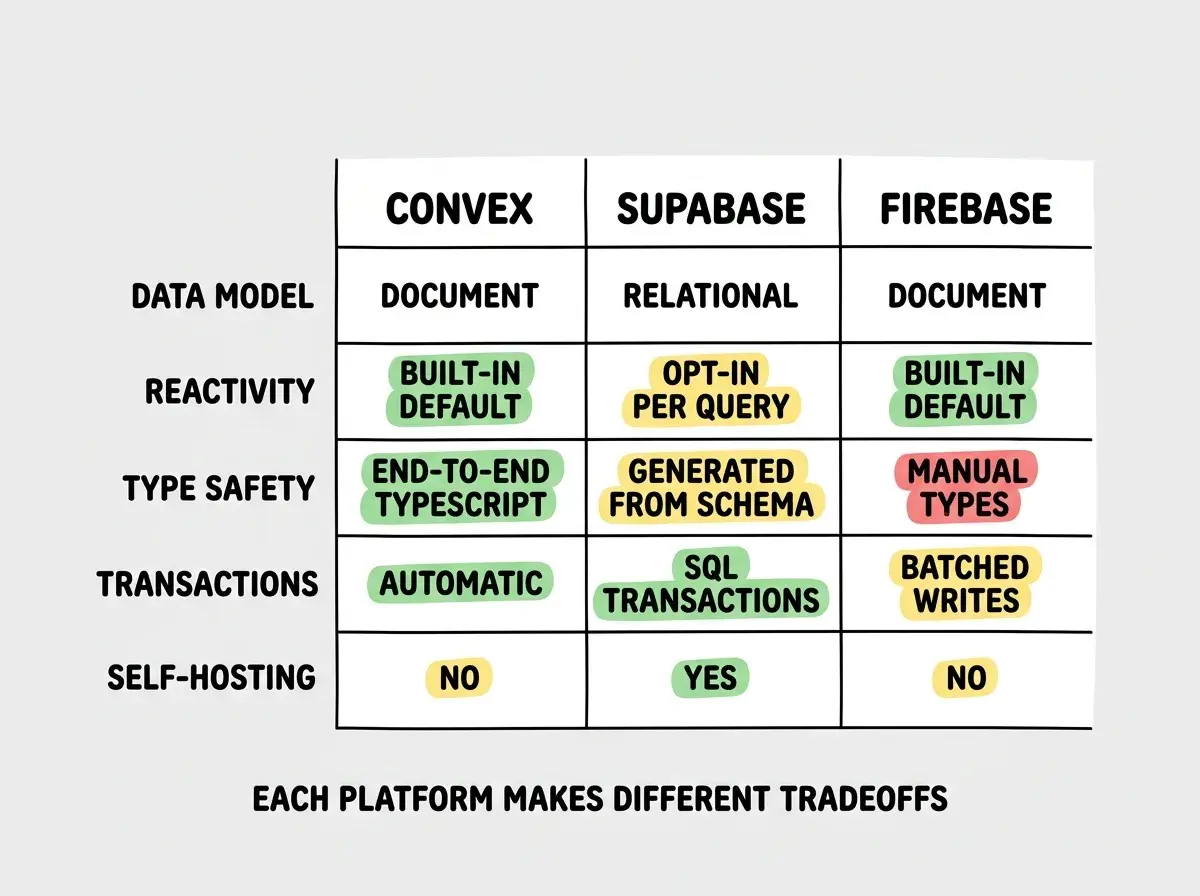
This is fundamentally different from how Supabase or Firebase handle real-time. Those platforms offer real-time as an additional layer on top of a traditional database. Supabase uses PostgreSQL's LISTEN/NOTIFY with their Realtime server. Firebase uses a proprietary sync protocol. Both require you to opt into real-time per query. Convex makes every query reactive by default, and lets you opt out when you need a one-shot read.
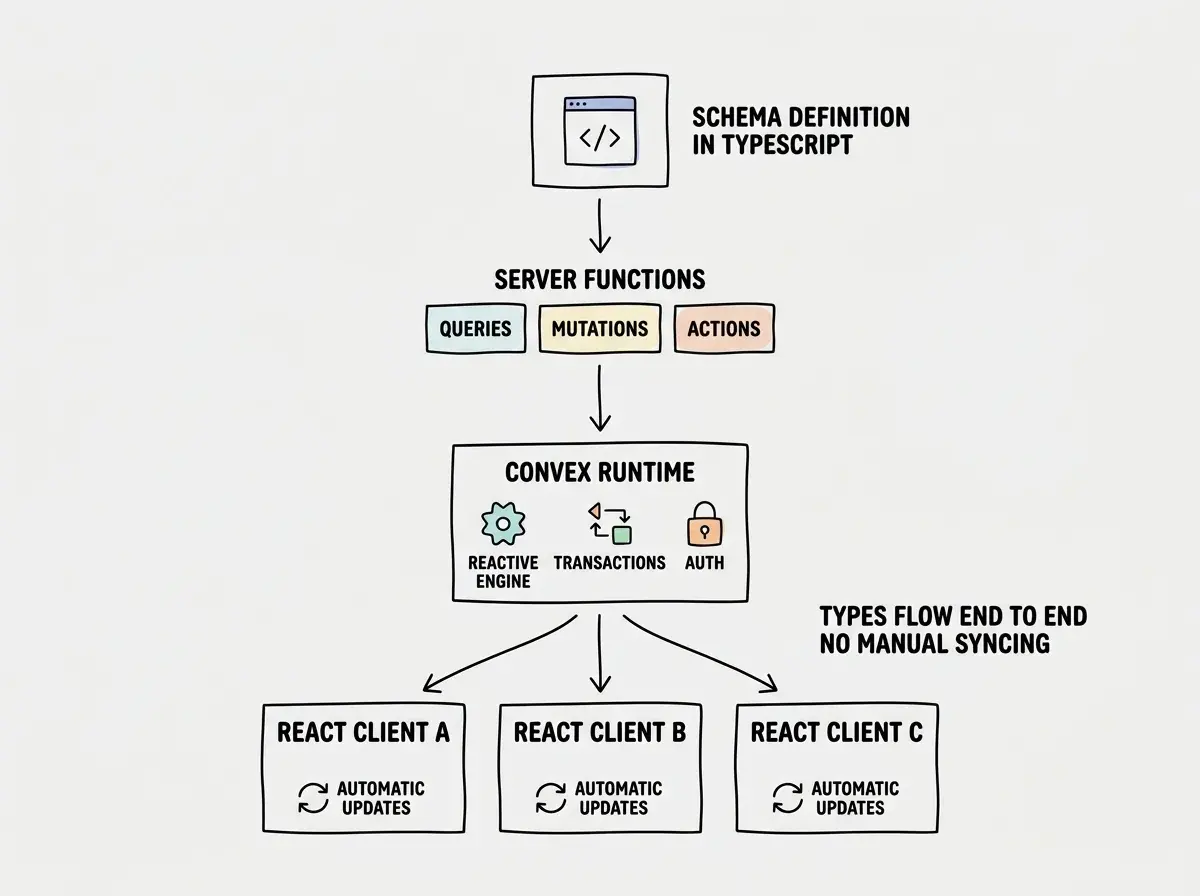
Server functions replace your entire API layer. Instead of building REST endpoints or GraphQL resolvers, you write TypeScript functions that run on Convex's servers. There are three types: queries (read data, automatically reactive), mutations (write data, transactional), and actions (call external APIs, run side effects). No Express server. No API routes. No route handlers to maintain.
// convex/tasks.ts
import { query, mutation } from "./_generated/server";
import { v } from "convex/values";

export const list = query({
  handler: async (ctx) => {
    return await ctx.db.query("tasks").order("desc").collect();
  },
});

export const create = mutation({
  args: { text: v.string() },
  handler: async (ctx, args) => {
    await ctx.db.insert("tasks", { text: args.text, completed: false });
  },
});
That is your entire backend for a task list. The query function automatically pushes updates to every connected client when any mutation modifies the tasks table. No additional code required. The scoreboard updates itself.
Built-in authentication that skips the configuration marathon. Convex Auth supports email/password, magic links, OAuth providers, and anonymous sessions out of the box. It integrates directly with the database layer, so your server functions can call ctx.auth.getUserIdentity() to get the current user without middleware or token parsing. For indie hackers who have burned hours configuring NextAuth callbacks, this is a meaningful time savings.
Convex is not just a database. It is a reactive backend platform that replaces your database, your API layer, and your real-time infrastructure in a single TypeScript-native package. The value proposition is eliminating the glue code between these layers, not just providing a faster database.
TypeScript-First Developer Experience
Convex was built for TypeScript from day one. Your schema, your server functions, your client queries, and your component hooks all share a single type system. When you define a table schema in convex/schema.ts, the types flow through to your query functions, your mutation arguments, and your React hooks without any manual type definitions.
This matters more than it sounds. In a Supabase workflow, you run a CLI command to generate TypeScript types from your PostgreSQL schema, then import those types into your application code. If the schema changes and you forget to regenerate, your types drift. In Convex, types are derived directly from your schema definition. No generation step to forget.
The developer experience extends to error handling. Convex mutations are fully transactional. If a mutation throws an error halfway through, all database writes in that mutation are rolled back automatically. The live scoreboard either updates completely or not at all. No partial states. For AI-generated code, this is particularly valuable. The type system catches argument mismatches at build time, and transactional guarantees mean AI-generated write operations cannot leave your database in an inconsistent state even if the generated error handling is incomplete.
How Convex Compares to Supabase
This is the comparison most developers ask about, and it starts with a fundamental architectural difference. Supabase is a relational database (PostgreSQL) with real-time and auth layers added on top. Convex is a document database with reactivity and transactions built into the core.
Data modeling. Supabase gives you full SQL with joins, foreign keys, views, and stored procedures. If your app has complex relational data with many-to-many relationships, Supabase's relational model is more natural. Convex uses a document model similar to MongoDB, but with a proper schema system and automatic indexing. For most SaaS and consumer applications, the document model works well. For analytics-heavy workloads with complex aggregations, PostgreSQL's SQL capabilities are hard to beat.
Real-time. Supabase Realtime works at the row level. You subscribe to changes on specific tables with optional filters. It uses WebSocket connections under the hood, and you manage subscriptions explicitly. Convex's real-time works at the query level. Any query function automatically becomes a live subscription. The difference is subtle but significant. With Supabase, you subscribe to data changes. With Convex, your query results stay current automatically, like the scoreboard always showing the latest score regardless of which play updated it.
Pricing. Both platforms offer generous free tiers for early-stage apps. At scale, Supabase's pricing is more predictable because it is based on database size and compute. Convex bills per function call and bandwidth, which can be harder to estimate for high-traffic applications.
AI tool support. Supabase has strong representation in AI training data because it has been around since 2020. Convex is newer but has invested heavily in AI-compatible tooling, including an MCP server that lets AI agents interact with Convex projects directly. When you ask an AI to build an app with Convex, it generates clean code because the patterns are simple and consistent.
Choosing Convex expecting it to replace PostgreSQL for every use case. Convex excels at reactive, real-time applications with moderate query complexity. If your app needs complex SQL joins, full-text search across millions of rows, or heavy analytical queries, a relational database is still the better fit. Convex is a specialized tool, not a universal database replacement.
AI Tool Support and the Convex Advantage
Here is where the Convex reactive database starts to pull ahead for AI-built applications specifically. The entire backend is TypeScript functions. There is no SQL to generate, no ORM configuration to get wrong, no migration files to manage. When you tell an AI to "add a comments feature," it writes a schema table, a few query and mutation functions, and a React hook. That is the entire stack.
Convex also ships with built-in vector search for embedding-based queries. If you are building AI features into your product (chatbots, semantic search, recommendation engines), Convex provides the infrastructure without requiring a separate vector database like Pinecone or Weaviate.
The MCP (Model Context Protocol) server is particularly interesting. It lets AI agents read your Convex schema, understand your data model, and generate functions that match your existing patterns. This is not just code generation from documentation. It is context-aware code generation from your actual project.
Understand what a database actually does before picking one for your app.
Read the guidePricing Breakdown
Convex offers three tiers as of early 2026.
Free tier. 1 million function calls/month, 1 GB storage, 5 GB bandwidth. Enough for prototyping and small production apps with modest traffic.
Pro tier ($25/month). 5 million function calls, 10 GB storage, 50 GB bandwidth. Overages billed at reasonable per-unit rates. This is the sweet spot for indie hackers with apps that have real users but are not yet at massive scale.
Enterprise. Custom pricing with dedicated support, SLAs, and higher limits.
The function-call billing model is the thing to watch carefully. Every query subscription counts as function calls when the underlying data changes. A highly reactive app with frequent data mutations can burn through function calls faster than you expect. Monitor your usage dashboard during development to understand your baseline before scaling.
When to Use Convex
Use Convex when you are building:
- Real-time collaborative apps (think Notion, Figma, multiplayer games)
- AI-powered products that need vector search and reactive data together
- SaaS applications with moderate data complexity and high interactivity
- Prototypes and MVPs where you want to skip the backend setup entirely
- Apps where your entire team writes TypeScript and wants end-to-end type safety
Consider alternatives when you need:
- Complex relational queries, joins, or analytical aggregations (use Supabase/PostgreSQL)
- Self-hosted infrastructure for compliance or data sovereignty (Supabase is open source)
- A battle-tested ecosystem with seven years of production usage (PostgreSQL via Supabase)
- Maximum control over your database engine and deployment (any self-managed solution)
Learn the full cost picture before choosing your backend stack.
See the real costsThe Bottom Line
Convex is not trying to replace PostgreSQL for everything. It is eliminating the glue code between your database, your API, and your real-time layer for a specific class of applications. For that class, the ones that 92% of AI-using developers are building with tools like Cursor and Claude Code, it does the job remarkably well.
Your data updates, every client sees it immediately, and you never wrote a WebSocket handler. For reactive, TypeScript-first, AI-built applications, Convex is one of the strongest options available in 2026. Just make sure your use case actually needs a live scoreboard before you commit to one.