To pitch an AI built product without scaring investors, lead with traction and customer evidence, treat the AI generation percentage as a side note rather than a headline, and have a clear answer for the four objections that show up in almost every meeting: technical risk, defensibility, team durability, and the cleanup tax. Investors in 2026 are not opposed to AI-built products; many of them are actively excited about them. They are opposed to founders who cannot answer the predictable hard questions, and the predictable hard questions are mostly about whether the founder understands what they shipped.
This piece walks through what to lead with, what to skip, the four objections to prepare for, and a clean structure for the pitch itself.
What Investors Actually Care About
The mistake most first-time founders make is treating "we built it with AI" as the headline of the pitch. It is not. Investors care about traction, market, team, and defensibility, in roughly that order. The fact that you used AI to ship faster is interesting but secondary. It is the equivalent of pitching a SaaS company in 2010 by leading with "we used Ruby on Rails." It speeds up your build, it is not the reason anyone would invest.
The pitches that work in 2026 lead with the same things pitches have always led with. A clearly defined customer problem, evidence that the customer is willing to pay, a plan for how the business gets larger as it acquires more customers, and a team that can execute. AI is a tool that supports each of those, not a replacement for any of them.
A 2025 First Round Capital survey of 200 seed and Series A investors found that 89 percent had funded at least one AI-built product in the prior 12 months, but 67 percent said they had passed on AI-built deals because the founder "could not articulate what the code actually did." The blocker was rarely the AI part. It was the founder's understanding of their own product.
The pattern to copy is the rise of no-code in the late 2010s. Founders pitching no-code products initially treated the no-code part as the pitch, which generated polite rejection from most investors. By 2022, the same investors were funding no-code companies enthusiastically, but only when the founders treated the no-code stack as an implementation detail and led with traction. The AI-built equivalent is happening now.
The Four Objections to Prepare For
Investors in 2026 will ask roughly the same four questions about any AI-built product. Having a crisp, honest answer for each one is the single highest-leverage prep you can do.
Objection 1, technical risk. "How do you know the code works? Has anyone else looked at it?" The good answer is a combination of automated tests, a recent third-party security review, and visible production observability. The bad answer is "Cursor wrote it and the tests all pass."
Objection 2, defensibility. "If anyone can build this with AI in a weekend, what stops a competitor?" The good answer is one or more of: customer relationships, distribution, data moats, regulatory expertise, brand, or speed of execution. The bad answer is "our prompts are really good."
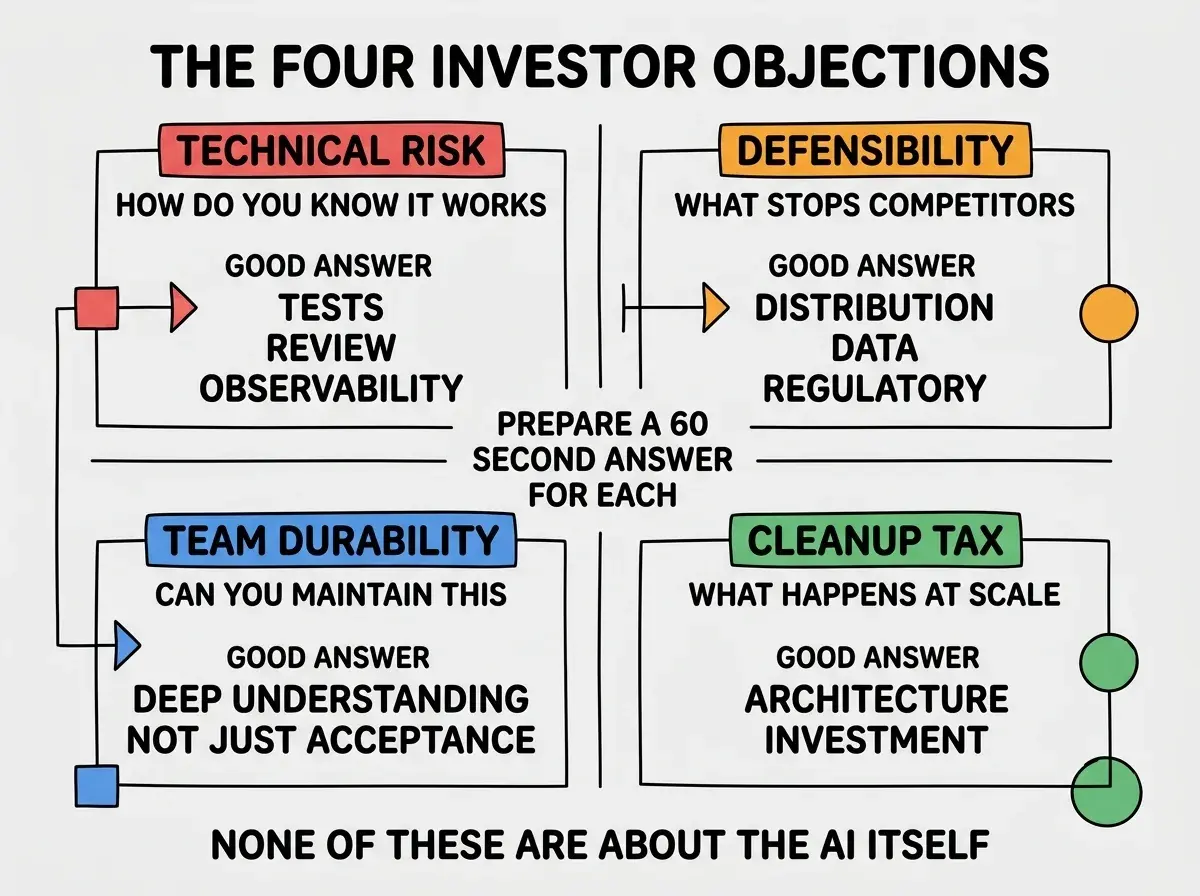
Objection 3, team durability. "If your CTO leaves, can the company maintain the product?" The good answer is that you (the founder) understand the system end to end and have processes for AI-assisted maintenance. The bad answer is silence or "we'll hire someone."
Objection 4, the cleanup tax. "What happens when you have 100x more code and 1000x more users? Will the architecture hold?" The good answer is that you have already invested in clean architecture, have refactored at least once, and know which parts of the system will need rewriting at scale.
What to Lead With Instead of AI
Strip the word "AI" out of the first three slides and see if the pitch still stands. If it does not, the pitch is not investable yet, and adding AI back will not save it. If it does, you have a real story and can mention AI as the speed multiplier in slide four or five.
The best pitches for AI-built products in 2026 follow a structure that is recognizable to any seed investor. Open with a customer problem (slide 1 to 2). Show traction (slide 3, often with revenue or active users). Explain the wedge into the market (slide 4). Cover the business model (slide 5). Show the team (slide 6). Then, briefly, mention how AI lets you move faster than competitors (slide 7). Close with the ask and the use of funds (slide 8 to 10).
Browse more business and strategy guides
Read more foundationsThe trap to avoid is the "AI-first" framing where the deck spends 5 slides on prompt engineering, model choice, and tooling. Investors do not buy that. They buy the underlying business with AI as a multiplier.
How to Talk About the Code Itself
When the conversation turns technical (and it will, in the second meeting if not the first), be specific and confident about what your codebase looks like. Vagueness here is the single biggest red flag.
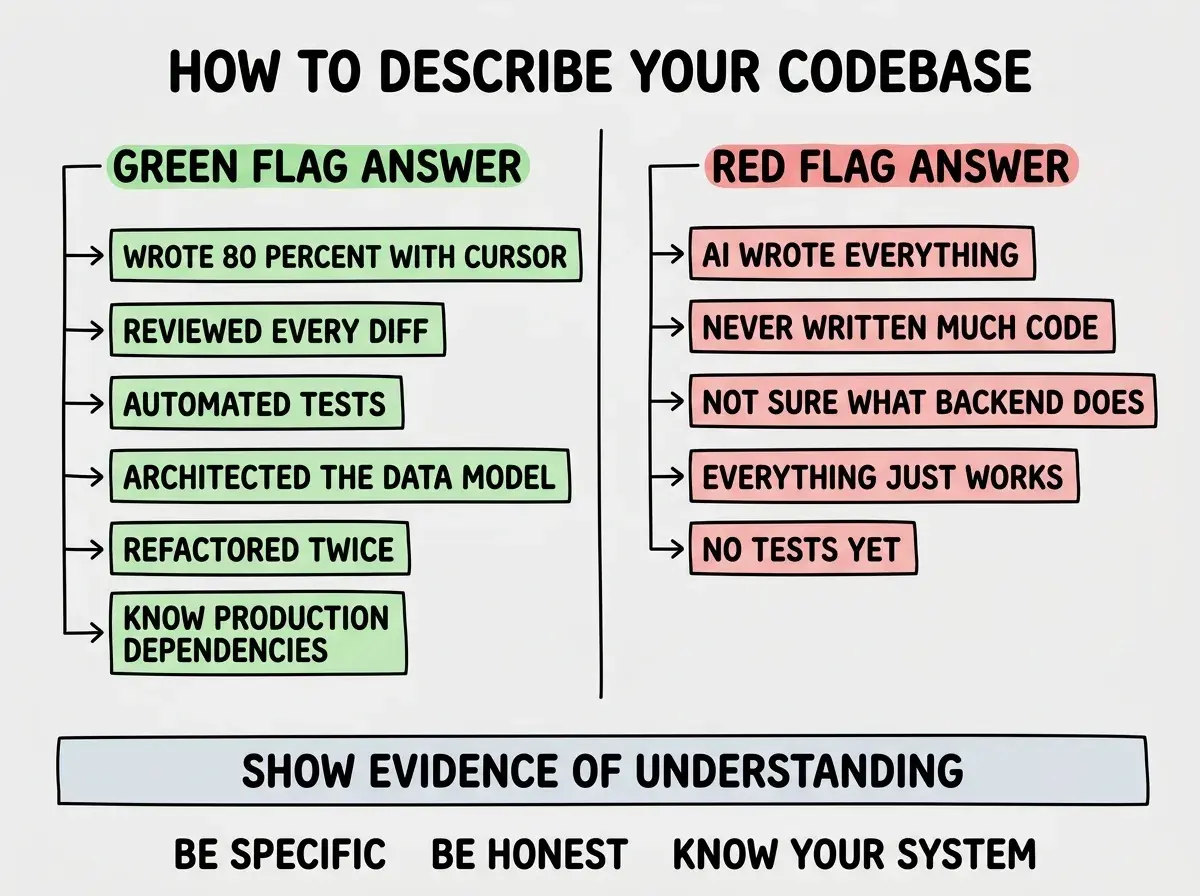
A good way to describe the codebase is with three sentences. First, the broad architecture (e.g., "Next.js frontend, Postgres on Supabase, Stripe for billing, Resend for email"). Second, the level of AI involvement (e.g., "Roughly 80 percent of the lines were initially generated by Cursor, then reviewed and edited"). Third, the level of human discipline (e.g., "Every change goes through git, automated tests cover the critical paths, and we do a security review every quarter").
The most damaging mistake in pitching AI-built products is overclaiming on the AI part. Saying "AI wrote 100 percent of our code" sets off every alarm bell. Saying "we used AI to write the first draft of most features and then reviewed and tested everything" is the same product, framed in a way that builds confidence rather than fear. Frame matters as much as substance in fundraising conversations.
The corollary is that under-claiming hurts too. Pretending you did not use AI when you obviously did is worse than overclaiming. Investors will see through it within minutes and will lose trust fast. Be specific, accurate, and proud of the speed advantage without making it the whole pitch.
The right level of detail for the technical answer is roughly two minutes of speaking time. Less than that feels evasive, more than that signals defensiveness. Practice the answer out loud until it lands in the right window, then never go off script when an investor pushes for more detail. The discipline of staying on the prepared version produces consistently better outcomes than improvising in the room.
What This Means For You
Pitching an AI-built product is mostly the same as pitching any product, with three or four extra preparation steps. Founders who do those extra steps move through the funnel as fast or faster than founders who built the same product the slow way.
- If you're a founder: Strip "AI" from your first three slides and rewrite them around the customer problem. Add AI back only where it is genuinely a competitive advantage.
- If you're changing careers: Build a small AI-built product, get one or two paying customers, and use that as your proof point in any pitch. Traction beats narrative every time.
- If you're a student: Watch real pitches on YouTube to internalize the structure. The AI part is a small chapter of a familiar story.
Read more on the business of vibe coding
Browse foundations