The cleanup economy is the quiet new market of engineering-for-hire that has grown alongside vibe coding, where experienced developers charge premium rates to fix, finish, or rewrite AI-built apps. Estimates from freelance platforms suggest the cleanup market grew roughly 4x in the 18 months between mid-2024 and early 2026, and now represents a meaningful slice of contract software work. The pattern is real, and it tells you something important about the limits of vibe coding that the marketing copy never quite admits.
This piece explains how the cleanup economy works, what it costs founders, when it typically kicks in, and what the demand signals about the trajectory of AI-built software.
Why the Cleanup Economy Exists
The trigger for almost every cleanup engagement is the same. A founder built an MVP with an AI tool, got it to a demo state, and started getting users. Then the app hit a wall. New features broke old ones. The codebase became too tangled to extend. A security audit failed. A scaling problem could not be solved with another prompt. At that point, the founder realizes they need someone who can do what the AI cannot, look at the whole system and refactor, redesign, or rewrite.
The supply side of the market is engineers who specialize in this exact transition. Most of them have 10+ years of experience and now charge two to three times what they did before, because the work is hard, the urgency is high, and the supply of qualified people is small. A typical cleanup engagement is 4 to 12 weeks, costs 15,000 to 80,000 dollars, and ends with a codebase the founder can hand off or maintain themselves.
A 2025 freelance platform analysis found that listings tagged with "AI cleanup" or "vibe code refactor" grew 312% year over year, with median rates 60% higher than equivalent non-cleanup contract work. The market is real, the rates are unusual, and the demand has not slowed.
The pattern to copy is the cleanup economy that emerged after the no-code wave. Companies that built on Bubble or Webflow eventually hit limits, and a sub-industry of engineers who could rebuild those apps as real code emerged. The same pattern is repeating with AI-built code, just compressed into a shorter timeline and with bigger price tags.
What Cleanup Engagements Actually Look Like
The work itself usually falls into one of three buckets, each with a different cost profile and different success criteria.
Bucket 1, refactor in place. The codebase has the right shape but accumulated convention drift, missing tests, no documentation, and architectural inconsistencies. The cleanup is a 4 to 6 week engagement where the engineer maintains feature parity but cleans up the structure. Cost, 15,000 to 30,000 dollars. Risk, low.
Bucket 2, rewrite the worst parts. Some sections of the codebase are salvageable, others are not. The engineer keeps the database schema and API contracts but rewrites the brittle modules, often the auth flow, the payment integration, or the frontend state management. Cost, 30,000 to 60,000 dollars. Risk, moderate.
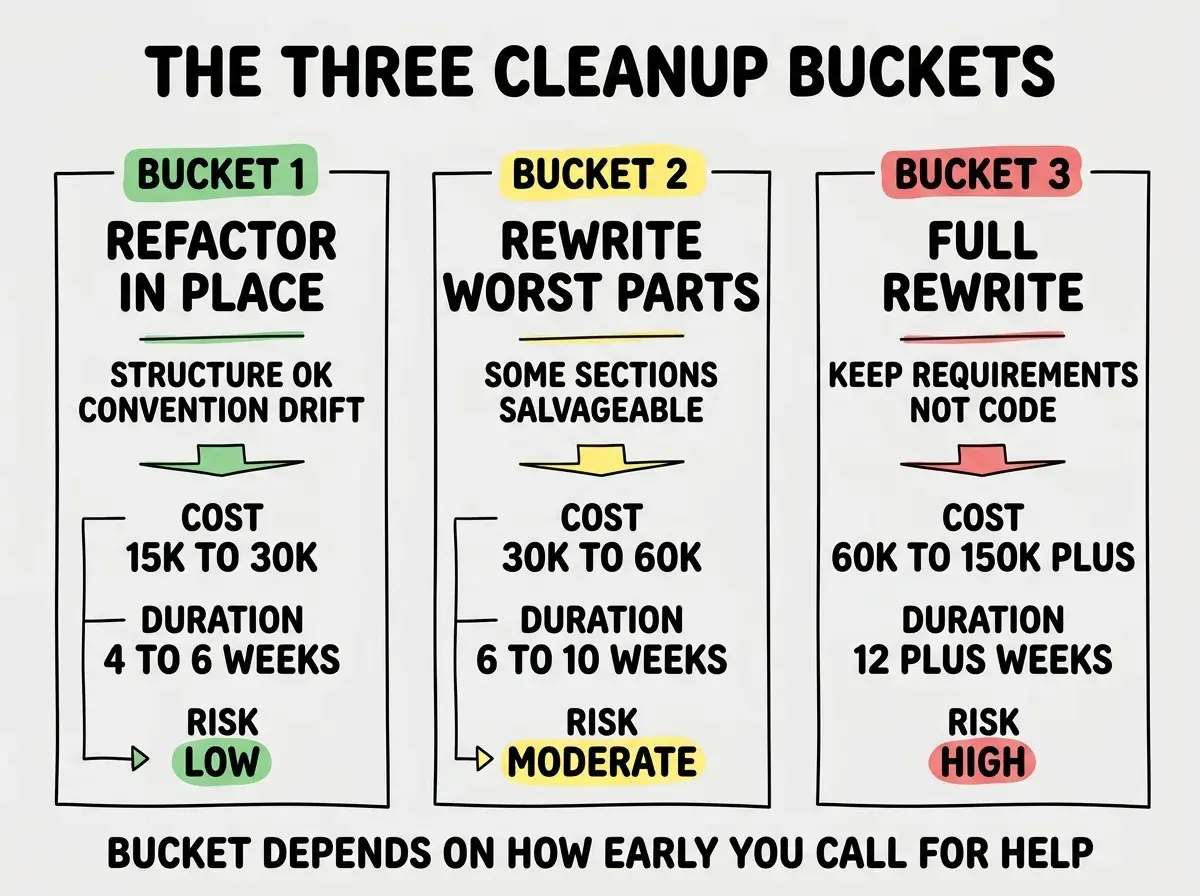
Bucket 3, full rewrite. The codebase is unsalvageable. The engineer keeps the product requirements and the user-facing functionality but rebuilds from scratch. This is the worst-case scenario for the founder, and the most expensive. Cost, 60,000 to 150,000+ dollars. Risk, high.
When Founders Call for Help
The data on when founders typically reach the cleanup point is surprisingly consistent. The median engagement happens between months 4 and 9 of the project's life, with the trigger usually being one of three events.
The first trigger is a feature that does not fit. The founder has tried for two weeks to add it, the AI keeps breaking unrelated parts of the app, and the velocity has dropped to nothing. The second trigger is a security or compliance event, often a security audit before a fundraise or an enterprise deal that requires SOC 2. The third trigger is performance, the app has reached enough users that latency or downtime is becoming a real problem.
Read more guides on building durable vibe coded apps
Browse foundations articlesThe honest pattern is, the founders who get the worst deal are the ones who wait until the third trigger before calling. By then, the codebase has accumulated the most damage, the engineer has the least time to plan a careful migration, and the work is the most expensive. The founders who get the best deal are the ones who recognize the first trigger early and bring help in while the codebase is still mostly salvageable.
What the Demand Signals
The growth of the cleanup economy says a few specific things about vibe coding that the marketing language obscures. First, AI tools genuinely are good for the early stages of building. The cleanup engagements would not be lucrative if AI did not produce working code in the first place. Second, AI tools genuinely struggle with the late stages. The same engagements would not exist if AI could finish what it started.
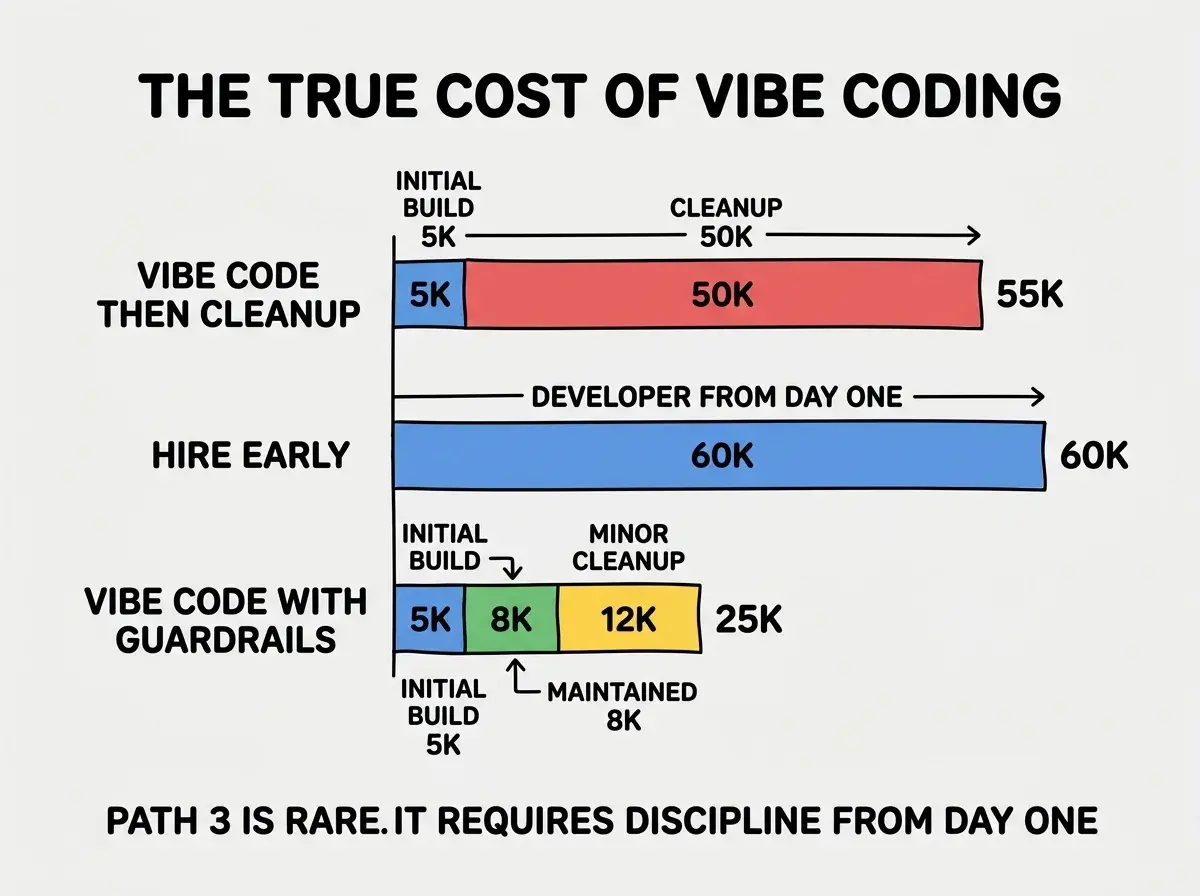
The third signal is more uncomfortable. The total cost of "vibe coding plus eventual cleanup" is not always lower than the cost of hiring a developer at the start. For founders building a serious product, the math sometimes favors hiring earlier and skipping the cleanup phase entirely. The founders who avoid the cleanup tax are usually the ones who treat vibe coding as a tool for the prototype phase only, then transition deliberately to either professional code or a managed handoff.
The most expensive cleanup mistake is the optimistic timeline, "we will hire someone for two weeks to fix this." The realistic minimum is four weeks because the engineer has to read the codebase before they can fix anything. Founders who book one or two weeks consistently overrun by 3x or 4x.
The corollary is that a founder hiring for cleanup should buy time, not output. The engineer needs unstructured weeks to read, model, and plan before they ship anything. Pressuring for fast deliverables in week one usually produces shallow patches that paper over the real problems.
The other underappreciated dynamic is the credentialing effect. Engineers who specialize in cleanup work are usually the most senior people in their networks, the ones who have already led teams or built infrastructure at scale. The cleanup market is one of the few places where deep experience commands a clear premium over recent novelty, which is why the rates in this segment have stayed elevated even as overall contract rates have wobbled with the broader economy.
What This Means For You
The cleanup economy is a signal worth reading honestly. AI tools are genuinely valuable, and they have genuine limits. Knowing where the limits are lets you avoid the most expensive version of crossing them.
- If you're a founder: Plan for cleanup as a likely cost, not an unlikely one. If your app reaches real users, you will probably need professional help by month 6. Budget accordingly.
- If you're changing careers: The cleanup economy is a real opportunity for engineers with traditional experience. Specialize in this transition and the rate premium is meaningful.
- If you're a student: Read the public postmortems and contractor blog posts about specific cleanup engagements. The patterns repeat, and the lessons are easier to absorb from someone else's pain.
Browse more business and strategy guides for vibe coding
Read more foundations