Vibe coding gives non-technical founders a real competitive advantage that did not exist three years ago, the ability to build, ship, and iterate on a product without depending on a technical co-founder or an early hire. The founders who internalize this advantage close the gap with technical peers in three specific ways, faster validation, lower dilution, and better fundraise terms. The advantage is not unlimited and it has clear limits, but inside those limits, it is meaningful enough to change the math of starting a company.
This piece explains the three concrete advantages, why they compound, and what the limits are so you can decide whether vibe coding is the right tool for your particular founding moment.
The Founding Game Has Changed
Five years ago, the standard advice to a non-technical founder was, find a technical co-founder. The advice was correct, because building a real product without one was nearly impossible. The founder had two options, give away 30 to 50 percent of the equity to attract the right co-founder, or hire developers at 100,000+ dollars per year and hope to fundraise before running out of cash. Both paths required months of work before a single user could touch the product.
Vibe coding has changed the math of those two options without eliminating them. A non-technical founder today can build a real working MVP in a week or two, put it in front of users, and learn whether the idea is worth pursuing before making any equity or hiring decision. The decision becomes informed instead of speculative.
A 2025 survey of 800 first-time founders found that those who built their own MVP using AI tools spent a median of 11 days from idea to first user, compared to 73 days for founders who hired developers, and that they retained an average of 18 percentage points more equity at first fundraise. The pattern is consistent across consumer and B2B products.
The pattern to copy is the relationship between the printing press and writing. Before the press, every author needed a patron or a printing license to share their work. After the press, anyone could publish, which did not eliminate publishers but radically changed the writer's leverage in the relationship. Vibe coding is doing something analogous for the founder-developer relationship.
Advantage 1, Faster Validation
The single biggest competitive advantage of vibe coding for non-technical founders is the speed of validation. The traditional founder spends three months building a prototype with a developer, three more months getting it to MVP, and only then learns whether the idea resonates. The vibe coder runs the same loop in three weeks.
The implication is that for the same calendar time, the vibe coder gets to test five to seven ideas against users while the traditional founder tests one. Idea testing is the work of starting a company, and 5x faster idea testing produces dramatically better outcomes on average. The founder who tests seven ideas and picks the one with the best signal is competing with founders who picked their first guess and committed.
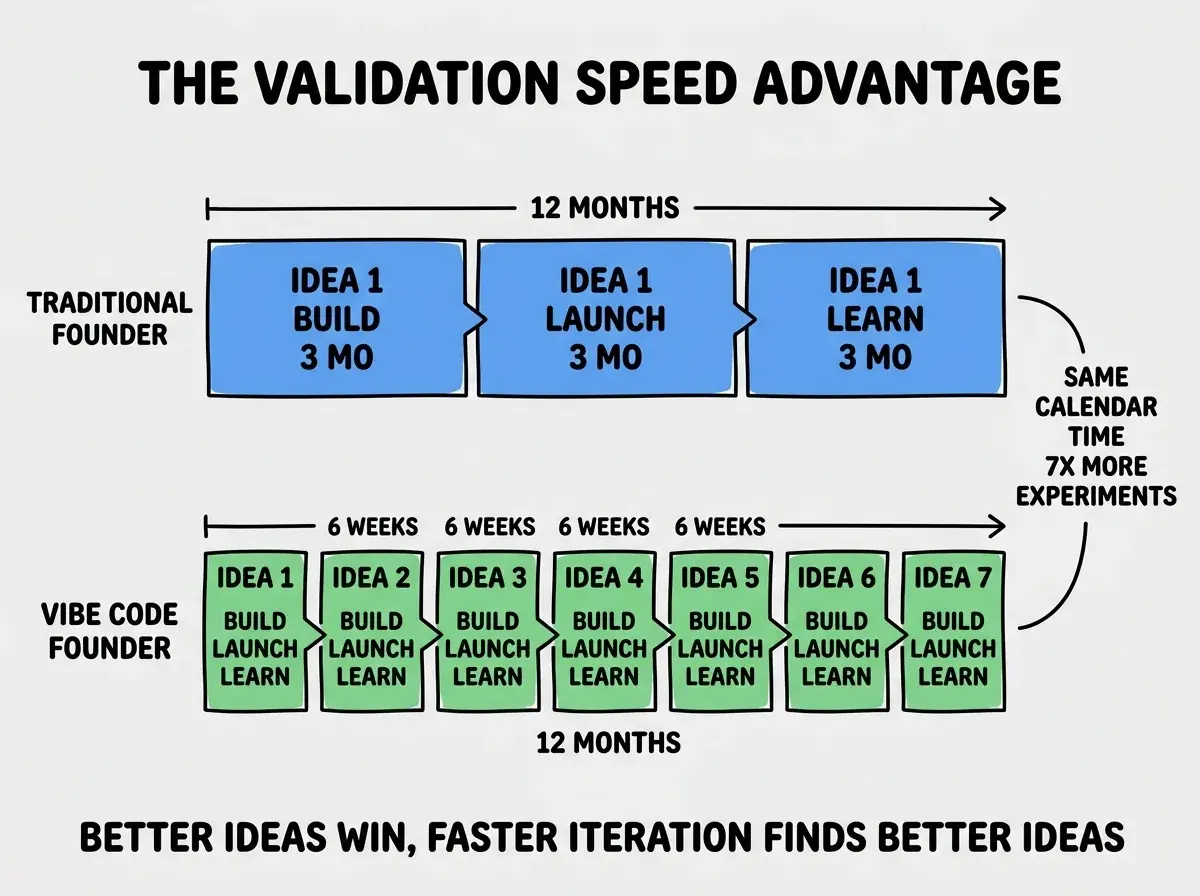
The compounding part of this advantage is that each cycle teaches the founder something. After three rounds of building and shipping, the vibe coder has direct experience with what users do and do not want. After ten rounds, the experience is the difference between guessing and knowing. The traditional founder hits the same learning curve eventually, just much later.
Advantage 2, Lower Dilution
The second advantage is purely financial. A non-technical founder who needs a technical co-founder to build the MVP is negotiating from a weak position, the co-founder has the skill that unlocks the product, and the founder usually gives 30 to 50 percent equity in exchange. The vibe coding founder removes this dependency, which fundamentally changes the negotiation.
The math of this advantage is enormous over a long timeline. A founder who keeps 20 extra percentage points of equity through a Series A and an exit at 100 million dollars retains an extra 20 million dollars they would otherwise have given up. The decision to learn vibe coding well enough to ship an MVP is, in financial terms, one of the highest-leverage decisions a non-technical founder can make in their first year.
Read more business and strategy guides for vibe coding
Browse foundations articlesThe other piece is the timing of the technical hire. A founder who can ship the MVP themselves can hire a senior engineer at the moment they have product-market fit, not before. The hire is much easier (the engineer can see traction), the founder retains more leverage in the offer (no equity ransom), and the company starts the engineering scale-up phase from a stronger position.
Advantage 3, Better Fundraise Terms
The third advantage shows up in fundraising. Investors have always preferred founders who can ship without help, because shipping is the highest-confidence signal of execution capability. The traditional non-technical founder could only show shipped product if they had spent months and tens of thousands of dollars on developers. The vibe coding founder can show shipped product before the first investor meeting.
The terms reflect this. Investors who see a working MVP, real users, and weekly iteration cycles offer better valuations and friendlier terms than investors who see slides. The 2025 startup funding data shows a meaningful premium for founders who built their own MVP, ranging from 20% to 60% higher pre-seed valuations across comparable startups.
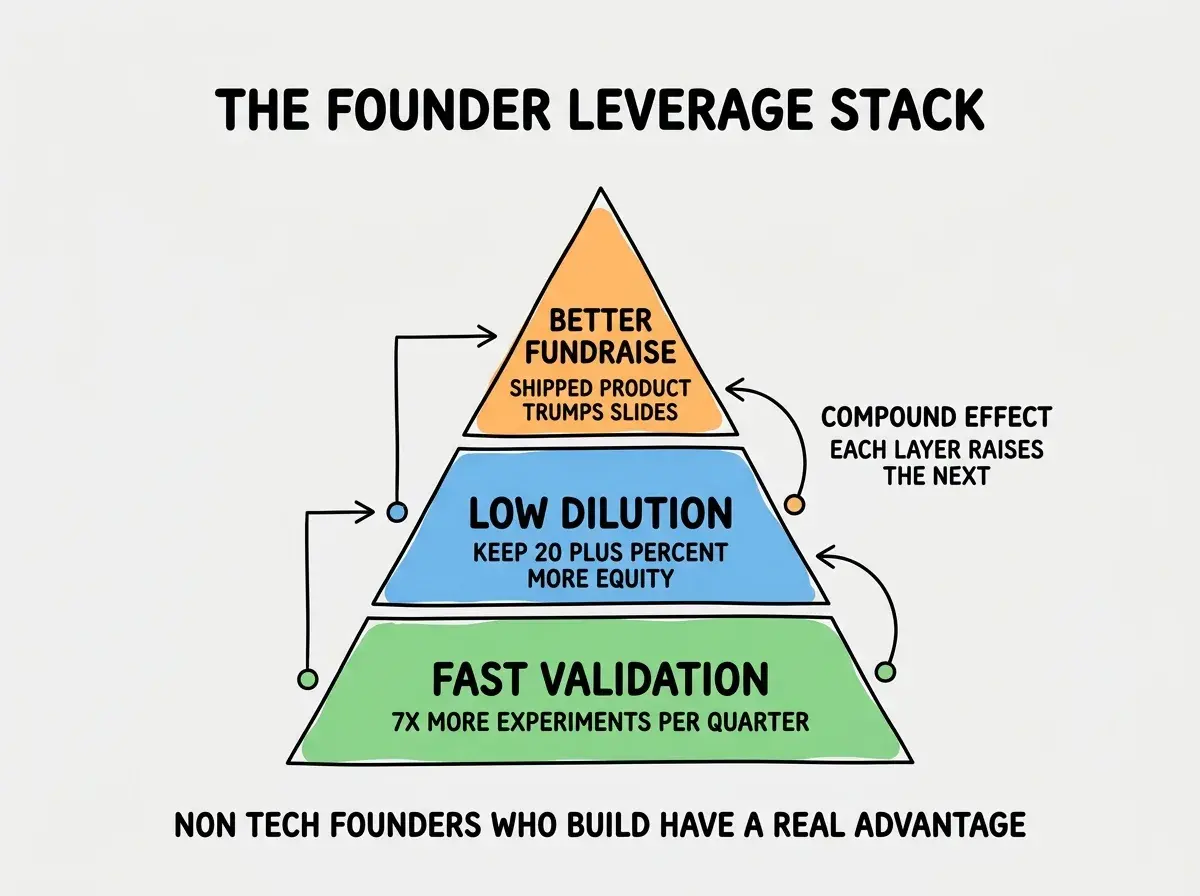
The compounding effect of the three advantages stacked on each other is what makes vibe coding genuinely transformative for the right founder profile. A founder who tests seven ideas, retains more equity, and raises on better terms is operating from a fundamentally different position than the founder who outsourced the build.
The most damaging vibe coding mistake for non-technical founders is treating it as a permanent solution. Vibe coding is excellent for validation and the first few months of growth, but the cleanup economy exists because the same code does not survive scaling. Plan for the transition, do not pretend you will not need it.
The corollary is that the advantage has a shelf life. Founders who try to scale a vibe coded MVP to 10,000 paying customers without bringing in real engineering help eventually hit a wall. The advantage is in the first 12 to 18 months. After that, the same skills that produced the MVP are no longer the bottleneck.
The other piece worth noting is that the advantage is not evenly distributed. Founders building software for software developers are competing with technical founders who have always had this leverage. Founders building software for non-developers are competing with other non-technical founders, most of whom still have not internalized vibe coding. The advantage is largest in the second case, smallest in the first.
What This Means For You
Vibe coding is a real competitive advantage with real limits. Knowing both is what lets you use it as the strategic asset it is, instead of a temporary patch you outgrow.
- If you're a founder: Spend two weekends learning to ship a small idea end-to-end. The skill compounds across every future startup decision you will make.
- If you're changing careers: The non-technical founder advantage is real, and the same patterns apply to first-time builders in any role. The leverage of building a small thing yourself is bigger than it looks.
- If you're a student: Pick any small idea and ship it before you graduate. The experience changes how you think about every subsequent career decision, even if the project itself does not become a business.
Browse more business strategy guides for non-technical founders
Read more foundations