MAI-Code-1-Flash, Microsoft's first in-house coding model, began rolling out in GitHub Copilot on June 2 across Free, Pro, Pro+, and Max plans. The 137B sparse mixture-of-experts model carries a 256K-token context window, scores 71.6% on SWE-Bench Verified, and uses up to 60% fewer output tokens on complex tasks compared to similarly capable models, according to Microsoft's model card.
What Is MAI-Code-1-Flash and How Do You Access It in Copilot
MAI-Code-1-Flash is now in the GitHub Copilot model picker inside VS Code. Open the Copilot Chat panel, click the model selector dropdown, and look for MAI-Code-1-Flash in the list. The rollout is gradual, starting with a limited percentage of accounts and expanding over the coming weeks, so availability varies by user.
The architecture is a sparse Mixture-of-Experts design. The total parameter count is 137 billion, but only around 5 billion parameters are active for any single inference step. The sparse routing is what drives token efficiency: the model activates only the sub-networks most relevant to a given input rather than running the full network on every token. The 256K-token context window covers roughly 200,000 lines of code, enough to hold a mid-sized codebase in a single prompt.
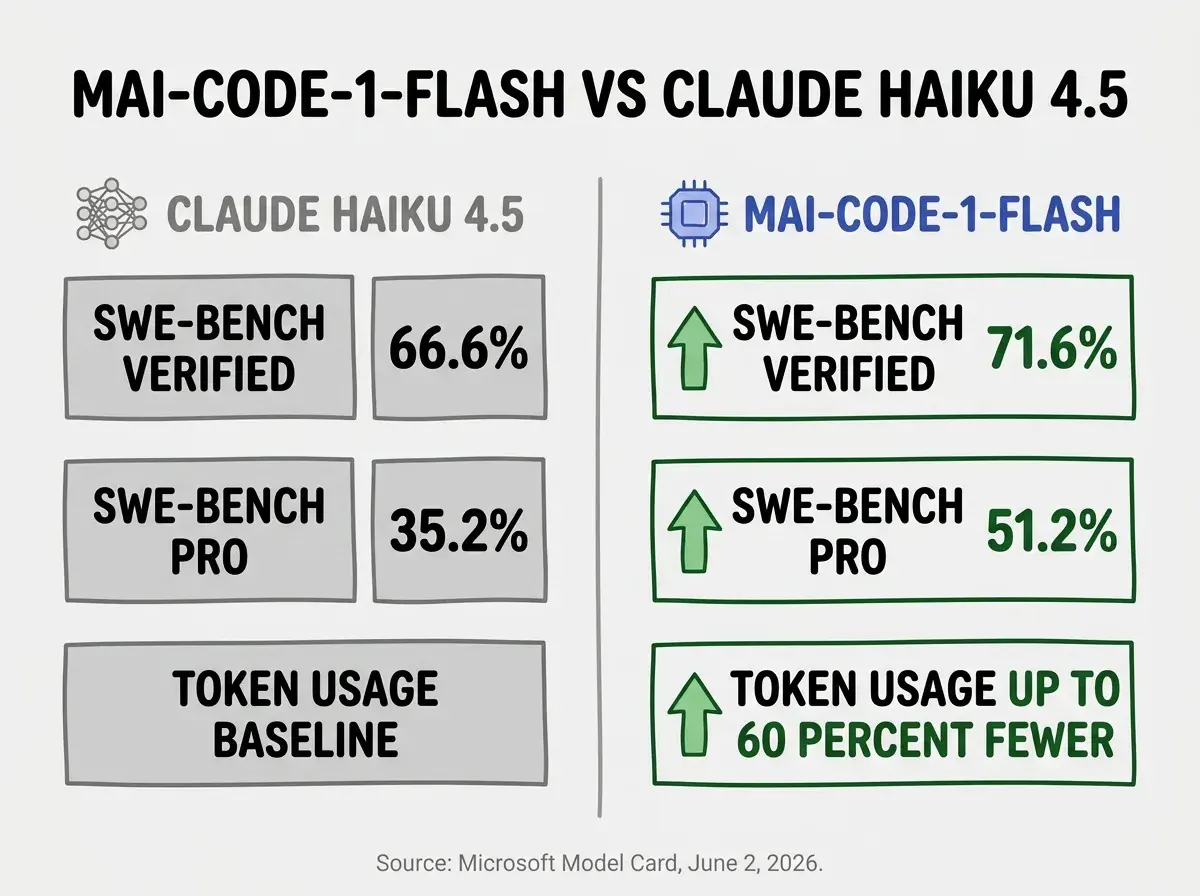
Microsoft published benchmark results comparing MAI-Code-1-Flash against Claude Haiku 4.5 as the primary reference point. On SWE-Bench Verified, the benchmark that tests resolution of real GitHub issues, the model scores 71.6% versus Haiku's 66.6%. On SWE-Bench Pro, a harder version of the same evaluation, the margin widens to 51.2% versus 35.2%. Additional results: 65.5% on SWE-Bench Multilingual and 54.8% on Terminal Bench 2. These figures come from Microsoft's own evaluation and have not been independently reproduced at launch time.
MAI-Code-1-Flash is distinct from Project Polaris, the model Microsoft announced will replace GPT-4 Turbo as the Copilot default in August 2026. Polaris is a larger, more capable model targeting the default tier. MAI-Code-1-Flash is a faster, lighter option you can select manually in the model picker starting today.
MAI-Code-1-Flash is rolling out to GitHub Copilot Free, Pro, Pro+, and Max plans via the VS Code model picker starting June 2, 2026. Microsoft reports 71.6% on SWE-Bench Verified (versus Haiku 4.5 at 66.6%) and up to 60% fewer output tokens on complex coding tasks. The rollout is gradual. It is separate from Project Polaris, which ships as the Copilot default in August.
Microsoft chose SWE-Bench Verified and SWE-Bench Pro as its primary benchmarks rather than older options like HumanEval. That choice matters: SWE-Bench tasks come from real open-source repositories and require multi-step reasoning across files, which is far closer to actual vibecoder work than function-level code generation tests. Treating Microsoft's published figures as a starting point rather than a verdict is the right posture until community benchmarks catch up.
How Does MAI-Code-1-Flash Affect Your GitHub Copilot AI Credits Bill
Using MAI-Code-1-Flash on long agentic runs directly lowers your AI Credits consumption. Microsoft reports up to 60% fewer output tokens on complex tasks compared to similarly capable models when pass rates are held equal. Since Copilot switched to AI Credits billing on June 1, every premium model request now draws from a monthly credit allocation, and fewer output tokens means less credit spent per session.
The timing between these two announcements is direct. The new billing system went live June 1. The more token-efficient model arrived June 2. For vibecoders who regularly run Copilot on long refactor sessions, agentic PR reviews, or multi-file generation tasks, the combination changes the cost math. A session that previously consumed 8,000 output tokens might consume closer to 4,000 with MAI-Code-1-Flash if Microsoft's efficiency figures hold for your specific workload.
The efficiency gain is most pronounced on complex tasks, which aligns with how sparse MoE architectures work: harder inputs activate more specialized sub-networks, and the router allocates capacity more selectively than a dense model would. Simple autocomplete and short edits see smaller differences than deep refactoring runs.
The practical recommendation is to test MAI-Code-1-Flash on your heaviest recurring tasks first, track whether output quality holds, and use that comparison to decide where it fits in your workflow. Do not switch everything over on the strength of Microsoft's benchmark numbers alone.
The Vibe Coder Blog covers the model releases, pricing shifts, and workflow changes that matter to builders.
Read MoreOne caveat worth naming: the model is in gradual rollout. If it does not appear in your VS Code model picker yet, that is expected. Microsoft says availability will expand over the coming weeks and it is not yet available in all Copilot surfaces beyond VS Code, including the GitHub.com chat interface and the Copilot CLI.
Why Did Microsoft Build Its Own Coding Model Instead of Using OpenAI
Microsoft built the MAI model family to reduce operational and strategic dependency on OpenAI and to run inference on Maia, its own AI accelerator infrastructure inside Azure. The MAI-Code-1-Flash model card specifies that training used commercially licensed data without distillation from any third-party model, giving Microsoft full IP ownership and legal control over the weights.
The economics of routing every Copilot request through an OpenAI API grew less attractive as Copilot scaled to millions of users and as Azure built out its own hardware infrastructure. Owning the model weights means Microsoft sets the inference schedule, controls pricing, and captures the margin that previously went to OpenAI.
MAI-Code-1-Flash is the first publicly available model in a family that already extends much further. MAI-Thinking-1, also announced at Build 2026, is a separate reasoning model with approximately 35 billion active parameters and roughly 1 trillion total parameters in a sparse MoE design. Microsoft says it is competitive with Claude Opus 4.6 on SWE-Bench Pro and is currently in private preview through Microsoft Foundry. The MAI family also includes MAI-Image 2.5, MAI-Voice 2, and MAI-Transcribe 1.5, which are not coding-focused but indicate a broader platform ambition.
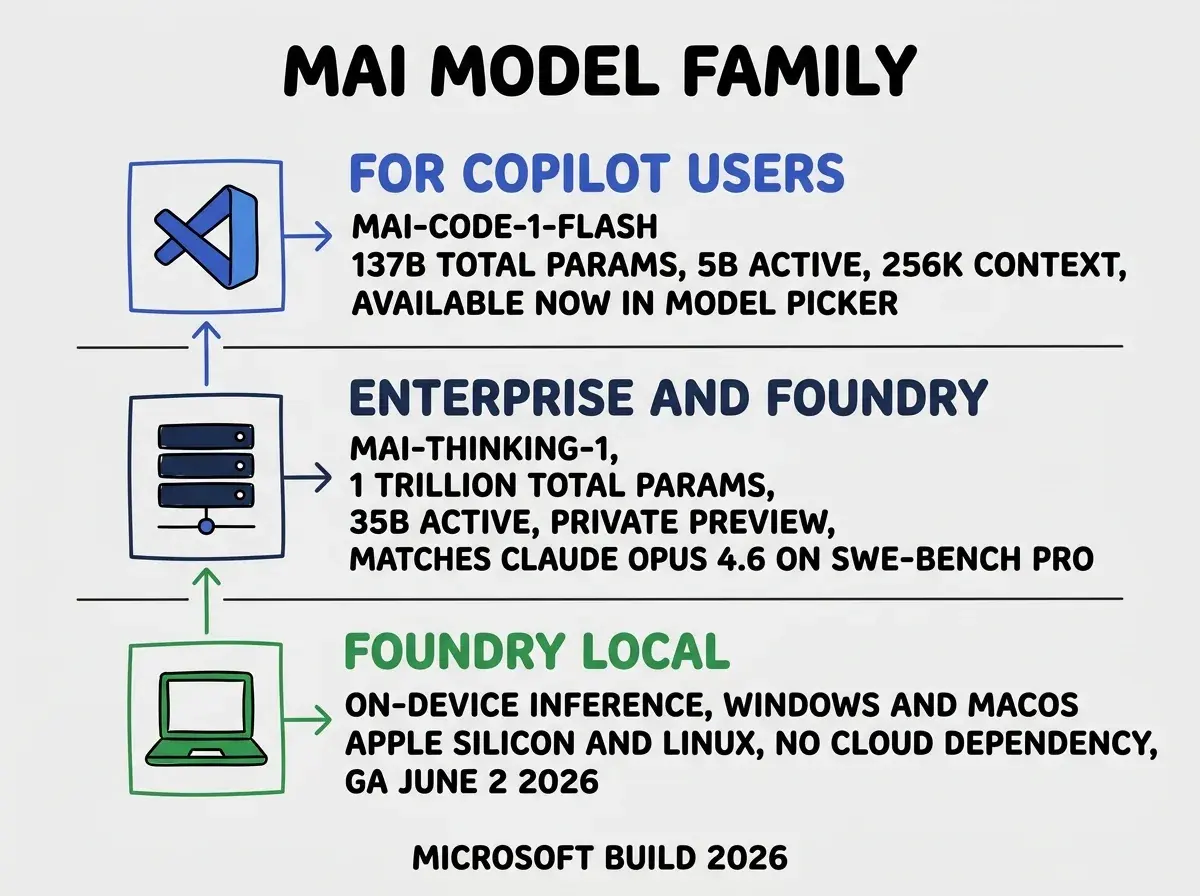
Foundry Local, which also reached general availability at Build 2026, lets developers run MAI models on-device without a cloud connection. It supports Windows, macOS on Apple Silicon, and Linux x64. For vibecoders building on high-end local hardware, on-device inference removes latency introduced by round-trips to Azure and eliminates per-token costs for self-hosted workflows.
When Should You Use MAI-Code-1-Flash vs Other Models in Copilot
Use MAI-Code-1-Flash for lightweight to medium complexity coding tasks where speed and credit efficiency matter: quick edits, autocomplete-heavy sessions, routine PR reviews, and standard refactors. For tasks requiring deep multi-file reasoning, complex architectural decisions, or sustained planning across a large context, the current GPT-4 Turbo default or the upcoming Project Polaris may hold up better until community benchmarks verify Flash's quality at those scales.
The model picker in Copilot Chat now gives vibecoders a practical choice between different capability-efficiency trade-offs within a single subscription. The typical pattern that works in similar tiered AI systems: use the Flash model as your default for the majority of requests, escalate to the heavier model when you hit quality issues, and track whether the quality delta justifies the credit delta over a few weeks.
Project Polaris, shipping as the Copilot default in August, is described by Microsoft as a more capable replacement for GPT-4 Turbo across the full range of coding tasks. Once Polaris is available for testing, comparing it against MAI-Code-1-Flash on your specific workload will be worthwhile. The credit cost of Polaris versus Flash has not been detailed yet, which means the credit efficiency comparison remains incomplete until August pricing is confirmed.
Treating all entries in the Copilot model picker as interchangeable. MAI-Code-1-Flash is optimized for speed and token efficiency. It is not a general-purpose reasoning model and was not built to replace GPT-4 Turbo for complex multi-step planning tasks. Using it for architecture-level design questions or large codebase refactors without testing quality first risks lower output quality without meaningful credit savings on shorter tasks.
The MAI-Thinking-1 model in private preview through Microsoft Foundry is the option for teams that need the deepest reasoning capabilities and can access enterprise preview programs. It is not available in the standard Copilot model picker at this stage.
What Does Microsoft's In-House Model Mean for the Vibecoder Stack
Microsoft now competes on model quality, not just product surface. For years, Copilot's value proposition was GitHub integration and IDE distribution, with model quality delegated to OpenAI. MAI-Code-1-Flash is the first public signal that Microsoft intends to own the model layer too, at least at the Flash tier, with MAI-Thinking-1 in private preview suggesting that ambition extends to the frontier tier as well.
The practical implication for vibecoders is more competition inside Copilot itself. Instead of one default model with limited alternatives, the model picker is becoming a substantive choice with real quality and cost trade-offs. That pressure will accelerate over the next 12 months as Polaris ships, MAI-Thinking-1 moves toward broader availability, and other AI coding tools add their own model options.
One other development from Build worth noting is Foundry Local's general availability for on-device inference. Teams with on-premises requirements or high latency sensitivity now have an official Microsoft-supported path to run MAI models locally without cloud dependency, which changes the cost and privacy calculation for enterprise vibecoder deployments that were previously forced to go fully cloud-hosted.
The complete model card and benchmark methodology for MAI-Code-1-Flash are available at microsoft.ai/models/mai-code-1-flash. Independent community benchmarks comparing it against GPT-4 Turbo and Claude Sonnet 4.6 will take a few weeks to surface. Check those before making workflow decisions based on Microsoft's self-reported figures alone.
The Vibe Coder Blog publishes analysis for builders who ship with AI tools.
Browse All Posts