Lovable is an AI app builder designed for people who do not write code. You describe what you want in plain English, and it generates a full-stack application with a frontend, backend, database, and authentication already wired together. If you are a founder with an idea but no technical co-founder, or a career changer who wants to build something real without spending months learning to code, Lovable is one of the most accessible options available right now. It is not perfect, and there is a significant security incident you need to know about, but for getting from zero to working app it delivers on its core promise.
I spent weeks building projects with Lovable to understand where it genuinely helps and where it falls short. This guide covers everything I found.
What Lovable Is and How It Works
Lovable is a web-based platform where you type a description of the app you want, and an AI generates the code, sets up the database, and gives you a working application you can preview immediately. There is no terminal, no file system to navigate, and no configuration files to manage. You interact entirely through a chat-like interface where you describe features and the AI builds them.
Behind the scenes, Lovable generates React code for the frontend and uses Supabase as its backend. Supabase handles your database, user authentication, file storage, and API layer. This is actually a smart architectural choice because Supabase is a production-grade platform used by real companies. Your app is not running on some proprietary toy infrastructure that disappears if Lovable shuts down. The Supabase project is yours, and you can access it directly if you need to.
You might think an AI that builds apps from descriptions produces throwaway prototypes that could never handle real users. But actually, the Supabase foundation means your database, auth system, and API layer are built on the same technology that powers apps serving millions of users. The weak link is not the infrastructure. It is whether the AI generates the right logic and security rules for your specific use case.
Getting Started With Lovable
Sign up at lovable.dev and you can start building immediately on the free tier. The onboarding is simple. You land on a prompt screen, type a description of what you want to build, and Lovable generates your first app within a minute or two.
Here is exactly what I did for my first test. I typed: "Build a customer feedback tool where users can submit feature requests, vote on existing requests, and see a public roadmap. Include user authentication with email login." Lovable generated a complete application with a login page, a submission form, a voting interface, and a roadmap view. It connected everything to a Supabase database with tables for users, requests, and votes. The whole thing was live and clickable in about ninety seconds.
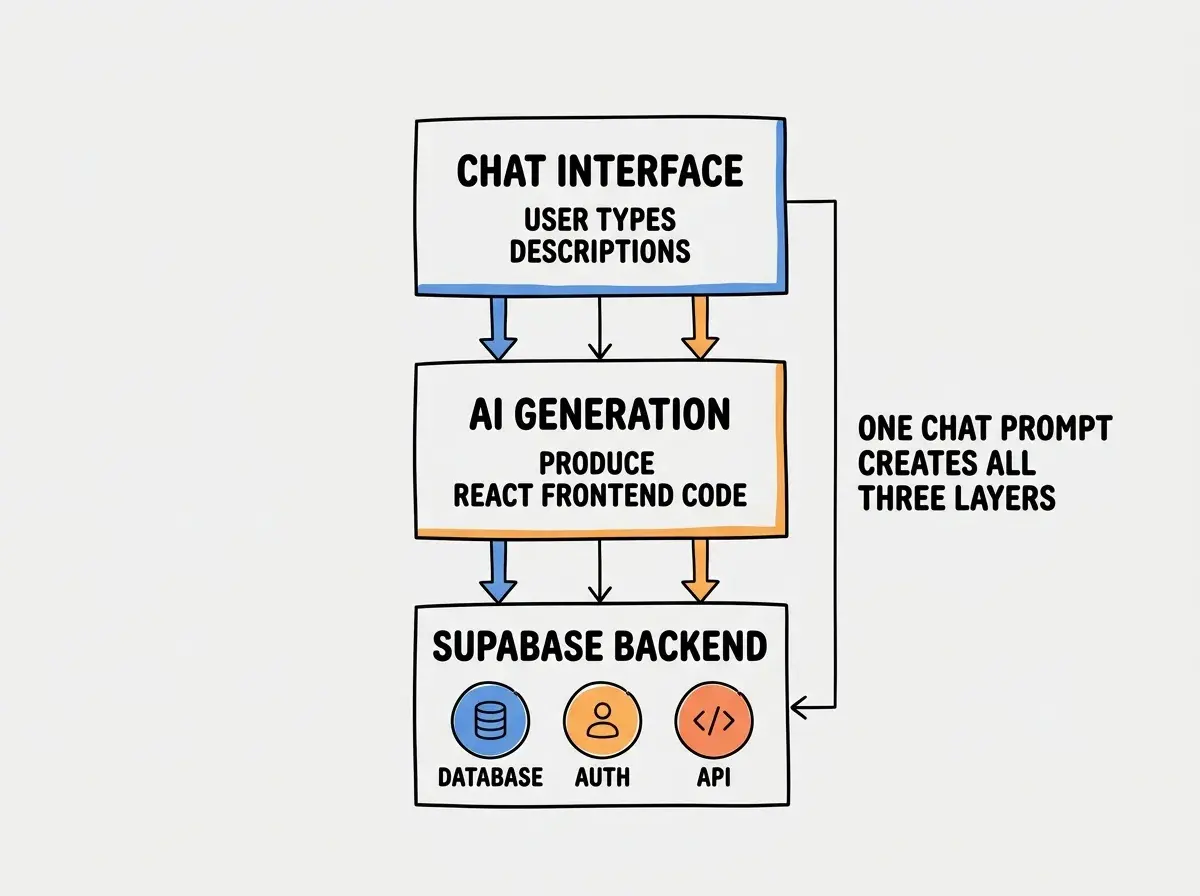
The iterative workflow is where Lovable shines for non-technical users. After the initial generation, you keep chatting. "Add an admin dashboard where I can update the status of feature requests." "Change the color scheme to dark blue and white." "Add email notifications when a request gets ten votes." Each instruction modifies the existing app, and you see the changes reflected in the live preview. It genuinely feels like directing a developer through conversation.
Can Lovable Actually Build Real Apps
Yes, with significant caveats. Lovable can build functional CRUD applications (apps that create, read, update, and delete data) with authentication, database storage, and a polished UI. For internal tools, landing pages with waitlists, simple SaaS MVPs, and customer-facing forms, it does a credible job.
Lovable reports that 60% of its users are non-developers, which tells you something about its target audience and the types of apps people are successfully building with it. These are not complex enterprise systems. They are focused tools that solve specific problems, and that is exactly where Lovable works best.
Where it struggles is anything requiring custom business logic, complex data relationships, or integrations with external APIs that are not part of the standard Supabase ecosystem. If your app needs to process payments through Stripe, sync with a CRM, or handle real-time collaborative editing, you will hit walls quickly. The AI generates reasonable boilerplate but does not understand the nuances of your specific business rules.
Lovable is strongest for apps that are primarily about collecting, displaying, and managing data with user authentication. If your app's core value is in its data model and UI rather than complex backend logic, Lovable can get you surprisingly far.
The Supabase Integration
The Supabase integration is both Lovable's greatest strength and the source of its most serious problem. On the strength side, you get a real PostgreSQL database, row-level security policies, authentication with multiple providers, file storage, and edge functions. When Lovable generates an app, it creates Supabase tables with appropriate columns, sets up authentication flows, and writes the queries to connect everything.
You can log into your Supabase dashboard directly and see everything Lovable created. You can modify tables, add indexes, write custom SQL, and even connect other applications to the same database. This means you are not locked in. If you outgrow Lovable, your data and infrastructure remain intact on Supabase.
The critical weakness is what happens when the AI does not set up security correctly, which brings us to the most important section of this guide.
Is Lovable AI Free
Lovable offers a free tier that lets you try the platform with a limited number of AI generations per day. This is enough to build a simple app and evaluate whether the tool works for your needs, but you will hit the limit quickly if you are iterating on anything substantial.
The paid tiers are $20 per month for the Creator plan and $50 per month for the Pro plan. The Creator plan gives you more daily generations and faster response times. The Pro plan increases limits further and adds priority support. On top of the Lovable subscription, you will likely need a paid Supabase plan once your app has real users, which starts at $25 per month.
So the realistic monthly cost for a production app built on Lovable is $45 to $75 per month between the two services. That is still dramatically cheaper than hiring a developer, but it is worth budgeting accurately rather than assuming the $20 headline price covers everything.
The Security Incident You Need to Know About
In 2025, security researchers discovered CVE-2025-48757, a vulnerability affecting apps built with Lovable. The core issue was that Lovable's AI was not consistently generating Row Level Security (RLS) policies for Supabase databases. Row Level Security is the mechanism that ensures users can only access their own data. Without it, anyone who knew the right API endpoint could read, modify, or delete other users' data.
This was not a theoretical concern. Researchers found over 170 production applications built with Lovable that had exposed user data because of missing RLS policies. These were real apps with real users whose personal information was accessible to anyone with basic technical knowledge.
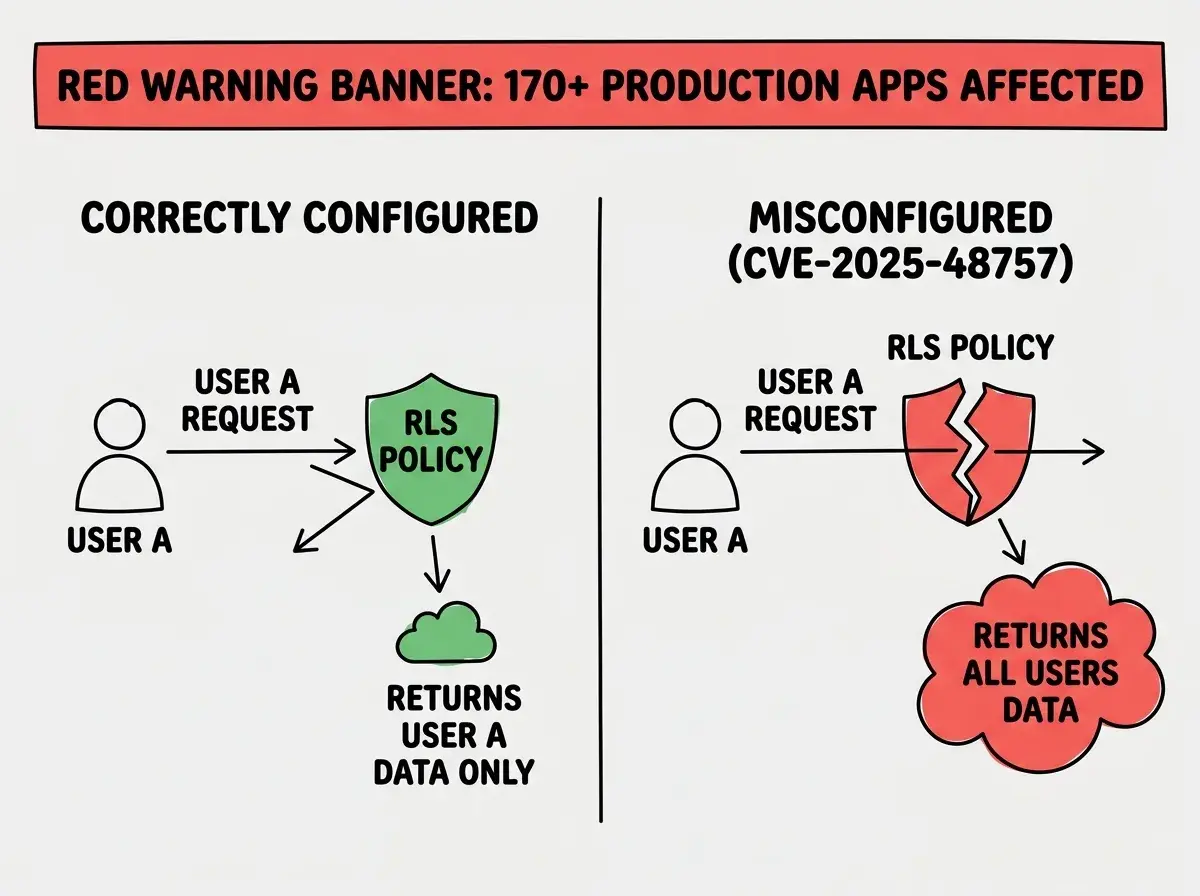
Lovable has since improved its RLS generation, but this incident reveals a fundamental tension in AI app builders. The AI generates code that works functionally but may not be secure by default. If you are building anything that handles user data, you need to verify that RLS policies are in place by checking your Supabase dashboard directly. Do not assume the AI handled it.
Limitations and Where Lovable Falls Short
Beyond the security concern, Lovable has practical limitations worth understanding before you commit.
Complex logic breaks down. The AI handles straightforward features well but struggles with multi-step workflows, conditional business rules, and edge cases. If your app needs to calculate pricing based on ten different variables, apply discount rules, prorate subscriptions, and handle currency conversion, you will spend more time fixing the AI's attempts than writing the logic yourself.
Debugging is hard without code knowledge. When something goes wrong, and it will, Lovable's chat interface is not always enough to diagnose and fix the problem. You might need to look at the generated code or the Supabase logs, which requires at least basic technical understanding. The promise of "no code needed" holds for building but not always for fixing.
Performance optimization is limited. Lovable generates functional code, but it does not optimize for performance. Database queries may be inefficient, components may re-render unnecessarily, and there is no built-in way to address these issues without editing code directly.
Version control is minimal. If the AI makes a change that breaks something, rolling back can be difficult. Professional developers use Git for version control, but Lovable's interface does not give you the same granular control over your codebase history.
Treating Lovable as a production-ready deployment tool without reviewing security settings. Always check your Supabase dashboard for RLS policies, verify authentication rules, and test that users can only access their own data before launching to real users.
Who Should Use Lovable
Lovable is a good fit if you are non-technical, want to build a data-driven app, and accept that you will eventually need technical help for complex features or security hardening. It is excellent for validating ideas quickly, building internal tools, and creating MVPs to show investors or early users.
It is not a good fit if you need complex integrations, real-time features, or applications that handle sensitive financial or medical data. The security track record means you should think twice before building anything where a data breach would have serious consequences.
Start with the fundamentals before picking a tool.
Learn the basicsWhat This Means For You
Lovable has made app building genuinely accessible to people who have never written a line of code. That is a real achievement with real limitations attached.
- If you are a founder with an idea: Lovable can get you from concept to clickable MVP in a single afternoon. Use it to validate your idea with real users, then hire a developer to rebuild properly once you have proven demand. Do not launch a production app without having someone technical review the security configuration.
- If you are a career changer: Lovable is a great way to understand how apps are structured (frontend, backend, database, auth) without getting bogged down in syntax. Build a few projects to learn the concepts, then start learning actual code to fill in the gaps that Lovable cannot handle.
- If you are a student: Use the free tier to prototype class projects and hackathon ideas rapidly. It teaches you application architecture by showing you how the pieces fit together, which gives you a head start when you learn to build those pieces yourself.
See how Lovable stacks up against other tools in the vibe coding ecosystem.
Browse tools