AI-assisted development interview prep separates candidates who actually understand their code from those who merely generated it. Whether you are switching careers or finishing school, every technical interview now includes some version of the same question: "Did you build this, or did your AI build it?" Your answer, and how you demonstrate what you know, determines whether you get the offer.
The landscape shifted fast. Two years ago, mentioning AI tools in an interview felt risky. Today, 92% of developers use AI daily, and hiring managers know it. The question is no longer whether you use AI. It is whether you use it like a professional or a passenger. Some interviewers will be thrilled you work with Cursor, Copilot, or Claude Code. Others will worry you cannot code without them. Your job is to make both types of interviewers confident that you bring real engineering judgment to the table, regardless of the tools in your workflow.
Why AI-Assisted Development Is a Hiring Advantage
Companies hiring in 2026 face a productivity calculation they cannot ignore. A developer who effectively uses AI tools ships features two to three times faster than one who does not. That is not hype; it is measured output from engineering teams that have adopted these tools at scale. When you walk into an interview and demonstrate that you can leverage AI effectively, you are not admitting a weakness. You are advertising a superpower.
The goal is not to hide that you use AI. It is to demonstrate that you understand every line of code it helped you write. Interviewers do not penalize AI usage. They penalize lack of understanding.
But here is where most candidates stumble. They list AI tools on their resume, show portfolio projects built with AI assistance, and then freeze when asked to explain a design decision or modify their code on the spot. The tool gave them the output, but they never built the mental model of why that output works. Hiring managers have seen this pattern enough times to test for it specifically. Your prep needs to address that test head-on.
What Interviewers Actually Want to See
Think of it like a chef's tasting menu versus fast food. Anyone can unwrap a burger and hand it to a customer. A chef at a tasting menu understands why the acid in the citrus cuts through the richness of the butter, why the plate is composed with negative space, why the courses progress from light to heavy. The food might even look similar at a glance. The difference is knowledge, improvisation, and the ability to adapt when something goes wrong.
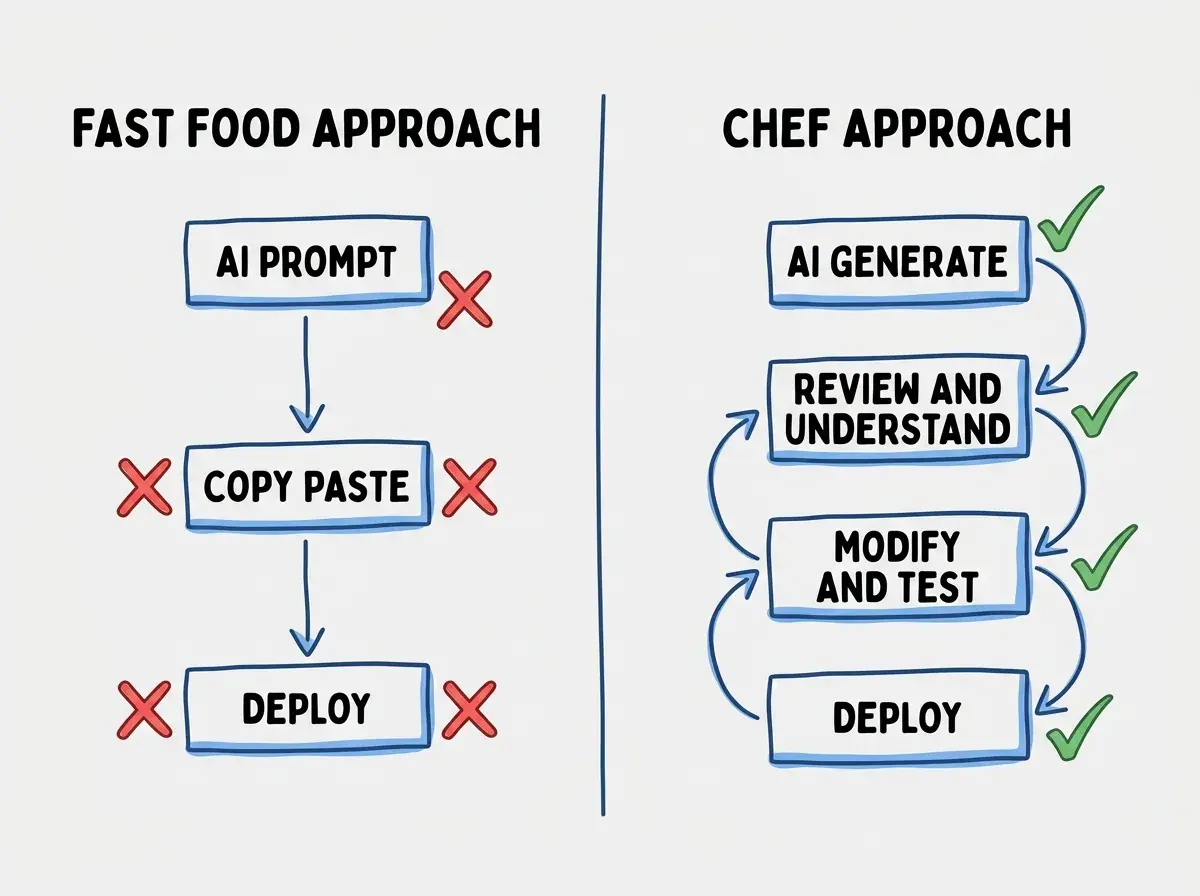
Your portfolio projects are the tasting menu. When you present a project you built with AI assistance, the interviewer is not judging the final product alone. They are probing your understanding of what is on the plate. Can you explain why you chose React Server Components over client-side rendering? Can you walk through the database schema and justify why you normalized certain tables but denormalized others? Can you describe a bug you hit during development and how you diagnosed it?
The candidates who get offers are the ones who treat AI as a sous chef, not an autopilot. They can point to a component and say, "The AI generated the initial version, but I restructured the state management because the original approach caused unnecessary re-renders." That sentence demonstrates tool proficiency and engineering judgment simultaneously. That is the combination interviewers want.
The Interview Scenarios You Will Face
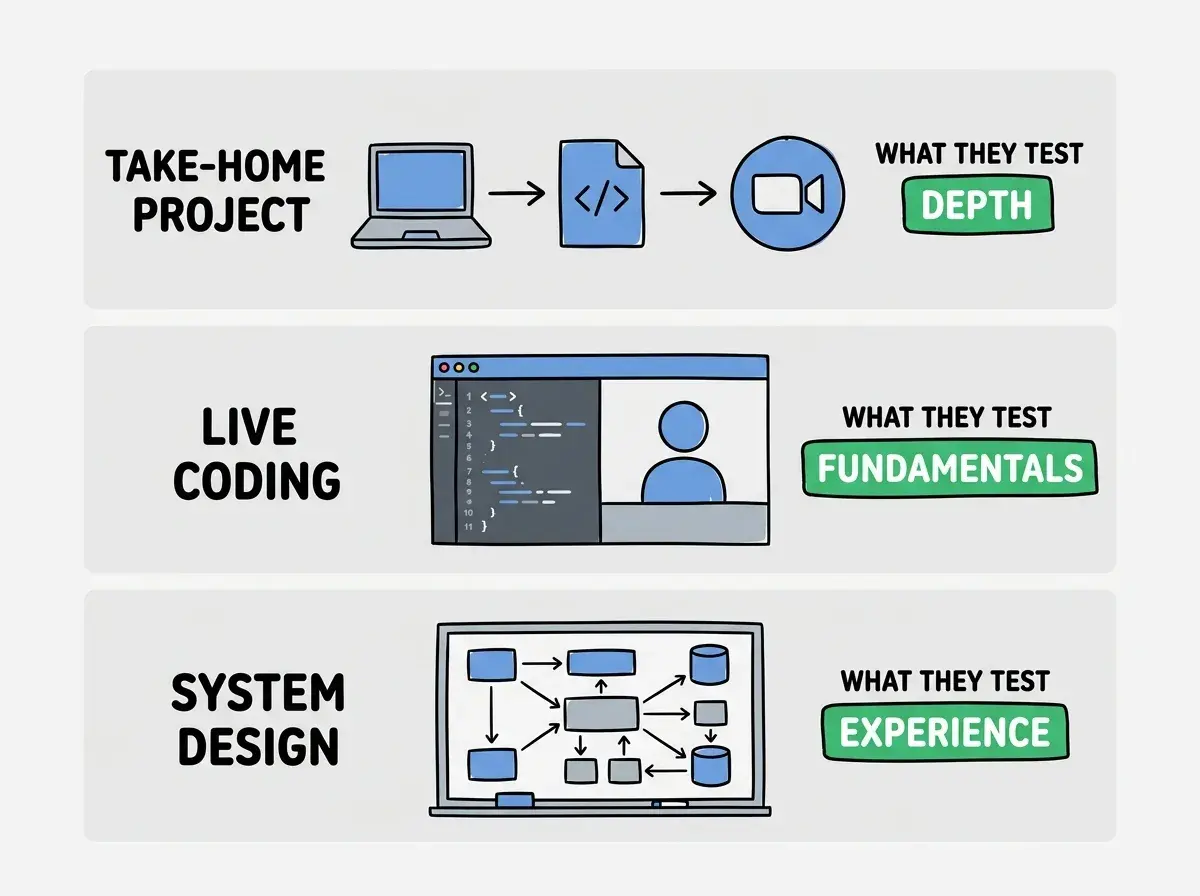
Three interview formats dominate technical hiring, and each one tests your AI skills differently. Preparing for all three is non-negotiable if you are serious about landing a role.
Learn the foundations of vibe coding so your portfolio projects demonstrate real engineering skills.
Explore the FundamentalsTake-home projects are the friendliest format for AI-assisted developers. You work on your own time, with your own tools, and submit a finished product. The trap is assuming the submission is the whole evaluation. Nearly every take-home includes a follow-up call where interviewers ask you to walk through your code, explain trade-offs, and sometimes modify a feature live. Prepare for the follow-up as much as the project itself. Before you submit, practice explaining every file out loud. If you cannot explain why a particular function exists without re-reading it, that is a gap the interviewer will find.
Live coding sessions are where AI-reliant candidates struggle most. Many companies now use environments without AI autocomplete specifically to test baseline skills. This does not mean you need to memorize syntax. It means you need to be comfortable writing code at a whiteboard-level pace, talking through your logic, and debugging without an AI suggestion appearing every three seconds. Practice by turning off Copilot for thirty minutes a day and solving small problems on your own. The goal is not to be fast. The goal is to be coherent and methodical while the interviewer watches.
System design discussions are actually where AI experience becomes your biggest asset. When an interviewer asks you to design a notification system or a real-time dashboard, your experience building AI-assisted projects gives you concrete examples to draw from. You have seen how different architectures perform, where caching matters, and what breaks at scale. Lean into that experience. Say, "In a project I built, I initially used polling for real-time updates because the AI suggested it, but I switched to WebSockets after profiling showed the polling approach was hitting rate limits." That answer shows you have built things, evaluated the results, and made informed changes.
How to Talk About AI in Your Workflow Without Red Flags
The language you use when discussing AI matters more than you might expect. Certain phrases trigger concern in interviewers, while others build confidence. Knowing the difference is a skill you can practice.
Never say "the AI wrote this for me." Instead, say "I used AI to accelerate the implementation, then reviewed and modified the output." The first framing positions you as passive. The second positions you as the decision-maker who happens to use powerful tools. Both descriptions might refer to the exact same workflow, but they create completely different impressions.
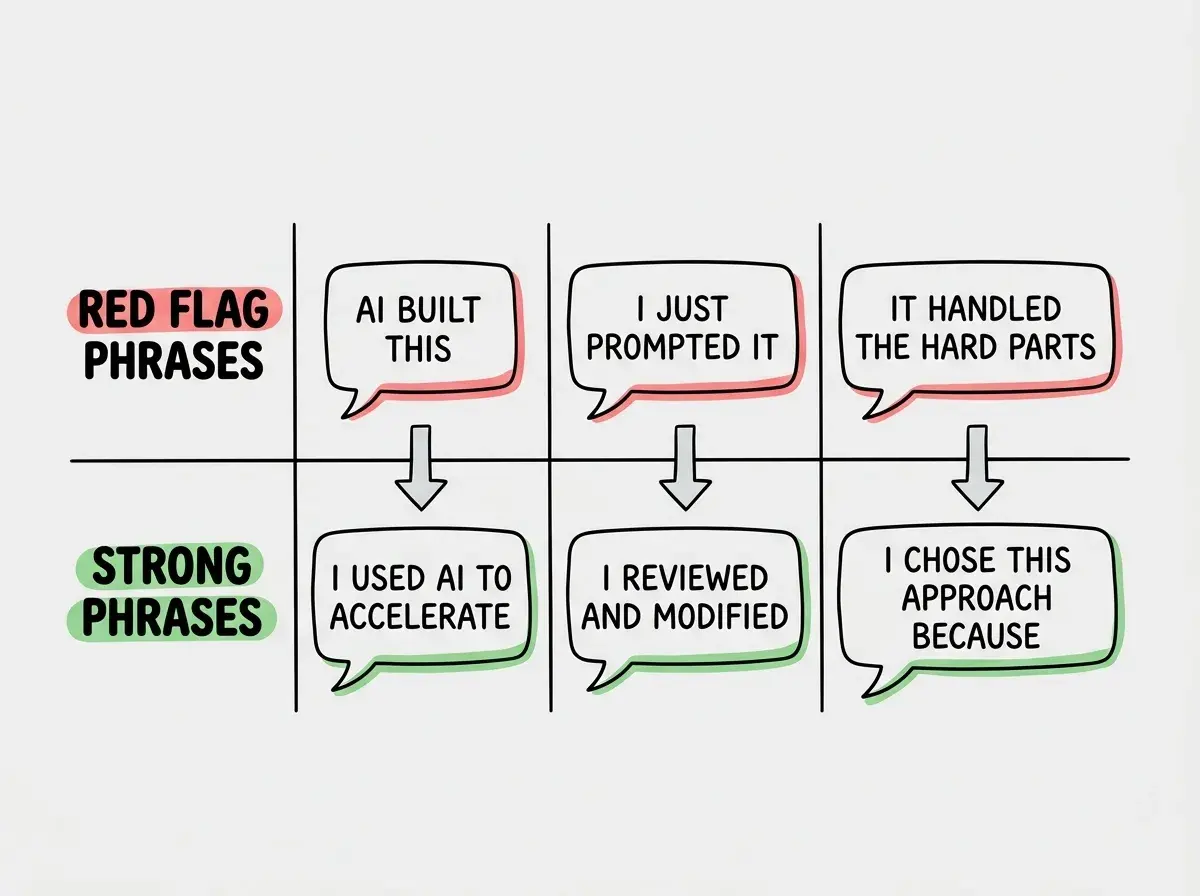
When interviewers ask directly about AI usage, be honest and specific. "I use Cursor with Claude as my primary development environment. For this project, I used it heavily for boilerplate generation and test writing, but I designed the architecture myself and manually debugged the authentication flow when the AI-generated version had a race condition." That answer is honest, specific, and demonstrates exactly the skills they want to see.
Some interviewers love AI. They want to know your prompt strategies, how you handle hallucinated code, and whether you have developed workflows for code review when working with AI. Lean in with these interviewers. Share your process. Explain how you validate AI output, how you catch common mistakes, and how you iterate on prompts to get better results. This is a legitimate skill set that forward-thinking companies value highly.
Other interviewers worry about AI dependence. With them, emphasize your fundamentals. Talk about your understanding of data structures, system design principles, and debugging methodology. Mention that you practice coding without AI assistance to keep your skills sharp. Show them you chose to use AI, not that you cannot function without it.
Candidates often prepare only for interviewers who are pro-AI or only for interviewers who are skeptical. You need talking points for both. Read the room in the first five minutes and adjust your emphasis accordingly.
Here is the preparation checklist that separates candidates who get callbacks from those who do not. For every project in your portfolio, practice explaining three things without looking at the code: the architecture decisions and why you made them, the hardest bug you encountered and how you diagnosed it, and one thing you would change if you rebuilt it today. If you can speak fluently about all three, you have internalized the knowledge that AI helped you produce. That internalization is what interviewers are testing for.
Practice modifying your own code live. Open a project, pick a feature, and change it without AI assistance while narrating your thought process. Record yourself doing this. The narration matters because live coding interviews are as much about communication as they are about code. Interviewers want to see how you think through problems, not just whether you arrive at the right answer.
Finally, prepare for the meta-question that every interviewer will eventually ask in some form: "How do you know when to trust AI output and when to rewrite it?" Your answer should include specific examples. "I always review generated database queries for N+1 problems because AI tools consistently miss those." "I never trust AI-generated authentication code without manual review because security edge cases require domain expertise the model lacks." Concrete, specific answers like these prove you have developed real judgment through experience, not just familiarity with a chat interface.
Dig deeper
A few hand-picked sources if you want to go further.
What This Means For You
The interview landscape for developers is changing faster than the prep advice keeps up with. Traditional resources still tell you to grind algorithm problems for weeks. That matters, but it is no longer the full picture. Companies want developers who can build real products quickly and understand what they have built. AI-assisted development is the skill that lets you do both, but only if you can demonstrate it under pressure.
Start your prep today by picking one portfolio project and practicing the three-point explanation: architecture, hardest bug, and what you would change. Do it out loud, without notes, in under five minutes. If you struggle, that is the gap you need to close before your next interview. The candidates who land offers in 2026 are not the ones who use the most advanced AI tools. They are the ones who can prove they are the chef, not the microwave.
Start with the fundamentals of vibe coding and build a portfolio that survives the interview follow-up call.
Start Learning