The transition from vibe coder to AI-assisted engineer is one of the most important career moves you can make in 2026. It means going from someone who builds things with AI to someone who understands what they are building, and that difference determines whether you plateau or keep growing.
Here is the reality most people do not talk about. Vibe coding gets you started. It lets you ship MVPs, build prototypes, and prove ideas fast. But there is a ceiling. You hit it when something breaks and you cannot figure out why. You hit it when a client asks you to explain your technical decisions. You hit it when a job listing says "engineering experience required" and you are not sure whether your portfolio counts. The transition is not about abandoning AI tools. It is about becoming dangerous with them, in the best possible sense.
Why the Transition Matters for Your Career
The job market in 2026 does not look like it did two years ago. Companies are not hiring people who can write code from scratch (AI handles that now). They are also not hiring people who can only prompt AI without understanding the output. The sweet spot, the role that keeps appearing in listing after listing, is the AI-assisted engineer. Someone who uses AI tools fluently but can also read the code they generate, debug it when things go wrong, and make architectural decisions that AI cannot make alone.
Companies are not choosing between "traditional developers" and "AI users." They are hiring people who can do both. The vibe coder who learns engineering fundamentals has a career advantage that pure coders and pure prompters cannot match.
This is not a theoretical argument. Look at the job postings from any mid-to-large tech company right now. Phrases like "AI-augmented development," "experience with AI coding tools," and "ability to review and refine AI-generated code" appear everywhere. They want people who ship fast (the vibe coder strength) and ship reliably (the engineering strength). If you can combine those two things, you are genuinely rare. Most traditional developers are still learning to work with AI effectively. Most vibe coders have not yet invested in the engineering side. The overlap is small, and that is where the opportunity lives.
The Skills Gap Between Vibe Coding and Engineering
Think of it like learning to drive versus becoming a mechanic. When you started vibe coding, you learned to drive. You got behind the wheel (opened an AI tool), pressed the gas (wrote prompts), and got where you wanted to go (shipped working software). You did not need to know how the engine works, what the transmission does, or why the car sometimes makes that weird clicking noise. You just drove.
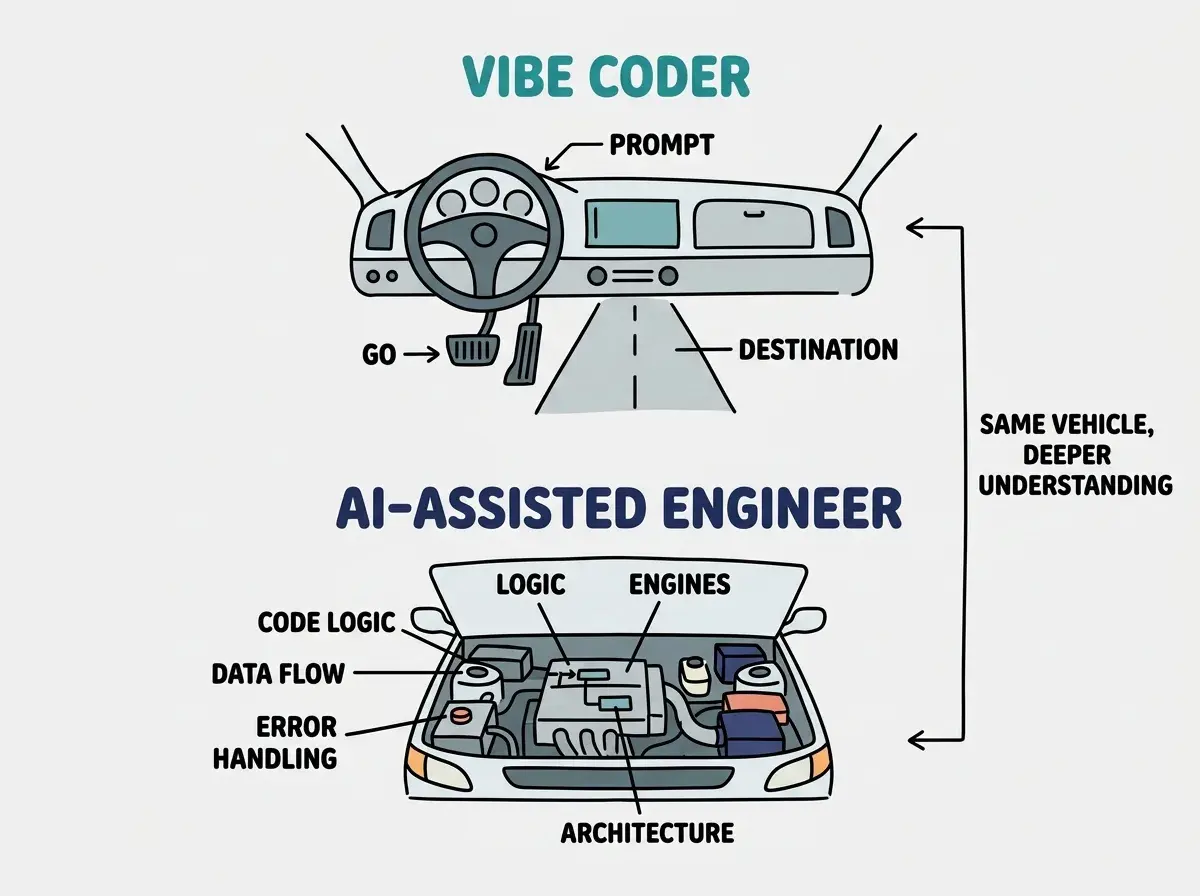
Becoming an AI-assisted engineer means popping that hood open. You do not need to become a full mechanic who can rebuild an engine from scratch. You are not trying to replace the AI. But you need to know enough to diagnose problems when the check engine light comes on. You need to understand why the car pulls to the left sometimes. You need to recognize when a strange noise means "pull over immediately" versus "deal with it at your next service."
In practical terms, this is the difference between someone who prompts "build me a user authentication system" and accepts whatever the AI produces versus someone who prompts the same thing but then reads through the output, notices the passwords are stored in plain text, and says "wait, this needs bcrypt hashing and rate limiting on the login endpoint." Both people used AI. Only one of them built something safe to deploy.
The gap is not about writing code. It is about reading it, evaluating it, and knowing when the AI got something subtly wrong.
The Bridge Skills You Need to Build
You do not need a computer science degree. Let me say that upfront, because the fear of needing to "go back to school" stops a lot of people from even starting. What you need are bridge skills, specific capabilities that connect your prompting ability to real engineering competence. Here are the ones that matter most, in the order you should learn them.
If you are still getting comfortable with AI tools, start with the fundamentals before diving into engineering concepts.
Learn the basics firstReading code, not writing it. This is the single most important skill, and it is also the easiest to develop because you already have unlimited study material. Every time your AI tool generates code, stop and read it before you accept it. You do not need to understand every line. Start by identifying the structure. Where does data come in? Where does it go out? What happens if something fails? Spend five minutes reading before you click "accept." Within a month, you will recognize patterns you could not see before.
Debugging with intention. Right now, when something breaks, you probably copy the error message and paste it back into the AI. That works, sometimes. But it is like calling a mechanic every time your car makes a noise instead of learning to check the basics yourself. Start using browser developer tools. Learn what the console tab shows you. Learn what the network tab reveals about failed API calls. When you can say "the API returned a 401, which means authentication failed, and I think it is because the token expired" instead of just "it is broken," you have crossed a meaningful threshold.
Testing what you build. Not formally at first. Just develop the habit of trying to break your own software. Click every button. Submit empty forms. Enter absurdly long text. Open the app on your phone. What you are building is an adversarial mindset, the instinct to ask "what could go wrong?" before a user discovers it for you. Once that instinct is solid, you can learn about automated testing, unit tests, and integration tests. But the mindset comes first.
Git workflows beyond "push to main." If you are already using GitHub, you are ahead of many vibe coders. The next step is learning to branch. Work on features in isolation. Make small, descriptive commits. Learn to read a diff so you can see exactly what changed. This is not just good practice; it is your safety net. When AI generates a change that breaks something (and it will), you can roll back to your last known working state in seconds instead of spending hours trying to undo things manually.
Basic CS concepts, the practical ones. You do not need algorithms and data structures coursework. You need to understand how HTTP requests work, what a database index does, why your app slows down when you query every row in a table, and what happens when two users try to update the same record simultaneously. These concepts are not academic. They are the difference between an app that works in development and one that works in production with real users.
Building Professional Credibility
Knowing the skills is one thing. Proving them is another. The vibe coding community has a credibility problem, and it is worth being honest about it. Some hiring managers see "built with AI tools" on a resume and mentally discount everything that follows. Fair or not, that is the reality you are working with.
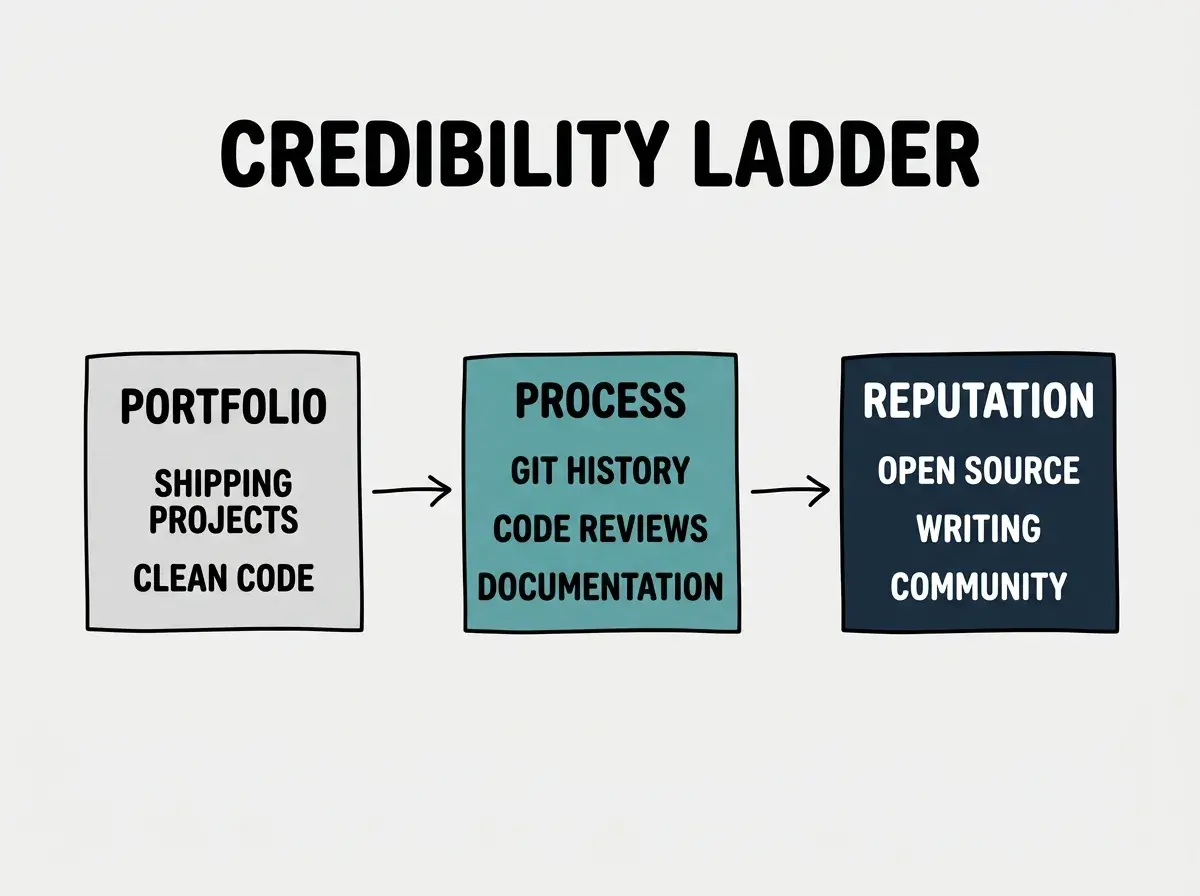
The fix is to show your work in ways that demonstrate engineering thinking, not just output. When you share a project, include the GitHub repository. Let people see your commit history, your branching strategy, and your pull request descriptions. Write a brief technical overview explaining the architecture and the tradeoffs you considered. Mention what you would do differently next time. These signals communicate something a deployed app alone cannot: that you understand what you built and why you built it that way.
Contribute to open source, even in small ways. Fix typos in documentation. Open issues with clear reproduction steps when you find bugs. Review other people's pull requests and leave thoughtful comments. None of this requires deep expertise. All of it builds a public track record of someone who thinks like an engineer.
Do not try to hide the fact that you use AI tools. The goal is not to pretend you write every line by hand. The goal is to demonstrate that you understand the code AI produces and that you can make informed decisions about it. Hiding your AI usage looks dishonest. Owning it while showing engineering judgment looks forward-thinking.
Start writing about what you learn. Even short posts explaining how you debugged a tricky issue or why you chose one database over another build credibility faster than another portfolio project. Writing forces you to understand something well enough to explain it, and that process alone accelerates your learning.
The mechanic analogy holds here too. Nobody expects you to have built the car from scratch. But when you can open the hood, point to specific components, and explain what they do and why they matter, people trust you with the keys.
Dig deeper
A few hand-picked sources if you want to go further.
What This Means For You
The path from vibe coder to AI-assisted engineer is not a cliff you need to jump off. It is a ramp. You can walk up it gradually, learning one bridge skill at a time, while continuing to ship projects with the AI tools you already know. Every time you stop to read the code before accepting it, you are on that ramp. Every time you check the network tab instead of just re-prompting, you are climbing. Every time you commit to a feature branch instead of pushing straight to main, you are building the habits that separate builders from engineers.
The companies hiring right now are not looking for people who can do everything. They are looking for people who can learn, who can think critically about AI output, and who care enough about quality to go beyond "it works on my machine." That is the profile of an AI-assisted engineer. And if you are reading this, you are probably closer to it than you think.
Explore our engineering fundamentals series designed specifically for vibe coders making the transition.
Browse the guides