Portfolio AI-assisted development is the new default for career changers and students. Everyone's portfolio has deployed apps now. The problem is that everyone's deployed apps look the same, because AI generates similar-looking projects from similar prompts. Standing out means showing your thinking, not just the output.
Hiring managers have caught on. They have seen dozens of "AI-built SaaS dashboards" and "full-stack e-commerce stores" this quarter alone. When every candidate's portfolio contains the same polished surfaces built with the same tools, the portfolio stops being a differentiator. It becomes background noise. The candidates who land interviews are the ones who can answer a question no screenshot can answer: what decisions did you make, and why?
Why Most AI-Built Portfolios Fall Flat
The typical AI-built portfolio follows a predictable pattern. Someone watches a tutorial, prompts an AI tool to build a project, deploys it, and adds it to their portfolio site. The result looks impressive at first glance. Clean UI, responsive layout, maybe even a dark mode toggle. But open the GitHub repo and you find a single commit message that says "initial commit," no README, no documentation, and code that the person cannot explain in an interview.
This is the equivalent of submitting a painting to an art school that you traced from someone else's work. The technical execution might be fine, but it reveals nothing about your eye, your taste, or your ability to solve problems independently.
Employers hiring junior developers and career changers are not looking for perfect code. They are looking for evidence that you can think through problems, make decisions under uncertainty, and learn from what goes wrong. Your portfolio needs to demonstrate those things explicitly, because AI-generated code alone cannot.
The real issue goes deeper than aesthetics. When you prompt AI to "build a task manager" and deploy whatever comes out, you have demonstrated one skill: the ability to use a tool. That is like listing "can operate a microwave" on a chef's resume. It is technically true and completely unhelpful. Employers want to see that you understand why certain decisions were made, that you can adapt when requirements change, and that you have opinions about tradeoffs.
What Makes a Portfolio Project Stand Out
Think of your portfolio like curating an art exhibition, not dumping canvases in a warehouse. A great curator does not hang every painting they own on the wall. They select three or four pieces that tell a story together. Each piece is there for a reason. The selection itself reveals taste, judgment, and a point of view.
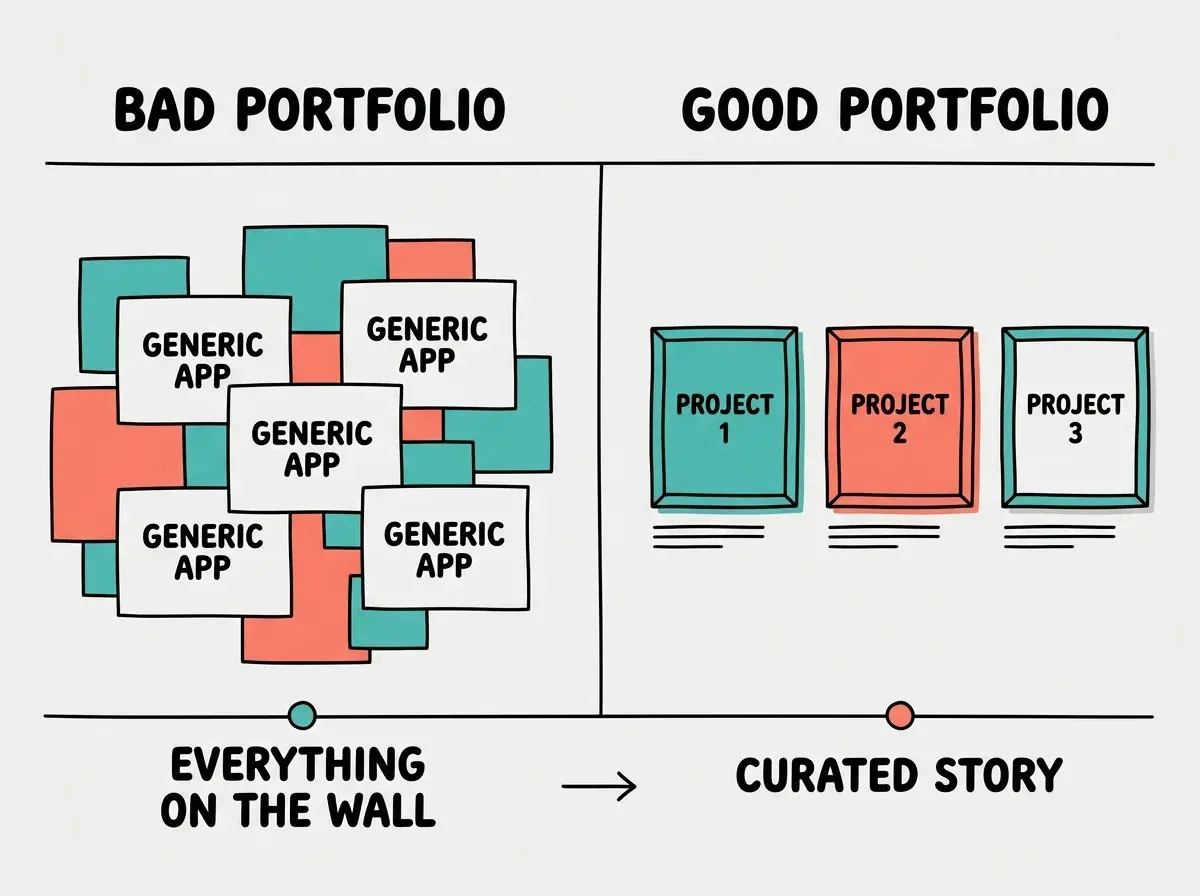
A bad portfolio is the warehouse approach. Eight projects, most of them todo apps and weather dashboards, no narrative connecting them, no explanation of why any of them exist. A good portfolio has three projects that each demonstrate something different. Together they paint a picture of someone who identifies problems, builds solutions, and ships to real people.
The difference between these two approaches is not effort. It is intention. The warehouse portfolio might represent more hours of work. But the curated portfolio communicates more about who you are as a builder.
The Three Projects Every Career Changer Needs
Here is the framework. You need exactly three projects, and each one serves a specific purpose in telling your story.
Project One: Something that solves YOUR specific problem. Not a generic app from a tutorial. Something you actually needed. Maybe you built a meal planning tool because you were tired of deciding what to cook every night. Maybe you built an invoice tracker because your freelance workflow was chaotic. The project itself can be simple. What matters is that you identified a real need from your own life and built something to address it. This proves you can spot problems worth solving, which is the single most valuable skill in product development.
Project Two: Something where you hit a wall and pushed through. Every builder encounters bugs, broken APIs, and architectural dead ends. This project is your evidence that you handle those moments with persistence instead of giving up. Pick a project where something went seriously wrong during development. Maybe the AI-generated auth system had a security flaw you had to research and fix. Maybe a third-party API changed and you had to rewrite your integration. Document the struggle. Employers love this project because it shows resilience and debugging ability.
Project Three: Something with real users, even just five friends. Deploy something and get people to actually use it. It does not need to be a startup. It could be a shared grocery list app your roommates use, a study group scheduler for your classmates, or a simple tool you posted in a Discord community. The point is that you shipped something to real humans and dealt with real feedback. This separates you from 95% of portfolio builders who never get past the deploy step.
Learn the fundamentals that make AI tools work for you, not the other way around.
Explore the foundationsFor each of these three projects, you need to document four things: what you built, why you built it, what broke along the way, and what you learned. That documentation is what transforms a deployed app into a portfolio piece.
How to Document Your Process, Not Just the Result
Documentation is where most people drop the ball. They have a live demo link and a GitHub repo with no README. That is like handing someone a novel with no title, no cover, and no table of contents. Maybe the writing inside is great, but nobody is going to find out.
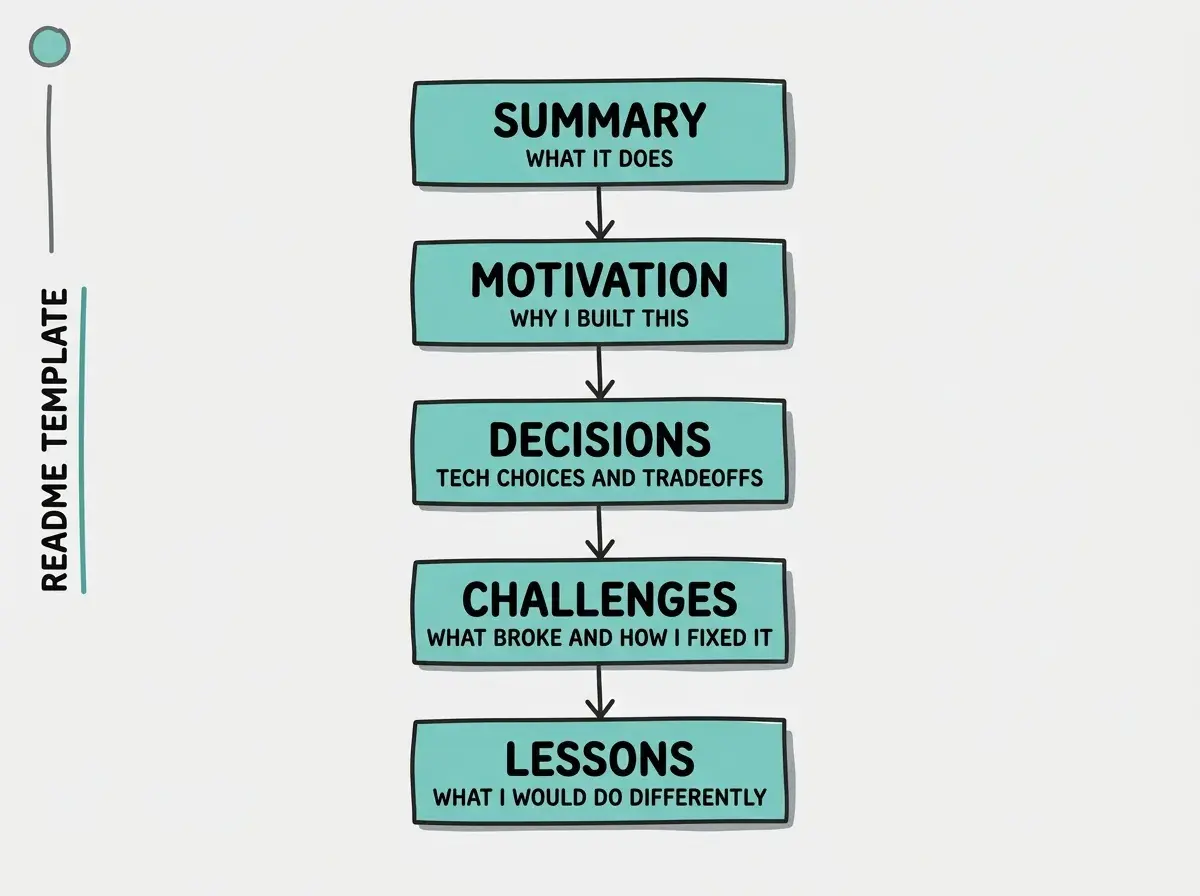
Your README is your first impression. It should answer five questions in under sixty seconds of reading. What does this project do? Why does it exist? What technology choices did you make and why? What challenges did you face? What would you do differently next time?
Here is a structure that works. Start with a one-paragraph summary that explains the project like you are telling a friend about it. Then add a "Why I Built This" section with two or three sentences about the problem you were solving. Follow that with a "Technical Decisions" section where you explain your stack choices (not just list them). Then include a "Challenges and Solutions" section where you walk through one or two real problems you hit and how you solved them. End with a "What I Learned" section.
Beyond the README, consider writing a short case study for your best project. A case study is a 500-word narrative that walks through the project from start to finish. Think of it as the wall placard next to a painting in a gallery. It gives the viewer context they cannot get from looking at the work alone.
The case study format is simple. Start with the problem (one paragraph). Then describe your approach (one paragraph). Walk through the biggest challenge you faced (two paragraphs). End with the outcome and what you learned (one paragraph). Post it on your portfolio site next to the project link.
Do not fabricate challenges or exaggerate problems for dramatic effect. Hiring managers who have built software can spot manufactured narratives instantly. Real problems are always more interesting than fake ones. If your biggest challenge was "I could not figure out why the CSS was breaking on mobile," that is a perfectly valid story. Authenticity beats drama.
GitHub itself is a portfolio tool most people underuse. Your commit history tells a story. A repo with one commit that says "initial commit" tells a bad story. A repo with forty commits that show you building feature by feature, fixing bugs as you find them, and refactoring when things get messy tells a great story. When you are building portfolio projects, commit early and commit often. Write commit messages that explain what you did and why. "Fix auth redirect loop by checking session before route guard" tells an interviewer more about your skills than a hundred lines of AI-generated code.
Your GitHub profile README is another opportunity. Add a short paragraph about who you are, what you are building toward, and what technologies you are focused on. Pin your three portfolio projects. Make it easy for someone to understand your story in thirty seconds.
Dig deeper
A few hand-picked sources if you want to go further.
What This Means For You
Your portfolio is not a collection of apps. It is an argument. You are making the case that you can identify real problems, build solutions with AI tools, push through obstacles, and ship to actual users. Three intentional projects with strong documentation will always beat ten generic apps with no context.
Start today. Pick the project you are most proud of and write a proper README for it. Add a "Challenges" section where you describe one real problem you solved. Push that update to GitHub. That single action puts you ahead of most candidates who are relying on their deployed apps to speak for themselves.
The curated exhibition always draws a bigger crowd than the warehouse. Your portfolio should tell a story, and that story should be about you, not the AI that helped you build it.
Master the skills that turn AI-assisted development into a career advantage.
Start building