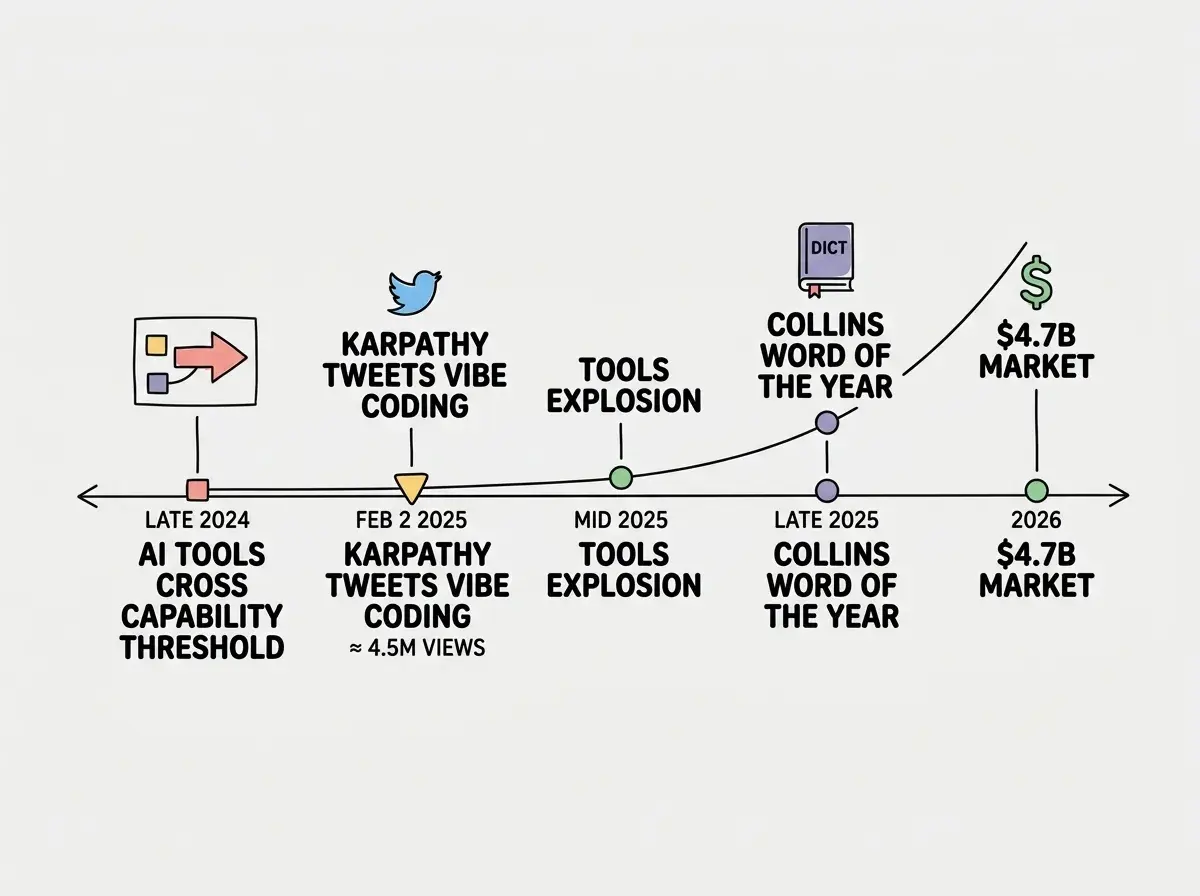
The history of vibe coding starts with a single tweet. On February 2, 2025, AI researcher Andrej Karpathy described a new way he was building software using natural language instead of writing code by hand. He called it "vibe coding." That tweet got 4.5 million views and the term went global overnight.
But here is what most people miss about that moment. Karpathy did not invent a technology. He named a behavior that millions of people were already doing. The word caught fire because it described something real that lacked a name.
The World Before the Word
To understand why vibe coding exploded, you need to understand what was happening in the months before Karpathy's tweet. By late 2024, AI coding tools had crossed a threshold. They were no longer curiosities or autocomplete utilities. They were genuinely capable of generating functional software from plain English descriptions.
Developers had been experimenting with tools like GitHub Copilot since 2021. But the leap from "AI suggests the next line of code" to "AI generates an entire application from a conversation" happened faster than anyone predicted. By January 2025, people across industries were quietly building software by describing what they wanted to AI. They just did not have a word for it.
This is important context because the history of vibe coding is not really the history of a technology. It is the history of a name. The practice existed before the word did. The word gave the practice an identity, a community, and, eventually, an industry.
Karpathy's tweet did not create vibe coding. It named something that was already happening across thousands of companies and millions of individual builders. The word gave the movement an identity that accelerated its adoption by orders of magnitude.
Understanding the timeline helps you see where vibe coding is going, not just where it has been. Movements that grow this fast tend to reshape industries in ways that are hard to predict from inside the moment.
Naming the Storm
Here is the analogy that makes the history of vibe coding click. Think about how meteorologists name storms.
A tropical depression forms in the ocean. Warm water feeds it. Wind patterns shape it. It grows stronger over days. But the storm does not "start" when it gets a name. It starts forming long before anyone notices. The name comes later, when the storm is organized enough and powerful enough that people need a way to talk about it, track it, and prepare for it.
Vibe coding was the storm. Karpathy provided the name. By February 2025, the conditions were all in place: large language models capable of writing functional code, interfaces that let people interact with those models through conversation, and a massive population of non-developers who wanted to build software but had no way to learn traditional programming fast enough. The storm was already forming. It just needed a name so people could find each other.
Karpathy described his workflow with disarming casualness. He used Cursor Composer with voice input, accepted all of the AI's suggestions, and copy-pasted error messages back into the conversation when things broke. His summary was deceptively simple: "I just see stuff, say stuff, run stuff, and copy paste stuff, and it mostly works."
That quote resonated because it matched what people were experiencing. They were not engineering software. They were vibing with it. The name stuck because it was honest about the process. It was exploratory, informal, iterative, and surprisingly effective.
The Explosion That Followed
What happened after the tweet was not gradual adoption. It was an avalanche.
Within weeks, "vibe coding" was everywhere. Tech publications wrote explainers. YouTube tutorials proliferated. Twitter threads debated whether it was real programming (a debate that is still going strong). But more importantly, people who had never built software before saw the term and thought, "Wait, I can do that?"
The tool ecosystem responded instantly. Cursor, which had been growing steadily as an AI-powered code editor, saw usage spike. Lovable launched and quickly reported that 60% of its users were non-developers. Bolt, Replit, and dozens of other tools positioned themselves for the vibe coding wave. By mid-2025, the market was crowded and growing fast.
The numbers were staggering. Google searches for vibe coding grew 2,400% from January 2025 onward. The market hit $4.7 billion and analysts projected $12.3 billion by 2027. Eighty-seven percent of Fortune 500 companies adopted vibe coding tools. This was not a subculture. It was mainstream.
Start with the fundamentals and build your first project this week.
Get startedThen came the cultural validation. Collins Dictionary named "vibe coding" their Word of the Year for 2025. Whatever you think about the practice, that distinction signals something real. Dictionary editors track how language evolves, and they recognized that this term had entered common usage faster than almost any technical term in recent memory.
The People Who Made It Matter
You might think vibe coding spread because of technologists. But actually, the people who drove mass adoption were not technical at all.
The 63% of vibe coding users who are non-developers are the story. Founders who could not afford to hire developers. Marketers who wanted custom internal tools. Teachers who wanted to build classroom apps. Artists who wanted interactive installations. These people did not adopt vibe coding because a famous AI researcher tweeted about it. They adopted it because it solved a problem they had been struggling with for years: they had ideas but no way to build them.
The startup world embraced it with particular intensity. Y Combinator's Winter 2025 batch was a watershed moment. Twenty-five percent of the startups in that cohort had codebases that were 95% or more AI-generated. The YC CEO stated that "ten engineers using vibe coding deliver what fifty to one hundred used to." These were not theoretical claims. They were coming from the most influential startup accelerator in the world, backed by the results of real companies.
Among students, adoption was even more dramatic. Eighty-five percent of students were using AI coding assistants by late 2025. A generation of future professionals was learning to build software in a fundamentally different way than any generation before them.
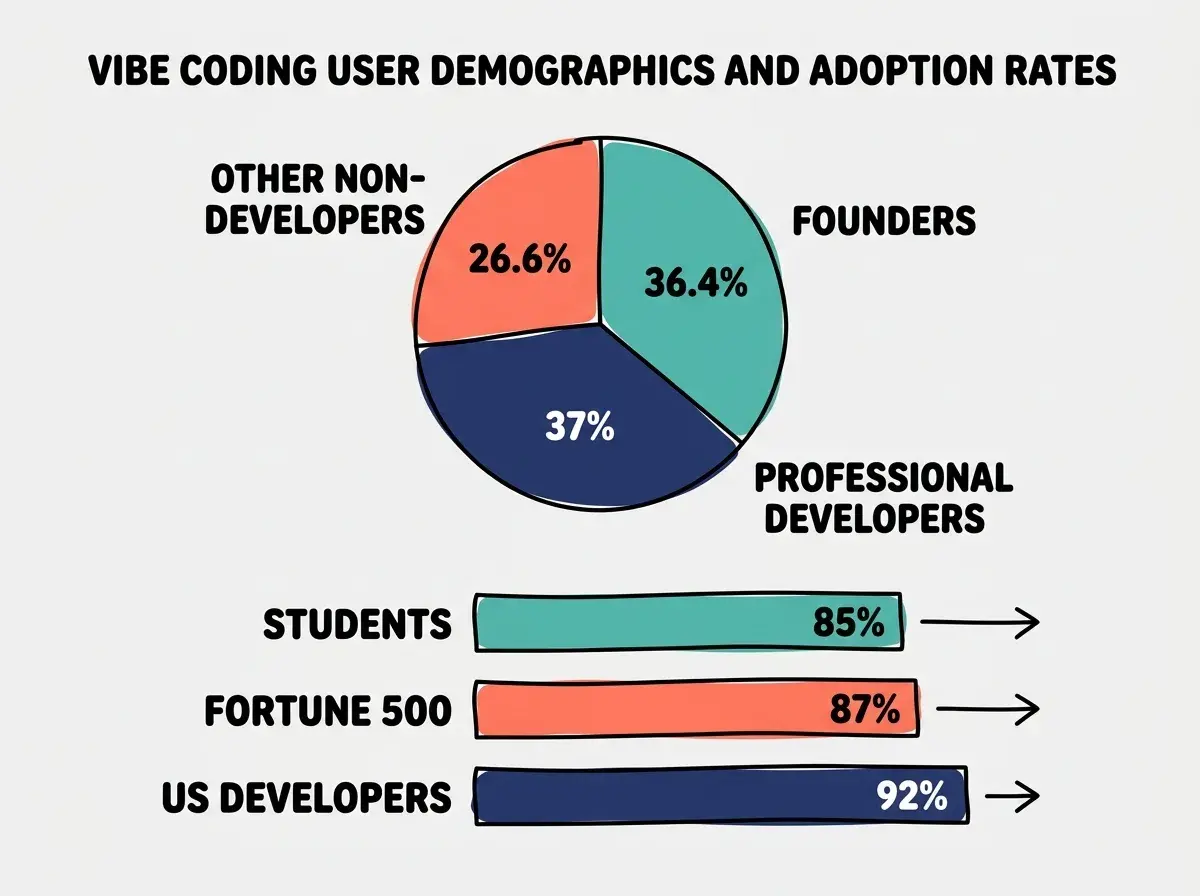
The data on professional developers is equally telling. Ninety-two percent of US developers now use AI coding tools daily. But only 33% fully trust the accuracy of AI-generated code. This tension, between near-universal adoption and limited trust, defines the current moment in vibe coding's history.
Many newcomers assume vibe coding appeared fully formed in February 2025. They miss the years of AI tool development that made it possible and the months of unnamed practice that preceded the term. Understanding the history helps you see that vibe coding is a natural evolution, not a sudden disruption, and that it will continue evolving rapidly.
The healthy skepticism among professional developers is not a sign that vibe coding is overhyped. It is a sign that the technology is still maturing. Senior developers who understand both the power and the limitations of AI tools report 81% productivity gains. They use vibe coding extensively while maintaining the judgment to know when to intervene manually.
Where the Story Goes From Here
History is useful only if it helps you understand the present and anticipate the future. So what does the trajectory of vibe coding tell us about where it is heading?
The pattern is clear. Every wave of software democratization, from personal computers to the web to mobile apps to no-code tools, followed the same arc. A new technology made building accessible to a larger group. Skeptics said the output would be inferior. Some of it was. But the sheer volume of new builders generated innovations that nobody anticipated.
Vibe coding is following that arc at an accelerated pace. The market grew from zero to $4.7 billion in under two years. The projection to $12.3 billion by 2027 suggests the growth is not slowing down. And the 46% of new code that is now AI-generated is a number that only moves in one direction.
The interesting question is not whether vibe coding will persist. It clearly will. The interesting question is what happens when hundreds of millions of people who could never build software before suddenly can. We are still in the early chapters of that story.
What This Means For You
The history of vibe coding is short, but its trajectory is unmistakable. A term that did not exist before February 2025 now describes a $4.7 billion industry used by the majority of Fortune 500 companies. Understanding this history is not nostalgia; it is context for decisions you are making right now.
- If you're a founder: You are entering the market at a moment when the cost and time to build an MVP have collapsed by orders of magnitude. The YC data proves this is not theoretical. Twenty-five percent of their funded startups are shipping with almost entirely AI-generated code. Your timing is excellent.
- If you're changing careers: The fact that 63% of vibe coding users are non-developers means you are joining a majority, not a fringe. The ecosystem of tools, tutorials, and communities is growing weekly. The barrier to entry has never been lower and it is still dropping.
- If you're a student: You are the first generation that will never know software development without AI assistance. That is not a limitation; it is a superpower. Learn the concepts behind what AI generates, and you will have a combination of speed and understanding that no previous generation could access.
Join the millions who are already building with vibe coding.
Read the beginner guide