Andrej Karpathy coined vibe coding on February 2, 2025, in a tweet that received 4.5 million views. He described building software by talking to AI and accepting every suggestion. That single post gave a name to something millions of developers were already doing, and it reshaped how the industry talks about AI development.
What makes Karpathy's story worth studying is not just the tweet. It is the evolution that followed. The person who named vibe coding has since moved past it, coining "agentic engineering" to describe where AI development is actually heading. Understanding his journey reveals the trajectory of the entire field.
Andrej Karpathy coined "vibe coding" on February 2, 2025 in a tweet describing his personal workflow with Cursor Composer plus voice input, where he accepted every AI suggestion without reading the code. The term stuck because thousands of developers were already doing it but lacked a name. Karpathy himself has since moved past the term, calling current AI development "agentic engineering" to reflect a more rigorous practice.
The Person Behind the Term
To understand why Karpathy's tweet carried so much weight, you need to understand who said it. This was not a random influencer coining a buzzword. Karpathy is one of the most accomplished AI researchers alive. He was a founding member of OpenAI. He served as Tesla's Director of AI, where he led the team building the neural networks behind Autopilot. He holds a PhD from Stanford, where he studied under Fei-Fei Li, one of the pioneers of computer vision.
When someone with that background publicly describes a new way of programming, the tech world pays attention. The tweet described his personal workflow: using Cursor Composer with voice input, "fully giving in to the vibes," accepting all AI suggestions, and barely looking at the generated code. He was building real projects this way, not just experimenting.
Think of it like the person who names a new genre of music. They did not invent all the instruments. They did not create every technique. But they heard something that many people were already playing and gave it a name that stuck. Before Karpathy's tweet, thousands of developers were doing exactly what he described. They just did not have a word for it. The moment the word existed, the practice became a movement.
Karpathy later called the tweet "a shower of thoughts throwaway" that "minted a fitting name at the right moment." The term succeeded not because he invented a new practice but because he articulated what a massive number of developers were already experiencing. The right label at the right time turned a scattered behavior into a recognized methodology.
The timing was essential. By February 2025, AI coding tools had matured enough that non-trivial projects were being built almost entirely through AI conversation. Cursor, Copilot, and Claude were all capable enough to produce working applications from natural language descriptions. The experience was widespread, but the vocabulary to discuss it did not exist yet. Karpathy provided that vocabulary in 280 characters.
How One Tweet Named an Industry
The music genre analogy helps explain why the name spread so fast. Before someone names a genre, fans and musicians struggle to describe what they are doing. "It's kind of like rock but with electronic beats and a hip-hop feel." After someone names it, everyone recognizes it instantly. "Oh, that's trip-hop." The name does not change the music. It changes the conversation about the music.
"Vibe coding" worked the same way. Before the tweet, developers described their AI workflow in clumsy terms. "I just let Copilot write it." "I'm basically prompting my way through this project." "I don't really read the code anymore, I just see if it works." After the tweet, all of those descriptions collapsed into two words. Vibe coding. Everyone knew exactly what it meant.
The 4.5 million views were just the beginning. Within weeks, the term appeared in blog posts, conference talks, YouTube tutorials, and job descriptions. Publications like The Verge, Wired, and Ars Technica covered it. Universities started discussing it in computer science curricula. Companies began debating whether vibe coding was acceptable in professional settings. Two words from a casual tweet reshaped an industry's vocabulary.
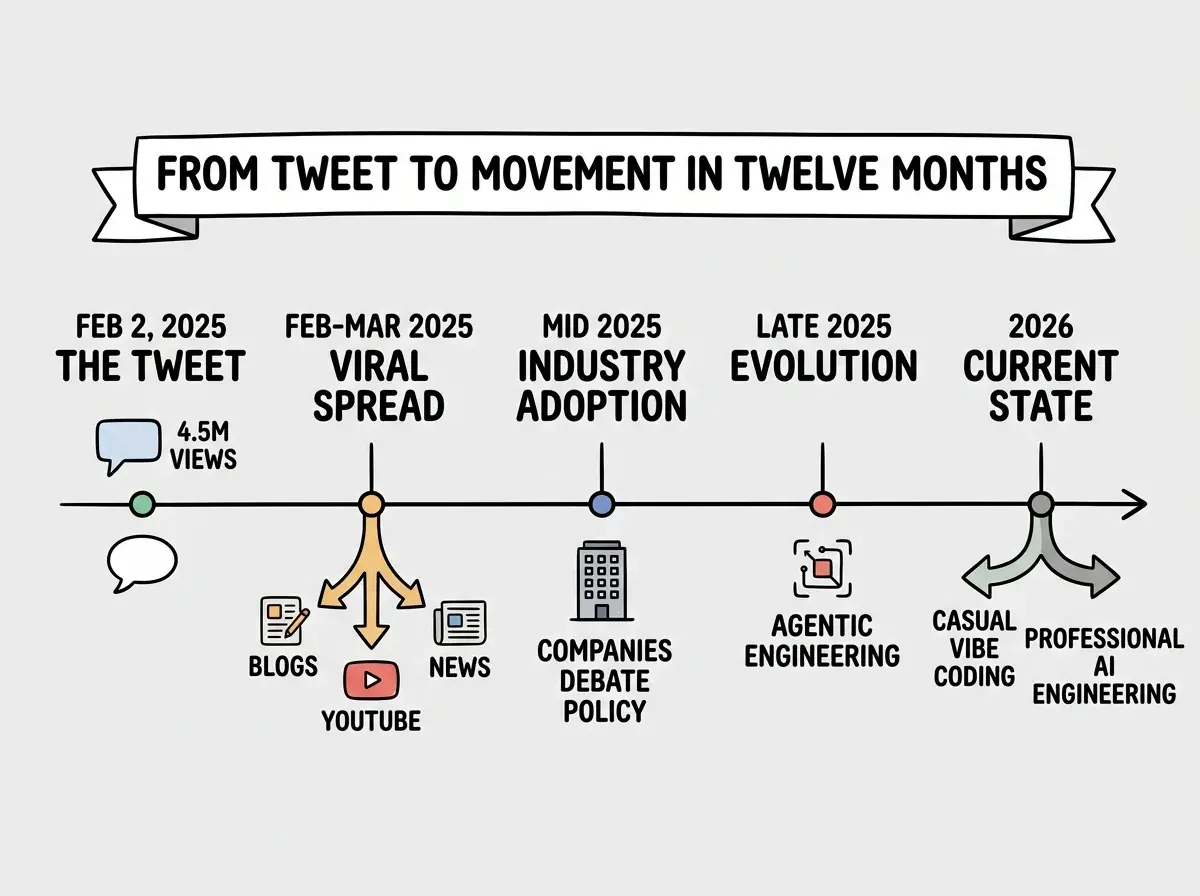
But the speed of adoption also created a problem. Karpathy's original description was specifically about his personal workflow as an expert AI researcher. He understood the code the AI was generating, even when he was not reading it line by line. He had decades of experience to fall back on when things went wrong. The term was adopted by people without that background, and the practice became something different from what Karpathy originally described.
The Evolution to Agentic Engineering
What makes Karpathy's journey genuinely instructive is that he did not stop at vibe coding. He kept iterating on the practice and arrived at something more structured, which he calls "agentic engineering."
In agentic engineering, the developer does not sit in front of a single AI tool accepting suggestions. Instead, they orchestrate multiple AI agents, each handling a different part of the development process. One agent writes code. Another reviews it. A third runs tests. A fourth handles deployment. The human developer becomes a manager of AI workers rather than a collaborator with a single AI assistant.
This shift reflects a pattern that the music genre analogy predicts perfectly. When a genre first gets named, it is raw and undefined. Early punk was three chords and attitude. Early vibe coding was prompting and accepting. But genres evolve. They develop subgenres, techniques, and professional standards. Punk eventually produced post-punk, new wave, and indie rock. Vibe coding is producing agentic engineering, AI-assisted development, and hybrid workflows.
The field is evolving fast. Stay current on what matters.
Explore moreKarpathy is currently building Eureka Labs, an AI education company. The fact that the person who named vibe coding is now focused on education reveals something important about his view of the field. He does not believe AI will replace the need to understand what you are building. He believes AI changes how you learn and how you build, but understanding remains essential.
What His Journey Reveals About the Field
You might think Karpathy's evolution from vibe coding to agentic engineering means vibe coding was just a phase. But actually, it means vibe coding was a starting point, a first attempt at describing a fundamental shift in how humans interact with code. The term captured the initial experience. The evolution captures the maturation.
Several patterns from Karpathy's journey apply directly to every developer working with AI today.
The vocabulary matters more than you think. Before "vibe coding" existed, the practice was invisible. People did it but could not discuss it, analyze it, or improve it systematically. Naming something is the first step to understanding it. If you find yourself doing something with AI that you cannot describe clearly, you are at the same point the industry was before Karpathy's tweet. Find the words, and the understanding follows.
Expert behavior does not transfer cleanly. Karpathy could vibe code safely because his decades of experience acted as an invisible safety net. He knew when AI output was wrong even without reading every line. That safety net does not exist for developers without deep programming experience. The practice that works for an AI pioneer may be dangerous for a beginner.
Tools evolve faster than vocabulary. Karpathy coined "vibe coding" in February 2025. By late 2025, his own practice had already outgrown the term. The tools and workflows available today are already beyond what "vibe coding" originally described. The people who succeed are the ones who evolve their approach as fast as the tools evolve.
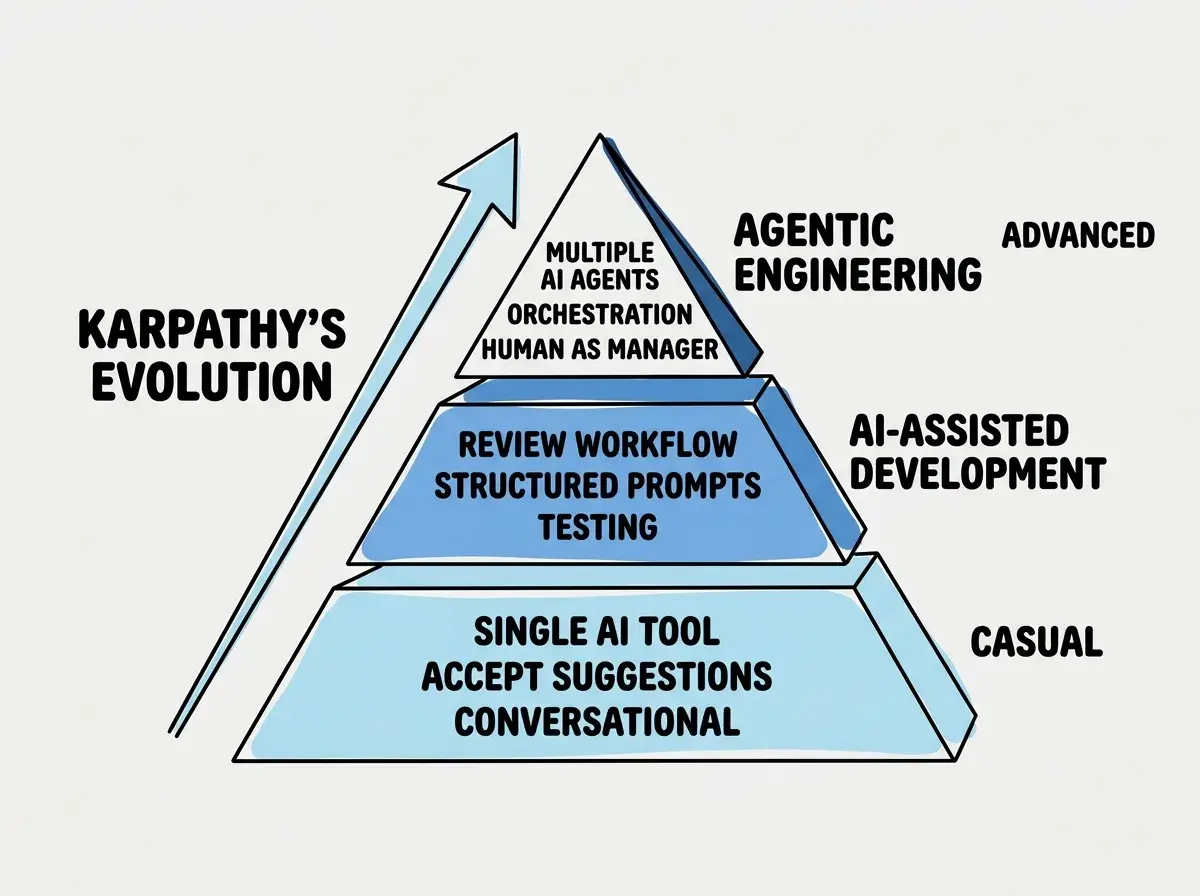
This confuses everyone at first because the term "vibe coding" sounds casual, almost dismissive. But the practice it describes is the entry point to a serious transformation in software development. Karpathy did not dismiss it. He built on it. The casualness of the origin does not diminish the significance of where it leads.
Treating vibe coding as either the final form of AI development or as a joke that serious developers should avoid. It is neither. It is the first stage of a rapidly evolving practice. Dismissing it means missing the evolution. Staying stuck in it means falling behind as the field matures toward agentic engineering and structured AI workflows.
Karpathy's journey from a throwaway tweet to building an AI education company tells us something about the pace of change. In less than a year, the way he worked with AI evolved from casual prompting to orchestrating multiple agents. That same evolution is available to everyone. The question is not whether to start vibe coding. It is how quickly you move beyond it.
What This Means For You
Karpathy's story is a map of where the field is heading. His evolution from vibe coding to agentic engineering is not just his personal journey. It is a preview of the path every developer will eventually walk. Understanding where he started and where he ended up helps you plan your own trajectory.
- If you are a founder, Karpathy's evolution tells you that the AI workflow your team uses today will be obsolete within a year. Build processes that can evolve. Do not lock into a single tool or approach. The companies that adapt to agentic engineering first will have a significant competitive advantage.
- If you are changing careers, Karpathy's story is encouraging. He described vibe coding as accessible and productive even for casual projects. But his evolution to agentic engineering shows that there is a growth path with increasing complexity and value. Start with vibe coding to build confidence, then develop the skills to orchestrate more sophisticated AI workflows.
- If you are a student, study Karpathy's trajectory as a case study in technology adoption. The person who named the practice moved beyond it within months. This is the pace of change you are entering. The most valuable skill is not mastering any single tool or workflow. It is the ability to learn new approaches quickly as the field continues to evolve.
From vibe coding to agentic engineering, the path starts with understanding the fundamentals.
Begin here