The AI code refactoring cost that nobody budgets for is becoming the defining expense of the post-vibe-coding era. 92% of developers use AI coding tools daily. 41% of AI-generated code gets reverted within a week. Between those two numbers lives an entire economy of developers who make a living fixing what the AI built.
This is the cleanup economy. It is growing faster than the tools that created the need for it.
The Invoices Tell the Story
The numbers below come from real cleanup projects completed between January and March 2026. They represent work done by freelance developers, boutique agencies, and security consultants hired to make AI-generated codebases ready for production. Company names have been anonymized, but the dollar amounts and scope descriptions are drawn from actual invoices shared in developer communities and freelance platforms.
| Category | Typical Scope | Cost Range | Timeline |
|---|---|---|---|
| Security Audit + Fixes | Auth gaps, exposed keys, SQL injection, missing RLS | $2,000 - $5,000 | 1-2 weeks |
| Architecture Refactor | Monolith to modules, proper separation of concerns, state management | $5,000 - $15,000 | 2-6 weeks |
| Full Codebase Rewrite | Keep the product, rebuild the code from scratch | $10,000 - $30,000 | 4-12 weeks |
| Test Suite Creation | Unit tests, integration tests, CI/CD setup for untested code | $3,000 - $8,000 | 2-4 weeks |
| Dependency Cleanup | Remove unused packages, resolve conflicts, audit supply chain | $1,000 - $3,000 | 3-5 days |
| Performance Optimization | Fix N+1 queries, add caching, reduce bundle size | $2,000 - $6,000 | 1-3 weeks |
One freelance developer on a popular contracting platform reported completing 14 AI code cleanup projects in Q1 2026 alone, with an average invoice of $7,200. A security-focused consultancy shared that AI code audits now represent 35% of their revenue, up from essentially zero in 2024. A Toptal engineer told a developer community that refactoring AI-generated React apps has become their highest-demand skill.
The pattern is consistent. Companies vibe-code a product in days, launch it, discover the problems when users complain or a security scan turns red, and then hire someone to fix what the AI built. The cleanup invoice frequently exceeds what a traditional developer would have charged to build it correctly the first time.
The average AI code cleanup project costs $5,000 to $15,000 and takes two to six weeks. Companies that budget $0 for code quality during the build phase end up spending more on cleanup than they would have spent on proper architecture from the start. The cheapest refactor is the one you never need.
Why AI Code Consistently Needs Cleanup
The cleanup economy exists because AI coding tools optimize for a single objective: producing code that runs and delivers the requested functionality. They are not optimizing for maintainability, security, testability, or architectural coherence. The result is code that works on demo day but creates compounding problems the moment a second developer touches it.
No tests. AI tools generate application code but almost never generate corresponding test suites. A codebase without tests is a codebase that cannot be safely modified. Every change becomes a gamble, and the longer the codebase grows untested, the more expensive it becomes to retrofit tests later. One cleanup contractor described an AI-generated SaaS with 47,000 lines of code and zero tests. The test suite creation alone cost $6,500.
Poor architecture. Large language models generate code one prompt at a time. Each prompt produces a locally correct solution, but the aggregate result often lacks coherent architecture. Business logic ends up in UI components. Database queries scatter across unrelated files. State management becomes a tangle of prop drilling and duplicated stores. The code works, but it is structured like a city built without zoning laws.
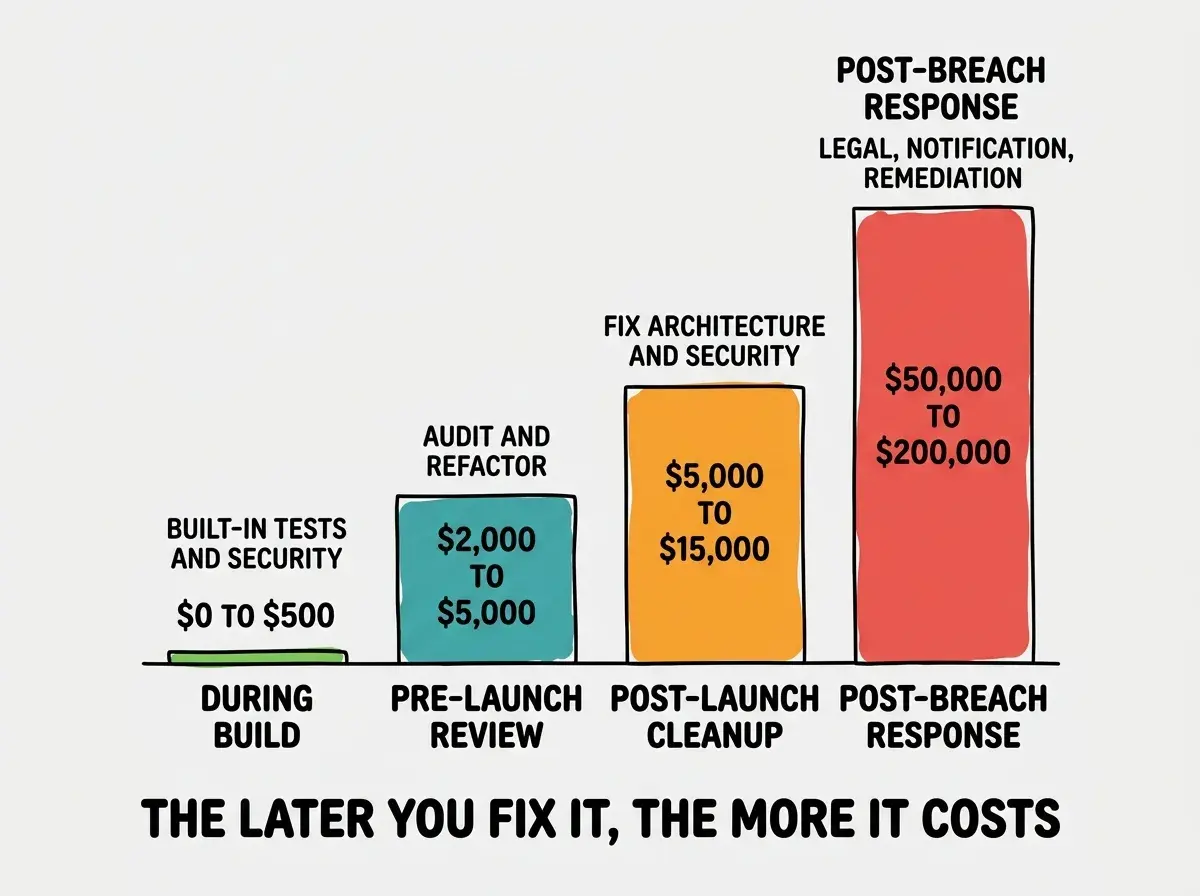
Security gaps. This problem has been well-documented elsewhere, but it bears repeating in the context of cost. Veracode found that 45% of AI-generated code introduces OWASP vulnerabilities. Fixing these after deployment is categorically more expensive than preventing them during development. A pre-launch security review might cost $2,000. A post-breach incident response can cost $50,000 to $200,000 when you factor in legal, notification, and remediation expenses.
Dependency sprawl. AI tools are generous with npm packages. They will install a library to solve a problem that a ten-line utility function could handle. One cleanup project found 187 npm dependencies in a relatively simple SaaS application. Forty-three of them were unused. Twelve had known security vulnerabilities. The dependency audit and cleanup took a full week.
The Cleanup Economy in Numbers
The people doing this work are not a niche. They represent a measurable and growing segment of the freelance development market.
Upwork reported a 340% increase in job postings containing "refactor AI code" or "fix AI-generated code" between Q1 2025 and Q1 2026. Toptal noted that requests for senior developers to restructure AI-built applications increased by 280% in the same period. Freelance rates for AI code cleanup work have settled between $150 and $400 per hour, with security-focused work commanding the highest rates.
The skill profile explains the premium. Cleaning up AI-generated code demands everything that writing AI-generated code does not: architecture judgment, security awareness, testing discipline, and dependency management. The cleanup economy is a transfer of value from AI tools that empower juniors to senior developers who fix what the juniors shipped.
Assuming that AI-generated code is "close enough" and just needs minor tweaks. Most cleanup projects start with a client saying "I just need someone to fix a few bugs" and end with a full architecture refactor. The problems in AI-generated code are rarely surface-level. They are structural, and structural problems require structural solutions. Get a proper code audit before scoping the work.
When to Clean and When to Rewrite
Not every AI-generated codebase needs a full rewrite. Some need targeted fixes. The decision framework is simpler than most people think.
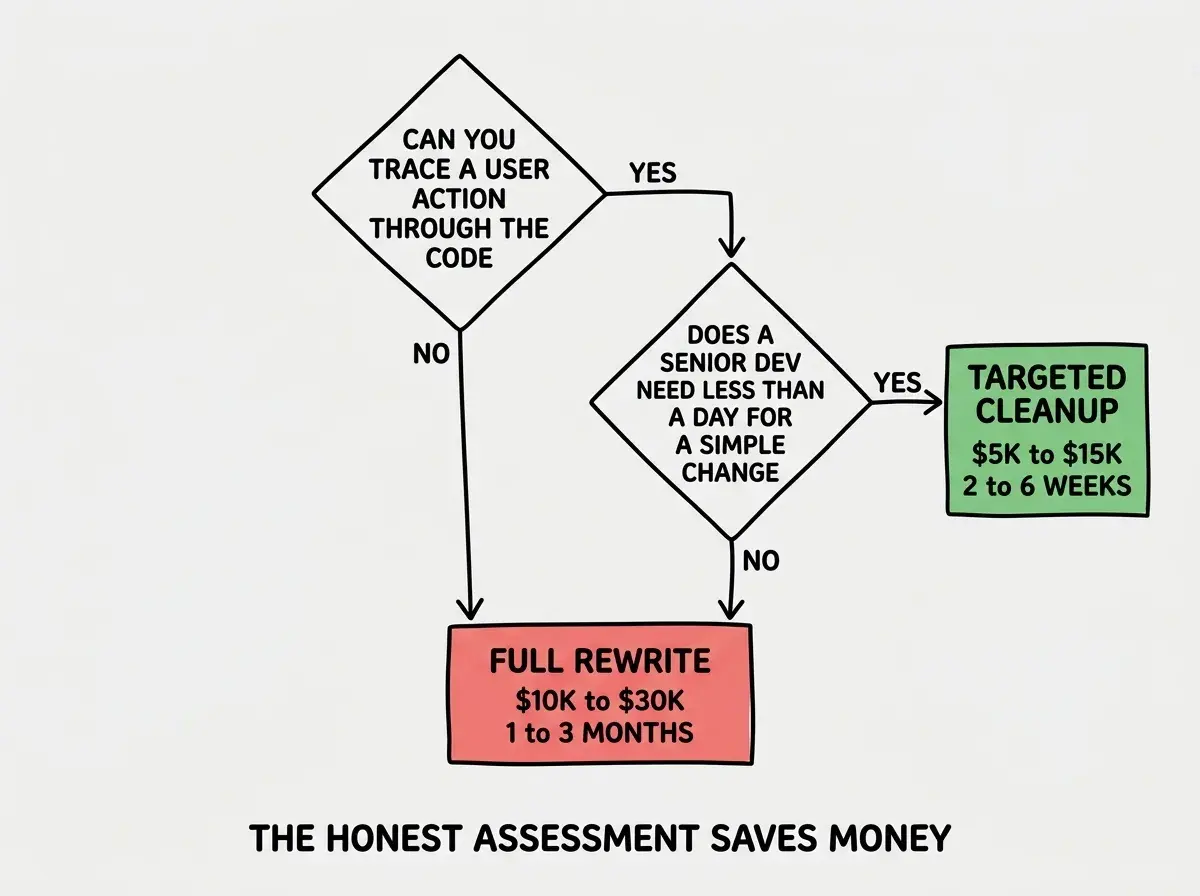
Clean when the architecture is basically sound. If the code has a recognizable structure, separates concerns at least partially, and the core data model makes sense, targeted refactoring is the right move. Fix the security gaps, add tests to critical paths, clean up the dependency tree, and improve the worst architectural violations. Budget $5,000 to $15,000 and two to six weeks.
Rewrite when you cannot explain the data flow. If tracing a single user action through the codebase requires touching eight files across four directories with no clear pattern, the architecture is not salvageable through incremental fixes. A rewrite preserves the product (the features, the UI, the user experience) while rebuilding the code from scratch with proper structure. Budget $10,000 to $30,000 and one to three months.
The test that matters. Ask a senior developer to make one meaningful change to the codebase, like adding a new field to a form that saves to the database. If that change takes less than a day, the codebase is cleanable. If it takes a week because the developer cannot safely modify anything without breaking something else, a rewrite is cheaper in the long run.
How to Reduce Cleanup Costs From the Start
The smartest money in AI-assisted development is spent preventing cleanup, not paying for it. These practices add modest time to the initial build but eliminate the largest categories of cleanup expense.
Prompt for tests alongside features. Every prompt that asks the AI to build a feature should also ask it to write tests for that feature. The AI will not write great tests, but it will produce a test structure that a developer can refine. A codebase with mediocre tests is dramatically cheaper to maintain than one with no tests at all.
Run security scans during development, not after. Tools like Snyk, Semgrep, and SonarCloud offer free tiers that catch the most common AI-generated vulnerabilities. Run them after every major generation session. Fixing a SQL injection vulnerability during development costs fifteen minutes. Fixing it after a breach costs months.
Review architecture at natural breakpoints. After the AI generates the authentication system, stop and review the architecture before moving to the next feature. After the database schema is generated, review it before building the API layer. These checkpoints take hours, not days, and they prevent the kind of compounding architectural debt that turns a $5,000 cleanup into a $30,000 rewrite.
Keep dependencies minimal. Before accepting an AI-suggested npm package, check whether a small utility function could do the same job. Fewer dependencies means fewer security risks and a smaller attack surface.
The difference between a $0 cleanup bill and a $15,000 one is how you build, not what you build with.
Read the guidesDig deeper
A few hand-picked sources if you want to go further.
What This Means For You
The hidden cost of AI-generated code is not hidden anymore. It is documented in invoices, visible in freelance marketplace trends, and quantifiable in the growing gap between "it works" and "it is ready for production."
- If you are a founder, add a cleanup budget line to your project plan. The realistic range is 30% to 50% of your initial build budget. If you spent $5,000 to build your MVP, budget $1,500 to $2,500 for a professional code review before scaling. This is the cost of doing business with tools that optimize for speed over quality.
- If you are a senior developer, the cleanup economy represents real opportunity. The skills that AI tools cannot replicate are exactly the skills that cleanup work demands. Freelance rates of $200 to $400 per hour reflect the scarcity of architectural thinking and security awareness.
- If you are evaluating AI coding tools, the answer is still yes. The productivity gains are real. But the total cost of ownership includes cleanup. Build the cleanup cost into your plan from day one.
The 41% revert rate is not a bug in the AI tools. It is a feature of the current state of the technology. The tools are genuinely useful. They are also genuinely incomplete. The gap between those two realities is measured in invoices, and those invoices are getting larger.
AI tools save time. Smart planning saves money.
Explore the guides