The best free startup tools in 2026 let you build a real, revenue-generating product without spending a dollar on infrastructure. That is not hype. The free tiers available today are more powerful than paid plans from five years ago, and bootstrapped builders are using them to ship products that make real money.
Consider the numbers. 92% of US developers now use AI tools daily. The vibe coding market has grown to $4.7 billion. Plinq, built by a non-coder, hit $456,000 in annual recurring revenue. The common thread is not big budgets. It is smart tool selection. You can build, launch, and grow a real product for $0 to $10 per month if you know which services to pick.
This guide covers every category of tool you need, with specific free tier limits and the gotchas that nobody mentions until you hit them.
Hosting and Deployment
Hosting is the most competitive free tier category. Every major platform wants your project because they know you will upgrade once traffic grows.
Vercel offers the most polished developer experience for Next.js apps. The free tier includes 100GB bandwidth per month, unlimited static sites, serverless functions with a 10-second execution limit, and preview deployments for every git push. The limit that catches people first is the 100GB bandwidth cap, but most apps with under 5,000 monthly visitors never touch it.
Netlify matches Vercel with 100GB bandwidth and 300 build minutes per month. Its serverless functions have a 10-second timeout and 125,000 requests per month. The free form handling (100 submissions per month) saves you from building a backend for simple contact forms.
Cloudflare Pages is the quiet winner. Unlimited bandwidth on the free tier, 500 builds per month, and access to Cloudflare Workers (100,000 requests per day). The tradeoff is a slightly more complex setup compared to Vercel's one-click deploys.
GitHub Pages is the simplest option for purely static sites. Free hosting, free SSL, unlimited bandwidth for public repositories. No serverless functions, so it works best for documentation sites, portfolios, and landing pages.
Your only unavoidable cost is a domain name at $10 to $15 per year. Every other service on this list has a free tier that can handle a real product with real users. Start at $0 and let actual usage data tell you when to upgrade, not anxiety about future traffic.
For most bootstrapped builders, start with Vercel (smoothest experience) or Cloudflare Pages (unlimited bandwidth).
Databases
Every app needs to store data, and the free database landscape in 2026 is remarkably generous.
Supabase is the most complete free option. You get a PostgreSQL database with 500MB of storage, 50,000 monthly active users for auth, 1GB of file storage, and real-time subscriptions. Five hundred megabytes holds millions of rows of typical application data. The real constraint is the two-project limit and the seven-day pause for inactive projects.
Neon offers serverless PostgreSQL with 512MB of storage and autoscaling compute that starts at zero. The key advantage is branching, which lets you create instant database copies for testing without touching production data. Free tier includes 190 compute hours per month.
Turso takes a different approach with SQLite at the edge. The free tier gives you 9GB of storage across up to 500 databases, with 500 million row reads per month. If your app needs low-latency reads from multiple locations, Turso's edge replication is compelling. It fits read-heavy workloads better than write-heavy ones.
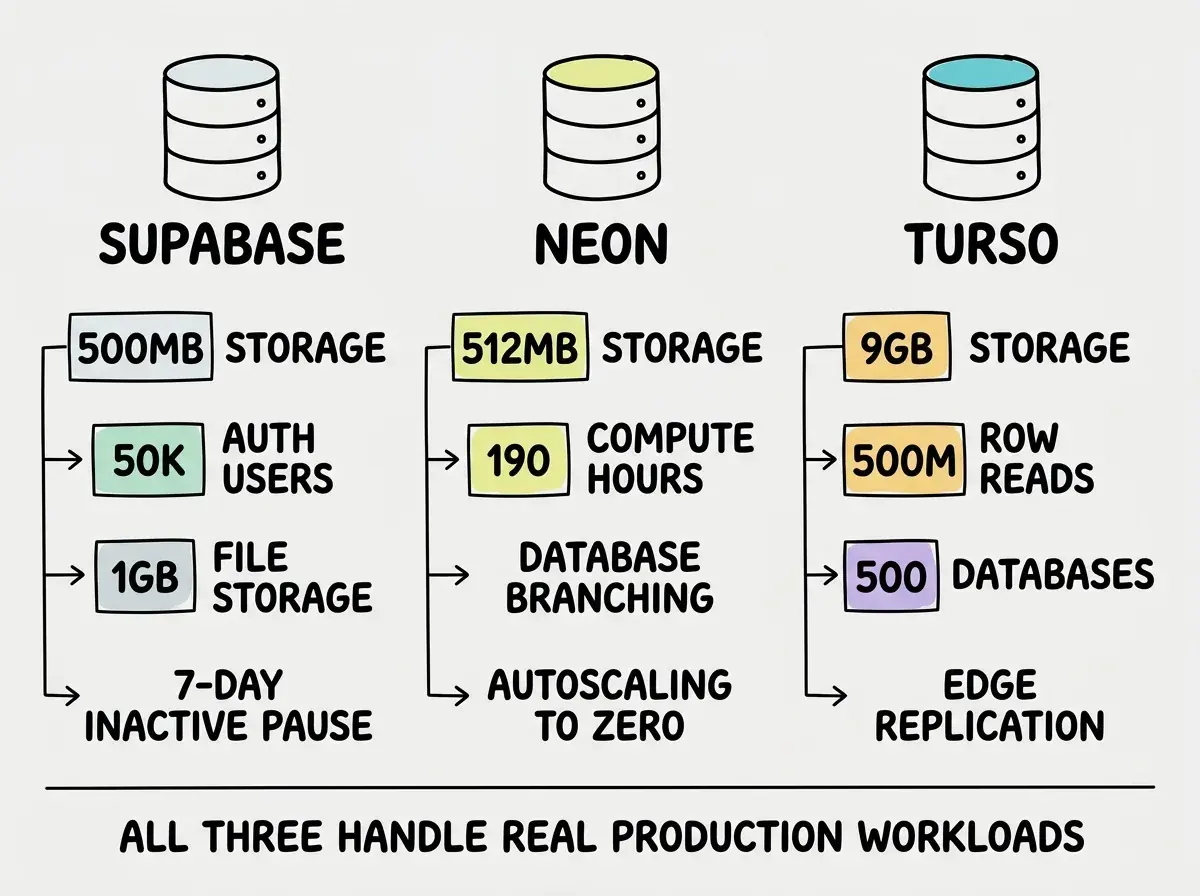
Pick Supabase for the all-in-one experience. Pick Neon for developer-friendly PostgreSQL. Pick Turso if edge performance matters most.
Authentication
Authentication is where "free" does not always mean "good enough." Bad auth is a security risk, not just a missing feature.
Auth.js (formerly NextAuth) is completely free and open source. You host it yourself, so there are no user limits and no vendor lock-in. It supports dozens of OAuth providers and email/password flows. The tradeoff is managing session storage and configuration yourself.
Supabase Auth comes free with every Supabase project. It supports email/password, magic links, OAuth providers, and phone auth with up to 50,000 monthly active users. If you are already using Supabase for your database, adding auth is a single configuration step.
Clerk offers a free tier with up to 10,000 monthly active users and polished, pre-built UI for sign-in, sign-up, and user management. The components look professional out of the box, saving you from building auth UI from scratch.
Transactional email is essential for password resets, welcome messages, and notifications.
Resend gives you 3,000 emails per month on the free tier with a solid API that takes minutes to integrate. Deliverability is strong and the developer experience is one of the best in the category. You will hit the daily sending limit of 100 emails before you hit the monthly cap, which is worth knowing if you plan to send batch notifications.
For bootstrapped builders, Resend is the clear default. It handles transactional email for apps with up to a few hundred active users.
Storage
File and image storage is where hidden costs sneak up on unsuspecting builders.
Cloudflare R2 is the standout option. 10GB of storage, 10 million Class B (read) operations, and 1 million Class A (write) operations per month, all free. The critical advantage is zero egress fees. Most cloud storage providers charge you every time someone downloads a file. R2 does not. For image-heavy apps, this difference saves real money as you grow.
Supabase Storage includes 1GB on the free tier, integrated with your Supabase project. It handles file uploads, image transformations, and access control through the same client you use for database queries. The 1GB limit is tight for image-heavy apps but fine for user avatars and documents.
Choosing a storage provider with egress fees and then serving images directly from it. One viral social media post can generate thousands of image downloads in an hour. With AWS S3 standard pricing, that single spike could cost $20 to $50 in egress fees. Cloudflare R2 charges $0 for the same traffic. Pick a storage provider with no egress fees from day one.
Analytics
You need to know what users do in your app. Paid analytics tools charge for page views, but several strong free alternatives exist.
Umami is open source and self-hostable. It tracks page views, custom events, and user journeys with full GDPR compliance (no cookies required). Self-hosting on a free Vercel or Railway instance gives you unlimited page views at $0. Setup takes about thirty minutes.
Plausible Community Edition is similar in philosophy. Open source, privacy-focused, and cookie-free. Self-hosting is free, and the hosted version starts at $9 per month if you prefer not to manage infrastructure.
PostHog offers the most feature-rich free tier. One million events per month, session recordings (5,000 per month), feature flags, and A/B testing. The complexity is higher than Umami or Plausible, but the capabilities are in a different league.
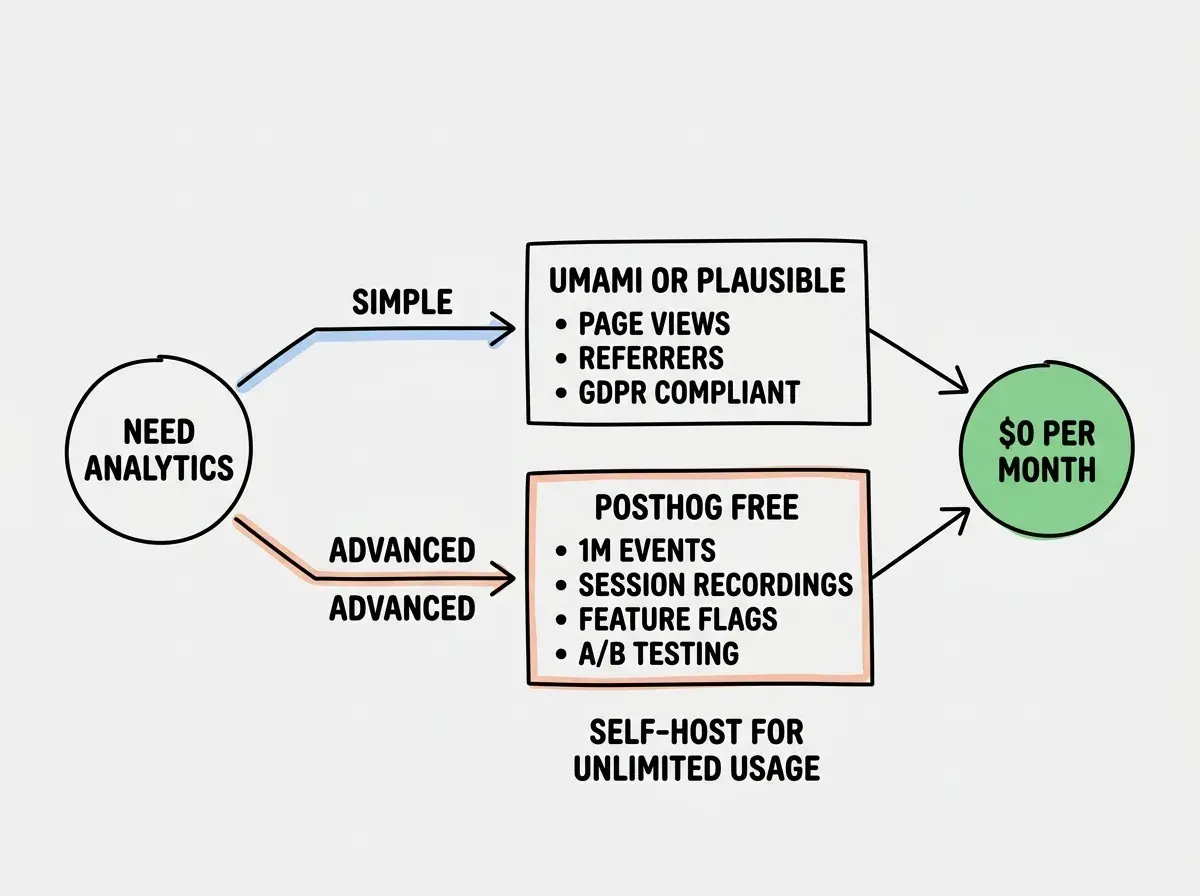
For most bootstrapped builders, start with Umami for simplicity. Upgrade to PostHog when you need session recordings and feature flags.
Monitoring and Uptime
Your app will break. The question is whether you find out before or after your users do.
Sentry offers a free tier with 5,000 error events per month, performance monitoring, and session replay. That sounds generous, but a single unhandled error in a popular code path can burn through the quota in hours. Set up error filtering to preserve your quota for issues that matter.
UptimeRobot monitors up to 50 URLs for free with 5-minute check intervals. It sends email, SMS, or Slack notifications when your site goes down. Set up monitors for your homepage, your API health endpoint, and your most critical user-facing page.
Together, Sentry and UptimeRobot give you error tracking and uptime monitoring at $0, covering 90% of what you need until you have paying customers.
Start with the free tier for everything. Upgrade only when real usage tells you to.
See all guidesThe Only Cost You Cannot Avoid
A custom domain runs $10 to $15 per year. That is your only mandatory expense. Cloudflare Registrar offers domains at wholesale cost with no markup. Namecheap and Porkbun are solid alternatives.
You could skip the domain and use a .vercel.app or .pages.dev subdomain, but a custom domain builds trust, helps with SEO, and costs less than a coffee per month. Worth paying for from day one.
The Complete Free Stack
Here is the full stack, assembled from the best free tier in each category.
| Category | Recommended Service | Free Tier Limit |
|---|---|---|
| Hosting | Cloudflare Pages | Unlimited bandwidth, 500 builds/mo |
| Database | Supabase | 500MB storage, PostgreSQL |
| Auth | Supabase Auth | 50,000 MAU |
| Resend | 3,000 emails/mo | |
| Storage | Cloudflare R2 | 10GB, zero egress fees |
| Analytics | Umami (self-hosted) | Unlimited page views |
| Error Tracking | Sentry | 5,000 events/mo |
| Uptime | UptimeRobot | 50 monitors, 5-min checks |
| Domain | Cloudflare Registrar | $10-15/yr (only cost) |
This is not a toy setup. It is the same architecture that apps generating thousands per month run on before they ever need to upgrade.
Dig deeper
A few hand-picked sources if you want to go further.
What This Means For You
The gap between "I have an idea" and "I have a live product" has never been cheaper to close. Every category of infrastructure you need has a genuinely capable free tier, and the total cost is $0 per month plus $10 to $15 per year for a domain.
- If you are a student or career changer: You have zero financial barriers. Build on this free stack, prove it works, and let the product justify future spending.
- If you are an indie hacker or founder: Stop budgeting for infrastructure and start budgeting for marketing. The tools are free. Your time and attention are the expensive resources.
- If you are already paying for services you do not need: Audit your current stack against this list. Many builders upgrade out of habit before their free tier is anywhere close to its limits.
The builders who win are not the ones with the biggest budgets. They are the ones who spend $0 on infrastructure while their competitors spend $200 per month on services they have not outgrown. Start free, ship fast, and let real usage tell you when it is time to pay.
Pick your tools, ship your product, and upgrade only when the numbers demand it.
Explore all guides